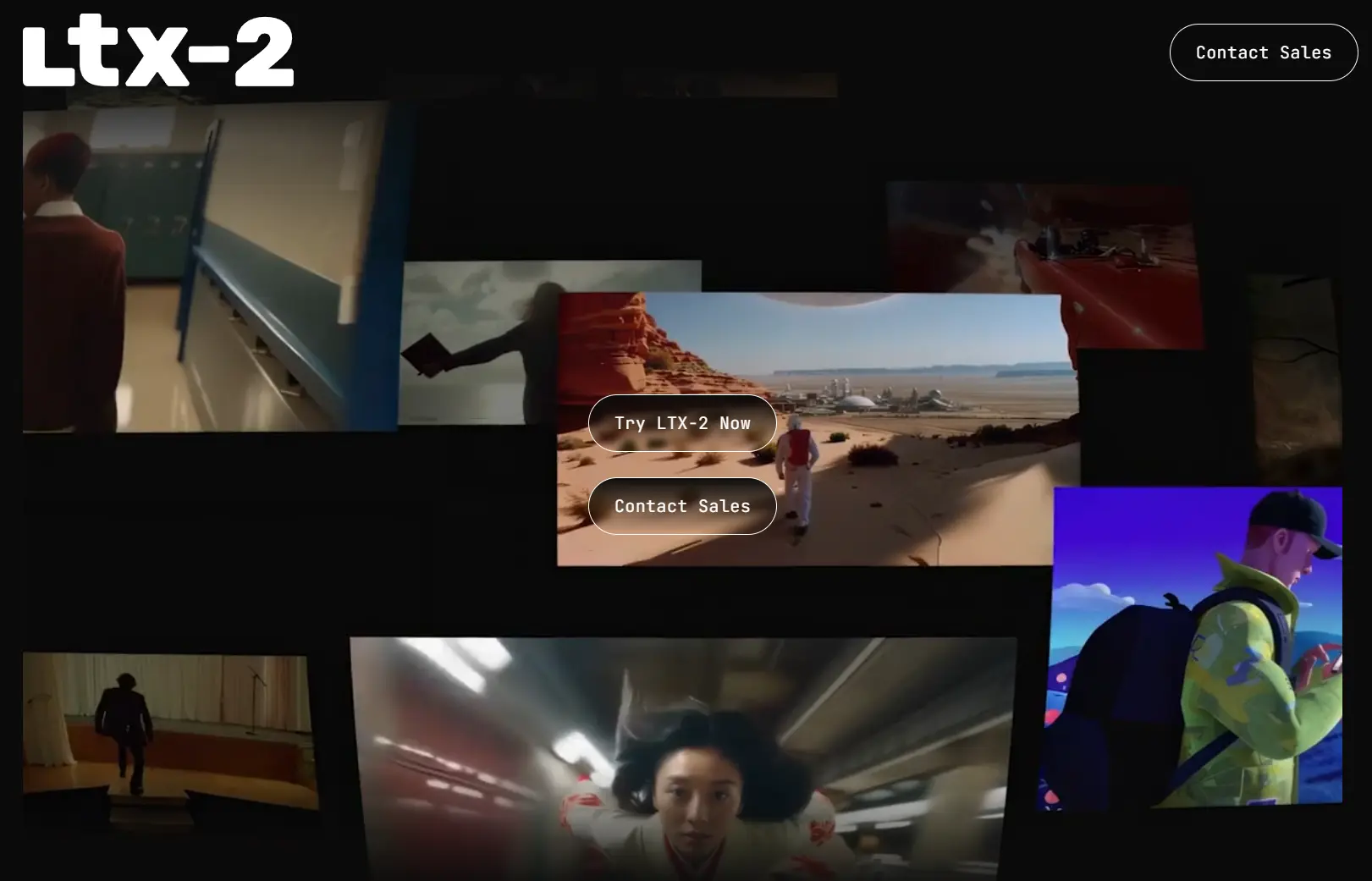
Generating one convincing shot is only part of making a video. A usable sequence also needs the same character to survive a cut, the lighting to carry into the next angle, and the soundtrack to follow the action. When each shot comes from a separate generation, those details often have to be rebuilt in editing.
LTX-2.5 approaches the job as an open-weights audio-video foundation model. You can describe a sequence with several shots, guide it with images, video, or audio, and generate connected footage with synchronized sound. Native multi-shot generation keeps the sequence inside one continuous context and helps preserve visual traits across cuts.
Once the model has established the motion and structure, a dedicated diffusion rendering stage reconstructs the final frames. This process restores details that can soften during latent compression. For finishing work, LTX-2.5 accepts 16-bit linear EXR footage in ACES and exports EXR files with the high dynamic range intact.
You can run LTX-2.5 through ComfyUI or your own infrastructure, fine-tune the base checkpoint, or pay for generation through the LTX API. Local deployment gives you control over the weights and output data, though the 22B model and its supporting components demand substantial storage and GPU memory. API prices start at $0.09 per generated second for 720p video.
What Changed in LTX-2.5?
LTX-2.3 improved detail, portrait output, prompt adherence, and audio quality within the existing LTX-2 generation process. LTX-2.5 changes more of the production path. It adds a second rendering stage for final-frame detail, treats several shots as one sequence, and introduces professional HDR input and output.
| Area | LTX-2.3 | LTX-2.5 |
|---|---|---|
| Visual decoding | Rebuilt VAE | VAE pipeline plus diffusion video decoder |
| Sequence structure | Individual clips and extensions | Native multi-shot generation in one output |
| Prompt processing | Larger gated attention connector | Gemma 4 12B encoder and prompt enhancer |
| Duration | Selected by the generation workflow | Automatic duration prediction |
| Finishing | Standard video output | 4K HDR, RAW, 16-bit EXR, and ACES |
| Checkpoints | LTX-2.3 model components | New 22B development and distilled components |
How Diffusion Fidelity Rendering Works
Video diffusion models compress frames into a smaller latent representation to make generation practical. That compression helps with speed, though small facial features, textures, and edges can lose definition by the time the latent video is decoded.
LTX-2.5 first builds the video’s motion and structure in an 8x temporally compressed latent space. During that pass, it also generates detailed keyframes that anchor the important visual moments. The model assigns more rendering work to demanding frames and less to simpler parts of the sequence.
A diffusion video decoder then reconstructs the final footage from that structure. The two-stage process concentrates detail where the viewer will notice it and keeps that detail steadier from frame to frame. It is especially relevant for faces, close-ups, complex textures, and footage intended for a larger display.
Features
- Native multi-shot generation: Creates several connected shots in one output while preserving character traits, visual style, and scene continuity across cuts.
- Stronger prompt understanding: A Gemma 4 12B text encoder and custom prompt enhancer interpret detailed directions with multiple subjects, actions, and spatial relationships.
- Automatic clip duration: A dedicated duration head chooses a length that fits the requested action and scene structure.
- Joint audio and video generation: Produces dialogue, ambience, music, and visuals in the same pass to keep the soundtrack aligned with motion.
- Image, video, and audio conditioning: Uses reference media to guide identity, composition, movement, pacing, or sound.
- Prompt-based video editing: Regenerates a selected region of existing footage while protecting the surrounding scene.
- 4K HDR and RAW workflows: The HDR ACES workflow reads 16-bit linear EXR footage, retains its dynamic range, and exports EXR files for grading and finishing.
- Base-model fine-tuning: Adapts the development checkpoint to project-specific subjects, visual domains, or production needs.
- LoRA and IC-LoRA workflows: Adds identities, styles, camera movement, restoration, lip sync, and other targeted behaviors through smaller adapters.
- Open deployment: Runs through downloadable weights, ComfyUI, on-premises infrastructure, edge systems, or the managed LTX API.
Use Cases
- Advertisements and product films: Build connected product shots with synchronized narration, music, or sound effects from one creative direction.
- Music videos and audio-led scenes: Let speech or music define the timing and movement of the generated footage.
- VFX and post-production: Process high-dynamic-range source footage through ACES and return EXR output to a grading or compositing pipeline.
- Targeted footage edits: Regenerate masked areas, remove foreground obstructions, restore detail, or apply a new camera path to an existing clip.
- Character and style development: Train the base checkpoint or apply adapters to carry an identity, voice, visual treatment, or camera behavior through a project.
Ways to Access LTX-2.5
Using the LTX API
Request an API key from the LTX model site, choose the required generation route and resolution, then supply your prompt and supported reference media. The API handles the model infrastructure and returns the generated clip to your application or editing process.
| Resolution | Price per Second | Ten-Second Clip |
|---|---|---|
| 720p | $0.09 | $0.90 |
| 1080p | $0.15 | $1.50 |
| 2K | $0.19 | $1.90 |
| 4K | $0.37 | $3.70 |
Using ComfyUI
Start by updating the LTX nodes and loading a workflow written for version 2.5. Download the checkpoint, text encoder, VAE components, upscalers, and duration head required by that workflow. A basic generation does not need every optional adapter in the collection.
Keep LTX-2.3 and LTX-2.5 assets in clearly identified workflows. Version 2.5 uses new transformer checkpoints, a Gemma 4 text encoder, new VAE files, new upscalers, and a duration head. Mixing old and new components can prevent a graph from loading or produce an invalid model combination.
Direct Local Deployment
Direct deployment begins with the gated LTX-2.5 repository on Hugging Face. Sign in, accept the LTX-2 Community License Agreement, and choose the smallest set of components required by your pipeline. The development transformer is the base for full inference and fine-tuning. The distilled transformer is intended for faster generation.
The collection provides BF16 development and distilled transformers, INT8 ConvRot versions, and an NVFP4 distilled transformer. Lower-precision variants reduce checkpoint size and memory pressure, with a corresponding change in numerical precision. Spatial and temporal latent upscalers are separate downloads.
| Component | Purpose | Available Variants |
|---|---|---|
dev transformer | Full inference and fine-tuning | BF16, INT8 ConvRot |
distilled transformer | Faster inference | BF16, INT8 ConvRot, NVFP4 |
text encoder | Gemma 4 12B prompt processing | BF16, INT8 ConvRot |
video and audio VAE | Video and audio encoding and decoding | BF16 |
latent upscalers | 2x spatial and temporal upscaling | BF16 |
duration head | Automatic clip-length prediction | BF16 |
distilled LoRA | Accelerated generation workflow | BF16 |
Hardware and Performance
There is no single GPU requirement for every LTX-2.5 workflow. Memory use changes with transformer precision, resolution, frame count, audio generation, upscaling, and component offloading. The full collection also occupies far more disk space than a single checkpoint.
LTX reports that two GB200 GPUs generate a ten-second 720p image-to-video clip in 6.8 seconds at steady state. That result demonstrates the model’s data-center throughput. It does not predict the render time of a single consumer GPU.
For a local trial, choose the workflow first and download only its required files. A distilled or lower-precision transformer reduces the initial burden. Begin with a short clip before adding upscaling or extra adapters, since higher resolutions, longer sequences, and the second rendering stage increase resource use.
License and Commercial Use
LTX-2.5 is an open-weights model distributed under the LTX-2 Community License Agreement. The weights can be downloaded, inspected, fine-tuned, and deployed on your own infrastructure after accepting the agreement. The license does not require mandatory branding.
Organizations with less than $10 million in annual recurring revenue can use the model under the community terms. Organizations above that threshold need a commercial model license. Review the agreement for redistribution and derivative-model conditions before shipping a fine-tuned checkpoint or providing model access to clients.
Self-hosting keeps prompts, reference media, weights, and generated files inside the infrastructure you operate. API generation sends the request media and prompt to the hosted service for processing. Teams working with unreleased footage or client assets should choose the route that matches their data-handling requirements.
Pros
- Multi-shot generation reduces continuity repairs between separately generated clips.
- Open weights give teams control over hosting, fine-tuning, and production data.
- 16-bit EXR and ACES support connects generated footage to professional HDR finishing.
- API, ComfyUI, and direct deployment offer distinct paths for different technical resources.
Cons
- The 22B checkpoints and supporting components demand substantial storage and GPU memory.
- The published faster-than-real-time benchmark requires two GB200 GPUs.
- Organizations above $10 million ARR need a commercial model license.
Alternatives and Related Resources
- LTX-2.5: The Foundation Film Is Made On
- LTX-2.5 Model Collection
- LTX-2 GitHub Repository
- Free Local AI Video Editor Powered by LTX-2.3: LTX-Desktop
- 10 Best AI Video Generators
- 10 Best AI Video Editors for Quick Professional Videos in 2026
FAQs
Q: Do I need an LTX API key to run LTX-2.5 locally?
A: No. Local inference uses the downloaded weights and your own compute. You need a Hugging Face account to accept the gated model agreement and download the files. An API key is required only for the hosted LTX API.
Q: Which LTX-2.5 checkpoint should I use for fine-tuning?
A: Use the development transformer as the base for fine-tuning. The distilled transformer and distilled LoRA target faster inference. Choose BF16 for the full-precision release path or a lower-precision variant when memory and storage are the limiting factors.
Q: Can LTX-2.5 generate a complete long-form video?
A: The model can generate several coherent shots in one output, and community workflows can assemble longer stories from repeated generations. A complete long-form production also needs sequence planning, clip selection, editing, and audio finishing.
Q: Is LTX-2.5 open source?
A: Yes. You can download and fine-tune the checkpoints under the LTX-2 Community License Agreement. The license places conditions on use, including a revenue threshold for commercial licensing.
Changelog
Aug 12, 2026
- Updated for LTX-2.5 with multi-shot generation, Diffusion Fidelity Rendering, Gemma 4 prompt processing, HDR EXR workflows, new checkpoints, API pricing, deployment guidance, and licensing details.
Mar 09, 2026
- Updated for LTX-2.3.
Jan 07, 2026
- LTX-2 released with synchronized audio and video generation.
Oct 24, 2025
- Updated for LTX-2.
Dec 19, 2024
- Released 0.1.2.