

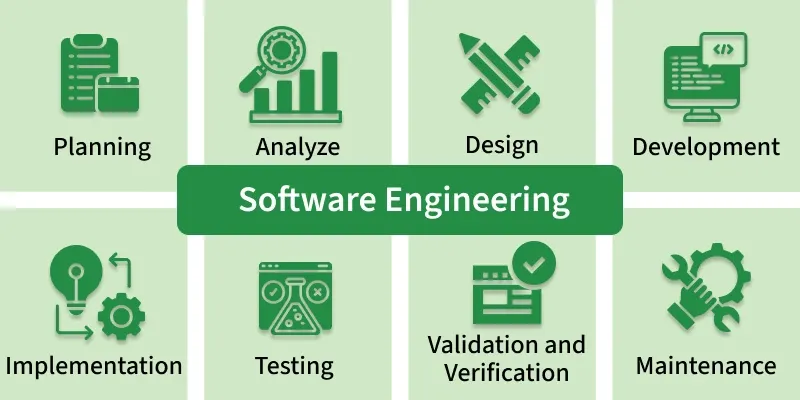
Software Engineering is the systematic process of designing, developing, testing, and maintaining software to create reliable, efficient, and high-quality applications.
- It applies engineering principles, methods, and tools to develop software in a systematic manner.
- It supports teamwork, planning, documentation, testing, and maintenance to ensure successful software development throughout its lifecycle.
- It helps create software that meets user requirements while ensuring reliability, security, efficiency, and maintainability.
Basics
Learn what software is and why Software Engineering is needed.
- Need of Software Engineering
- Introduction to Software Engineering
- Software and its Types
- Software Evolution
Software Development Models
Need to manage complexity, reduce risks, and ensure software is built systematically, on time, and within budget.
- Classical Waterfall Model
- Iterative Waterfall Model
- SDLC V-Model
- Incremental process model
- Rapid application development model(RAD)
- RAD Model vs Traditional SDLC
- Spiral Model
- Agile Development Models
- Agile Software Development
- Extreme Programming (XP)
- Comparison of different life cycle models
Information Systems
Defines the high-level structure of a system, showing how components are organized and interact with each other.
Software Project Management(SPM)
Focuses on planning, organizing, and controlling software projects to deliver quality software on time and within budget.
- Project Management Process
- Role and Responsibilities of a software Project Manager
- Software Project Management Complexities
- Project size estimation techniques
- System configuration management
- COCOMO Model
- Capability maturity model (CMM)
- Integrating Risk Management in SDLC
- Reliability Growth Models
- Mills’ Error Seeding Model
- Basic fault tolerant software techniques
Software Metrices
Measurable values used to evaluate the quality, performance, and efficiency of software and its development process.
- Software Measurement and Metrics
- People Metrics and Process Metrics in Software Engineering
- Lines of Code (LOC) in Software Engineering
- Functional Point (FP) Analysis – Software Engineering
- Cyclomatic Complexity
- Halstead’s Software Metrics
Software Requirements
Define what a system must do and serve as the foundation for its design, development, and testing.
- Requirements Engineering Process
- Classification of Software Requirements
- How to write a good SRS for your Project
- Quality Characteristics of a good SRS
- Requirements Elicitation
- Challenges in eliciting requirements
Software Configuration
Focuses on managing and controlling changes to software components and artifacts throughout the development lifecycle.
- Software Configuration Management
- Objectives of Software Configuration Management
- Software Quality Assurance
- Project Monitoring & Control
Software Quality
Measures how well a software product meets requirements and delivers reliable, efficient, and user-friendly performance.
Software Design
Creates a structured blueprint that defines how a software system will meet its requirements efficiently.
- Software Design Process
- Software Design Principles
- Coupling and Cohesion
- Function Oriented Design
- Object Oriented Design
- User Interface Design
Software Reliability
Measures how consistently a system performs its intended functions without failure over time.
- Software Reliability
- Software Fault Tolerance
- Jelinski Moranda software reliability model
- Schick-Wolverton software reliability model
- Pham-Nordmann-Zhang Model (PNZ model)
- Goel-Okumoto Model
- Quasi renewal processes
Software Testing and Debugging
It ensure that software works correctly by identifying and fixing defects throughout development.
- Introduction to Software Testing
- Seven Principles of software testing
- Testing Guidelines
- Black box testing
- White box Testing
- Debugging
- Selenium: An Automation tool
- Integration Testing
Software Maintenance
Involves updating and improving software to keep it effective, efficient, and relevant over time.
Software Engineering Interview Questions
- Software Engineering Interview Questions
- Software Engineering Quiz
- SDLC MCQ Questions
- Risk Management MCQ Questions
- Software Development Models MCQ Questions and Answers
- Software Quality Assurance Quiz
