

Software is a program or set of programs containing instructions that provide the desired functionality. Engineering is the process of designing and building something that serves a purpose efficiently and cost-effectively.
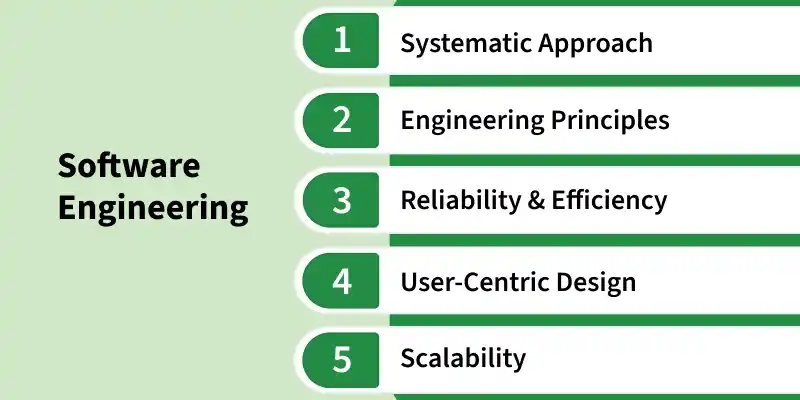
- Uses requirements analysis, design, testing, and maintenance techniques.
- Follows a well-defined software development lifecycle (SDLC).
- Improves development efficiency, cost management, and timely delivery.
- Adapts to new tools and technologies for complex software development.
Key Principles
- Modularity: Divide software into small, independent parts that are easy to develop and test.
- Abstraction: Show only what is necessary and hide internal implementation details.
- Encapsulation: Keep data and related functions together and protect them from outside access.
- Maintenance: Regularly update software to fix bugs, improve features, and enhance security.
- Testing: Check the software to ensure it works correctly and meets requirements.
- Design Patterns: Use proven solutions for common software design problems.
- Agile Methodologies: Develop software in small steps with frequent feedback and flexibility.
- Continuous Integration & Deployment (CI/CD): Frequently merge code changes and automatically deploy updates.
Dual Role of Software
Software plays a dual role in the industry by acting both as a product delivered to users and as a tool for building and running other systems.
1. As a Product
- Delivers functionality to users
- Processes and manages information
- Runs on hardware systems
2. As a Vehicle for Delivering a Product
- Provides system functionality (e.g., payroll systems)
- Controls hardware/software (e.g., operating systems)
- Helps build other software (e.g., development tools)
Objectives
- Maintainability: Software should be easy to update and improve when requirements change.
- Efficiency: Uses memory, CPU, and other resources without unnecessary waste.
- Reliability: Works consistently without failures over time.
- Correctness: Perform exactly as defined in the requirements.
- Reusability: Components can be used again in other projects.
- Testability: Easy to test and verify functionality.
- Portability: Runs smoothly across different systems or environments.
- Adaptability: Adjusts easily to new requirements or changes.
- Interoperability: Works well with other systems or software.
Careers
A degree in software engineering and relevant experience can be utilized to explore several computing job choices. Software engineers have the opportunity to seek well-paying careers and professional progress, although their exact possibilities may vary depending on their particular school, industry, and region.
Following are the job choices in software engineering:
- Development Roles: Software Engineer, SDE, Front-End, Back-End
- Testing Roles: QA Engineer, Software Test Engineer
- Design Roles: Web Designer
- Specialized Roles: Cloud Engineer, DevOps Engineer, Security Engineer
Tasks of Software Engineers
The main responsibility of a software engineer is to develop useful computer programs and applications. Working in teams, you would complete various projects and develop solutions to satisfy certain customer or corporate demands. Some of the key responsibilities of software engineer are:
- Requirement Analysis: Collaborating with stakeholders to understand and gather the requirements to design and develop software solutions.
- Design and Development: Creating well-structured, maintainable code that meets the functional requirements and adheres to software design principles.
- Testing and Debugging: Writing and conducting unit tests, integration tests, and debugging code to ensure software is reliable and bug-free.
- Code Review: Participating in code reviews to improve code quality, ensure adherence to standards, and facilitate knowledge sharing among team members.
- Maintenance: Updating and maintaining existing software systems, fixing bugs, and improving performance or adding new features.
- Documentation: Writing clear documentation, including code comments, API documentation, and design documents to help other engineers and future developers understand the system.
Skills Required
Following are some must have technical skills to become Software Engineers:
- Coding and computer programming
- Programming (Java, Python, C++, etc.)
- Software testing
- Object-oriented design (OOD)
- Software development & Testing
Following are some must have soft skills to become Software Engineers:
- Communication skills
- Problem-solving
- Teamwork
- Attention to detail
Program vs Software Product
| Program | Software Product |
|---|---|
| A set of instructions written to perform a specific task. | A complete solution that includes the program along with documentation and licensing. Software Product = Program + Documentation + Licensing |
| Limited to a specific problem or task. | Broader scope, designed to solve real-world problems and serve multiple users. |
| Focuses mainly on coding. | Follows a full development process including planning, design, development, testing, and maintenance. |
| Little or no documentation. | Proper and detailed documentation is provided. |
