

Extreme Programming (XP) is one of the most popular Agile software development methodologies focused on delivering high-quality software quickly and efficiently.
- Promotes close collaboration between developers, testers, and customers.
- Supports iterative development with faster delivery and continuous improvement.
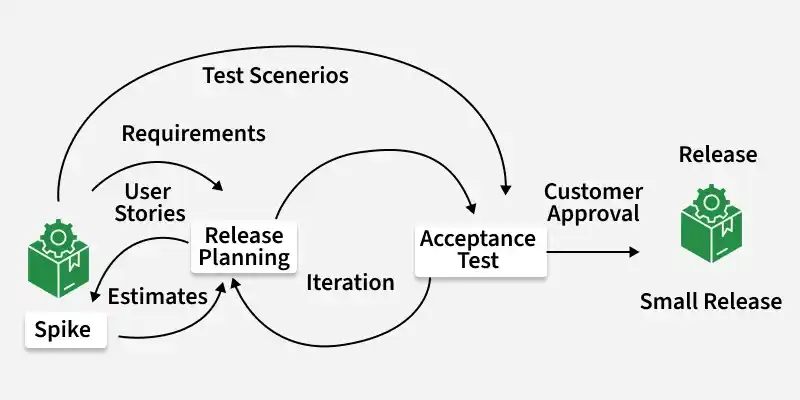
Extreme Programming (XP) Workflow Diagram
The following diagram represents the workflow of Extreme Programming (XP) and explains how customer requirements move through planning, iterations, testing, and final software release. It highlights the continuous feedback cycle followed in XP to improve software quality and customer satisfaction.
- Requirements are collected from customers in the form of user stories.
- Release planning is performed to estimate effort and organize development tasks.
- Development takes place through short iterative cycles with continuous coding and testing.
- Acceptance testing ensures the developed software meets customer expectations.
- Customer approval is taken before delivering small and frequent releases.
- Continuous feedback and iteration help improve the software throughout the development process.
Agile Development and the Origin of XP
Agile development methodologies emerged as a response to traditional models like the Waterfall Model, which focused heavily on documentation and rigid processes. .
- Delivering working software in small and frequent increments.
- Accepting changing requirements even in later stages of development.
- Encouraging continuous customer involvement and team collaboration.
- Focusing on simple and adaptable software design.
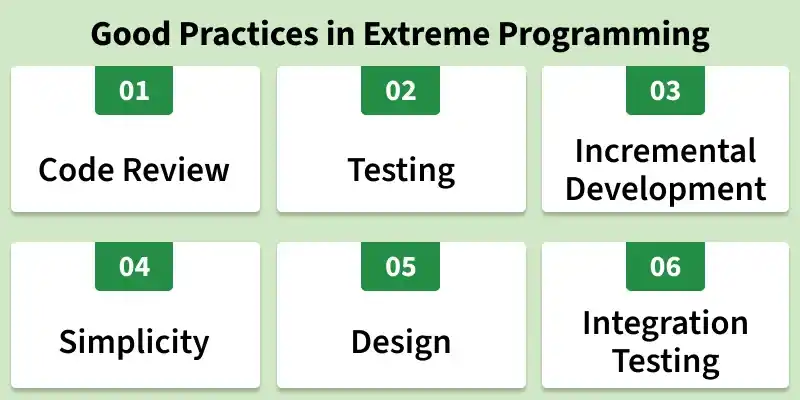
Good Practices in Extreme Programming
- Code Review: Helps identify and fix errors quickly. XP promotes pair programming, where two developers work together and regularly switch roles.
- Testing: Improves reliability by removing errors. XP follows Test-Driven Development (TDD), where tests are written before the actual code.
- Incremental Development: Software is built in small parts, allowing frequent feedback and continuous improvement after each iteration.
- Simplicity: Keeping the design simple makes the code easier to develop, test, and maintain.
- Design: Continuous attention to design ensures better quality software.
- Integration Testing: Frequent integration and testing help detect issues early. XP supports continuous integration by testing multiple times a day.
Basic Principles
Extreme Programming (XP) follows an iterative approach where developers implement user stories provided by customers. These user stories describe the required features in a simple way. XP also uses metaphors to create a shared understanding of the system, and spikes are used to explore solutions for complex or uncertain features.
- Coding: Coding includes writing code, creating simple designs, and selecting effective solutions for development.
- Testing: Continuous testing helps ensure reliable and error-free software.
- Listening: Developers carefully understand customer requirements and feedback.
- Designing: XP focuses on simple and effective designs to reduce complexity.
- Feedback: Regular customer feedback helps improve the software continuously.
- Pair Programming: Two developers work together on the same code to improve quality and reduce errors.
- Continuous Integration: Code is integrated and tested frequently to identify issues early.
- Refactoring: Code structure is improved without changing functionality to make it cleaner and maintainable.
- Collective Code Ownership: The entire team shares responsibility for the codebase.
- Planning Game: Helps prioritize features and plan releases based on customer needs.
- On-site Customer: Customers work closely with the development team to provide continuous feedback.
Life Cycle
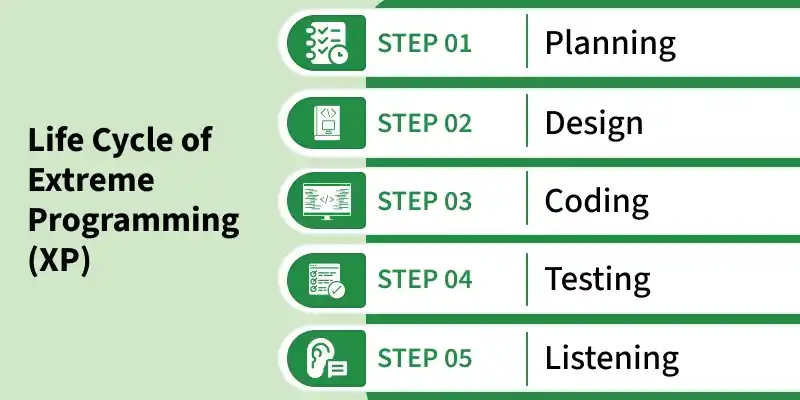
The Extreme Programming Life Cycle consists of five phases:
- Planning: In this stage, customers define their requirements as user stories. The team estimates the effort for each story and plans releases based on priority.
- Design: Only the necessary design for current needs is created. A simple and shared understanding of the system is maintained to keep the design clear and manageable.
- Coding: XP encourages pair programming, where two developers work together to improve code quality. Tests are written before coding (TDD), and code is frequently integrated into a shared repository.
- Testing: Strong focus is given to testing, including unit tests and acceptance tests. Unit tests verify individual features, while acceptance tests ensure the system meets customer requirements.
- Listening: Continuous customer feedback is taken to understand requirements better and adapt to changes effectively.
Values of Extreme Programming (XP)
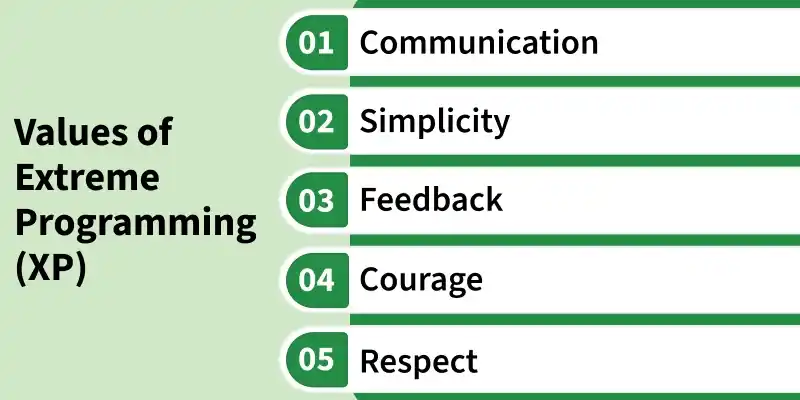
Extreme Programming (XP) is based on five core values:
- Communication: Promotes open and frequent interaction among team members to ensure a clear understanding of requirements and goals.
- Simplicity: Focuses on keeping the design and code simple to reduce complexity and improve maintainability.
- Feedback: Continuous feedback through testing and customer involvement helps identify issues early.
- Courage: Encourages team members to take risks, raise concerns, and adapt to changes confidently.
- Respect: Values every team member’s contribution, fostering a supportive and collaborative environment.
Applications
- Small projects: Best for small teams with easy communication.
- New technology projects: Suitable for projects involving new technologies or research.
- Web development: Ideal for iterative development with frequent testing.
- Collaborative projects: Requires close interaction between developers and customers.
- Tight deadlines: Enables faster delivery through iterative development.
- Changing requirements: Easily adapts to frequent requirement changes.
- Quality-focused projects: Ensures high software quality through continuous testing.
Advantages
- Timely delivery: Short and manageable development cycles help maintain project schedules.
- Better understanding of requirements: Continuous customer involvement reduces misunderstandings about the business or domain.
- Reduced project failure: Regular communication and feedback help identify and solve issues early.
- Improved team collaboration: Strong teamwork and a supportive environment boost morale and handle staff changes effectively.
- Lower cost of changes: Continuous testing ensures that changes can be made without affecting system performance.
- Adaptability to business changes: Changes are accepted at any stage, making the process flexible.
- Fewer defects: Regular unit testing helps detect and fix bugs early, improving software quality.
