

Web Application Penetration Testing (Web App Pentesting) is a security practice that identifies, tests and helps remediate vulnerabilities in web applications before attackers can exploit them. It simulates real-world hacking techniques in a safe and authorized environment to evaluate the application’s resilience against potential threats.
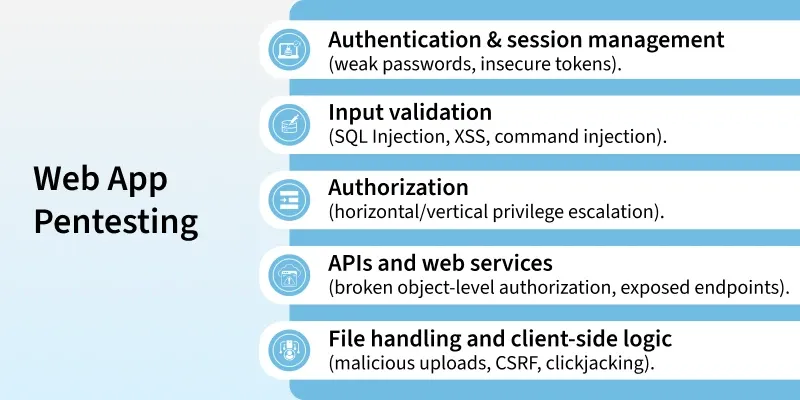
Web App Pentesting Methodology
A methodology ensures that penetration tests are performed consistently across different web applications and projects, using standardized procedures and techniques to cover all necessary areas
Penetration Testing Execution Standard (PTES)
PTES is a structured penetration testing methodology that covers the complete security assessment lifecycle, from pre-engagement to reporting. It provides a consistent framework for identifying, validating and documenting web application vulnerabilities while considering both business objectives and technical risks.
- Pre-engagement, intelligence gathering, threat modeling and vulnerability analysis to define the scope, collect application information, identify attack surfaces and discover potential security weaknesses.
- Exploitation, post-exploitation and reporting to validate identified vulnerabilities, assess their impact, document findings and provide remediation recommendations for improving web application security.
OWASP – Web Security Testing Guide (WSTG)
The OWASP Web Security Testing Guide (WSTG) is a globally recognized framework for web application security testing maintained by OWASP. It provides standardized test cases and methodologies to help penetration testers systematically identify and validate security vulnerabilities.
WSTG Structure
- Information Gathering, Configuration & Deployment Management, Identity Management, Authentication, Authorization, Session Management and Input Validation to assess the application's attack surface, access controls, session security and input handling.
- Error Handling, Cryptography, Business Logic, Client-Side and API Testing to evaluate secure error management, encryption, application logic, client-side security and API implementation.
Open Source Security Testing Methodology Manual( OSSTMM )
The Open (OSSTMM) is a peer-reviewed security testing standard that provides a structured approach for assessing security across digital networks, wireless, telecommunications, physical and human interaction channels. It focuses on measuring security objectively through consistent and repeatable testing methodologies.
- Scientific Approach: Measurable, repeatable and verifiable test cases.
- Five Channels of Interaction: Human, Physical, Wireless, Telecommunications, Data Networks.
- Security Metrics: Quantifies trust and risk levels of systems.
- Vendor-Neutral: Community-driven, not tied to specific tools or technologies.
- Beyond IT: Covers social engineering, physical and operational security along with digital security.
Key Attack Surfaces in Web Apps
An attack surface refers to all the possible entry points in a web application where an attacker could attempt to break in, exploit vulnerabilities or gain unauthorized access. Understanding these areas helps security teams prioritize defenses.
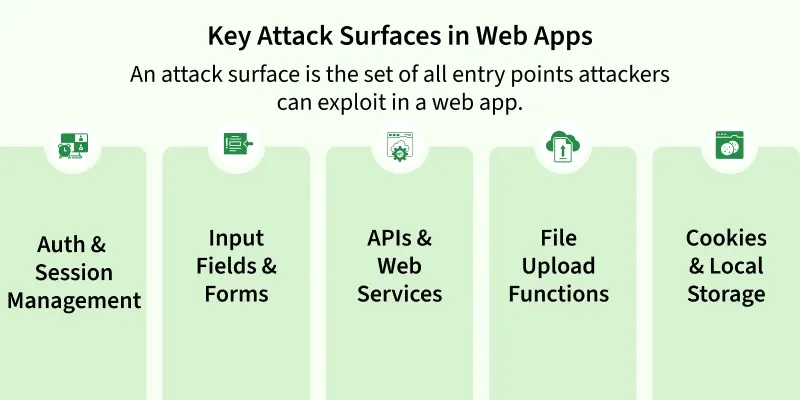
Authentication & Session Management
- Weak login forms, poor password policies and insecure session tokens expose applications to attacks like brute-force logins or session hijacking.
- Example: An attacker can guess weak passwords or steal session tokens to impersonate a user and gain unauthorized access.
Input Fields & Forms
- User input fields such as search boxes, comment sections and signup forms can be exploited if not properly validated, leading to attacks like SQL Injection or Cross-Site Scripting (XSS).
- Example: An attacker injects malicious SQL code in a login form to bypass authentication or inserts a script in a comment box to steal user cookies.
APIs & Web Services
- APIs such as REST, SOAP or GraphQL often expose sensitive endpoints to clients and if not properly secured, attackers can exploit them.
- Example: Using broken object-level authorization to access another user’s data or abusing insecure API keys to gain unauthorized access.
File Upload Functions
- Unvalidated file upload features can let attackers bypass restrictions and upload harmful files.
- Example: Uploading a malicious script disguised as an image, which executes on the server and leads to Remote Code Execution (RCE).
Cookies & Local Storage
- Storing sensitive data insecurely on the client side exposes it to theft or manipulation.
- Example: Stolen cookies can be used for session hijacking and poorly protected tokens can enable Cross-Site Request Forgery (CSRF) attacks.
Tools For Web App Pentesting
Here are some essential tools for Web Application Penetration Testing (Web App Pentesting):
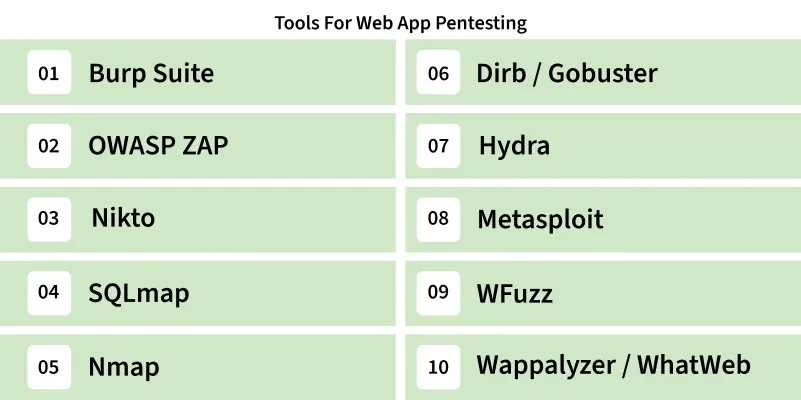
- Burpsuite: Intercepts, modifies and analyzes HTTP/S traffic.
- OWASP ZAP (Zed Attack Proxy): Open-source tool for automated scanning and manual testing.
- Nikto: Web server scanner for outdated software, misconfigurations and vulnerabilities.
- SQLmap: Automates SQL injection detection and exploitation.
- Nmap: For port scanning, service discovery and basic enumeration.
- Dirb / Gobuster: Directory and file brute-forcing tools.
- Hydra: Password brute-forcing tool for login forms.
- Metasploit: Exploitation framework for testing discovered vulnerabilities.
- WFuzz: Web application fuzzer for brute-forcing parameters.
- Wappalyzer / WhatWeb: Identifies web technologies (CMS, frameworks, servers).
To learn the difference between Vulnerability Scanning and Penetration Testing, refer to the article - Penetration Testing vs. Vulnerability Assessments
