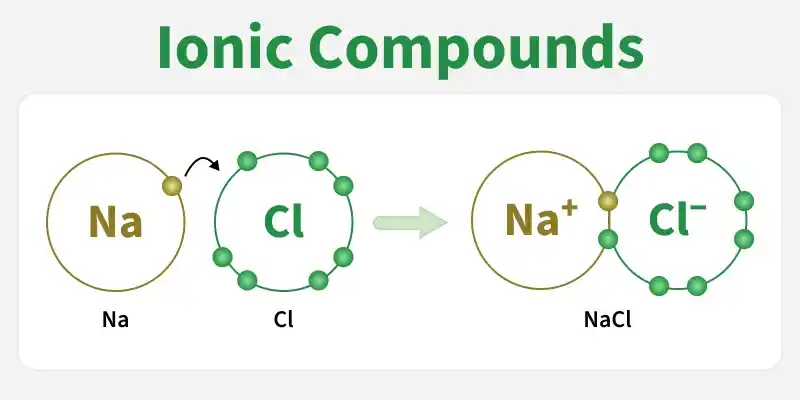
Ionic compounds are a class of chemical substances formed when atoms transfer electrons from one atom to another. This transfer of electrons produces positively charged ions (cations) and negatively charged ions (anions).
- The strong electrostatic attraction between these oppositely charged ions holds them together, forming an ionic compound.
- Ionic compounds are usually formed between a metal and a non-metal.
- Metals tend to lose electrons to form positive ions, while non-metals gain electrons to form negative ions.
Examples: sodium chloride (NaCl), magnesium oxide (MgO), and calcium chloride (CaCl2).
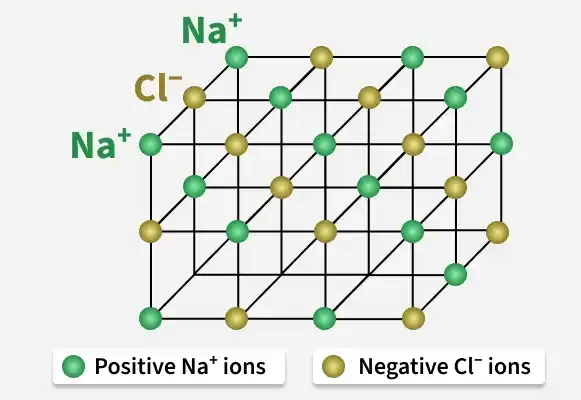
- Ionic compounds have a regular and well-organized three-dimensional arrangement of ions called a crystal lattice structure.
- In this structure, positive ions (cations) and negative ions (anions) are arranged alternately and are held together by strong electrostatic forces of attraction.
- Instead, a large number of oppositely charged ions are arranged in a repeating pattern throughout the crystal.
- This arrangement makes the compound stable, solid, and strong.
In sodium chloride (NaCl), each Na+ ion is surrounded by six Cl -ions, and each Cl⁻ ion is surrounded by six Na+ ions in a regular cubic arrangement. This type of structure is known as a crystal lattice.
Formation of Ionic Compound
- Ionic compounds are formed when one atom transfers one or more electrons to another atom.
- This transfer of electrons usually occurs between a metal atom and a non-metal atom.
- The metal atom loses electrons to form a positively charged ion (cation), while the non-metal atom gains electrons to form a negatively charged ion (anion).
- After the transfer of electrons, the oppositely charged ions attract each other through a strong electrostatic force of attraction.
- This force is called an ionic bond, and it holds the ions together to form an ionic compound.
- The ions arrange themselves in a crystal lattice structure, making the compound stable.
Example: NaCl, MgCl2
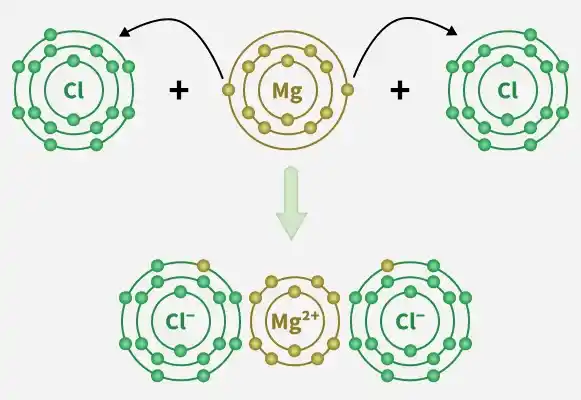
Examples of Ionic Compounds
1. Sodium Chloride (NaCl)
a) Electron configuration of Sodium (Na):
- Sodium has one electron in its outermost shell.
Na(2,8,1)
- To become stable, sodium loses one electron.
Na→ Na++ e-
Thus, sodium becomes a sodium ion (Na⁺).
b) Electron configuration of Chlorine (Cl):
- Chlorine has seven electrons in its outermost shell: Cl(2,8,7)
- To complete its octet, chlorine gains one electron.
Cl + e− →Cl-
Thus, chlorine becomes a chloride ion (Cl⁻).
c) Formation of Ionic Compound
- The Na⁺ ion and Cl⁻ ion attract each other due to electrostatic force and form sodium chloride (NaCl).
Na++Cl- → NaCl
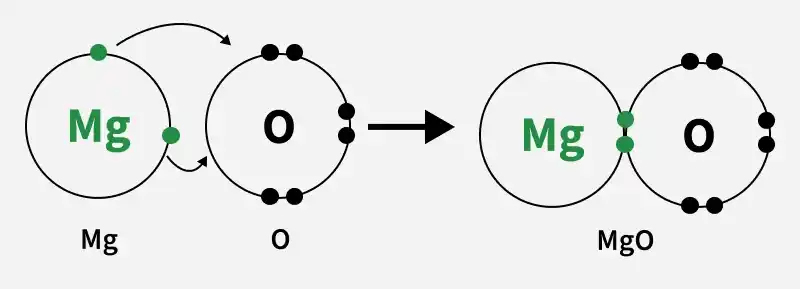
2. Magnesium Oxide ( MgO)
a) Electron configuration of Magnesium (Mg):
- Magnesium has two electrons in its outermost shell: Mg (2, 8, 2)
- To become stable, magnesium loses two electrons:
Mg → Mg 2+ + 2e −
Thus, magnesium becomes a magnesium ion (Mg²⁺).
b) Electron configuration of Oxygen (O):
- Oxygen has six electrons in its outermost shell: O (2, 6)
- To complete its octet, oxygen gains two electrons:
O + 2e − → O 2-
Thus, oxygen becomes an oxide ion (O 2-).
c) Formation of Ionic Compound:
- The Mg2+ ion and O 2- ion attract each other due to strong electrostatic force and form magnesium oxide:
Mg 2+ + O 2- → MgO