

Atoms are extremely small, and understanding their structure has always been a challenge for scientists. Earlier models, such as Thomson’s and Bohr’s models, explained some properties of atoms but could not describe everything accurately. To give a more complete explanation of how electrons behave inside an atom, scientists developed the quantum mechanical atomic model.
This model uses ideas from quantum theory to explain that electrons do not move in fixed circular paths. Instead, their behavior is described in terms of probability and wave nature. Today, the quantum mechanical model forms the basis of modern atomic theory.
Development of the Quantum Mechanical Model
The quantum mechanical model did not appear suddenly. It was developed gradually as scientists tried to solve the problems left unanswered by earlier atomic models. Although Bohr’s model explained the hydrogen atom successfully, it failed to explain the behavior of electrons in more complex atoms.
To improve the understanding of atomic structure, several important ideas were introduced, such as the dual nature of electrons, the uncertainty principle, and the wave equation. These discoveries together led to the development of the quantum mechanical model of the atom. It is as follows:
1) Bohr's model of hydrogen
Niels Bohr proposed a new model of the atom to explain the structure of the hydrogen atom. He stated:
- Electrons move around the nucleus in fixed circular paths called orbits.
- Each orbit has a fixed amount of energy.
- Electrons do not lose energy while moving in these orbits.
- Energy is absorbed or emitted only when an electron jumps from one orbit to another.
Limitation
- Bohr’s model works well only for the hydrogen atom.
- It does not explain atoms with more than one electron.
2) Dual Nature of Matter
The dual nature of matter is an important concept in modern atomic theory. It states that very small particles, such as electrons, behave both like particles and like waves. Earlier, electrons were considered only as tiny particles with mass and charge. However, new discoveries showed that they also have wave-like properties.
Louis de Broglie proposed that every moving particle has an associated wavelength. This idea is known as the de Broglie hypothesis.
de Broglie Equation
This equation shows that every moving particle has a wave associated with it, and its wavelength depends on its mass and velocity. He gave a formula to calculate the wavelength of a moving particle:
\lambda = \frac{h}{p}
Where:
- λ = wavelength
- h = Planck’s constant
- p = momentum of the particle
Since momentum p=mv the equation can also be written as:
\lambda = \frac{h}{mv}
3) Heisenberg’s Uncertainty Principle
Werner Heisenberg introduced an important idea called the Uncertainty Principle. According to this principle, it is impossible to determine both the exact position and the exact momentum (or velocity) of an electron at the same time.
The more accurately we know where an electron is, the less accurately we can know how fast it is moving, and vice versa. This idea played a key role in the development of the quantum mechanical model and led to the concept of probability-based orbitals.
The uncertainty principle is written as:
\Delta x \cdot \Delta p \geq \frac{h}{4\pi}
Where:
- Δx = uncertainty in position
- Δp = uncertainty in momentum
- h = Planck’s constant
Outcomes of the Quantum Mechanical Model
These discoveries together transformed the understanding of atomic structure and led to the modern quantum mechanical description of the atom. The outcomes are as follows:
1) Schrödinger’s Wave Equation
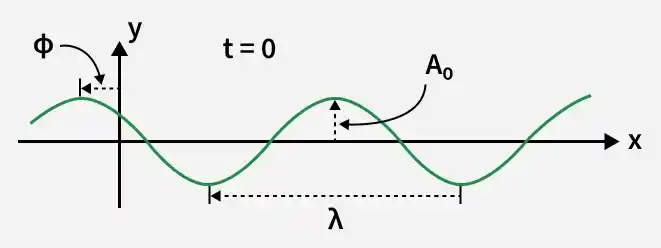
To describe the wave nature of electrons mathematically, Erwin Schrödinger developed a wave equation in 1926. This equation treats the electron as a wave rather than a particle moving in a fixed orbit.
Before understanding the equation, it is helpful to understand the idea of standing waves.
Standing Waves
A standing wave is a wave that remains confined to a particular region and does not travel from one place to another. For example, when a string is fixed at both ends and vibrates, it forms standing waves. Only certain wave patterns are possible.
Similarly, in an atom:
- The electron behaves like a wave.
- Only certain wave patterns are allowed around the nucleus.
- These allowed wave patterns correspond to specific energy levels.
This explains why electron energy is quantized.
Schrödinger’s Equation
From this equation, we obtain the wave function, which helps determine the probability of finding an electron in a particular region of space. The mathematical form of the Schrödinger equation is:
\hat{H} \psi = E \psi
Where:
\hat{H} = Hamiltonian operator (represents total energy)- ψ = wave function
- E = total energy of the electron
Wave Function
- The wave function
\psi does not directly give the position of the electron. - Instead, the square of the wave function:
\psi^2
- It gives the probability of finding the electron in a particular region around the nucleus.
This means:
- We cannot say exactly where the electron is.
- We can only say where it is most likely to be found.
2) Concept of Orbitals
According to the quantum mechanical model, electrons do not move in fixed paths. Instead, their behaviour is described by a mathematical function called the wave function (
- Orbitals are probability regions, not fixed paths.
- Each orbital can hold a maximum of two electrons.
- Orbitals have definite shapes and energies.
- The size and shape of orbitals depend on quantum numbers.
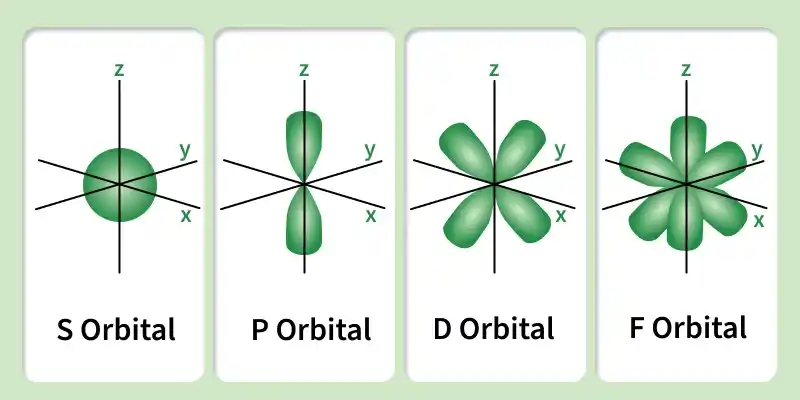
Types of Orbitals
Based on their shapes and energy levels, orbitals are classified as:
- s-orbitals – spherical in shape
- p-orbitals – dumbbell-shaped
- d-orbitals – complex shapes
- f-orbitals – more complex shapes
Features of Quantum mechanical Atomic Model
The Quantum Mechanical Model is the modern and most accurate explanation of atomic structure. It was mainly developed using the wave equation of Erwin Schrödinger and is based on principles of quantum theory. Its important features are explained below:
1) Wave–Particle Dual Nature of Electrons
- Electrons behave both as particles and as waves.
- This means they have mass and charge like particles, but they also show wave-like properties such as diffraction and interference.
- Because of this dual nature, their behavior cannot be explained using only classical physics.
2) No Fixed Circular Orbits
- Unlike earlier models (such as Bohr’s model), electrons do not move in fixed circular paths around the nucleus.
- The idea of a definite orbit was replaced by a more realistic concept based on probability.
- Electrons do not travel like planets around the Sun.
- Instead, their motion is complex and wave-like.
3) Probability-Based Description
- The exact position and momentum of an electron cannot be known simultaneously.
- Therefore, the model does not describe the exact path of an electron.
- Instead, it uses a wave function (
\psi ) to describe electron behavior. - The square of the wave function (
\psi^2 ) gives the probability of finding the electron in a particular region around the nucleus. - This makes the model statistical in nature.
4) Concept of Orbitals
- Electrons are found in specific three-dimensional regions around the nucleus called orbitals.
- An orbital is a region where the probability of finding an electron is maximum.
Orbitals:
- Have definite shapes and sizes
- Are arranged according to energy levels
- Can hold a maximum of two electrons
5) Quantization of Energy
- The energy of electrons in an atom is not continuous.
- Electrons can only have certain fixed energy values.
- These allowed energy levels are called quantized energy levels.
- An electron can move from one energy level to another by absorbing or emitting a specific amount of energy.
6) Schrödinger’s wave equation
The model is based on Schrödinger’s wave equation, which mathematically describes the energy and behaviour of electrons. The solutions of this equation give:
- Allowed energy levels
- Shapes of orbitals
- Probability distribution of electrons
7) Explains Atomic Spectra
- The model successfully explains the line spectra of hydrogen and other atoms.
- It accounts for why atoms emit or absorb light of specific wavelengths.
