

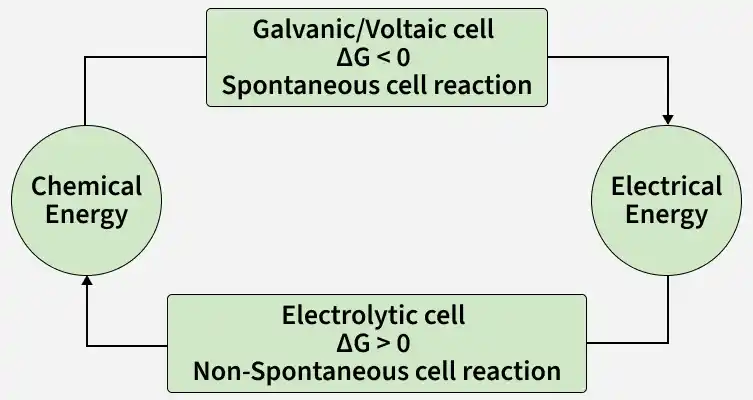
A galvanic cell, also known as a voltaic cell, is an electrochemical cell that converts chemical energy into electrical energy through a spontaneous redox reaction. In this cell separation of oxidation and reduction reactions causes electrons to flow through an external circuit and producing electric current.
Principle of Galvanic Cell
A galvanic cell works on the principle that chemical energy is converted into electrical energy through a spontaneous redox reaction. Oxidation and reduction reactions occur in separate half-cells, which results in the flow of electrons through an external circuit and produces electric current.
Construction of Galvanic Cell
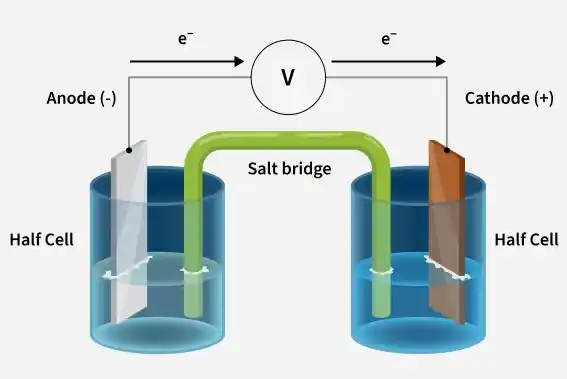
A galvanic cell consists of two half-cells in which oxidation and reduction reactions occur separately.
Main Components of a Galvanic Cell
- A galvanic cell consists of two electrodes immersed in electrolyte solutions.
- The electrodes are placed in separate containers called half-cells.
- The two half-cells are connected by a salt bridge containing an inert electrolyte.
- The electrodes are connected externally by a metallic wire.
- A voltmeter may be connected in the external circuit to measure the potential difference.
- The salt bridge allows the movement of ions and maintains electrical neutrality of the solutions.
- Electrons flow through the external wire from one electrode to the other, producing electric current.
Working of Galvanic Cell
Oxidation and reduction reactions occur in separate half-cells, due to which electrons flow through the external circuit and produce electric current.
- Oxidation occurs at the anode where metal atoms lose electrons and form positive ions.
- The electrons released at the anode flow through the external wire towards the cathode.
- Reduction occurs at the cathode where positive ions gain electrons.
- The salt bridge allows the movement of ions and maintains electrical neutrality in both half-cells.
- Anions move toward the anode compartment to balance Zn²⁺ formation, while cations move toward the cathode compartment to replace Cu²⁺ ions.
- The reaction continues until the cell potential becomes zero and electrochemical equilibrium is reached.
Zn–Cu Galvanic Cell (Daniell Cell)
The Zn–Cu galvanic cell, also known as the Daniell cell, is a common example of a galvanic cell in which electrical energy is produced by a spontaneous redox reaction between zinc and copper.
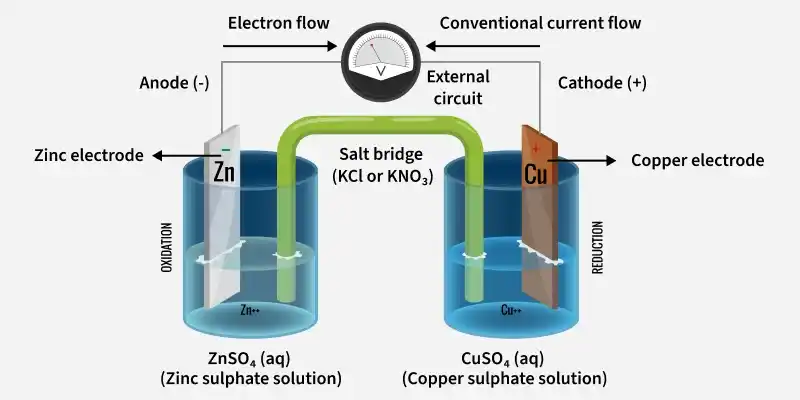
- In this cell, a zinc electrode is dipped in zinc sulphate (ZnSO4) solution and a copper electrode is dipped in copper sulphate (CuSO4) solution.
- The two half-cells are connected by a salt bridge and an external wire.
Working of Zn–Cu Galvanic Cell
- Zinc acts as the anode where oxidation takes place.
- Copper acts as the cathode where reduction takes place.
- Zinc atoms lose electrons and enter the solution as zinc ions.
- The electrons released travel through the external wire from zinc electrode to copper electrode.
- Copper ions gain electrons and get deposited as copper metal.
- The salt bridge maintains electrical neutrality by allowing movement of ions.
Reaction at Anode (Oxidation): At anode, zinc loses electrons and gets oxidized.
Zn (s) → Zn2+ (aq) + 2e−
Reaction at Cathode (Reduction): At cathode, copper ions gain electrons and get reduced.
Cu2+ (aq) + 2e− → Cu (s)
Overall Cell Reaction:
Zn(s) + Cu2+ (aq) → Zn2+ (aq) + Cu(s)
Representation of Galvanic Cell
A galvanic cell can be represented by a symbolic notation known as cell notation or cell representation. In this representation, the anode is written on the left side and the cathode is written on the right side.
The conventional representation of a Zn–Cu galvanic cell is:
Zn(s) | Zn2+ (aq) || Cu2+ (aq) | Cu (s)
- A single vertical line (∣) represents the boundary between two phases.
- A double vertical line (∣∣) represents the salt bridge.
- The left side represents the anode where oxidation occurs.
- The right side represents the cathode where reduction occurs.
Applications of Galvanic Cell
Galvanic cells are widely used for the production of electrical energy in many devices and industrial applications.
- Galvanic cells are used in batteries such as dry cells and storage batteries.
- They are used in mobile phones, laptops, calculators, watches, and remote controls.
- They are used as a source of power in automobiles and inverters.
- Fuel cells, which are based on the principle of galvanic cells, are used for efficient energy production.
