Best Google Forms Alternatives for 2026
The best Google Forms alternative for most businesses is Paperform at $49/month billed annually, because one subscription covers forms, eSignatures and workflow automation, which is the whole stack Google Forms sends you out to buy. For free internal surveys inside Workspace, Google Forms is still the right tool and you should keep using it.
Google Forms is genuinely good at the job it was built for. It is free, it takes about four minutes to learn, several people can edit the same form at once the way they edit a Google Doc, and the responses land in a spreadsheet without anyone configuring anything. Capterra's 11,572 reviewers rate it 4.7 with value for money at 4.8, and they are right. If you need to collect some answers and look at them, there is no argument to make here: use Google Forms and spend the money elsewhere.
The searches for an alternative come from a different place. They come from the week the form has to take a deposit, or produce a contract somebody signs, or route an approval through two people before it reaches finance, or carry a client's branding rather than Google's. Google Forms answers none of those, and the answer it does give is a link to Zapier, an Apps Script somebody on the team wrote once, and a separate invoice from DocuSign. The cost of staying is not the price of Google Forms. It is the three subscriptions holding it together and the person who has become the integration between them.
There is a second thing worth thinking about before you pick a replacement, and it rarely makes these lists. Google Forms is not a product with its own revenue; it is a free feature of Workspace, and its roadmap follows whatever serves the suite. Seventeen years in, it still has no payments and no custom domains. When you move a business process onto a tool, you are betting on whoever makes it still caring about it in five years, which is why the ownership and funding of each alternative below is stated plainly alongside the features.
| Feature | Google Forms | Paperform | Jotform | Typeform | Cognito Forms | Tally | SurveyMonkey |
|---|---|---|---|---|---|---|---|
| Form Building | |||||||
| Templates . The number of ready-made form templates in the tool’s template gallery. | 20+ | 30,000+ | 20,000+ (starter) | 3,000+ | Yes | 100+ | 500+ (Individual Standard) |
| Field types . How many kinds of question or input field the form builder offers, such as text, dropdown, date, file upload and signature. | 12 | 26+ | 30+ (starter) | 20+ | 20+ | 20+ | 20+ |
| Calculations . Compute totals, scores, prices or dates from answers while the form is being filled in. | No | Yes pro | Yes starter | Yes | Yes | Yes | No |
| E-signatures . Collect a signature, either with a signature field on the form or by sending a document out to be signed. | Yes Business Standard | Yes | Yes starter | Yes growth flow | Yes pro | Yes | No |
| Appointment booking . Let respondents pick and book a time slot directly in the form, with availability managed by the tool. | Yes | Yes | Yes starter | Yes business | Yes team | No | No |
| Payments | |||||||
| Payment gateways . The number of payment processors a form can take payments through. Where a vendor’s full count isn’t recorded, the cell lists the gateways we confirmed. | No | 5 Stripe, PayPal, Square, Braintree, Google Pay | 34 (starter) options in its builder, incl. Stripe, PayPal, Square, Braintree | 2 (basic) Stripe, PayPal | 5 Cognito Pay, Stripe, PayPal, Square, Google Pay | 1 Stripe | 2 (Individual Advantage) Stripe, PayPal |
| Subscriptions and recurring payments . Charge respondents on a repeating schedule, such as monthly or annually, from a form. | No | Yes pro | Yes starter | Yes basic | No | No | No |
| Product sales . Sell products from a form, with product listings, quantities and an order total. | No | Yes pro | Yes starter | Yes basic | Yes | Yes | No |
| Conditional pricing . Change the price or add fees automatically based on the answers given in the form. | No | Yes pro | Yes starter | Yes basic | Yes | Yes | Yes Individual Advantage |
| Coupons and discounts . Offer discount codes that respondents can apply to a payment or subscription on the form. | No | Yes pro | Yes starter | Yes basic | Yes | Yes | No |
| Design & Customization | |||||||
| Custom themes . Set your own logo, colours and fonts on forms and save them as reusable themes. | Yes | Yes pro | Yes starter | Yes basic | Yes pro | Yes | Yes Individual Standard |
| Custom CSS . Add your own CSS (and in some tools HTML) for styling beyond the built-in theme options. | No | Yes pro | Yes starter | No | Yes pro | Yes pro | Yes enterprise |
| Remove vendor branding . Remove the form builder’s own logo or badge so forms carry only your branding. | No | Yes pro | Yes bronze | Yes plus | Yes pro | Yes pro | Yes Individual Premier |
| Custom domain . Host forms on your own domain, such as forms.yourcompany.com, instead of the vendor’s. | No | Yes business | Yes enterprise | Yes enterprise | No | Yes pro | No |
| Custom form URL . Choose a readable link for a form instead of a random string. | No | Yes pro | Yes starter | Yes plus | Yes | Yes pro | Yes Individual Standard |
| Analytics | |||||||
| Response reports . Built-in summaries and charts of the answers a form has collected. | Yes | Yes | Yes starter | Yes | Yes | Yes | Yes |
| Form analytics (views and drop-off) . Track how many people view, start and finish a form, and where they abandon it. | No | Yes pro | Yes starter | Yes business | Not recorded | Yes pro | Not recorded |
| Partial submissions . See the answers people entered before leaving a form without submitting it. | No | Yes pro | No | Yes basic | Not recorded | Yes pro | Yes Individual Advantage |
| Custom tracking scripts . Add your own analytics or conversion-tracking scripts to a form. | Not recorded | Yes pro | No | Yes business | No | Yes pro | Not recorded |
| AI response insights . AI-written summaries and insights generated from the responses a form has collected. | Yes Business Standard | Yes pro | Yes starter | Yes growth flow | Not recorded | No | Yes Individual Advantage |
| Collaboration | |||||||
| Team members . Invite colleagues into the same account to build forms and work with responses together. | Yes | Unlimited | Yes enterprise | Yes plus | Yes pro | Yes pro | Yes Team Advantage |
| Roles and permissions . Give team members different levels of access, such as admin, editor or viewer. | Yes | Yes business | Yes enterprise | Yes plus | Yes pro | No | Yes Team Advantage |
| Advanced permissions and admin controls . Fine-grained, organisation-wide controls over who can access what, usually on enterprise plans. | Yes Business Starter | Yes enterprise | Yes enterprise | Yes enterprise | Yes business | No | Yes enterprise |
| Workspaces . Separate spaces or folders for organising forms by team, client or project. | Yes | Yes | Yes enterprise | Yes | Yes pro | Yes pro | Yes |
| Security | |||||||
| Require 2FA for the whole team . Admins can make two-factor authentication mandatory for everyone in the account. | Yes Business Starter | Yes business | Yes enterprise | Not recorded | Yes enterprise | No | Yes enterprise |
| SSO (SAML) . Team members sign in through your company’s identity provider, such as Okta or Microsoft Entra ID, using SAML single sign-on. | Yes Business Starter | Yes business | Yes enterprise | Yes enterprise | Yes enterprise | No | Yes enterprise |
| HIPAA compliance . Whether the vendor supports collecting US protected health information under HIPAA, typically by signing a business associate agreement on an eligible plan. | Yes Business Starter | No | Yes gold | Yes enterprise | Yes enterprise | No | Yes enterprise |
| SOC 2 . Whether the vendor holds a SOC 2 audit report covering its security controls. | Yes Business Starter | Yes | Yes enterprise | Yes | Yes | No | Yes |
| Data residency . Choose the region, such as the EU, where your form data is stored. | Yes Business Standard | Yes enterprise | Yes starter | Yes enterprise | No | No | Yes enterprise |
| Integrations & API | |||||||
| Native integrations . Apps the tool connects to directly, without going through a third-party connector such as Zapier or Make. | Yes | 500+ | 150+ (starter) | 300+ | 28 | 13 | 200+ |
| Zapier . Connect forms to thousands of other apps through Zapier. | Yes | Yes | Yes starter | Yes | Yes pro | Yes | Yes |
| Workflow automation . A built-in builder for multi-step automations that act on submissions, such as approvals, routing and syncing data to other systems. | Yes Business Starter | Yes | Yes starter | Yes growth flow | Yes team | No | Not recorded |
| Webhooks . Send each new submission to a URL of your choice as soon as it arrives. | No | Yes pro | Yes starter | Yes basic | Yes pro | Yes | Yes enterprise |
| WordPress plugin . A plugin for adding forms to a WordPress site. | No | Yes | Yes starter | No | Yes | No | No |
— means we haven't recorded it for that tool.
Five Dimensions Google Forms Loses On
Compliance is the one Google wins outright, and it wins it convincingly. Here is where it sits against the alternatives on each of the five things buyers actually check.
Pricing
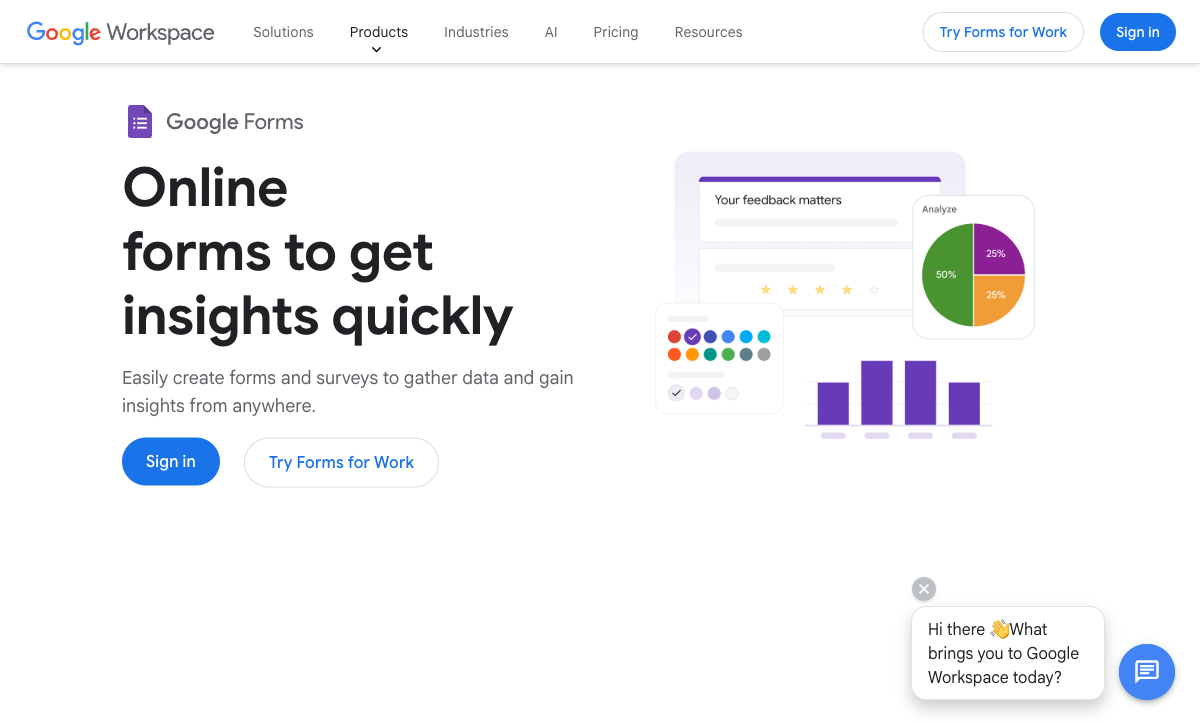
Google Forms is free with unlimited forms and up to 500,000 responses per form, and the Workspace plans around it run $7, $14 and $22 per user per month on an annual commitment. That per-seat structure is the number to compare, not zero: twenty people on Business Standard is $3,360 a year. Tally Pro is $24/month billed annually with unlimited submissions and unlimited seats, Cognito Forms Pro $19/month for 2,000 entries and 1 user, Jotform Bronze $34/month for 1,000 submissions and one user, Typeform Basic $28/month for 100 responses and one user, SurveyMonkey Team Advantage $30 per user per month with a three-user minimum. Paperform Pro is $59/month, or $49/month billed annually, with unlimited submissions and unlimited seats.
Integrations & API
Google Forms has roughly 20 native integrations and nearly every one of them is a Google product; beyond Workspace Studio flows on paid plans there is no native CRM, email or billing connector, and no outbound webhooks. There is a documented REST API and Apps Script for anything custom, which is powerful and turns into unowned code surprisingly fast. Paperform counts 9,800+ integrations across native connectors, Zapier, Make, webhooks and a REST API. SurveyMonkey lists 200+, Jotform 150+ natives, Typeform 300+, Cognito Forms 28, and Tally around 13 natives plus Zapier, Make, n8n and Pipedream. Inside the Google ecosystem, Forms is unbeatable. One step outside it, you are writing the plumbing yourself.
Conditional logic
Google Forms logic is section jumps only: it can send a respondent to a different section based on a multiple choice or dropdown answer, and it cannot show or hide an individual question, chain conditions, pipe an earlier answer into a later one or calculate anything. There are no calculation fields at all. Paperform's Excel-style calculations drive question and page visibility, conditional emails, what reaches an integration and what the success page displays. Cognito Forms has the other serious calculation engine here, handling repeating sections and line-item order forms. Typeform includes logic and a calculator on every plan, free included. Tally includes a formula editor free.
Payments
Google Forms supports zero payment processors, and that includes Google Pay. Jotform supports 30+ on every plan including the free tier. Paperform supports 5 (Stripe, PayPal, Square, Braintree and Google Pay) with products, subscriptions, coupons, calculated pricing rules, tax and refunds behind them, and no transaction fee of its own. Cognito Forms runs its own card processing plus Stripe, adding PayPal and Square on Business. SurveyMonkey and Typeform have Stripe and PayPal, and Tally is Stripe-only. Any of them clears the bar here, because the bar is one.
Compliance (HIPAA / GDPR / SOC 2)
Google Forms is HIPAA-eligible under a Google Workspace BAA and carries GDPR, SOC 2, ISO 27001, ISO 27701 and FedRAMP through Google Cloud, which is the strongest compliance position of any tool on this page. Jotform, Typeform, SurveyMonkey and Cognito Forms are all HIPAA, GDPR and SOC 2 compliant as well. Paperform is SOC 2 Type II, GDPR and CCPA compliant with SAML SSO and enforced 2FA, but it is not HIPAA compliant and signs no BAAs, so protected health information rules it out. Tally holds GDPR and EU hosting and nothing else. If PHI is in scope, staying on Google Forms is a perfectly defensible answer.
 #1 Paperform — Best for Replacing the Whole Stack Around the Form
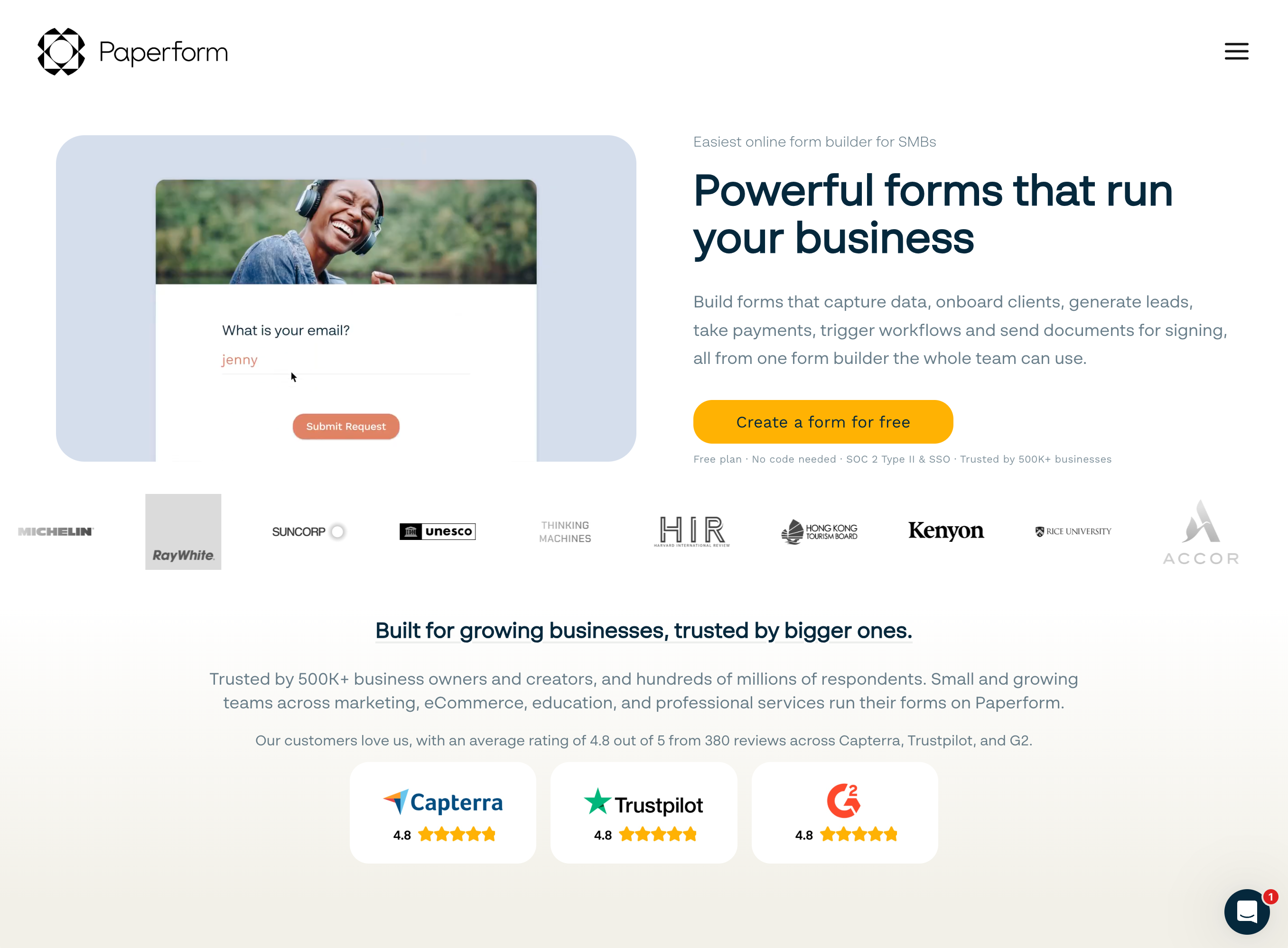
The honest comparison is not Paperform against Google Forms. Almost nobody runs a business process on Google Forms alone. They run it on Google Forms plus a signature tool plus an automation tool plus the Workspace seats underneath, which is three renewal dates, three admin consoles and a process that lives in a Zapier canvas nobody owns. Paperform covers all three jobs in one subscription on every plan: Paperform for the form, Papersign for the contract that follows it, Stepper for the approvals and handoffs after that. Pro at $49/month billed annually includes 25 signed documents a month and 20,000 automation credits; Business at $124/month includes 100 signed documents and 100,000 credits.
The second argument is the one that separates Paperform from most of this list, and it is about who you are buying from. Paperform was founded in 2016, has been bootstrapped and profitable throughout, and is still run by the people who started it. Ten years is long enough to have shipped through two funding winters without an acquisition or a repricing. Compare the ownership of the field: Typeform is Series C and answerable to investors who want a return, SurveyMonkey is owned by private equity firm Symphony Technology Group and has moved all but one of its paid plans to an annual commitment, Cognito Forms took private equity money, Tally is four people plus a few more and four years old. Google Forms is Alphabet's, which is to say nobody's in particular. When the form becomes the system of record for how money and contracts move through your business, the vendor's incentives are part of the product.
On the form itself, Paperform's editor works like a document rather than a question list: headings, copy, images, GIFs, video and fields sit wherever the page needs them, with custom HTML and CSS, custom fonts and full theming, which is the difference between sending a client a form and sending them a page. Submissions and seats are unlimited on paid plans within fair use, so a campaign that lands does not generate a bill and the designer, the reviewer and the person who signs off cost nothing to add. Support is priority on Pro and included in the price rather than sold back as an enablement fee. Reviewers rate that support 4.7 on Capterra and 4.9 on GetApp.
- Strengths over Google Forms: Papersign eSignatures and Stepper workflows in the same subscription, 5 payment gateways with coupons, tax and refunds, Excel-style calculations driving logic across the whole form, custom domains and full white-labelling, drop-off analytics with your own tracking scripts, 9,800+ integrations, 30,000+ templates, save and resume with no sign-in, ten years of independent ownership
- Limitations: $49/month billed annually against free, not HIPAA compliant and signs no BAAs, Stepper automation credits are metered, custom domains are $20/month each on Pro, no mobile editor, a far smaller review footprint than Google
- Best for: Operators who have already bolted a signature tool and an automation tool onto Google Forms and want one vendor instead of four
 #2 Jotform — Best If You Need Payments and Keep the Compliance
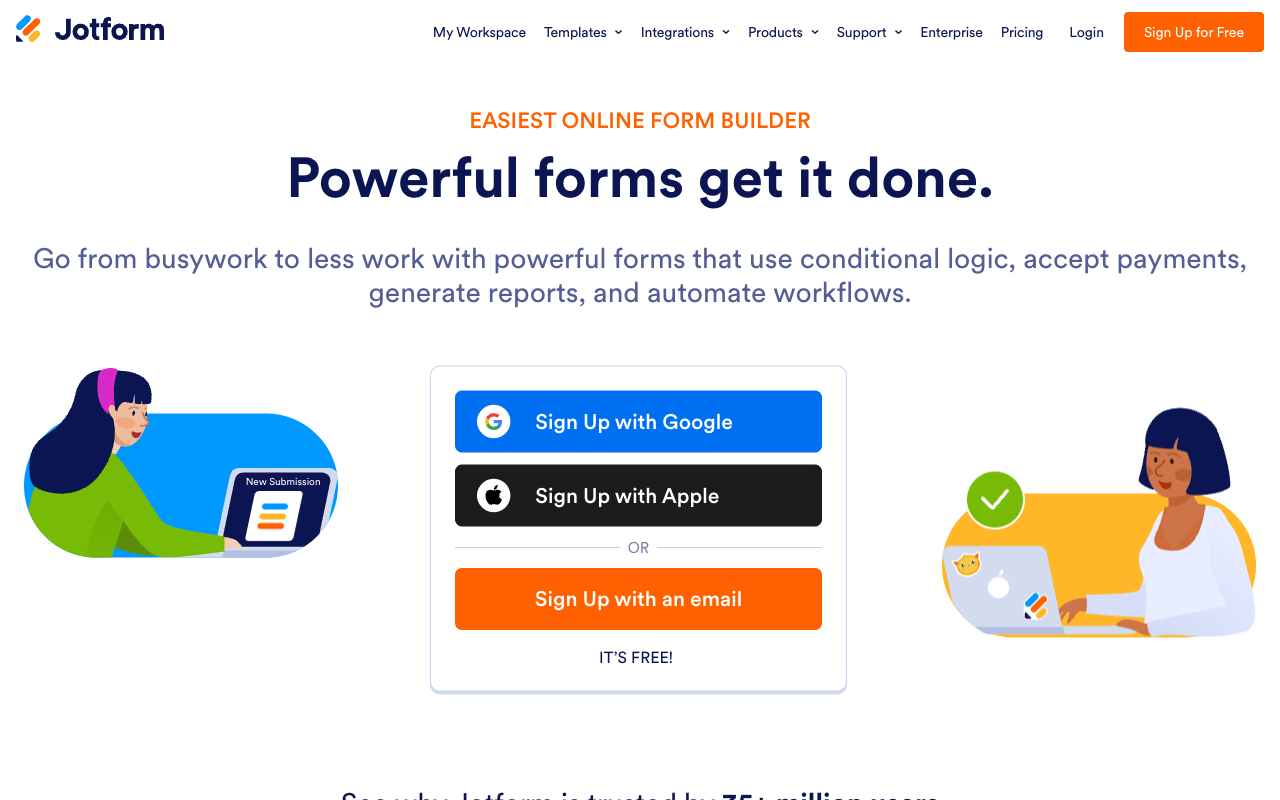
Jotform is the alternative that adds the most without giving anything up on the compliance side. Google Forms' HIPAA eligibility is often the reason teams in healthcare, education and government stay put, and Jotform signs a BAA on its Gold tier at $99/month billed annually while also carrying SOC 2, ISO 27001, PCI DSS Level 1, FERPA and StateRAMP. On top of that it does the thing Google Forms cannot do at all: take money, through more than thirty processors, on every plan including the free one. It has native mobile apps for building and reviewing forms, which Google Forms lacks too. Founded in 2006 and still bootstrapped after twenty years, it is the most stable vendor here after Alphabet itself.
What it asks in return is a tolerance for meters and for clutter. Coming from a product where responses run to 500,000 per form for free, Jotform's structure is a shock: submissions, forms, form views, submission storage, fields per form and signed documents are all quotas, and every self-serve tier from Starter to Gold is single-user, so the collaborative editing you took for granted in Google Forms means an Enterprise quote. Two decades of features also have to live somewhere, and reviewers regularly describe the interface as cluttered with settings buried in nested menus. Our Jotform alternatives page breaks down the quota structure in detail.
- Strengths over Google Forms: 30+ payment processors on every plan, HIPAA with a BAA plus ISO 27001 and PCI DSS Level 1, 150+ native integrations beyond the Google ecosystem, approval workflows and PDF generation, native mobile apps, full branding control
- Limitations: Submissions, forms, views, storage and fields all metered, single-user on every self-serve plan where Google Forms is collaborative and free, cluttered editor, $34/month annually buys only 1,000 submissions
- Best for: Teams that stayed on Google Forms for the BAA and now need to charge people too
 #3 Typeform — Best When the Form Is Marketing
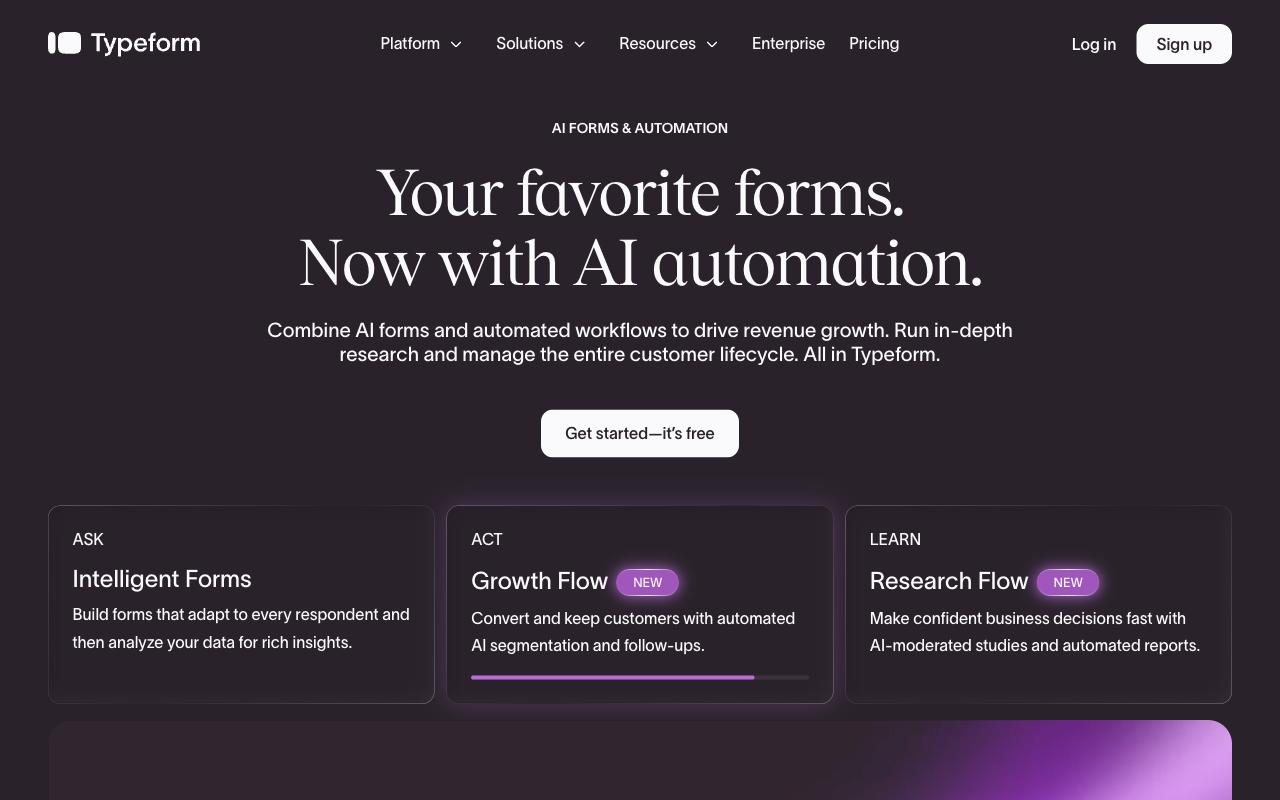
Typeform exists because a Google Form looks like a Google Form. It asks one question at a time, it moves well, and for short lead-qualification and feedback flows where the completion rate is the whole point, it remains the reference implementation of that format. It is HIPAA compliant on Enterprise, holds ISO 27001, 27017 and 27018, and in June 2026 added ISO/IEC 42001 for AI management. If your objection to Google Forms is purely that respondents can tell it is a Google Form, Typeform is the most direct fix.
Then the bill arrives. Typeform meters responses and seats on every plan without exception: 100 responses and one user on Basic at $28/month annually, 1,000 and three on Plus, 10,000 and five on Business at $91/month annually, and Growth Flow at $266/month annually raises neither of those numbers. Moving from free responses capped at 500,000 per form to 100 a month for $28 is the sharpest step down available on this page, and it lands hardest on exactly the high-volume public forms people run in Google Forms today. Payments are Stripe and PayPal only, and Typeform is Series C venture-funded, which is the usual precursor to a pricing conversation you do not control. See our Paperform vs Typeform breakdown for the full cost picture.
- Strengths over Google Forms: Conversational one-question format, strongest default design in the category, real branding control with custom domains on Enterprise, HIPAA on Enterprise plus ISO 27001 and ISO/IEC 42001, 300+ integrations, Stripe and PayPal payments
- Limitations: 100 responses a month on the $28 entry plan where Google Forms allows 500,000 per form, seats capped on every tier, Stripe and PayPal only, venture-funded rather than independent
- Best for: Marketing teams running low-volume, high-value forms where presentation drives the result
 #4 Cognito Forms — Best for Order Forms and Real Calculations
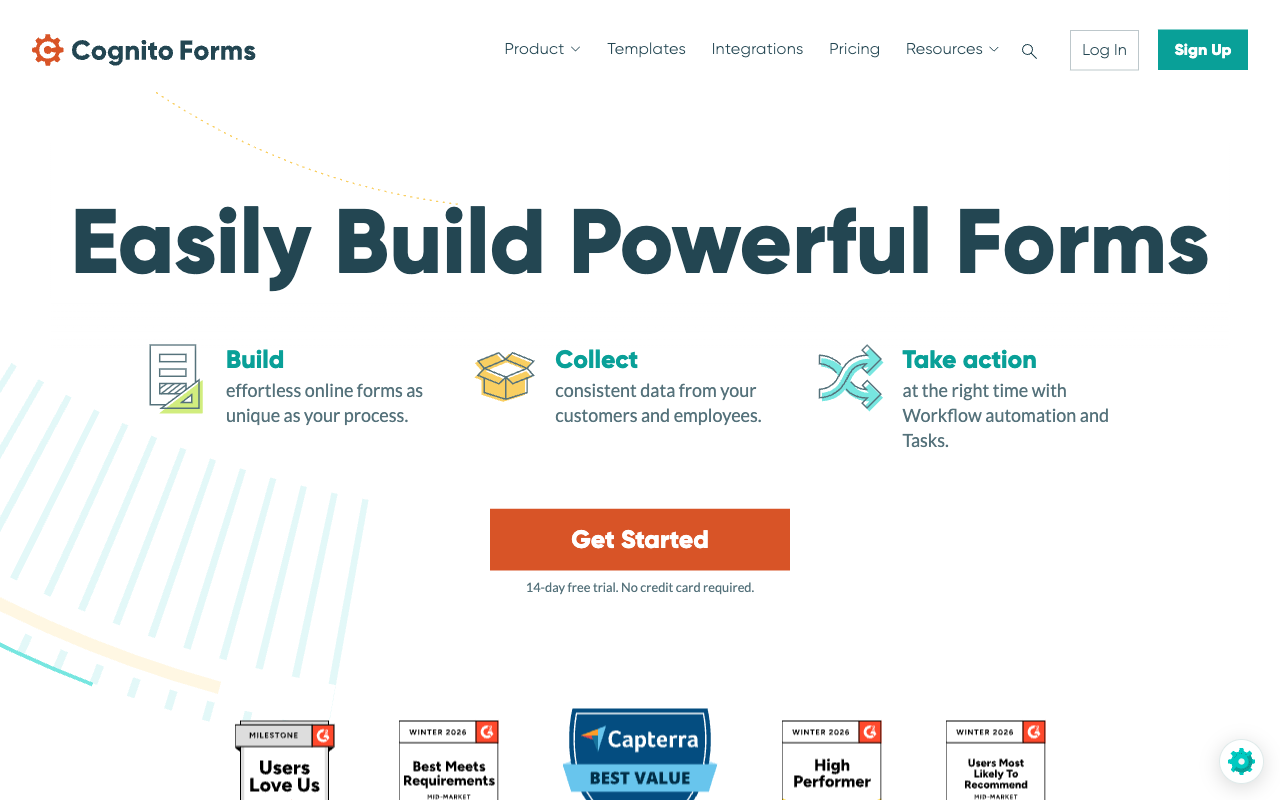
Cognito Forms is the answer for people whose Google Form has quietly become an order form. Google Forms has no calculation capability whatsoever, so the arithmetic currently happens in the Sheet afterwards, or in somebody's head. Cognito's calculation engine handles repeating sections, line items, quantity tiers and nested conditions, then takes the payment through its own card processing or Stripe, with PayPal and Square from the Business tier at $99/month annually. It is HIPAA compliant with a BAA and SOC 2 audited, so it keeps the compliance floor Google Forms set. Pro is $19/month billed annually, the cheapest paid rung on this page.
The trade is appearance and arithmetic of a different kind. Forms built in Cognito look like forms from a decade ago unless somebody writes CSS, which is not obviously an upgrade on Google's clean defaults, and API requests are metered by plan. It also meters four separate ways: entries, users, storage and guest collaborators each carry their own quota and their own overage line, with Pro stopping at 2,000 entries and 1 user and extra people at $5 each per month. Cognito Forms is also private-equity owned, and the pace of product change reflects it. Our Cognito Forms alternatives page covers the metering in more depth.
- Strengths over Google Forms: Genuine calculation engine with repeating sections and line items, payments through Cognito Pay, Stripe, PayPal and Square, HIPAA with a BAA, save and resume, document generation, $19/month entry price
- Limitations: Dated visual design, metered API requests, metered on entries, users, storage and guests simultaneously, private-equity ownership and slow release cadence
- Best for: Small teams whose forms are really price quotes, on a tight budget and with compliance to satisfy
 #5 Tally — Best Free-to-Free Swap
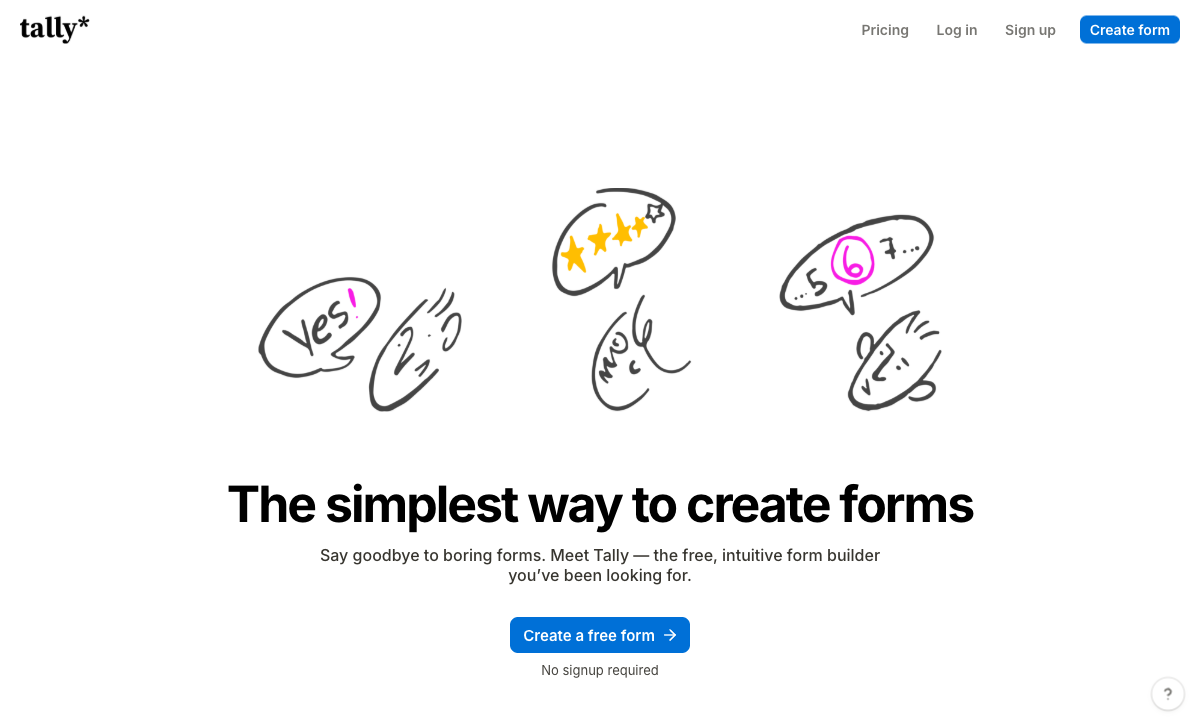
If the only thing wrong with Google Forms is how it looks, Tally solves that without moving off free. Unlimited forms and unlimited submissions on the free plan within a fair use policy, plus conditional logic, a real formula editor, Stripe payments, e-signatures and an AI builder, all included at $0. Google Forms gates its Gemini features behind Business Standard at $14 per user per month; Tally gives its AI to everyone. The editor is block-based and Notion-like, hosted in the EU, and the resulting forms look modern in a way Google's four font choices and single header image cannot reach.
What you lose is the compliance backing, and for many organisations that ends it. Tally holds GDPR and EU hosting, with no SOC 2, no ISO 27001, no HIPAA, and no SSO or enforced 2FA on any tier including the $74/month annual Business plan at the top of its list. Moving from Google's FedRAMP-and-ISO stack to that is a large step backwards on paper, whatever the product feels like. Tally is also bootstrapped and profitable but very small, founded in 2020 with a team in single digits, so there is no support tier to escalate to when a launch goes wrong. Our Tally alternatives page covers where that ceiling sits.
- Strengths over Google Forms: Modern block editor with real branding control and custom domains, unlimited free submissions, conditional logic and a formula editor free, Stripe payments, AI builder on every plan, Notion and Airtable integrations, EU hosting
- Limitations: No SOC 2, ISO 27001 or HIPAA, no SSO or enforced 2FA at any price, Stripe-only payments, no workflow builder, a team of under ten people carrying the whole roadmap
- Best for: Small teams and solo operators who want Google Forms' price and a form they are not embarrassed to send
 #6 SurveyMonkey — Best When the Survey Is the Research
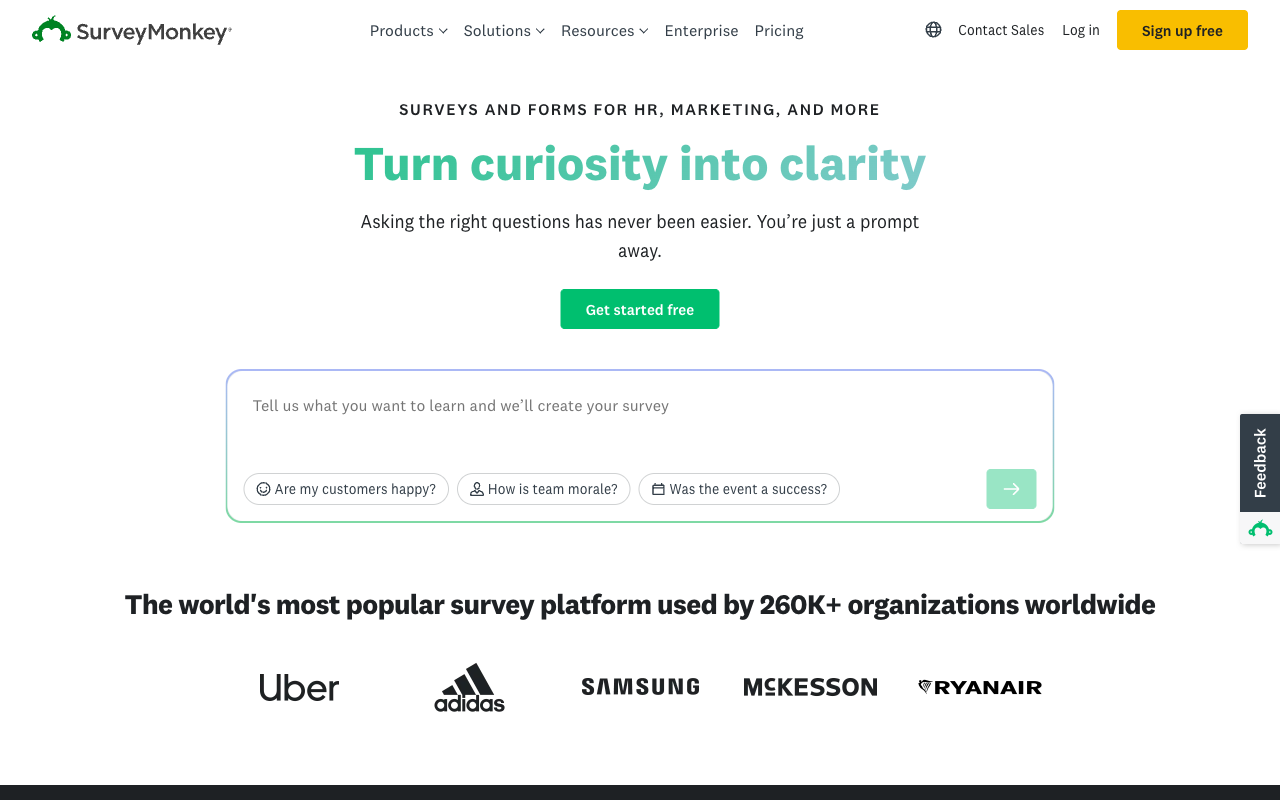
There is one scenario where Google Forms' charts genuinely are not enough: formal research. SurveyMonkey has been doing this since 1999 and brings question banks written by methodologists, significance testing, cross-tabulation, sentiment and text analysis, benchmarking against industry data, and a global respondent panel of around 335 million people you can buy answers from. Google Forms gives you bar charts. Against 23,525 G2 reviews at 4.4 and 10,508 on Capterra at 4.6, this is the most scrutinised product in the comparison, and it is HIPAA, GDPR, SOC 2 and ISO 27001 compliant.
It is also the least suited to what most people leave Google Forms for. Every paid plan carries a response cap, annual on all but one, with $0.15 charged for each response over it, teams start at three paid seats and Enterprise at five, and every paid plan except the $149/month Standard Monthly is an annual commitment, so the flexibility Google Forms gave you for free largely disappears. Payments are Stripe and PayPal with no products, coupons or tax handling, and there is no eSignature or workflow layer. SurveyMonkey is owned by private equity firm Symphony Technology Group, which shows in the direction pricing has moved.
- Strengths over Google Forms: Research-grade analytics with significance testing and cross-tabs, methodologist-written question banks, a 335M respondent panel, 200+ integrations, HIPAA and ISO 27001, the largest review base of any tool here
- Limitations: Annual response caps with $0.15 overage per response, three-seat minimum on team plans, annual commitment on every plan bar the $149/month Standard Monthly, no workflow or eSignature, weak payments, private-equity owned
- Best for: Insights and research teams who need defensible survey methodology rather than a business process
See Google Forms in Action First
Worth ten minutes before you switch: watch what Google Forms actually does well, so you know precisely which gap you are paying to close.
Full Feature Comparison
Every feature across Google Forms and its alternatives, grouped by category. The payments, platform and design rows are where a free tool stops being free.
| Feature | Google Forms | Paperform | Jotform | Typeform | Cognito Forms | Tally | SurveyMonkey |
|---|---|---|---|---|---|---|---|
| Form Building | |||||||
| AI form builder . Describe the form you need in plain language and the tool drafts the questions for you. | Yes Business Standard | Yes | Yes starter | Yes | Yes | Yes | Yes |
| Templates . The number of ready-made form templates in the tool’s template gallery. | 20+ | 30,000+ | 20,000+ (starter) | 3,000+ | Yes | 100+ | 500+ (Individual Standard) |
| Field types . How many kinds of question or input field the form builder offers, such as text, dropdown, date, file upload and signature. | 12 | 26+ | 30+ (starter) | 20+ | 20+ | 20+ | 20+ |
| Conditional logic . Show, hide or skip questions and pages based on how someone has answered earlier questions. | Yes | Yes | Yes starter | Yes | Yes | Yes | Yes Individual Standard |
| Calculations . Compute totals, scores, prices or dates from answers while the form is being filled in. | No | Yes pro | Yes starter | Yes | Yes | Yes | No |
| Multi-page forms . Split a long form across several pages that respondents move through in order. | Yes | Yes | Yes starter | Yes | Yes | Yes | Yes |
| One question at a time . A conversational layout that shows a single question per screen, popular for surveys on mobile. | Not recorded | Yes | Yes starter | Yes | Yes | Yes | Yes |
| Answer piping . Insert a respondent’s earlier answer, such as their name, into later questions or text on the form. | Not recorded | Yes | Yes starter | Yes | Yes | Yes | Yes Individual Advantage |
| Pre-filling and hidden fields . Fill in answers ahead of time from a link or existing data, and pass along values the respondent never sees. | Yes | Yes | Yes starter | Yes | Yes | Yes | Yes Individual Advantage |
| File uploads . Let respondents attach files such as documents and photos to their submission. | Yes | Yes | Yes starter | Yes basic | Yes | Yes | Yes Individual Advantage |
| E-signatures . Collect a signature, either with a signature field on the form or by sending a document out to be signed. | Yes Business Standard | Yes | Yes starter | Yes growth flow | Yes pro | Yes | No |
| Appointment booking . Let respondents pick and book a time slot directly in the form, with availability managed by the tool. | Yes | Yes | Yes starter | Yes business | Yes team | No | No |
| Quiz scoring . Give answers point values so the form can score quizzes and assessments automatically. | Yes | Yes pro | Yes starter | Yes | Yes | Yes | Yes |
| Save and resume . Respondents can leave a form part-way through and come back later to finish it. | Yes | Yes | Yes starter | Yes | Yes pro | Yes | Yes Individual Advantage |
| Close forms by date or response limit . Stop accepting submissions automatically on a set date or once a set number of responses has arrived. | Yes | Yes pro | Yes starter | Yes business | Yes | Yes | Yes Individual Advantage |
| Payments | |||||||
| Payment gateways . The number of payment processors a form can take payments through. Where a vendor’s full count isn’t recorded, the cell lists the gateways we confirmed. | No | 5 Stripe, PayPal, Square, Braintree, Google Pay | 34 (starter) options in its builder, incl. Stripe, PayPal, Square, Braintree | 2 (basic) Stripe, PayPal | 5 Cognito Pay, Stripe, PayPal, Square, Google Pay | 1 Stripe | 2 (Individual Advantage) Stripe, PayPal |
| Subscriptions and recurring payments . Charge respondents on a repeating schedule, such as monthly or annually, from a form. | No | Yes pro | Yes starter | Yes basic | No | No | No |
| Product sales . Sell products from a form, with product listings, quantities and an order total. | No | Yes pro | Yes starter | Yes basic | Yes | Yes | No |
| Conditional pricing . Change the price or add fees automatically based on the answers given in the form. | No | Yes pro | Yes starter | Yes basic | Yes | Yes | Yes Individual Advantage |
| Coupons and discounts . Offer discount codes that respondents can apply to a payment or subscription on the form. | No | Yes pro | Yes starter | Yes basic | Yes | Yes | No |
| Tax calculations . Add sales tax to payments on the form automatically. | No | Yes | Yes starter | Not recorded | Yes | Yes | No |
| Refunds . Refund a payment from inside the form tool rather than going to the payment processor. | No | Yes | No | No | Yes | Not recorded | No |
| Design & Customization | |||||||
| Custom themes . Set your own logo, colours and fonts on forms and save them as reusable themes. | Yes | Yes pro | Yes starter | Yes basic | Yes pro | Yes | Yes Individual Standard |
| Custom CSS . Add your own CSS (and in some tools HTML) for styling beyond the built-in theme options. | No | Yes pro | Yes starter | No | Yes pro | Yes pro | Yes enterprise |
| Remove vendor branding . Remove the form builder’s own logo or badge so forms carry only your branding. | No | Yes pro | Yes bronze | Yes plus | Yes pro | Yes pro | Yes Individual Premier |
| Custom domain . Host forms on your own domain, such as forms.yourcompany.com, instead of the vendor’s. | No | Yes business | Yes enterprise | Yes enterprise | No | Yes pro | No |
| Custom form URL . Choose a readable link for a form instead of a random string. | No | Yes pro | Yes starter | Yes plus | Yes | Yes pro | Yes Individual Standard |
| Emails from your own domain . Send notification and confirmation emails from your own email domain instead of the vendor’s. | Yes Business Starter | Yes business | Yes starter | Yes plus | Yes team | Yes pro | Yes enterprise |
| Multi-language forms . Show a form’s questions, buttons and messages in languages other than English. | Not recorded | Yes | Yes starter | Yes business | Yes pro | Yes | Yes Individual Premier |
| Analytics | |||||||
| Response reports . Built-in summaries and charts of the answers a form has collected. | Yes | Yes | Yes starter | Yes | Yes | Yes | Yes |
| Form analytics (views and drop-off) . Track how many people view, start and finish a form, and where they abandon it. | No | Yes pro | Yes starter | Yes business | Not recorded | Yes pro | Not recorded |
| Partial submissions . See the answers people entered before leaving a form without submitting it. | No | Yes pro | No | Yes basic | Not recorded | Yes pro | Yes Individual Advantage |
| Google Analytics and Meta Pixel . Connect a form to Google Analytics or the Meta (Facebook) Pixel to track visits and conversions. | Not recorded | Yes pro | Yes starter | Yes business | Yes pro | Yes pro | Not recorded |
| Custom tracking scripts . Add your own analytics or conversion-tracking scripts to a form. | Not recorded | Yes pro | No | Yes business | No | Yes pro | Not recorded |
| AI response insights . AI-written summaries and insights generated from the responses a form has collected. | Yes Business Standard | Yes pro | Yes starter | Yes growth flow | Not recorded | No | Yes Individual Advantage |
| Collaboration | |||||||
| Team members . Invite colleagues into the same account to build forms and work with responses together. | Yes | Unlimited | Yes enterprise | Yes plus | Yes pro | Yes pro | Yes Team Advantage |
| Roles and permissions . Give team members different levels of access, such as admin, editor or viewer. | Yes | Yes business | Yes enterprise | Yes plus | Yes pro | No | Yes Team Advantage |
| Advanced permissions and admin controls . Fine-grained, organisation-wide controls over who can access what, usually on enterprise plans. | Yes Business Starter | Yes enterprise | Yes enterprise | Yes enterprise | Yes business | No | Yes enterprise |
| Workspaces . Separate spaces or folders for organising forms by team, client or project. | Yes | Yes | Yes enterprise | Yes | Yes pro | Yes pro | Yes |
| Security | |||||||
| Two-factor authentication . Users can protect their login with a second step, such as a code from an authenticator app. | Yes | Yes | Yes starter | Yes | Yes | Yes | Yes |
| Require 2FA for the whole team . Admins can make two-factor authentication mandatory for everyone in the account. | Yes Business Starter | Yes business | Yes enterprise | Not recorded | Yes enterprise | No | Yes enterprise |
| SSO (SAML) . Team members sign in through your company’s identity provider, such as Okta or Microsoft Entra ID, using SAML single sign-on. | Yes Business Starter | Yes business | Yes enterprise | Yes enterprise | Yes enterprise | No | Yes enterprise |
| HIPAA compliance . Whether the vendor supports collecting US protected health information under HIPAA, typically by signing a business associate agreement on an eligible plan. | Yes Business Starter | No | Yes gold | Yes enterprise | Yes enterprise | No | Yes enterprise |
| SOC 2 . Whether the vendor holds a SOC 2 audit report covering its security controls. | Yes Business Starter | Yes | Yes enterprise | Yes | Yes | No | Yes |
| GDPR . Whether the vendor states that it complies with the EU General Data Protection Regulation. | Yes Business Starter | Yes | Yes starter | Yes | Yes | Yes | Yes |
| Data residency . Choose the region, such as the EU, where your form data is stored. | Yes Business Standard | Yes enterprise | Yes starter | Yes enterprise | No | No | Yes enterprise |
| Store files in your own S3 bucket . Send uploaded files and exports to your own Amazon S3 storage instead of the vendor’s. | No | Yes business | Not recorded | Not recorded | No | Not recorded | Not recorded |
| Spam protection (CAPTCHA) . Block bot and spam submissions with reCAPTCHA or a similar challenge. | Not recorded | Yes | Yes starter | Yes plus | Yes | Yes | Yes |
| Integrations & API | |||||||
| Native integrations . Apps the tool connects to directly, without going through a third-party connector such as Zapier or Make. | Yes | 500+ | 150+ (starter) | 300+ | 28 | 13 | 200+ |
| Zapier . Connect forms to thousands of other apps through Zapier. | Yes | Yes | Yes starter | Yes | Yes pro | Yes | Yes |
| Make . Connect forms to other apps through Make (formerly Integromat). | Yes | Yes | Yes starter | Yes | Yes pro | Yes | Yes |
| Workflow automation . A built-in builder for multi-step automations that act on submissions, such as approvals, routing and syncing data to other systems. | Yes Business Starter | Yes | Yes starter | Yes growth flow | Yes team | No | Not recorded |
| Webhooks . Send each new submission to a URL of your choice as soon as it arrives. | No | Yes pro | Yes starter | Yes basic | Yes pro | Yes | Yes enterprise |
| API access . A developer API for reading forms and submissions, or managing them, from your own code. | Yes | Yes pro | Yes starter | Yes | Yes pro | Yes | Yes enterprise |
| MCP server / AI assistant connector . An official connector, such as an MCP server, that lets AI assistants like Claude or ChatGPT work with your forms and responses. | Not recorded | Yes | Yes starter | Yes | Yes pro | Yes | Yes |
| WordPress plugin . A plugin for adding forms to a WordPress site. | No | Yes | Yes starter | No | Yes | No | No |
— means we haven't recorded it for that tool.
Pricing Comparison
Google Forms itself costs nothing and the Workspace plans around it are billed per user per month, from $7 on Business Starter to $22 on Business Plus on an annual commitment. Read the table for the shape of each bill rather than the headline rung: per-seat, per-response and per-entry pricing behave very differently once a team or a campaign grows.

What will it cost you?
Paperform plans
- FreeFreeForms Unlimited, Submissions 30/month, Team Unlimited, Storage Unlimited
- ProMatches$49/moForms Unlimited, Submissions Unlimited, Team Unlimited, Storage Unlimited
- Business$124/moForms Unlimited, Submissions Unlimited, Team Unlimited, Storage Unlimited
| Plan | Price | Forms | Submissions | Team | Storage |
|---|---|---|---|---|---|
| Free | Free | Unlimited | 30/month | Unlimited | Unlimited |
| ProMatches | $49/mo | Unlimited | Unlimited | Unlimited | Unlimited |
| Business | $124/mo | Unlimited | Unlimited | Unlimited | Unlimited |
Google Forms plans
- Free (Personal)FreeForms Unlimited, Submissions 500,000 per form, Team 1, Storage 15 GB (shared across Google Drive)
- Business Starter$7/moForms Unlimited, Submissions 500,000 per form, Team Up to 300, Storage 30 GB per user
- Business Standard$14/moForms Unlimited, Submissions 500,000 per form, Team Up to 300, Storage 2 TB per user
- Business Plus$22/moForms Unlimited, Submissions 500,000 per form, Team Up to 300, Storage 5 TB per user
| Plan | Price | Forms | Submissions | Team | Storage |
|---|---|---|---|---|---|
| Free (Personal) | Free | Unlimited | 500,000 per form | 1 | 15 GB (shared across Google Drive) |
| Business Starter | $7/mo | Unlimited | 500,000 per form | Up to 300 | 30 GB per user |
| Business Standard | $14/mo | Unlimited | 500,000 per form | Up to 300 | 2 TB per user |
| Business Plus | $22/mo | Unlimited | 500,000 per form | Up to 300 | 5 TB per user |
| Product | Plan | Monthly Price | Annual Price (per month) | Free Plan | Free Trial | Limits |
|---|---|---|---|---|---|---|
| Google Forms | Free (Personal) | Free | Free | Yes | 14 days | forms: Unlimited, submissions: 500,000 per form, storage: 15 GB (shared across Google Drive), users: 1, file uploads: Count against the owner's 15 GB Google Account storage |
| Google Forms | Business Starter | $8.4/mo | $7/mo billed annually | forms: Unlimited, submissions: 500,000 per form, storage: 30 GB per user, users: Up to 300, file uploads: Count against the owner's pooled Drive storage | ||
| Google Forms | Business Standard | $16.8/mo | $14/mo billed annually | forms: Unlimited, submissions: 500,000 per form, storage: 2 TB per user, users: Up to 300, file uploads: Count against the owner's pooled Drive storage | ||
| Google Forms | Business Plus | $26.4/mo | $22/mo billed annually | forms: Unlimited, submissions: 500,000 per form, storage: 5 TB per user, users: Up to 300, file uploads: Count against the owner's pooled Drive storage | ||
| Paperform | Free | Free | Free | Yes | 7 days | forms: Unlimited, submissions: 30/month, storage: Unlimited, users: Unlimited, file uploads: 100 MB |
| Paperform | Pro | $59/mo | $49/mo billed annually | forms: Unlimited, submissions: Unlimited, storage: Unlimited, users: Unlimited, file uploads: 10 GB | ||
| Paperform | Business | $149/mo | $124/mo billed annually | forms: Unlimited, submissions: Unlimited, storage: Unlimited, users: Unlimited, file uploads: 100 GB | ||
| Jotform | Starter | Free | Free | Yes | No | forms: 5, submissions: 100/month, storage: 100 MB, users: 1 |
| Jotform | Bronze | $39/mo | $34/mo billed annually | forms: 25, submissions: 1,000/month, storage: 1 GB, users: 1 | ||
| Jotform | Silver | $49/mo | $39/mo billed annually | forms: 50, submissions: 2,500/month, storage: 10 GB, users: 1 | ||
| Jotform | Gold | $129/mo | $99/mo billed annually | forms: 100, submissions: 10,000/month, storage: 100 GB, users: 1 | ||
| Typeform | Free | Free | Free | Yes | 14 days | forms: Unlimited, submissions: 10/month, users: 1 |
| Typeform | Basic | $39/mo | $28/mo billed annually | forms: Unlimited, submissions: 100/month, storage: 1 GB, users: 1 | ||
| Typeform | Plus | $79/mo | $56/mo billed annually | forms: Unlimited, submissions: 1,000/month, storage: 2 GB, users: 3 | ||
| Typeform | Business | $129/mo | $91/mo billed annually | forms: Unlimited, submissions: 10,000/month, storage: 4 GB, users: 5 | ||
| Typeform | Growth Flow | $379/mo | $266/mo billed annually | forms: Unlimited, submissions: 10,000/month, storage: 4 GB, users: 5 | ||
| Typeform | Talent | $169/mo | $119/mo billed annually | forms: Unlimited, submissions: 3,000/month, users: 3 | ||
| Cognito Forms | Individual (Free) | Free | Free | Yes | 14 days | forms: Unlimited, submissions: 100 entries/month, storage: 100 MB, users: 1 |
| Cognito Forms | Pro | $24/mo | $19/mo billed annually | forms: Unlimited, submissions: 2,000 entries/month, storage: 1 GB, users: 1 | ||
| Cognito Forms | Team | $62/mo | $49/mo billed annually | forms: Unlimited, submissions: 10,000 entries/month, storage: 10 GB, users: 5 | ||
| Cognito Forms | Business | $129/mo | $99/mo billed annually | forms: Unlimited, submissions: 25,000 entries/month, storage: 50 GB, users: 10 | ||
| Cognito Forms | Enterprise | $199/mo | $149/mo billed annually | forms: Unlimited, submissions: Unlimited, storage: 100 GB, users: 20 | ||
| Tally | Free | Free | Free | Yes | No | forms: Unlimited, submissions: Unlimited, storage: N/A, users: 1, file uploads: 10 MB per file |
| Tally | Pro | $29/mo | $24/mo billed annually | forms: Unlimited, submissions: Unlimited, storage: N/A, users: Unlimited, file uploads: Unlimited | ||
| Tally | Business | $89/mo | $74/mo billed annually | forms: Unlimited, submissions: Unlimited, storage: N/A, users: Unlimited | ||
| SurveyMonkey | Basic (Free) | Free | Free | Yes | No | forms: Unlimited, submissions: Limited per survey (exact number now only shown after sign-up/login), storage: N/A, users: 1 |
| SurveyMonkey | Individual Standard | $149/mo | Not listed | forms: Unlimited, submissions: 1,000/month, storage: N/A, users: 1 | ||
| SurveyMonkey | Individual Advantage | Annual billing only | $39/mo billed annually | forms: Unlimited, submissions: 15,000 per year, storage: N/A, users: 1 | ||
| SurveyMonkey | Individual Premier | Annual billing only | $139/mo billed annually | forms: Unlimited, submissions: 40,000 per year, storage: N/A, users: 1 | ||
| SurveyMonkey | Team Advantage | Annual billing only | $30/mo billed annually | forms: Unlimited, submissions: 50,000 per year (shared), storage: N/A, users: 3 minimum | ||
| SurveyMonkey | Team Premier | Annual billing only | $92/mo billed annually | forms: Unlimited, submissions: 100,000 per year (shared), storage: N/A, users: 3 minimum |
Review Ratings Across Platforms
Google Forms rates 4.7 on Capterra across 11,572 reviews with ease of use at 4.7 and value for money at 4.8, and 4.3 on TrustRadius across 948. Its weakest sub-scores are features at 4.4 and customer support at 4.4, which is what you would expect from a free product with no support desk behind it.
Verdict: Which Google Forms Alternative Should You Choose?
Start by deciding whether you have actually outgrown Google Forms or just got bored of looking at it. If the forms are internal, the responses go to a spreadsheet, and the compliance answer is already covered by your Workspace BAA, nothing on this page will improve your week. Stay.
If the form has become the front door to a process, Paperform is the recommendation. One subscription at $49/month billed annually covers the form, the contract Papersign sends afterwards and the multi-step workflow Stepper runs after that, which is the same job most Google Forms setups currently do with three vendors and a script. Seats and submissions are unlimited within fair use so growth is not a billing event, and the company behind it has been independently owned, bootstrapped and profitable for ten years, which is a reasonable thing to want from whoever holds your contracts.
Where the requirement is narrower, take the specialist. Jotform if you need payments and cannot give up the BAA. Cognito Forms if the form is really a price quote and the budget is small. Typeform if the problem is purely that respondents can tell it is a Google Form, and your volumes are low enough to survive its response caps. Tally if you want to stay at zero and just look better. SurveyMonkey if what you are running is research rather than operations.
And keep the honest ranking in mind. Google Forms beats every paid tool here on price, on compliance breadth through Google Cloud, and on the number of people who already know how to use it. Paperform's entry price of $49/month billed annually is the highest floor on this page, it is not HIPAA compliant, and it has a fraction of Google's reviews. What it replaces is not Google Forms; it is the four things sitting around it. The 7-day trial needs no card if you want to test that claim against your own process.
Frequently Asked Questions
Can I take payments on a Google Form?
No, at no tier and on no Workspace plan. Google Forms has no payment field, no Stripe connection and, despite Google owning a payments product, no Google Pay. The usual workaround is a form followed by a manual invoice, or a link out to a second checkout tool, which leaves somebody reconciling two systems by hand every week. Paperform takes Stripe, PayPal, Square, Braintree and Google Pay inside the form itself, with products, subscriptions, coupons, tax rules and refunds behind them, and charges no transaction fee of its own. Jotform is the broadest option at 30+ processors on every plan including the free one. Cognito Forms has its own card processing plus Stripe, with PayPal and Square from the Business tier at $99/month billed annually.
Why does my Google Form only jump to sections instead of hiding individual questions?
Because section-level branching is the whole of Google Forms' logic engine. You can send a respondent to a different section based on a multiple choice or dropdown answer, and that is it: no show/hide on individual questions, no chained conditions, no answer piping into later questions and no calculation fields to drive any of it. A quiz that forks two ways works fine. Eligibility rules, tiered pricing and an intake that has to ask a contractor different questions from an employee do not. Paperform branches at question and page level from any answer, and its Excel-style calculations feed that logic as well as conditional emails, integration payloads and what the success page says.
Is Google Forms HIPAA compliant, and which alternatives are?
Yes, Google Forms is covered for HIPAA when your organisation is on a paid Google Workspace plan with a signed BAA, and it carries GDPR, SOC 2, ISO 27001 and FedRAMP through Google Cloud. That is a genuinely strong compliance position and it costs nothing beyond the Workspace seats you already pay for. Among the alternatives here, Jotform (HIPAA from Gold at $99/month annually), Typeform (HIPAA on Enterprise), SurveyMonkey and Cognito Forms all sign BAAs. Paperform does not: it is SOC 2 Type II, GDPR and CCPA compliant with SAML SSO and 2FA, but it is not HIPAA compliant and signs no BAAs, so protected health information rules it out. Tally holds GDPR only.
How do I stop my form living on a docs.google.com URL?
You cannot, on any plan. Every Google Form is served from Google's domain with a generated URL, and paid Workspace does not change that. Internally nobody cares. Sent to a client, or to a client's customers, the link reads as borrowed, and you also lose the ability to run your own tracking on the page because Google's hosting blocks script injection. Paperform serves forms on your own domain with your own slugs and white-labelling, though it is worth knowing the pricing: custom domains are an extra $20/month each on Pro, while Business at $124/month billed annually includes one plus unlimited custom email domains. Tally also supports custom domains from Pro, and Typeform on Enterprise.
Do I get Gemini in Google Forms on the free plan?
No. The "Help me create" form generator and the AI quiz generator that rolled out in 2026 require Business Standard or above, Enterprise Standard or Plus, Education Plus, or a consumer Google AI Pro or Ultra subscription. On a free personal Google account, Forms has no AI at all. Business Standard is $14 per user per month on an annual commitment, so a five-person team pays $840 a year mainly to get AI features into a product that is otherwise free. Tally gives its AI builder away on every plan including free. Paperform includes AI form generation, an AI assistant that writes calculation formulas, and AI Insights that summarise responses into readable reports, with no per-seat charge because seats are unlimited on every plan.
Can respondents save a long Google Form and finish it later?
Only if they are signed in to a Google account, which is exactly the wrong constraint for the forms where it matters. Grant applications, membership renewals and client onboarding are long by nature, and requiring a Google login to resume is both a drop-off and an access barrier for a public audience. Paperform saves progress automatically with no account and no sign-in, and keeps what was already typed as a partial submission so you can see where people stopped. Jotform and Cognito Forms both offer save and resume too, though Jotform counts every submission against a monthly quota and Cognito counts entries, users, storage and guests separately.
Is Google Forms actually free, or am I paying for it through Workspace?
The forms themselves are free forever on a personal Google account, with unlimited forms and up to 500,000 responses per form against your 15 GB of Drive storage. What is not free is everything an organisation needs around them: admin controls, SSO, a BAA, retention policies and the Gemini features all live in Workspace, from $7 per user per month on Business Starter up to $22 on Business Plus, billed per seat per month on an annual commitment. A twenty-person team on Business Standard is $3,360 a year. Set against that, Paperform Pro at $49/month billed annually with unlimited seats and unlimited submissions is a different shape of bill rather than simply a bigger one.
What do I use instead of Apps Script to connect a form to my CRM?
Google Forms has around 20 native integrations and nearly all of them are Google: Sheets, Drive, Calendar, Gmail, Classroom, Chat, Sites, Looker Studio and Apps Script itself. Workspace Studio flows on paid plans can reach a few outside apps such as Salesforce and Asana, but the form itself has no native connector to any CRM, email platform or billing system, so most connections become either a Zapier line item or a script one person on the team wrote and now maintains alone. Paperform reaches 9,800+ destinations through native connectors, Zapier, Make, webhooks and a REST API, and Stepper handles the multi-step routing that a Google Forms setup usually rents from Zapier. SurveyMonkey lists 200+ integrations and Jotform 150+ native ones if you want breadth without changing how you work.
Will Google keep investing in Forms?
Forms is a free feature of Google Workspace rather than a product with its own revenue, which makes its roadmap a function of what serves the suite. The 2026 additions bear that out: native response limits and close dates in January, Gemini quiz generation in July, both useful and both aimed at the education and internal-survey audience Forms has always served. Payments, custom domains and real logic have not arrived in seventeen years and there is no sign they will. If you are choosing a vendor to run a business process on rather than a feature to use, vendor incentives are worth weighing: Paperform has been building the same product for ten years as an independent, bootstrapped and profitable company, so forms are the business rather than a checkbox in a suite.
Which Google Forms alternative is closest to free?
Tally, comfortably. Its free plan carries unlimited forms and unlimited submissions within a fair use policy, with conditional logic, calculations, Stripe payments and its AI builder included, and Pro is $24/month billed annually if you want branding removed and custom domains. Nothing else on this page gets that close to Google Forms on price while looking like a modern product. Jotform's free tier allows 100 submissions a month and Cognito Forms 100 entries. Paperform has no cheap rung at all: Pro is $59/month, or $49/month billed annually, which is the highest floor in this comparison. It earns that by replacing more than the form.
Can I move my existing Google Forms and responses somewhere else?
The responses move easily and the forms do not. Google Forms exports to Google Sheets and CSV and exposes a REST API, so the data comes out cleanly. There is no export format any other builder can read as a form, so rebuilding is the practical route. That is less painful than it sounds, because Google's 12 question types and roughly 20 templates mean most forms are short. Paperform gives you 30,000+ templates to start from instead of a blank page, plus a 7-day trial with no card required. If you want to survey the whole field first, our best form builders roundup ranks every tool here side by side.
Sources & References
- The 6 best Google Forms alternatives in 2026 — Zapier, 2026
- Google Forms Review: Is This the Best Free Survey Tool? — TechRadar, 2025
- Best Google Forms Alternatives in 2026 (Free and Paid Options Compared) — Qualtir, 2026-09
- Google Forms reviews and ratings — Capterra, 2026
Last updated November 17, 2026
Ready to try Paperform?
Create beautiful forms, payment pages, and workflows — no code required.
