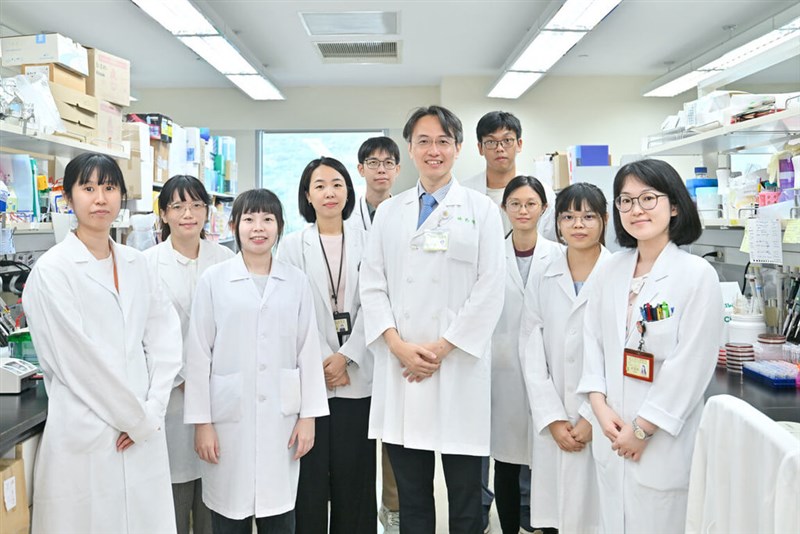
Taipei, Oct. 28 (CNA) Researchers at Taipei Veterans General Hospital (Taipei VGH) and National Yang Ming Chiao Tung University (NYCU) have highlighted their discovery of a novel drug-resistant strain of Klebsiella pneumoniae in Taiwan.
The finding, based on patient cases from 2021 and published in the U.S. Centers for Disease Control and Prevention's peer-reviewed journal Emerging Infectious Diseases in June 2026, was detailed in a press release by NYCU on Tuesday.
It documented Taiwan's first clinical cases of Klebsiella pneumoniae carrying a newly identified mutation linked to resistance to multiple antibiotics.
According to the NYCU press release, the study was conducted by a joint Taipei VGH-NYCU team in collaboration with Chen Liang (陳亮), a professor at the University at Buffalo, State University of New York.
The bacteria were isolated from urine and sputum samples of two hospitalized COVID-19 patients at Taipei VGH in 2021, both of whom received antibiotic treatment under standard and contact isolation care.
After years of effort, researchers found and confirmed that the strain contained a new mutation, featuring the insertion of four amino acids, tyrosine, arginine, isoleucine, and threonine, or "YRIT," in penicillin-binding protein 3 (PBP3).
PBP3 is often the target that antibiotics attack to kill bacteria, but the study found that the mutation, resulting in the YRIT insertion, changed the protein's structure and prevented antibiotics from binding to it.
That meant that different classes of antibiotics, such as penicillins, cephalosporins, and monobactams, were less effective in treating the bacteria, though the patients involved did recover, according to NYCU.
Though the results were based on the cases of patients in 2021, it took several years of research and tests and considerable resources to obtain the findings, which is why they were not published until this year, said Lin Yi-tsung (林邑璁), who led the study and serves as a professor at NYCU's Institute of Emergency and Critical Care Medicine.
Lin said the finding suggested that a resistance mechanism previously seen mainly in E. coli could jump across bacterial species and provided a reference for physicians whose patients with Klebsiella pneumoniae or other bacteria may not be responding to antibiotics.
The study also underscored the need for continued genomic surveillance, the development of new therapies and stronger infection control measures to combat highly drug-resistant bacteria, Lin said.
The press statement warned that the strain belonged to a high-transmission risk lineage already carrying multiple antibiotic-resistance genes.
It said that laboratory simulations showed that if it acquired additional mutations or another enzyme capable of breaking down broad-spectrum antibiotics, it could evolve into a nearly untreatable "superbug" with global public health implications.
Klebsiella pneumoniae is a common hospital-acquired pathogen that can cause pneumonia and urinary tract infections, and is listed by the World Health Organization (WHO) as a priority pathogen because of its growing antimicrobial resistance.
- Politics
Lai warns of China election interference; Cheng urges supporters to vote
10/28/2026 08:26 PM - Society
Taipei teacher indicted for sexually assaulting 38 students
10/28/2026 08:13 PM - Culture
Cheng Ming-chin, Taiwanese children's book pioneer, dies at 95
10/28/2026 07:47 PM - Culture
Kaohsiung announces traffic controls ahead of Fujii Kaze concert Saturday
10/28/2026 07:13 PM - Business
Taiwan's AerosoarX collaborates with U.S. firms on AI drones
10/28/2026 06:52 PM
