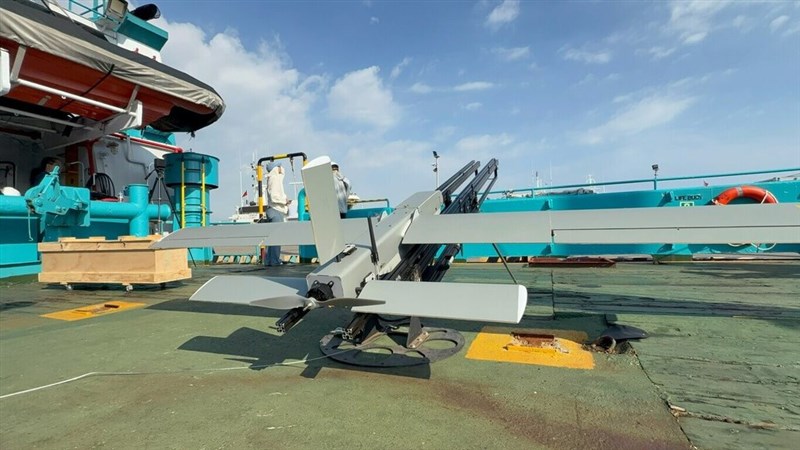
Taipei, Oct. 26 (CNA) The Ocean Affairs Council (OAC) said Monday it is funding a university team to develop an intelligent system that coordinates different types of drones to provide wide-area coverage and continuous monitoring, as part of efforts to strengthen maritime defense.
The system is expected to improve maritime defense and search-and-rescue operations through coordinated flights, while also helping make society more resilient, the OAC said in a news release.
The team, led by Chueh Chih-che (闕志哲), an associate professor in National Cheng Kung University's (NCKU) Department of Aeronautics and Astronautics, is combining artificial intelligence, flight dynamics and coordinated swarm control with fixed-wing drones capable of vertical takeoff and landing to develop the system.
The NCKU team has completed synchronized flight simulations involving two groups of drones, 20 in total, the council said. To prevent collisions, the system's control algorithm uses 3D distance measurements and maintains a minimum vertical separation of 100 feet (about 30 meters).
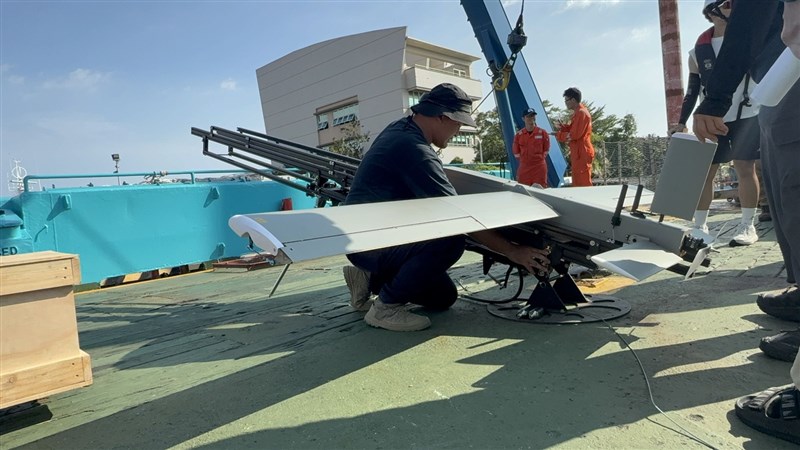
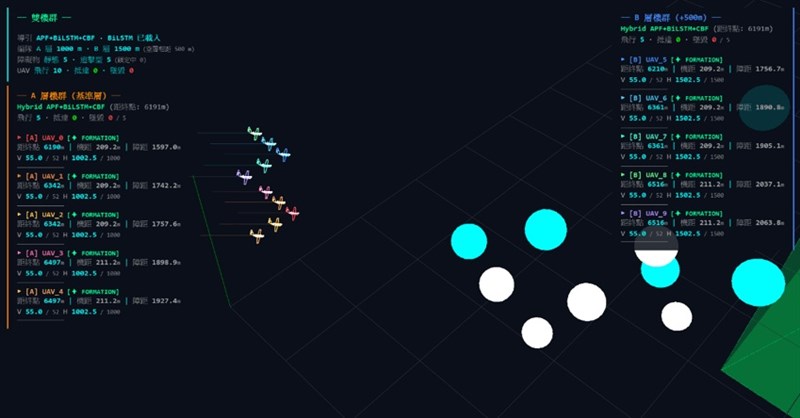
The team will next conduct hardware-in-the-loop testing, prototype integration and real-world flight tests to assess the system's reliability in different sea conditions, the council added.
The system uses multi-agent reinforcement learning to enable drones to coordinate tasks and plan routes autonomously. It also incorporates formation control and obstacle-avoidance technology to help the drones adapt to changing conditions and operate safely during maritime patrols, the OAC said.
The project focuses on three drone models: the JUMP 20, V-BAT and Flexrotor. Using 3D modeling, aerodynamic analysis and six-degrees-of-freedom flight simulations, the team will develop flight and control models for each, laying the groundwork for autonomous navigation and coordinated operations.
Drones have evolved from single-aircraft operations to coordinated missions involving multiple aircraft, underscoring their growing role in maritime security, the OAC said.
- Politics
Lai warns of China election interference; Cheng urges supporters to vote
10/28/2026 08:26 PM - Society
Taipei teacher indicted for sexually assaulting 38 students
10/28/2026 08:13 PM - Culture
Cheng Ming-chin, Taiwanese children's book pioneer, dies at 95
10/28/2026 07:47 PM - Culture
Kaohsiung announces traffic controls ahead of Fujii Kaze concert Saturday
10/28/2026 07:13 PM - Business
Taiwan's AerosoarX collaborates with U.S. firms on AI drones
10/28/2026 06:52 PM
