Archive for the ‘Uncategorized’ Category

Tuesday, September 8th, 2026

RefPack074: Norwegian Cartooning, 50s Commercials, Polish Animation and Disney’s Wildest Animator

Every month, Animation Resources shares an amazing Reference Pack with its members. These carefully curated collections consist of e-books packed with high resolution scans video downloads of rare animated films set up for still frame study, as well as podcasts and documentaries— all designed to help you become a better artist. Members will have 30 days to download the current batch of treasures from the Animation Archive A new RefPack will be posted at the beginning of the next month. Bookmark the Members Only Page and remember to check back every month, because when the new month starts, the old downloads go POOF!


MEMBERS LOGIN To Download

JOIN TODAY To Access Members Only Content


REFPACK074: July 2026

PDF E-BOOK
Blaeksprutten

Blaeksprutten (Cuttlefish)
Download Page
1912-1913 Christmas Annuals
Download this article

The Scandinavian countries (Denmark, Sweden, Norway, Finland, & Iceland) have contributed many traditions to the celebration of Christmas around the world: Christmas trees, elves, reindeer, advent calendars, and even Santa Claus. But one of the most unique holiday traditions in Scandinavian countries is the "Christmas book flood". Catalogs are distributed of special books and magazines, and people order them as gifts for friends and family. More books are sold in this part of the world between November and December than the rest of the year. Scandinavians are among the most literate people in the world. Amazingly, 1 in 10 Icelandic residents is a published author. The holiday tradition of giving books as holiday gifts is so ubiquitous, Scandinavians don’t even recognize it as a tradition. They assume all countries buy special books for Christmas.

In addition to books, Norwegian publishers put out annual Christmas magazines, the earliest of which date back to the mid 19th century. These early annuals featured sheet music, stories, humorous cartoons, satirical gossip about local public figures and recipes, and they were usually presented in a horizontal format to set them apart from monthly and weekly periodicals.

Blaeksprutten

In Copenhagen, a satirical Christmas annual magazine called Blaeksprutten was launched in 1889. The title translates to Cuttlefish, and the idea was that the writers and artists who worked for the magazine had their "tentacles" in all aspects of life in Denmark. The magazine blended both the tradition of the Christmas annual and the satirical magazines flourishing around the world at the time. Beautifully printed, the magazine featured catty theater reviews, humorous stories and poems, and sentimental music; and it was illustrated with panoramic "birds eye view" shots of Danish villages bustling with life, fanciful subjects in lavish color, caricatures and line drawings in ink. The principle artists in the beginning of the 20th century were Alfred Schmidt, a well known caricaturist and poster designer; painters Paul Gustav Fischer and Axel Nygaard; line artists Sven Brasch and Gerda Ploug Sorenson Sarp; and fashion illustrator Gerda Wegener. Blaeksprutten is still being published every Christmas after 125 years.

This publication is pretty much unknown in the United States, but Animation Resources has been working to collect a sampling of these hard-to-find magazines to share with its members. We hope you find it useful to your in your studies.


MEMBERS LOGIN To Download

JOIN TODAY To Access Members Only Content


DVD QUALITY VIDEO:
Download Page
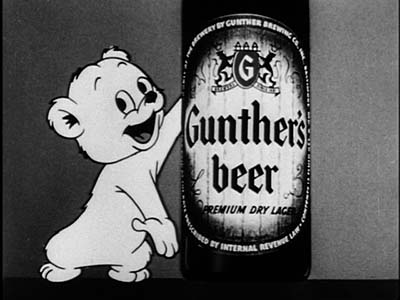
Beer Commercial Reel

Beer and Automotive Commercial Reels
Download Page
Paul Fennell Studios (ca. mid 1950s)

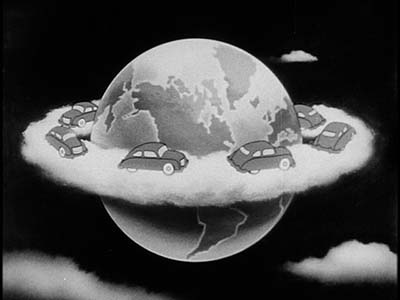
As our members already know, the Paul Fennell Studio was a pioneer in animated television advertising. This time, we are featuring two commercial reels from the mid 1950s. The first reel deals with automotive products- tires, gasoline, motor oil… The Shell gasoline commercial designed by Ed Benedict is a real standout with infectious music and animation. Spots like this certainly wouldn’t get tiresome upon repeated viewings. If you compare the Shell Motor Oil spot to our earlier reel of 1940 theatrical commercials, you will see how Fennell repeated and updated certain concepts from his earliest advertising cartoons.
Download Page
Automotive Commercial Reel

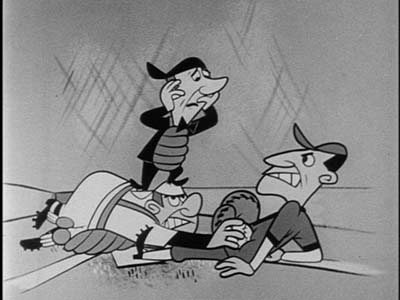
The beer commercial reel includes several commercials each for Gunther’s, Valley Forge, Ram’s Head, and Schaefer Beer. The distinctive designs of Ed Benedict and jazzy musical accompaniment give these spots a very modern feel. They must have seemed unique among contemporary television advertising. It’s interesting to note that the earliest commercials for Gunther’s feature a typical cartoon bear, while the later more modern looking spots all have sports themes. The crew at Fennell was honing in on their target audience to create more effective advertisements.
Download Page
Automotive Commercial Reel

Because of the ephemeral nature of commercials from the early days of television, these prints may be the last surviving copies of these films in existence. Animation Resources thanks the family of Paul Fennell for sharing these with us.


MEMBERS LOGIN To Download

JOIN TODAY To Access Members Only Content


Polish Animation

A Collection of Polish Animation
Download Page
"Dumpling" Lucjan Dembinski (1959) / "Beyond The Wood, Beyond The Forest" Wladyslaw Nehrebecki (1961) / "The Little Quartet" Edward Sturlis (1965) / "A Little Western" Witold Giersz (1960)
Download this article

In one of our previous Reference Packs, we discussed how The Wan Brothers’ "Havok In Heaven" perfectly adapted the format of the animated feature to reflect the art and culture of China. This time we are presenting a couple of films that show how film makers halfway around the globe used animation to reflect a distinctly Polish point of view.

Polish Wycininki
Wycinanki: The art of paper cutting

Tell A FriendTell A FriendLucjan Dembinski’s "Dumpling" and Wladyslaw Nehrebecki’s "Beyond The Wood, Beyond the Forest" both are styled after traditional Polish folk art.

The folk art form known as wycinanki (pronounced vee-chee-non-kee) originated in the Ukraine at the end of the 15th century. Shepherds would cut designs out of bark and leather, and artists would paint colorful floral patterns on furniture, beams and walls of homes. The art of wycinanki paper-cutting for holidays became very popular in the mid-1800s, and regional styles developed. The tradition still continues with skilled artisans competing to create the most beautiful patterns.

Polish Animation

Wladyslaw Nehrebecki, who is best known for the television series "Bolek and Lolek", became interested in the peasant art of his native Poland, and teamed up with a Polish folk art museum to adapt the designs to animation using paper cut outs. The result was "Beyond The Woods, Beyond The Forest". Beautifully composed using a wide screen format, the bright colors and simple shapes are skillfully animated, essentially bringing wycinanki to life. Puppet animator Lucjan Dembinski also mined this rich well of inspiration with a film called "Dumpling" that translated wycinanki designs into three dimensional stop motion animation.

Hopper's Nighthawks

Too often we take culture for granted. As film makers, we look to other films for inspiration instead of seeing the creativity that surrounds us. Obviously in the United States, we don’t have anything like wycinanki, but that doesn’t mean that we can’t draw on our culture for inspiration. Roy Lichtenstein saw comic books as fine art, Andy Warhol painted Campbells soup cans and Edward Hopper created an incredibly powerful image of a diner in the city late at night. Who’s to say that modern highway interchanges, television, neon signs, computer screens or billboards aren’t American equivalents of cultural folk art. As you watch these films, think about the unappreciated man-made beauty that exists in the place you live and try to incorporate that into your work. I guarantee you it will be a lot more engaging and interesting than recycling the same old tired animation tropes and done-to-death styles.


MEMBERS LOGIN To Download

JOIN TODAY To Access Members Only Content


Polish Animation

In RefPack 032, we shared a simple film called "Beach" that Edward Sturlis made in 1964. The following year, he made a fantastic puppet film called "The Little Quartet". It’s interesting that Sturlis moved so effortlessly from hand drawn animation to stop motion. He must have seen himself as an animator, not a person who just draws or makes puppets. The two skills might be different from a technical standpoint, but the principles of creating personality and displaying it through timing and movement are the same. A lot of current animators define themselves as 2D or CG or Stop-Mo, but an animator is an animator. Sturlis proves it. As you watch this film check out the wonderful musical timing and expressive posing. It’s pure genius.

Edward Sturlis
Edward Sturlis at work in his studio

Witold Giersz is a towering figure in Polish animation. He pioneered the art form in Poland as early as 1950 and went on to produce fifty films. Michael Sporn’s "Splog" has a great interview with Giersz that you really should make a point of reading. That blog post will give you a sense of his work and biography. But I would like to focus on a specific aspect of his technique here…

Polish Animation
"Rooty Toot Toot" / John Hubley / UPA (1951)

In the past decade or so, there has been renewed interest in "modern animation". Books have been written on artists like Mary Blair and studios like UPA. Highly stylized animation is de rigueur for title sequences of CGI features, often looking more expressive and appealing than the film itself. Television animation and internet cartoons are produced with programs like Flash using libraries of modular virtual puppets designed with the flair of the 1950s cartoons and early 60s TV animation. But even though it’s nicely designed and colored, modern stylized animation always seems to look flat compared to films like Rooty Toot Toot and even some of the television commercial reels Animation Resources has shared here in the past. Why is that?

Polish Animation

If you analyze Witold Giersz’s film "A Little Western" you will spot the missing element. The film looks deceptively simple— flat featureless shapes, abstract textured blobs for backgrounds, simple bold primary colors. But behind that simple surface, there is a magic trick being performed.

Still frame through a few scenes and you will see simple, elegant flat shapes. Play it in motion and those flat shapes turn into solid volumetric forms. How can it be two dimensional and three dimensional at the same time? The secret is the fourth dimension of time and space. Ward Kimball once said that the art of animation doesn’t exist in individual drawings. The art is in the differences between the drawings. The way those flat shapes change from one to another is the secret that gives it form. Look at Grim Natwick’s animation of the courtroom scene in "Rooty Toot Toot" for another brilliant example of fourth dimensional animation. The characters exist as two dimensional shapes which reveal their three dimensional volume only when they move. Think about that as you watch "A Little Western".


MEMBERS LOGIN To Download

JOIN TODAY To Access Members Only Content


ANALYSIS:
Breakdowns

John Sibley
Download Page
Curated By David Eisman
Download this article

In the past two articles, we broke down the works of Soviet-era filmmakers like József Gémes and Vaclav Mergl. Now, we are returning to the Golden Age of American animation to analyze the techniques of one of the best of the Disney masters, and perhaps the greatest Goofy animator of them all: John Sibley. So much can be said about Sibley. He took Art Babbitt’s loose-limbed but uniform ambles, and introduced a controlled chaos through extreme lines of action and exaggerated squash and stretch. Sibley’s Goofy feels like a rag doll, pushed and pulled by physics.

Sibley was a master of many formal and informal principles: momentum, weight, overshoots, the wave principle, and appeal, just to name a few. Obviously, it would be impossible to tackle every single one of Sibley’s techniques in this singular article. Therefore, we will take a more specific approach to this analysis. First, we will break down Sibley’s use of the wave principle and transformation of s-curves and c-curves in How to Ride a Horse (1950) and How to Play Baseball (1942). Then, we’ll compare Sibley’s Goofy in How to Be a Sailor (1944) to his feature animation of Lackey in Sleeping Beauty (1959), specifically how Sibley animates footwork and maintains clarity during complex movements.


MEMBERS LOGIN To Download

JOIN TODAY To Access Members Only Content


VIDEO PODCAST:
Animated Discussions Podcast

Alexandru Curilov Interview
Download Page
Animated Discussions 017 / Hosted by Davey Jarrell with Alexandru Curilov

NewNewAlexandru Curilov has worked in animation, filmmaking, gaming, advertising, brand design, and web design for over 20 years in Slovenia. He founded an organization in 2025 called The Toon Room, a network that brings together animators from all over the world. Listen to Alexandru talk all about his creative influences and hopes for the future of animation in the latest episode of Animated Discussions!


MEMBERS LOGIN To Download

JOIN TODAY To Access Members Only Content


Whew! That is an amazing collection of treasures! The most important information isn’t what you already know… It’s the information you should know about, but don’t know yet. We bring that to you every other month.

THIS IS JUST THE TIP OF THE ICEBERG!

Animation Resources has been sharing treasures from the Animation Archive with its members for over a decade. Every month, our members get access to a downloadable Reference Pack, full of information, inspiration and animation. The RefPacks consist of e-books jam packed with high resolution scans of great art, still framable animated films from around the world, documentaries, podcasts, seminars and MORE! The best part is that all of this material has been selected and curated by our Board of professionals to aid you in your self study. Our goal is to help you be a greater artist. Why wouldn’t you want to be a member of a group like that?

Membership comes in two levels. General Members get access to a bi-monthly Reference Pack as well as a Bonus RefPack from past offerings in the in-between months. We offer a discounted Student Membership for full time students and educators.


JOIN TODAY!
https://animationresources.org/membership/levels/

FREE SAMPLES!

Not Convinced Yet? Check out this SAMPLE REFERENCE PACK! It will give you a taste of what Animation Resources members get to download every other month! That’s 560 pages of great high resolution images and nearly an hour of rare animation available to everyone to download for FREE! https://animationresources.org/join-us-sample-reference-pack/
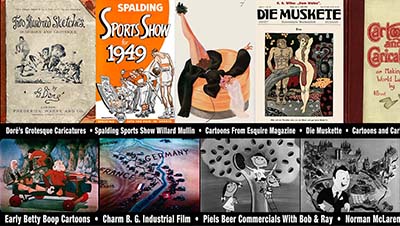

Sample RefPack

PayPalAnimationAnimation Resources depends on your contributions to support its projects. Even if you can’t afford to join our group right now, please click the button below to donate whatever you can afford using PayPal.


FacebooktwitterredditpinterestlinkedinmailFacebooktwitterredditpinterestlinkedinmailby feather

Monday, July 13th, 2026

RefPack073: Musical Timing Deconstructed, Rare Golden Age Films and Commercials and Incredible Industrials!

Reference Pack


Download RefPack073 Review
Every month, Animation Resources shares an amazing Reference Pack with its members. These carefully curated collections consist of e-books packed with high resolution scans video downloads of rare animated films set up for still frame study, as well as podcasts and documentaries— all designed to help you become a better artist. Members will have 30 days to download the current batch of treasures from the Animation Archive A new RefPack will be posted at the beginning of the next month. Bookmark the Members Only Page and remember to check back every month, because when the new month starts, the old downloads go POOF!


MEMBERS LOGIN To Download

JOIN TODAY To Access Members Only Content


REFPACK073: July 2026

PDF E-BOOK / HD Video / Podcast
Chuck Jones Bar Sheets

Chuck Jones Bar Sheets
Download Page
“How The Grinch Stole Christmas” (1966)
Download this article

Animation Resources is proud to share with its members our most ambitious project to date— an e-book, video and podcast detailing the timing techniques used to make the Chuck Jones television special “How The Grinch Stole Christmas”. Chuck Jones was a master at controlling the pacing of the action for every single frame of his films. The method of timing cartoons in the golden age of animation is nothing like the way it is done today. We think you will learn a lot from this research, and perhaps discover some techniques to improve the timing of your own projects.

Chuck Jones Bar Sheets

This overview of the process of musical timing takes the form of an e-book with Chuck Jones’ entire timing plan for "How The Grinch Stole Christmas", along with a video showing Jones’ notes alongside the corresponding scene in the film, and a podcast discussing the nuts and bolts. This project is our most requested download. Grab it while you can. We understand that it is dense and complicated. It may not all sink in at first. But peruse it at your leisure and try to figure it out. It may help you in timing your own scenes.


MEMBERS LOGIN To Download

JOIN TODAY To Access Members Only Content


DVD QUALITY VIDEO:
Download Page
Campbells Soup Commercial Reel

Campbells Soup Commercial Reel
Download Page
Paul Fennell Studios (ca. mid-1950s)

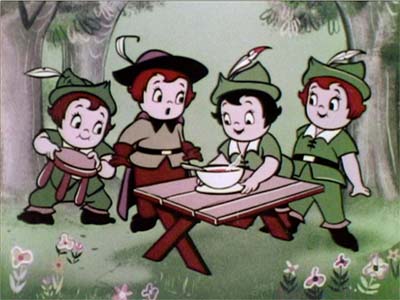
We continue our series of commercial reels from the Paul Fennell Studios with another great reel of commercials from the early days of television. This batch features the Campbells Kids in a variety of themes from old West to pirates to Pilgrims. ey were directed by Paul Fennell and designed by Ed Benedict in the mid-1950s. At the end of the reel is a surprise- a full color Campbells Soup commercial that may very likely be the first color animated television commercial ever aired. The first color TV broadcast was in 1951, but the technology didn’t become prevalent until the early 1960s. Throughout the 1950s, broadcasters dabbled in color but in October of 1954, the anthology program "Ford Theater" became the first series to air in color. My educated guess is that the color Campbells commercial was produced to air with that series. These rare commercials have not been seen since they originally aired, and we thank the family of Paul Fennell for sharing them with us.


MEMBERS LOGIN To Download

JOIN TODAY To Access Members Only Content


Gran'Pop Monkey Cartoons

Gran’Pop Monkey Cartoons
Download Page
Cartoon Films Ltd. (1940)

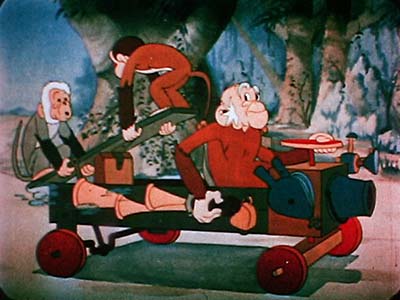
When Ub Iwerks decided to end his contract with Columbia Pictures and turn the reins of his studio over to Paul Fennell, there was initially a scramble to drum up work to keep the studio afloat. The result of this effort was the creation of three of the rarest and most obscure cartoons in the history of the studio… "A Busy Day", "Baby Checkers" and "Beauty Shoppe". The films were based on the popular monkey illustrations by Lawson Wood that adorned magazine covers and calendars in both the US and the UK, and were part of a brief period where the newly renamed Cartoon Films Ltd. had co-production deals with producers in Britain. Iwerks had decided to return to Disney, so it’s likely that he had no hand in these films- Fennell took on the directors’ duties. These three shorts were mentioned in trade magazines at the time, but for many years they were thought to be lost. Animation Resources Advisory Board member, Steve Stanchfield discovered several fragments of prints, in both two color and B&W and reconstructed the complete cartoons from the fragments. Because of the ephemeral nature of these films, these prints may be the last surviving copies of these films in existence. Animation Resources thanks Steve Stanchfield for sharing these with us.


MEMBERS LOGIN To Download

JOIN TODAY To Access Members Only Content


Sidetrips

Inspiration for animated films doesn’t just come from other animated films. A lot can be gained from exposing yourself to music, dance, live action cinema and fine art. Even architecture can be a useful area to study. Occasionally, we will share interdisciplinary inspiration here in the Side Trips section.

SD VIDEO:
Charles and Ray Eames

Ray & Charles Eames
Download Page
Babbages (1967) / Nicholas Copernicus (1973) / World Of Franklin & Jefferson (1976) / The Black Ships (1989) / Kaleidoscope Jazz Chair (1989) / Expanding Airports (1958) / Fiberglas Chairs (1970) / Fisheries & Aquarium (2004)/ S73 (1958) / Design Q & A (1972)
Download this article

The foundation of modern design as we know it can be attributed in large part to the work of Ray and Charles Eames. Together, the husband and wife duo pioneered techniques in architecture and design, influenced educational and industrial filmmaking, and set a new standard for corporate and civic presentation in the burgeoning information age. Their philosophy was one of function defining form and the power of an image to simply convey complex information. The meticulous craftsmanship behind the designs remained transparent— they convey their concepts effortlessly. This manipulation of ideas through pure visuals led to contracts with the US military, the State Department, and some of the biggest corporations of the mid 20th century.

Charles and Ray Eames

HISTORICAL FILMS

The historical films by Ray and Charles Eames are adept at making the past seem alive. They contain evocative imagery that allows the audience to immediately grasp not just the concept but the feel of the times. Charles Eames avoided using a script whenever he could, allowing the visuals to speak for themselves. Their goal was not to plainly reiterate the facts of history, but to transform it into a visual narrative.

The magnum opus in this historical collection is the retrospective, "The World of Franklin and Jefferson" (1976). Created in conjunction with a massive exhibition at the Museum of Modern Art for the country’s 200th anniversary and sponsored by IBM, this film and the others we share here laid the foundation for historical museum presentations that are still in use today, offering a depth that is both thought-provoking and intelligent.

Charles and Ray Eames

DESIGN PROJECTS

Like the military contracts funding their furniture design during World War II, these design project films were sponsored by corporate and civic entities. The exercise of putting across information visually allowed Ray and Charles Eames to innovate on what an educational film should be. We include films for the Herman Miller company featuring a step-by-step creation of a fiberglass chair and a showcase of how design can be interpreted from manufacturer to consumer with an early take on at home furniture construction, like Ikea. Additionally, this section includes architectural reports for both Washington International Airport and the National Fisheries Center and Aquarium in D.C., as well as an interview regarding design with Charles Eames himself.

Due to the function of these reports, the films needed to have a precisely clear message. Where these films stand out from other corporate work of the time is the profound sense of design and acuity through which the imagery is conveyed. Mixed media is used throughout these reports, with static pictures, scale models, flat informational graphs, and captured footage all combining to create a visually engaging product, visualizing the project for the Eames’ corporate sponsors.
Charles and Ray Eames
We hope this look at the influential design work of Ray and Charles Eames inspires you to think about ways to impart information visually to clearly express the ideas operating beneath the surface of mere data points.


MEMBERS LOGIN To Download

JOIN TODAY To Access Members Only Content


Whew! That is an amazing collection of treasures! The most important information isn’t what you already know… It’s the information you should know about, but don’t know yet. We bring that to you every other month.

THIS IS JUST THE TIP OF THE ICEBERG!

Animation Resources has been sharing treasures from the Animation Archive with its members for over a decade. Every month, our members get access to a downloadable Reference Pack, full of information, inspiration and animation. The RefPacks consist of e-books jam packed with high resolution scans of great art, still framable animated films from around the world, documentaries, podcasts, seminars and MORE! The best part is that all of this material has been selected and curated by our Board of professionals to aid you in your self study. Our goal is to help you be a greater artist. Why wouldn’t you want to be a member of a group like that?

Membership comes in two levels. General Members get access to a bi-monthly Reference Pack as well as a Bonus RefPack from past offerings in the in-between months. We offer a discounted Student Membership for full time students and educators.


JOIN TODAY!
https://animationresources.org/membership/levels/

FREE SAMPLES!

Not Convinced Yet? Check out this SAMPLE REFERENCE PACK! It will give you a taste of what Animation Resources members get to download every other month! That’s 560 pages of great high resolution images and nearly an hour of rare animation available to everyone to download for FREE! https://animationresources.org/join-us-sample-reference-pack/

Sample RefPack

PayPalAnimationAnimation Resources depends on your contributions to support its projects. Even if you can’t afford to join our group right now, please click the button below to donate whatever you can afford using PayPal.


FacebooktwitterredditpinterestlinkedinmailFacebooktwitterredditpinterestlinkedinmailby feather

Thursday, June 11th, 2026

RefPack072: Iron Curtain Cartooning, Mid-Century Design, A Mysterious Technique and MORE!

Reference Pack

Download RefPack072 Review

Every month, Animation Resources shares an amazing Reference Pack with its members. These carefully curated collections consist of e-books packed with high resolution scans video downloads of rare animated films set up for still frame study, as well as podcasts and documentaries— all designed to help you become a better artist. Members will have 30 days to download the current batch of treasures from the Animation Archive A new RefPack will be posted at the beginning of the next month. Bookmark the Members Only Page and remember to check back every month, because when the new month starts, the old downloads go POOF!


MEMBERS LOGIN To Download

JOIN TODAY To Access Members Only Content


REFPACK072: June 2026

PDF E-BOOK:
Eulenspiegel

Eulenspiegel Volume One
Download Page
July 1st to November 2nd, 1963
Download this article

After the Second World War, satirical caricature magazines experienced a rapid decline. The general public in the post-war years wasn’t as receptive to radical politics and muckraking as they were before the war. One by one, satirical magazines around the world were replaced by illustrated current events magazines like Life, Look, The Illustrated London News and L’Illustration (see our previous e-book on the L’Illustration Christmas annuals for information on the rise of photo magazines.) Political cartooning migrated to the editorial page in the newspaper, and humor cartooning in magazines focused on social subjects in single panel gag cartoons. Harvey Kurtzman created Mad as a comic book, but soon the comic shifted to the satirical magazine format. Instead of lampooning political figures and Kings like the satirical magazines of the past, Mad Magazine made fun of TV stars and suburban lifestyles.

However, behind the Iron Curtain, satirical magazines didn’t disappear after World War II, in fact, they flourished for a time. Chief among these magazines was Krokodil. It was launched a few years after the Russian Revolution. Political satire in the Soviet Union was a dangerous thing, but Krokodil was given a wide berth to lampoon the inefficiency and lack of initiative of mid level bureaucrats and the sloppiness of labor workers.

Die Muskete Frischer Wind (Fresh Breeze) was one of the last satirical caricature magazines to be established, beginning in 1946. It was the only humor magazine in East Germany, and it was retitled after the legendary prankster Eulenspiegel in 1954. Only three East German magazines survived after the Berlin Wall fell, and Eulenspiegel was one of them. It continues to be published to this day. Punch ceased publication in 1991 after more than a century and a half in print, Krokodil closed its doors in 2008, Mad Magazine recently announced that they were ending their print magazine. It may well be that Eulenspiegel is the last of the classic satirical humor magazines still in circulation.

We know very little about the artists who drew for Eulenspiegel. If you have any information on them, please let us know so we can add it to our database. Animation Resources was fortunate to Find a batch of these rarely seen magazines in a bookshop in Hungary and had them shipped to us in the United States for digitization. We hope you find them useful.


MEMBERS LOGIN To Download

JOIN TODAY To Access Members Only Content


Sidetrips

Inspiration for animated films doesn’t just come from other animated films. A lot can be gained from exposing yourself to music, dance, live action cinema and fine art. Even architecture can be a useful area to study. Occasionally, we will share interdisciplinary inspiration here in the Side Trips section.

SD VIDEO:
Charles and Ray Eames

Ray & Charles Eames
Download Page
The Architect And The Painter (2011) / An Eames Celebration (2011) / Parade (1952) / Solar Powered Do Nothing Machine (1958) / Bread (1958) /Powers Of Ten (1977) / Toccata For Toy Trains (1989)
Download this article

The foundation of modern design as we know it can be attributed in large part to the work of Ray and Charles Eames. Together, the husband and wife duo pioneered techniques in architecture and design, influenced educational and industrial filmmaking, and set a new standard for corporate and civic presentation in the burgeoning information age. Their philosophy was one of function defining form and the power of an image to simply convey complex information. The meticulous craftsmanship behind the designs remained transparent— they convey their concepts effortlessly. This manipulation of ideas through pure visuals led to contracts with the US military, the State Department, and some of the biggest corporations of the mid 20th century.

Charles and Ray Eames

In 1939, Charles Eames became the new head of the Industrial Design Department at the Cranbrook Academy of Art, based on a fellowship offered by the Finnish designer Eliel Saarinen who was president of the school at the time. Charles collaborated with Eliel’s son, Eero Saarinen, on a number of projects before entering the Organic Design in Home Furnishings competition hosted by the Museum of Modern Art in New York City. Ray Kaiser, an abstract painter who had studied under Hans Hofmann and was a key figure in the New York abstract art scene, contributed design drawings to Charles and Eero’s project while studying at Cranbrook. Their relationship blossomed, and in 1941, they settled in Los Angeles as Ray and Charles Eames, partners in both design and life.

Charles and Ray Eames

The most notable of the films in this catalog is "Powers of Ten" (1977). Commissioned by IBM for public release after a 1968 version was installed in the Smithsonian’s National Air and Space Museum, the film begins with an overhead shot of picnickers on the Chicago lakefront, with measurements being represented by simple squares. The camera slowly zooms out from a one-meter square to show a distance of 10 meters, and then a distance of 100 meters, increasing in distance by powers of 10 until we see the universe on a cosmic scale. We then return to the picnic at a rate of two seconds per power of ten. The speed at which the Eames relay this content was revolutionary, as our modern understanding of how quickly an audience can process imagery and ideas was not yet fully known or tested in film.

Charles and Ray Eames

At their core, each of the films produced by Ray and Charles Eames showcases the basic essence of what film is all about. Whether through stop-motion or film photography, every shot is carefully crafted and designed with captivating visuals centered around a single idea. The strength of these films lies in their simplicity, conveying a message that is easily understood by all who watch. What makes these shorts unique compared to the others in our Eames catalog is that, aside from "Powers of Ten", each of these films was a personal project by Ray and Charles, bringing to life what brought them joy, such as toys or the circus. You will see Ray’s keen color sensibility, combined with Charles’s expertise in manipulating ideas, which heavily influenced the shot design.

Charles and Ray Eames

Today, we are sharing the definitive documentary on Ray and Charles Eames, "The Architect And The Panter" (2011), the short film, "An Eames Celebration" and a handful of their live-action films. In future Reference Packs, we will feature more of the Eames’ most important films.


MEMBERS LOGIN To Download

JOIN TODAY To Access Members Only Content


Breakdowns

One of the most popular features of Animation Resources’ social media accounts is our breakdown clips. Animation Resources board member, David Eisman shares a handful of them in each Reference Pack, along with analysis of what you can learn from still framing through the animation.

ANALYSIS:
Breakdowns

Josef Gemes: Heroic Times
Download Page
Curated By David Eisman
Download this article

When I first set out to write this article, it was meant to be an examination of the filmography of Hungarian animator Jozsef Gemes. However, while immersed in my initial research phase, I found myself continuously coming back to his most well known work "Heroic Times" (1983). Not for lack of trying, I have been completely unable to determine exactly how this film was made. All the "evidence" as to the exact nature of its production is contradictory and unreliable. Some sources claim the entire film was composed of tens of thousands of oil paintings individually photographed and then stitched together in film. Others say it’s a combination of different techniques: cel animation, hand painted backgrounds, and oil on glass, all staged under a multiplane camera. IMDB claims in its Trivia section that the film was made by ten artists over ten years, culminating in 600 backgrounds and 30,000 painted cels. Still, I am unable to find a reliable source to confirm this.

Maybe somewhere out there there is an interview with Jozsef Gemes lost to Soviet History, or warehoused in some hidden corner of the internet, untranslated from its native Hungarian. Whatever the case, I am left at a loss for absolutes. I do not know entirely how each of the following four breakdowns were made. As such, this article will be an attempt to unravel a mystery and provide a lesson on efficiency in animation.


MEMBERS LOGIN To Download

JOIN TODAY To Access Members Only Content


Whew! That is an amazing collection of treasures! The most important information isn’t what you already know… It’s the information you should know about, but don’t know yet. We bring that to you every other month.

THIS IS JUST THE TIP OF THE ICEBERG!

Animation Resources has been sharing treasures from the Animation Archive with its members for over a decade. Every month, our members get access to a downloadable Reference Pack, full of information, inspiration and animation. The RefPacks consist of e-books jam packed with high resolution scans of great art, still framable animated films from around the world, documentaries, podcasts, seminars and MORE! The best part is that all of this material has been selected and curated by our Board of professionals to aid you in your self study. Our goal is to help you be a greater artist. Why wouldn’t you want to be a member of a group like that?

Membership comes in two levels. General Members get access to a bi-monthly Reference Pack as well as a Bonus RefPack from past offerings in the in-between months. We offer a discounted Student Membership for full time students and educators.


JOIN TODAY!
https://animationresources.org/membership/levels/

FREE SAMPLES!

Not Convinced Yet? Check out this SAMPLE REFERENCE PACK! It will give you a taste of what Animation Resources members get to download every other month! That’s 560 pages of great high resolution images and nearly an hour of rare animation available to everyone to download for FREE! https://animationresources.org/join-us-sample-reference-pack/

Sample RefPack

PayPalAnimationAnimation Resources depends on your contributions to support its projects. Even if you can’t afford to join our group right now, please click the button below to donate whatever you can afford using PayPal.


FacebooktwitterredditpinterestlinkedinmailFacebooktwitterredditpinterestlinkedinmailby feather