


Vulture’s critics are tracking the year’s TV highlights across the streaming and broadcast spectrums, from breakout hits to underseen gems and everything in between. Check back each month for the latest additions. Series are organized chronologically by 2026 premiere date, with the most recent at the top.
Furious (Hulu)

The individual parts of Furious do not suggest a show that stands apart from one of television’s most well-worn genres. It has a tired, traumatized detective, one who’s not so different from the serial killer she’s trying to track down, and a criminal conspiracy going all the way to the top. But Furious, created by Liz Meriwether, falls in a compelling place between Netflix’s 2019 cop drama Unbelievable and Prime’s Deadloch: It’s motivated by the corruption, misogyny, and violence that defines women’s lives inside and outside of criminal-justice environments, but it also has enough of a sense of humor and appreciation of the absurd to not slip into abject misery. Emmy Rossum is stellar as FBI agent Alice Black, but the casting shines most in its secondary characters, especially Scoot McNairy as her former partner, Quincy Tyler Bernstine as her FBI mentor, and Steve Way as one of the figures implicated in the show’s criminal web. —KVA
King of the Hill season 15 (Hulu)

Pulling off a successful revival is one kind of achievement. Doing it after a 15-year hiatus is another. But returning for another round and keeping the party going without losing any momentum? That’s rare indeed, and it’s exactly what King of the Hill accomplishes. The ease with which the 15th season continues the aged-up, modern-day, slice-of-life adventures of the Hill family and the residents of Arlen, Texas, is a testament to the sturdy ship showrunner Saladin K. Patterson has built to further the spirit series co-creators Mike Judge and Greg Daniels originated. This season offers plenty to savor: adult Bobby settling comfortably into a relationship with Connie (and then getting into reality-TV-sparked drama); a funny, grounded thread following Peggy as she navigates menopause; and a memorable chicken-related story line that exemplifies the show’s sly, subtle approach to contemporary politics. There is so much about this revived King of the Hill to admire that it’s hard not to feel a little spoiled by the quality of its return. The television establishment seems to recognize that as well with Pamela Adlon getting an Emmy nomination for her performance as Bobby last season; in a just world, she’d be a perennial nominee. Better yet, King of the Hill itself would become a fixture in the Outstanding Animated Program category — or, if we’re really being fair, the Outstanding Comedy Series race. —NQ
The Five Star Weekend (Peacock)

A wonderful thing about Peacock’s adaptation of Elin Hilderbrand’s Nantucket-set beach read is that the stakes are so low, which is meant as a compliment. Plenty of shows about pretty, sad people in gorgeous locales loop in a murder or two to up the ante, but that’s not so for Jennifer Garner’s cooking influencer Hollis Shaw. Her husband has died, and she’s processing her grief by inviting friends from different eras of her life to spend time together, but rest assured you’ll never find out one of them killed him or something. (Sure, we do learn he had an affair, but that’s as high as the tension gets.) Bekah Brunstetter’s thoughtful adaptation rests comfortably at a level of light comedy mixed with genuine emotional processing as Hollis and her friends work their way to personal and sexual awakenings through bickering and group activities. It’s soothing, rendered with detail, and performed by an ace supporting cast, including Regina Hall, D’Arcy Carden, Gemma Chan, and a surprisingly and movingly normcore Chloë Sevigny. Watching this series is like being wrapped in a quality cardigan after a day at the beach. —JM
Little House on the Prairie (Netflix)

Rebecca Sonnenshine’s version of Little House on the Prairie is at fascinating odds with itself. Is it possible to make a show about American optimism and gumption while also being honest about how this country’s history is defined by bloodshed, theft, and ignorance? How do you reconcile the myths this country’s (white) citizens tell with the reality of the (Indigenous) people hurt by those stories? Those questions don’t have tidy answers, but Little House on the Prairie gives it a try with well-developed characters; episodic plots that address the classism and racism at play in Independence, Kansas; and a lovely eye for process-based details, like how to build a log cabin and weave a flower crown. The cast is uniformly great, particularly Alice Halsey as the tomboyish Laura Ingalls; Luke Bracey as the distractingly hot, realizing-his-flaws Pa; and Alyssa Wapanatâhk as the Osage wife and mother White Sun. The series treats its Native characters thoughtfully and honestly depicts the Osage as manipulated and divided. It can’t totally rewrite the American exceptionalism that drove Laura Ingalls Wilder’s books, but it does provide context and perspective that makes Little House on the Prairie more deliberate viewing for our age. — RH
The Bear season five (FX)

The final season of The Bear is everything great about the show and everything frustrating about it all wrapped into one compact single-shift structure, but thankfully, the dials are mostly turned in the right direction. The tightly wound format allows the end of The Bear to focus on the things it has always done best: kitchen crises, teamwork, artistry forced up against irreducible physical constraints, and its central cast of characters all working together in one tiny building. Episode seven, when it all comes together in one exhausting dinner service, is among the best the show has ever made. It renders the finale largely extraneous, but it’s nice to see the show figure out how to finally (mostly!) land the plane. —KVA
House of the Dragon season three (HBO)

Going into the third season of House of the Dragon, HBO heavily messaged that the show, which had spun its wheels in a wandering second season, would return to grand action. And it did just that with a big opening two-episode arc built around the naval Battle of the Gullet and Rhaenyra’s seizure of the throne in King’s Landing. But beyond the spectacle, the show has also grown punchier and more self-assured in the way it traces the soap-operatic tangle of relationships involved in the Dance of the Dragons. House of the Drogan has made the claim of trying to add texture and complication to the chronicle that is George R.R. Martin’s Fire & Blood, and this season has nailed the tactile, stranger-than-fiction oddness of real history. Some of the funniest comedy on television right now comes from Olivia Cooke’s Alicent attempting to make the best of her experience in captivity (and to credit Cooke’s performance, you never forget her schemes are fueled by dread), while we’re also getting doses of gothic horror via Gayle Rankin’s witchy Alys and a buddy road trip with Tom Glynn-Carney’s Aegon and Matthew Needham’s Larys. Most thrilling of all has been the addition of James Norton’s Ormund Hightower, a scheming religious zealot obsessed with putting his Targaryen ward (Benjamin Evan Ainsworth) on the throne. Norton’s big bad is terrifying, hilarious, obsessed with perfume, and, as the internet has noted, more than a little like Dennis Reynolds from It’s Always Sunny in Philadelphia. What more could you ask from genre TV? —JM
Sugar season two (Apple TV)

To love Sugar, Apple TV’s neo-noir starring Colin Farrell, is to surrender to one glorious, absurd fact: Its impeccably dressed, sad-eyed, classic-Hollywood-obsessed private investigator is actually an alien, a revelation the series audaciously withheld until deep into its first season. So where do you go after a twist like that? The answer is simple: You give Sugar another case. With Breaking Bad veteran Sam Catlin taking over as showrunner in season two, the series fully leans into its own peculiar identity, and the results are unexpectedly terrific. This time, Sugar is on the search for the missing brother of a rising boxer (Raymond Lee and Jin Ha, respectively), pulling him into a labyrinth of drug trafficking, gang violence, and corrupt cops. He’s aided in his quest by a streetwise hustler, Val (Sasha Calle), whom he recruits as an unlikely partner, and a friendly Fed (Shea Whigham — just fabulous). Freed from the mystery-box obligations of its central twist, Sugar is lighter on its feet and way more pleasurable. At the center of it all is Farrell’s impossibly tender performance as a soulful alien who loves humanity more than we do. The extraterrestrial stuff is still very much there, but the show wears it so naturally that what registers most is how much emotion the series carries — proof that, wildly enough, the twist was so, so worth it. —NQ
The Vampire Lestat (AMC)

It requires gumption to take Interview With the Vampire — acclaimed in its first two seasons for lead actor Jacob Anderson’s performance, the show’s mannered theatricality, and its slow-and-steady pacing — and blow it all up. But the drastically different feel of Anne Rice’s 1985 novel The Vampire Lestat demanded it, and showrunner Rolin Jones and his creative team rose to the challenge of updating the material for a 2026 audience while maintaining the core concepts of their adaptation. There’s no one truth, especially not for vampires who have lived hundreds of years, and the series furthers that approach in this delightfully riotous renamed season. Jones, head writer Hannah Moscovitch, composer Daniel Hart, and the cast led by Sam Reid and Anderson are all just going for it, packing the season with electric musical performances and blissfully petty vampiric bickering. At the same time, it’s a deeply sad season, reminding us of the pervasive loneliness that accompanies immortality. That tonal whiplash is the point, one of the series’s strongest qualities in a season that never eases up in its prodding at how our memories can’t be trusted. — RH
Maximum Pleasure Guaranteed (Apple TV)

Apple’s latest mom thriller is a showcase for Tatiana Maslany, always a treat. She’s especially well deployed here, ping-ponging back and forth between manic flailing in the middle of a criminal conspiracy, frantic attempts to appear normal on the sidelines of an elementary-school soccer game, and ice-cold mediations with her ex-husband, played by Jake Johnson. Mostly, though, Maximum Pleasure Guaranteed stands out for what it avoids rather than what it includes. It dodges the overburdened, sluggish pacing of many hourlong dramas, wisely sticking closer to a half-hour run time and generally keeping things on the rails even in the challenging mid-season section. Even better, it avoids the infuriating thing where thriller protagonists make absurdly shortsighted choices and try to keep even sillier secrets. Maslany’s character, Paula, is too smart to think she can figure things out on her own, and the whole show is better because of it. —KVA
Couples Therapy season five (Showtime)

There’s nothing shocking or new about this season of Couples Therapy. It has not reinvented itself or attempted to shake things up to distinguish this season from its earlier successes. It is still, blessedly, the same straightforward show it’s been nearly from the start: Dr. Orna Guralnik providing insightful, incisive couples therapy to a handful of people who are really struggling in their relationships. If season five has a particular standout quality, it’s the one Guralnik explains to a fellow therapist: The world has become so fraught, and politics especially is so tense, that couples come in closer to the brink, and individuals are more primed to think of their relationships as battlegrounds. That quality does not make things easier for the people seeking therapy this season, but it does help Couples Therapy continue to be the most addictive series on TV. —KVA
Nemesis (Netflix)

A layered, propulsive thriller exemplifying the energy and dynamism that keeps the cops-and-robbers genre so appealing, Nemesis is television’s first great Heat evocation, and one of the best new series Netflix has released this year. Series creator Courtney A. Kemp is a pillar of crime TV, and Nemesis has all the formal strengths of someone who understands how television is supposed to work: Episodes have recognizable starting and ending points; they’re deliberately paced, with twists and turns and coherent forward momentum; and the show is affectionately, palpably about Black Los Angeles, with details that feel sprouted from real places and real ways of life. Nemesis combines the gloss of a nighttime soap with the grit of a ’90s thriller, and co-leads Matthew Law and Y’lan Noel are electric together — plus there are, by my count, six Wire alumni in this thing. Domenick Lombardozzi! Chris Bauer! Maestro! What more could you want? —RH
Amadeus (Starz)

This miniseries adaptation of the 1979 stage play that imagines a rivalry (key word: imagines) between composers Wolfgang Amadeus Mozart (Will Sharpe) and Antonio Salieri (Paul Bettany) incorporates the men’s music vivaciously and stages the operas immersively, and then undercuts all this artistic posturing with a bleak scene that reminds us the Habsburg Empire in which they lived was sliding into widespread war. With so many lives on the line, why care about these two? Because they, like the recurring series symbol of a songbird in a cage, demonstrate the universality of feeling trapped by circumstances one can’t control. What this adaptation offers is a deeper examination of genius as an existential burden in a society that enables others to co-opt it, monetize it, and use it as part of an agenda. Mozart’s downfall was as much caused by Salieri’s hatred and jealousy as it was by the Habsburg Empire refusing to accept his operas because they didn’t align with the monarchy’s alleged virtues and imperialist goals, and Amadeus hits that point over and over as it shows us how willing the powerful are to kill their darlings if they don’t do what has been commanded. —RH
Legends (Netflix)

Legends is best described as solid meat-and-potatoes entertainment, but since it’s the Brits we’re talking about, let’s call it bangers-and-mash television. This and creator Neil Forsyth’s last project, The Gold, make up a nice pair of shows that split the difference between pulpy crime novels and social history, reliable cops-and-robbers dramas set in loving re-creations of the recent past. The Gold, which starred Hugh Bonneville and Jack Lowden among its ensemble, revolved around the 1983 Brink’s-Mat heist, one of the largest robberies in British history that’s still partially unsolved and remains a subject of fascination in the nation. Here, the action follows an underfunded special task force of Customs and Excise officers, formed amid Margaret Thatcher’s war on drugs in the early ’90s, as they adopt undercover personas — the titular “legends” — to infiltrate heroin smuggling rings across London and Liverpool. The ensemble again runs deep, headlined by Furiosa’s Tom Burke and Steve Coogan, both excellent: Burke, a sturdy actor perpetually on the brink of breaking through, and Coogan, who showboats with gruff charm. Legends is not terribly surprising and has the tendency to hammer you with its themes and hammy cool-guy dialogue, but when this thing hits its stride, it bursts with flavor. —NQ
The Other Bennet Sister (Britbox)

If you’ve watched a lot of great and not-so-great period dramas on services like Britbox, the thought of yet another spin on Jane Austen might make your toes curl with anxiety. But fear not, with The Other Bennet Sister, you are in good hands. Adapted from the 2020 novel of the same name and executive produced by British television maestro Jane Tranter, the show is a loving yet incisive riff on the most superficially tiresome sister from Pride and Prejudice. In the original, Mary is prim, judgmental, and ponderously obsessed with morality, and she never lands that gold ring of a husband like Elizabeth, Jane, or even Lydia. Here, thanks to a perfectly tuned performance by Ella Bruccoleri that lets us see Mary’s depth without sacrificing her quirks, she gets to have her own coming-of-age story. The series traces the events of the novel from a new perspective, painting Mrs. Bennet’s bullying of Mary in a new light, and then launches the young woman on adventures outside the home, letting her pursue her interests in London, explore a love of geology, and yes, of course, meet a few handsome men along the way. The Other Bennet Sister indulges in more than a few period-drama tropes — not one but two men go swimming in a lake in white shirts — but also has a clear-eyed sense of purpose, opening the world up a bit for people who march to the beat of their own drum piano. —JM
Conbody vs Everybody (Criterion Channel)

The men and women in Conbody vs Everybody, when describing their prison experiences, tend to cite figures — number of years served, length of parole, rate of recidivism — but the docuseries rejects defining its subjects in such limited terms. For eight years, filmmaker Debra Granik followed Coss Marte, who, after losing 70 pounds by working out in prison, realized his experience could become a business: Conbody, a gym where Marte would hire only other ex-convicts and give them a second chance at a straight life. It’s not easy to raise the capital for the gym, build a client base, or ensure that his employees don’t get in trouble again while working for him, and Granik documents all this in exacting, humanist detail over the series’ five episodes. Marte is honest about how easy it would have been to slide back into the life and how hard it is to hustle in a different way, and Conbody vs Everybody expands its focus to follow the gym’s various employees and show how America’s prison and justice systems underserve the people ensnared within them. The matter-of-fact empathy with which Granik captures this community, and the bleeding-heart openness with which they reveal themselves to her camera, make Conbody vs Everybody as transformative a watch for its audience as it was an experience for her participants. —RH
Widow’s Bay (Apple TV)

The premise is broadly familiar: Matthew Rhys plays the mayor of an isolated, conveniently cell-service-free island off the New England coast who aspires to turn it into the next Martha’s Vineyard. He succeeds, only to learn the old-timers were right: The place is totally cursed. Surely you’ve seen this before, right? Well, yes and no. Created by Katie Dippold, Widow’s Bay is a true comedy-horror hybrid where neither side is seasoning for the other. On the one hand, it’s satisfying horror television that’s as versatile as it is effective. Dippold’s palpable love for the genre comes through in how the early stretch plays like a pulpy anthology riffing on different slices of horror — a haunted hotel here, a bit of The Fog there, some Halloween to go around — and in the clever, inventive ways it spins those templates. On the other, it’s a Parks and Recreation–ish comedy set in a town where terrible things are happening, which fits Dippold’s pedigree as a former writer on that show. Rhys anchors the cast alongside the ever-reliable Stephen Root and a terrific Kate O’Flynn, and populating the community around them is a murderer’s row of players you’d love to see in more things: Dale Dickey, Jeff Hiller, Chris Fleming, and Kevin Carroll among them. It all goes down with a gorgeous, nervy visual style templated by Hiro Murai, who directs most of the episodes and splits the remainder with Sam Donovan, Ti West, and Andrew DeYoung. Widow’s Bay is a tough show to pin down, and that’s the magic trick: It lives and dies by its control of tone, and Dippold’s team makes it look easy. With every dark hallway or lonely streetlamp, I eagerly waited for the scare … and the punch line jumping out right behind it. —NQ
This Is a Gardening Show (Netflix)

Zach Galifianakis’s short, sweet, vaguely off-kilter docuseries about gardening is a collection of bite-size treats. It’s not claiming to be full of impressive expertise, nor will it impart all that much useful gardening information to anyone looking for helpful tips about combating powdery mildew. Galifianakis’s appeal is as a wildly enthusiastic amateur. He is either grumpily suspicious, especially when interviewing children about plants, or happily in awe of little tidbits, like how deep to plant a tomato. (Plant it deeper than you’d think!) This Is a Gardening Show feels like an outlier in the current Netflix programming slate, but it would’ve been right at home ten years ago when the streamer was full of bespoke, niche experiments never designed for mass algorithmic appeal. There’s no real reason for it to exist, which makes it feel like even more of a treat. —KVA
Beef season two (Netflix)

In the second season of Lee Sung Jin’s Beef, “the customer is always right” takes on enormous, repellant implications at a California country club. On the surface, this is a major shift for Beef, whose first season was initially about the enmity between two people involved in a road-rage incident that spun out of control. But in both seasons, the now-anthology series has questioned why people are the way they are and how access, gatekeeping, and money conspire to make us lose sight of ourselves. Those questions will be familiar for anyone who has watched The White Lotus, and, now that Beef follows the overlapping tensions among Monte Vista Point’s owners, employees, and members, comparisons with that series will be inevitable. But those comparisons won’t do The White Lotus any favors, since Beef is more effective than that series’ second and third seasons in interrogating how exclusive locations sharpen class differences. The country club isn’t a respite in Beef — it’s the whole world — and Lee’s new story is more wacky, condescending, romantic, and nastily, wonderfully furious than the already nastily and wonderfully furious first season. —RH
Big Mistakes (Netflix)

Big Mistakes, Dan Levy’s follow-up to the silly-sappy comedy Schitt’s Creek, looks at first like a pendulum swing in the opposite direction. Although it is also a comedy about a family with adult children, Big Mistakes is a tightly wound ball of stress, spiraling downward toward disaster at all times. It’s like a more slapsticky take on an early Safdie project, complete with inevitable drug-running subplot. But the core sibling dynamic between Levy’s somewhat-closeted gay minister, Nicky, and his existentially stagnant sister, Morgan, played by Taylor Ortega, is key to Big Mistakes, which is more like Schitt’s Creek than it seems from the outset: Nicky and Morgan’s fondness and support for each other provides a safety net underneath the show’s constant feints toward mortal peril and the upper-level descant of Laurie Metcalf, as their mother, perpetually bellowing about catastrophe. —KVA
The Real Housewives of Rhode Island (Bravo)

There’s nothing quite like the honeymoon period that marks the first season of a new lifestyle reality show, where we’re just getting to know a cast of characters, none of whom have yet become fully self-aware of their own personas. Rhode Island is somewhat unusual in this regard since it features a reality veteran, Bachelor Nation émigré Ashley Iaconetti, as the new Real Housewife in town, functioning as a de facto audience surrogate being introduced to the lore of the state’s socialite universe. But it’s a fabulous honeymoon nonetheless. With RHORI, it feels like we’re witnessing the beginning of an all-timer: Alicia Carmody is a fantastic character (Pizza Mamma ran someone over with her car, come on!); Jo-Ellen Tiberi and Liz McGraw are reliable fire starters; and there are multiple narratives revolving around affairs, various states of advanced conscious coupling (sugar daddies, semi-ethical non-monogamy, marriage via reality television), and the judgmental side-eyeing thereof. Giving everything that extra zest is the Rhode Island of it all, which the rest of the homegrown cast repeatedly emphasizes is a tiny village where everybody knows everybody’s business since preschool. The fact that the accent is not quite New Yawk, not quite Boston? Magical. With enough luck, RHORI will break Rhode Island out as the new Utah. —NQ
For All Mankind season five (Apple TV)

Every season, Apple TV’s alt-history space saga, For All Mankind, pulls off a time jump, an array of thoughtfully nostalgic needle drops, and a politically driven story line making a deliberate point about the flawed nature of the current American state; this fifth season is no exception. Showrunners Ben Nedivi and Matt Wolpert are so adept at this that the season can start with a defection, a new international alliance, and a tense stand-off between Earth’s politicians and Mars’ workers, and the storytelling just gets more incisive and timely from there. This is For All Mankind in its Andor era, with the Mars story line tracking, with sympathy and understanding, how people get radicalized when oppressed by a resource-ravenous occupying force. Toby Kebbell and The Americans alum Costa Ronin are excellent on opposing sides of that conflict, and it’s another indication of FAM’s genuine belief in human dignity, especially for people underserved and underestimated by the Western world, that the two men eventually align in their ideologies. The series’ next season will be its last, but this fifth go-round is a strong penultimate chapter. —RH
Bait (Prime Video)

Created and written by star Riz Ahmed, Bait is both an exercise in self-analysis and an interrogation of it, a breakneck romp through farce, satire, thriller, family drama, and romantic walk-and-talk that transforms itself in each of its six episodes. Sometimes Bait, which resuscitates the much-debated question of whether a non-white actor should play James Bond, is so enamored with the idea of Ahmed as 007 that you’ll suspect the whole series is just a proof of concept. Sometimes its characters’ conversations about Muslim life are so breathtakingly inside baseball that you have to admire the gumption it took to willingly exclude an unaware portion of the audience. Sometimes a single episodic observation about the hypocrisy of the entertainment industry is so incisive and compelling that you’ll wish Bait had devoted a little more time to it and a little less time to Patrick Stewart voicing a pig’s head. Bait never once suggests that Ahmed would be anything but an exemplary Bond, and the actor cuts the figure quite nicely; he’s suave, sophisticated, and believably lethal in 007 mode. What’s more interesting, though, is how Bait keeps chipping away at the question of whether the way we choose to perform our chosen culture benefits or constrains us. The series is at odds with itself, and that is the point. —RH
The Comeback season three (HBO)

Valerie Cherish is always there for us when we need her most — and when Hollywood seems to want her least. In the midst of a very dark hour for the television industry, Lisa Kudrow and her co-creator, Michael Patrick King, revived Kudrow’s desperate sitcom star for a final season of cringe comedy and, often, disarming sentiment, as she signs up to star in an AI-created sitcom and then stumbles through the backlash. (She liked the catchphrase!) As a depiction of the current state of Los Angeles, The Comeback’s swan song is much more brutal and honest than anything else on TV — it makes the soft-focus of The Studio and Hacks seem like child’s play, even if it also seems to have had every minorly famous comedian begging for a chance to guest star — but our girl Valerie has also, slowly, grown a heart and a brain. Kudrow, three decades into finding comedy in the way Valerie swallows humiliation at every turn, gives a career-capping performance as someone shocked to discover she’s now the adult in the room. Well, maybe it’s not quite as good as Valerie Cherish’s work in her detective series, Mrs. Hatt, but nobody saw that. It was on Epix, and there are simply too many apps! —JM
Rooster (HBO)

Anyone who has been following TV for a while can now spot a Bill Lawrence show coming a mile away, and you could probably clock Rooster from the next town over. It’s a sweet, slightly sad, immensely heartfelt show about a guy who has found himself adrift in middle age, trying to rebuild his chosen family out of a combination of blood relatives, co-workers, current-but-hopefully-one-day-former nemeses, and a grumpy older mentor figure played by John C. McGinley. Steve Carell plays this series’ central Guy Trying to Figure Out His Life, a best-selling author who has moved in with his adult daughter to support her during her divorce, and Danielle Deadwyler is his friend and colleague who he should not be in a romantic relationship with … but of course they’re going to slip. Set at a college campus that provides unending fodder for intergenerational wistfulness, Rooster’s strengths are not in being new and different ground for Lawrence. Rather, it’s a perfectly calibrated version of all the stuff these shows do best: found family, empathy, self-awareness, and emotional softness combined with a veneer of face-saving masculinity. —KVA
Vladimir (Netflix)

The Netflix adaptation of Julia May Jonas’s novel is full of self-satisfied direct-to-camera narration, which is a style that can quickly slip across the line into being grating. But the series’ central character, played by Rachel Weisz, has enough nervous, itchy, manic energy to make the show’s narrative structure feel purposely unstable rather than safely smug. Weisz plays M, an English professor careening into the depths of an obsession with her young, hot colleague Vladimir (Leo Woodall), and the series toys with M as an unreliable narrator in order to turn her sleepy college town into a snarl of sex scandals and betrayals. Without Weisz, the series would fall apart entirely, but no one in this show has more fun than John Slattery, who plays M’s professor husband teetering on the verge of harassment-based cancellation. —KVA
Elsbeth season three (CBS)

If it weren’t for all the murder, we’d all want to live in Elsbeth’s New York, a heightened version of our own fair city full of some delightfully intense subcultures, with theater actors lurking around every corner. Three seasons in, the Good Wife spinoff procedural holds down the fort for well-crafted, long-running, and always satisfying network television — formulaic, sure, but with a formula that satisfies. Carrie Preston’s quirky former lawyer (never mind how, exactly, she’s ended up working with the police) always sniffs out her suspect fast, and then through a combination of off-kilter enthusiasm and observational skills, finds a way to get them to confess. The show has built out its supporting and recurring cast well — we’re all very invested in Elsbeth’s relationship with her gay son — but excels in bringing on murderer-of-the-week guest stars who tend to be New York–y actors playing New York–y celebrities: Steve Buscemi as a crossword puzzler, Beanie Feldstein as a perpetual bridesmaid, Amy Sedaris as a comedy writer who kills Stephen Colbert. At this point, they’re happily bringing back repeat offenders: Tracey Ullman has played a psychic and now a gossip columnist. Sure, why not! May her killing spree run forever! —JM
Dark Winds (AMC)

There’s a moment in every season of Dark Winds when Zahn McClarnon’s Navajo police lieutenant Joe Leaphorn is staggered by white people’s cruelty, cliquishness, and violence and vows to never be like them. It’s one of the series’ most consistent tropes, but Dark Winds has never really had fun with it — until this fourth season, when Leaphorn faces off against Irene Vaggan (Franka Potente), a blonde German hit woman obsessed with him and his culture. McClarnon and Potente have wonderfully odd chemistry together, with Leaphorn reacting to her declarations of love with increased befuddlement, and Potente refusing to back down from her insistence that the two belong together. It’s wild stuff, and it’s a solid counterpoint to Dark Winds’s other seasonlong narrative, a more somber documentation of how Leaphorn’s partner, Jim Chee (Kiowa Gordon), reckons with his mother’s death. After Chee’s mother moved them off the reservation and to Los Angeles, he lost contact with the rituals and practices he now realizes he needs to keep himself on an even keel; Gordon plays the arc of that realization, from doubt to acceptance, with lovely nuance. This fourth season was the series’ most ambitious, both in its set pieces (shoot-outs, car chases) and in its interrogation of what its characters value and love, and if Dark Winds can keep mixing up the flavor of Leaphorn and Chee’s foes, its forecast looks good. —RH
How to Get to Heaven From Belfast (Netflix)

How to Get to Heaven From Belfast, the latest series from Derry Girls mastermind Lisa McGee, has many of the same glorious eccentricities as McGee’s prior comedy, and it can be a somewhat chaotic sensory overload of needle drops, jump cuts, flashbacks, and bickering Irish slang. But McGee’s stories have always been charming in their maximalist exuberance and their nationalist specificity. Even the overdone Netflix framing device of the series starting with a death that might have been a murder, might have been something else, can’t tamp down the energy bursting out of these performances. Saoirse (Roisin Gallagher), Robyn (Sinéad Keenan), and Dara (Caoilfhionn Dunne) travel from Belfast to the remote Knockdara to pay their respects to a late estranged friend, but when they get there, Saoirse becomes convinced that it wasn’t actually Greta (Natasha O’Keeffe) in the coffin. The three vow to find out what actually happened to her, tangling with Greta’s family, a memory of an awful thing they all did as teens, and a mysterious mercenary named Booker (Bronagh Gallagher). There’s timeline tampering galore, but also a commitment to understanding and depicting what these girls, now women, have meant to each other over the years. If you can get on How to Get to Heaven From Belfast’s wavelength, it’s a deliriously entertaining ride. Plus Derry Girls’s Saoirse-Monica Jackson pops up as a raver with a flair for sedatives! —RH
Bridgerton season four (Netflix)

Season four is the best Bridgerton has been since its first season almost entirely because of newcomer Yerin Ha, who plays the Cinderella-esque heroine Sophie Baek. Because the foundation of Sophie and Benedict Bridgerton’s story is such a familiar fairy-tale structure, the season does not feel as exciting or surprising as Bridgerton has been in the past — its beats are well worn, and as is always the case with this series, its world-building only goes about an inch thick before all the rules of its fantasy Regency society fall apart. But it doesn’t matter: Ha takes a rote fairy-tale character and turns Sophie into a tender, furious, funny person whose authenticity and emotional transparency also gives Benedict more reflected nuance. The show is on more solid ground when it’s doing commentary on class and wealth than when it veers into racism and colonialism, and it handles the necessary serieslong arcs (like setting up a season-five story line between Francesca and Michaela) with grace. —KVA
A Knight of the Seven Kingdoms (HBO)

If TV must be full of unending franchise extensions and unasked-for revivals, A Knight of the Seven Kingdoms is one of the best ways to do it. Although it takes place in the bloody, vengeful Game of Thrones world of warring families and cycles of violence, AKOT7K takes an Andor-esque approach: Its characters are just normal people. Dunk, the hapless himbo hedge knight, is not a long-prophesied savior, he’s just a sweet, dumb guy who wants to win some tournaments and drink some beer and have a modicum of stability in his life. His squire, Egg, has some very Game of Thrones–style secrets — could it be a Westeros story if no one had mysterious important parentage? — but that’s not what makes the show so charming. It is delightful precisely because it does not try to be epic. It’s a small story about the marginal people in history, and it’s so much better because of it. —KVA
The Fall and Rise of Reggie Dinkins (NBC)
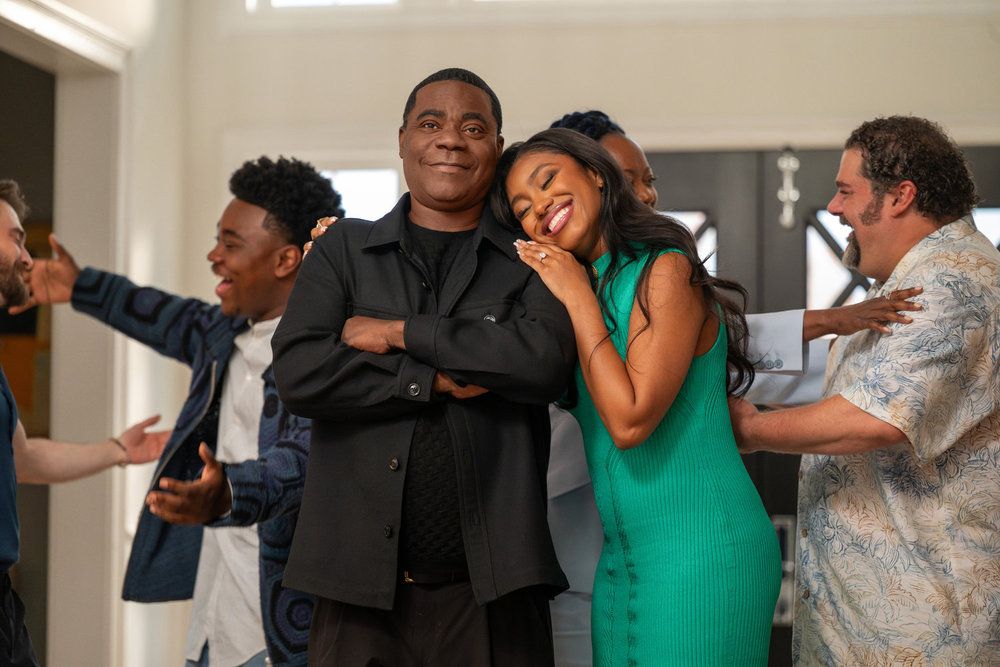
Sometimes, TV is worth watching because of one or two vital elements that justify everything else — a compelling premise, one key performance, a particularly standout episode. The Fall and Rise of Reggie Dinkins is the opposite: It is a show worth watching for a half-dozen different reasons, which work together exactly because of how improbable and strange they should be when put together. It would be a show worth checking out even if it were just the most Tina Fey–Robert Carlock show to exist since Girls5Eva. But it is also the best TV role for Erika Alexander since Living Single, as well as being the grand return of Tracy Morgan to network television. And then on top of all of that, it’s also host to one of the greatest misfit comedy duos in recent memory. Morgan, as Dinkins, is a colleague and eventually friend of a dweeby little documentarian played by Daniel Radcliffe, who starts out as the straight man and then inexorably becomes just as weird as everyone else in this show. Shout it from the rooftops! Reggie Dinkins! Everybody get onboard! —KVA
Ponies (Peacock)

Ponies is not nuanced in its worldview, nor is it a coherent spy narrative. It is, however, a gratifying best-friends show about two women whose CIA-agent husbands mysteriously die in the Soviet Union, leading the wives to figure out what exactly happened. The most compelling onscreen friendships present the relationship as a kind of osmosis, one in which two companions affectionately absorb each other’s qualities and quirks over time. Ponies nails that arc. Where Emilia Clarke plays Beatrice as heady and prim, Haley Lu Richardson’s Twila is reckless and chummy, and the actresses carve out a distinct puzzle-pieces-fitting-together relationship that evokes some of the best feminist screwball comedies of the past few decades, including Dick, Romy and Michele’s High School Reunion, The Heat, and Spy. (Series co-creator Susanna Fogel has played in this lane before, writing Booksmart and The Spy Who Dumped Me.) Clarke and Richardson’s chemistry makes Ponies work, even when everything around them makes no sense. —RH
Riot Women (Britbox)

Sally Wainwright has devoted her career to series about women of all ages who buck against convention and constraint (the BAFTA-winning Happy Valley, the canceled-too-soon Gentleman Jack, the underseen historical fantasy Renegade Nell), and Riot Women is like the encore topping off an already great set list. The six-episode series follows a group of women in their 40s, 50s, and 60s, from different backgrounds but similar frustrating circumstances — crappy husbands, spoiled children, aging parents — who realize the overlaps in their lives when they create a punk band to compete in a town talent contest. There are gags about menopause, sure, but Riot Women otherwise avoids the obvious jokes you’d expect about women of a certain age. Instead, each character has her own distinct personality, her own specific frustrations with her life, and her own approach to working through those issues in song. After a lifetime of being told to stay quiet and smile, screaming your truths or slamming them out on a drum set feels damn good. The cast is uniformly excellent, but especially Joanna Scanlan as Beth, who keeps considering a bright-blue length of rope and how it could help her end her life, and Rosalie Craig as Kitty, the daughter of a local gangster with a secret from her past that could upend her present reality. A sister show to We Are Lady Parts and Bad Sisters, with a bit of Pump Up the Volume flair, Riot Women will fill a hole in your spirit you might not know needed mending. —RH
Primal season three (Adult Swim)

Genndy Tartakovsky’s Primal has always been a dreamy prehistoric jumble of ancient civilizations and cultures, monstrous creatures, and dinosaurs that smash together like a kid playing with all his toys at once. The fact that said characters rarely talk only adds to the effect of being transported to an alien world where we don’t understand the language but can still clearly recognize the characters’ emotions, desires, and regrets. In the series’ third season, Primal got gnarlier by bringing protagonist Spear (voiced by Aaron LaPlante) back from the dead but keeping the character unaware of his new zombie status. Even with a visible chunk of brain, a missing nose, and a skeletal hand, Spear is still just a man trying to survive in a harsh environment where cruelty and slavery are the norm. Each episode of Primal balances Spear trying to either help the helpless, fight for his life, or both, and the third season kept that pattern going while also exploring what Spear being undead means for his relationships with his T. rex frenemy, Fang, and his love interest and ally, Mira (voiced by Laëtitia Eïdo). It’s the kind of show that can, with equal ease, make you pump your fist when Spear defeats the members of an evil tribe living at the rim of a volcano or weep when he finally sees his reflection for the first time since his resurrection. It’s one of the best series Adult Swim has ever produced. —RH
Industry season four (HBO)

Set a year after Industry sold off the Pierpoint bank that once employed most of its characters and scattered them to London’s various elite cloisters, the series’ focus on the machinations of asset management, wealth hoarding, and all the ways people with resources find ways to deny them to others is sharper than ever in season four. Characters who once thought they could make the system of capitalism more ethical, thoughtful, or equitable have given up, and with that surrender looming overhead, Industry fascinatingly deconstructs who people become once they fail to disrupt, fail to make a name for themselves, and fail to overthrow the systems they know are suppressing them. As a portrait of what it looks like to buckle under society’s insatiable desire for more — not just more cash, but more happiness, more power, and more life — Industry is operating at optimal bleakness and maximal watchability. The dialogue is dense and poignant, the performances (especially from Marisa Abela and Ken Leung) are as layered as Russian dolls, the cynicism is so high that it’s practically in orbit, and the series’ ensemble is more fucked up than ever as they stagger toward the illusory oasis of self-fulfillment they think will finally fix their broken insides. Everyone’s unbelievably wealthy and everyone is miserable, and it makes for Industry’s best season yet. —RH
A Thousand Blows season two (Hulu)

The pleasures of Steven Knight’s A Thousand Blows lie in how fully the series embraces its anachronistic treatment of old-timey crime, from its fight design to its needle drops. Adolescence Emmy winners Stephen Graham and Erin Doherty yell at each other in gutter-trash accents while a swaggy Malachi Kirby terrorizes a British officer to avenge his murdered family. There’s a street war between feuding factions! An art heist! A French anarchist with a stash of dynamite! A Thousand Blows is sometimes nonsensical narratively, but its brisk pace makes for a pulpy, enthusiastically engrossing ride. Things buzz along so fleet-footedly you won’t notice the characters whose personalities were entirely rewritten after season one, or all the subplots that drop out of the story as these latest episodes progress — nor, really, will you care. It’s just too much of a good time watching Mary (Doherty) and the Elephants ingratiate themselves into high society, and Hezekiah (Kirby) calling out nobles on their cruelty, and Sugar and his younger brother, Treacle (James Nelson-Joyce), after a season of backstabbing and undermining, finally trusting each other. A Thousand Blows hits the same combination as before, but all the jabs still land. —RH
The Pitt season two (HBO Max)

Although it does not reach the same heights as its first season, season two of The Pitt is still some of the best, most capably produced TV around, and as a 15-episode weekly release, it’s also operating in a space every other streaming platform has left entirely unoccupied. In its second season, The Pitt remains a rock-solid procedural, with Noah Wyle continuing to hold down the show’s earnest, intense, hardworking team of doctors and nurses. Season two is quieter, narrower, and more introspective than season one, and yet despite that smaller focus leading the season to neglect some of its best assets, The Pitt still runs circles around every other medical drama on TV. —KVA
The Traitors season four (Peacock)

When exactly did it become clear that overalls-sporting, snake-wrangling Love Island alum Rob Rausch was in contention for the title of greatest Traitor to ever grace the roundtable? Was it his early turn on Lisa Rinna? Cold-reading Natalie to steal the dagger? “This is about to be bad for Robby Bobby”? This outing of the U.S. Traitors had plenty of other highlights that kept the juice flowing: a Housewives-heavy cast (controversial as it might be), the largely hopeless Johnny Weir–Tara Lipinski duo (timed neatly with the Winter Olympics) coming close to figuring it all out but not being able to do squat about it, Michael Rapaport’s self-immolation, Maura Higgins’s pronunciations. But the slow realization that Snake Rob was a genuine threat who would ultimately run the game was especially satisfying and a reminder of how well The Traitors works as an all-star showcase and narrative machine, even in its fourth season. —NQ
More From This Series
- The Best Podcasts of the Year So Far
- The Best Books of the Year So Far
- The Best Albums of the Year So Far
