



Yerin Ha, breakout star of Bridgerton’s fourth season, strolls into Koryo Books on a frigid afternoon in February and asks, “Why haven’t I been here before?” Bundled in a full-length black puffer, gray scarf, and black baseball cap for the short walk from her hotel, the 28-year-old Australian actress and I had just met at the entrance of one of the oldest bookstores in New York’s Koreatown. She looks around, delighted. “Ooh, sticker sheets!” she says, pointing out ones with her favorite boy bands and girl groups — Stray Kids, Twice, Katseye. She eyes a mug featuring characters from the K-drama, Boys Over Flowers, then pauses to examine the translation of Fourth Wing, a romantasy book she loves despite rarely gravitating toward fantasy. During COVID, Ha read romances both classic and contemporary, and when she got cast as Bridgerton’s newest heroine, she immediately dug into the Julia Quinn novel that inspired her season of the show. “I feel like people don’t take romance seriously,” Ha says. “But there’s obviously a hunger for it.”
Her respect for the genre fuels the best season of Bridgerton since its premiere. As Sophie Baek, the Cinderella-style housemaid of illegitimate birth who charms the latest eligible Bridgerton bachelor, Ha is exquisite. Sophie is the first Bridgerton protagonist to exist fully outside the world’s upper-class Regency fantasy. While Benedict Bridgerton, played by Luke Thompson, wallows in tortured yearning and makes disastrous grand gestures, Ha’s Sophie rarely has the power or freedom to say what she feels, as she’s constrained by her financial dependency on her employers, her stepmother’s vindictive streak, and the threat of physical violence from entitled noblemen. The only way Benedict and Sophie’s romance becomes convincing under these circumstances is because of Ha’s capacity for making Sophie’s love, desire, and resentment transparent on her face. Her arc does not revolve around the show’s increasingly rote, claustrophobic obsession with the marriage market. Sophie has to deal with real stakes, and Ha plays her as stubbornly self-sufficient. When the first part of season four ends with Benedict fumbling through a disastrous proposal that Sophie become his mistress, Ha does not crumple or explode in fury. What more could she have expected from a rich, privileged son?
When we meet at the bookshop, Ha is in the middle of hurtling around the world with the Netflix press machine. Hours earlier, she got off a flight from Australia, where she was in the Gold Coast attending the AACTA Awards, Australia’s equivalent of the Oscars. She has a New York Fashion Week event later this week, then it’s off again — maybe Bucharest and possibly South Korea for more Bridgerton press. In a few days, she’ll co-host Gold House’s Lunar New Year celebration with Heated Rivalry star Hudson Williams. For now, she’s happy to be anywhere other than a hotel lobby or on a red carpet. She would not be opposed to popping into the H Mart across the street, either. Ha sounds understandably worn out by the schedule but has not slipped into the press-polished numbness that can overtake actors during a long promotional stint. Last month, she flew her mother to Paris for the Bridgerton premiere so they could be together for Ha’s 28th birthday.
Ha grew up in the northern suburbs of Sydney, the younger of two children, with parents who cared deeply about grounding their children in Korean culture and identity. The language books on the lower shelves of Koryo Books remind Ha of her weekly Saturday-morning Korean lessons, which she loathed. “I wagged one time,” she says, Australian slang for skipping school. (She was 8, and she hid behind the school before walking home alone and eating chocolate until her mom found her.) She wanted to perform, a passion she says her mother could intuit while watching Les Misérables during her pregnancy. “Apparently I kicked a lot during ‘I Dreamed a Dream,’” Ha says, grinning. “I’m a musical-theater kid at heart.” At 14, her mother suggested they move to Korea, where Ha’s grandmother, Son Sook, is a decorated stage actress and former Korean politician. Ha spent three years studying at the Kaywon High School of Arts. It was formative and hard. “I remember having to bow to people in the year above me, having to bow to every single person that went by. I thought, Why are we doing this?” she says. “It really did feel like a K-drama situation.” She got a 7 out of 100 on her first Korean-language test. Her instructors discouraged her musical-theater ambition. “My teacher would always say that you had to pursue what you do well in, not what you want to do,” Ha says. “The education there is very much that they make you hit rock bottom so that you grow a thick skin.”
After graduating in 2015, Ha had a choice: Stay in Korea, where she would not have to swim upstream against western casting prejudices and where her grandmother’s professional reputation might help her make connections, or move back to Australia. She missed home. She did not think she could do another four years of Korean education if she went to college there — “Mentally, I had fallen off a little bit” — and she started to see and hear about more non-white actors getting cast in lead roles, like Disney’s live-action Mulan. It didn’t seem as impossible to work in Hollywood as an Asian actress anymore. She auditioned for and was accepted to NIDA, Australia’s leading performing-arts university. In 2019, she was cast in the Paramount+ video-game adaptation Halo, which felt “like a lottery ticket.” But Ha’s character, Kwan, was invented for the series, and the game’s intense fandom resented the attempt to insert new side plots into the main narrative. “What is the point of Kwan?” reads a typical Reddit thread.
It was disorienting to book a role that seemed like an enormous break only to discover that a preexisting fandom rejected her character’s existence. On her flight through Los Angeles the previous night, a Customs agent asked Ha to list her credits to see if he knew her from anything. “‘Wait, you’re that character!’” he told Ha when she mentioned Halo. “‘You’re annoying, but it wasn’t your fault!’” Ha laughs. “I was like, ‘Thank you for noticing it was the writing and not me!’ He went on a rant about how ‘you were just doing the best you could,’ and I was like, ‘Thank you sir. This is so hilarious.’” Sophie is not Korean in the novels, and Bridgerton viewers are no easier to please than Halo fans, but their issues with the series are manifold and often contradictory. Even the angriest internet commenters, some of whom initially review-bombed the season on sites like Rotten Tomatoes, will often add an introductory clause: “Yerin Ha is so good! The real problem is …”
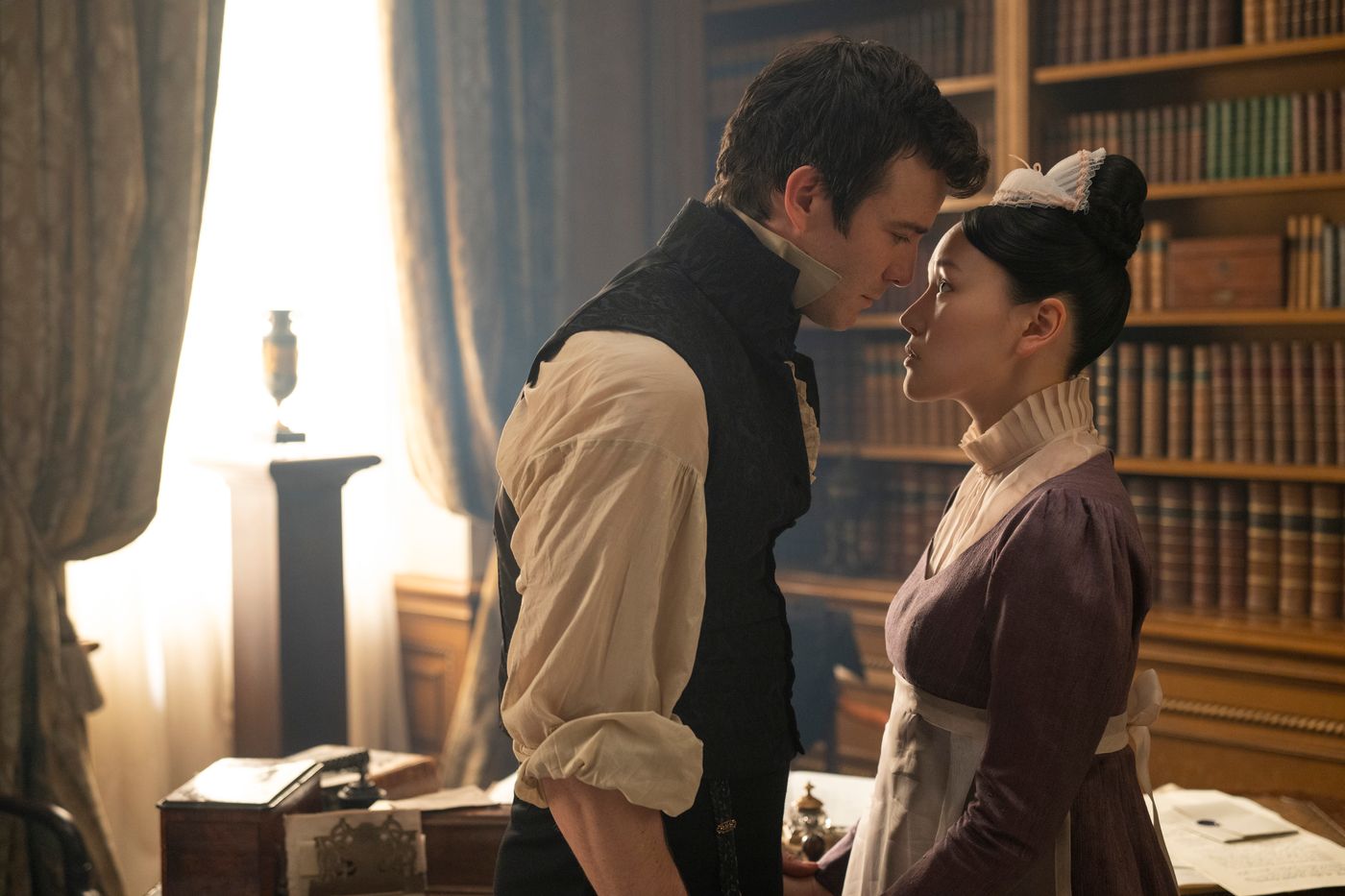
Ha had booked a few other roles after Halo but nothing on the same scale, and there were only about two weeks between sending a self-tape and learning she got the part of Sophie. She was ecstatic, but knew immediately it would require getting over the mental hurdle of filming Bridgerton’s sexual-intimacy scenes. “My own insecurities bubbled up while shooting,” she says. “Luke and I had a very open conversation about it. We talked about the standard of being the lead person and feeling like there’s a certain body type you have to have,” Ha says. “I’m someone who’s still coming into my own skin, and it doesn’t help with the Asian beauty standards and my three years in Korea. A lot of Asian beauty is about being very tiny. I don’t know that it’ll ever go away, but I’m trying to practice that this is the body I was given. As long as I’m healthy, that’s really all that matters.”
Exiting the store, we walk down the block to the Prince Tea House, where we order individual pots of floral tea kept hot over tiny candlelit warmers. For as much as Hollywood has changed, Ha says, and for as big as her current platform is, she is not expecting it will suddenly be easy for her to land worthwhile roles. She got a question the other day: Is the phone ringing off the hook? “No!” she says. “This idea that all of a sudden you’re shot into fame and work is so much easier — it might be for some, but it’s not the reality for me.” There’s been more diversity in casting, but she knows that Asian actors are inevitably compared with other Asian actors, and many films and shows hesitate to cast multiple Asian performers in a way that is not true for white performers. Bridgerton, with its consciously diverse vision of a Regency world, feels like a project conceived in a more inclusive moment; the pendulum has since swung the other way. Ha’s been fascinated by how many questions she’s gotten on this press tour about how she feels about the adaptation choice to change her Bridgerton character’s last name, Beckett, into the Korean surname Baek. It’s become an easy shortcut for people to ask her about representation. “Beckett’s just not a last name that would suit me,” she says. “It’s so interesting that people want it to be this really big thing.” She sees it as a sign that Hollywood “still has a ways to go.”
Ha is making no assumptions about her future. “I’m very anxious about unemployment,” she says, but she’s also ready to be pickier about her new projects — and start making movies. “On TV, it’s quite different,” she says. “Writers have a lot more input, and the director has to make so many people happy.” Ha would love to be able to work more closely with a director, almost reverently lowering her voice when I press her to name someone in particular: “Park Chan-wook.” She called her agent immediately when she heard Greta Lee was attached to direct an adaptation of Monika Kim’s novel The Eyes Are the Best Part, hoping to at least look at a script. What does she not want to do? She specifically declined her agent’s suggestion to audition for the new Fourth Wing adaptation, saying she just wanted to watch it as a fan. “I’ve done a lot of IP,” she says dryly. She would like to take a break from works with quite so much baggage.
More ‘Bridgerton’
- Say ‘Sul Sul!’ to the Sims 4 and Bridgerton Collab
- British Period Drama’s Go-To Rooms, Ranked
- What to Expect Next Season on Bridgerton, Based on the Books
