

Noddi bleu
Systématique
- OrdreCharadriiformes
- FamilleLaridés
- GenreAnous
- Espèce ceruleus
Statut de conservation
LCPréoccupation mineureDistribution

Noms étrangers
- Blue Noddy,
- Tiñosa azulada,
- tinhosa-azulada,
- Blaunoddi,
- ezüstnoddi,
- Blauwe Noddy,
- Noddy azzurro,
- grå noddy,
- Blånoddy,
- nody modrý,
- nody šedý,
- Grå Noddy,
- tuhkatiira,
- nodi blau,
- rybołówka polinezyjska,
- pelēkais zīriņš,
- Серая глупая крачка,
- ソライロアジサシ,
- 蓝灰燕鸥,
- grå noddy,
- 藍灰燕鷗,
Nomenclature
La première description de ce taxon est due à Bennett, FD en 1840. Sur Oiseaux.net, le nom français retenu pour cette espèce est « Noddi bleu ».
La nomenclature française s'appuie sur la liste CINFO (rév. 2013).
Genre grammatical du nom français : masculin.
Notes taxonomiques (IUCN) : Cibois et al. (2016) found that Procelsterna sits within Anous, which is accepted and results in P. cerulea changing name to Anous ceruleus (HBW and BirdLife International 2018). Procelsterna cerulea and P. albivitta (del Hoyo and Collar 2014) were previously lumped as P. cerulea following Sibley and Monroe (1990, 1993).
Sous-espèces (5) :
Identification
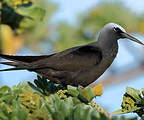
sp. Anous ceruleus
Confusion possible

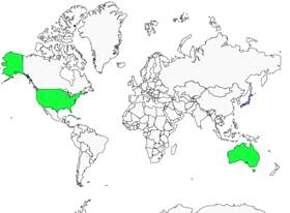
Distribution
Voix chant et cris
- 0:26Nihoa Island, Hawaii (Etats-Unis)Eric VanderWerfCC BY-NC-SA
- 0:20Cook Isle, Kiritimati, Kiribati (Kiribati)Todd MarkCC BY-NC-SA
Vol - déplacement
Capacité de vol : HWI = 59,0 (vol soutenu, migrateur)
Habitat
Données complémentaires
| Habitat | milieu marin | Bird et al. 2020, Tobias et al. 2021 |
|---|---|---|
| Densité | milieux ouverts | Tobias et al. 2021 |
| Mode de vie | diurne | terrestre | Bird et al. 2020 |
Alimentation - mode et régime
Données complémentaires
| Niveau trophique | carnivore | Pigot et al. 2020, Tobias et al. 2021 |
|---|---|---|
| Niche trophique | prédateur aquatique | Pigot et al. 2020, Tobias et al. 2021 |
| Niche de recherche | aquatique aerial | Pigot et al. 2020 |
| Alimentation | vertébrés, poissons, charognes | Bird et al. 2020 |
Reproduction nidification
Données complémentaires
| âge première reproduction | 1,8 ans | Bird et al. 2020 |
|---|---|---|
| Ponte | 1 oeufs | Bird et al. 2020, Myhrvold et al. 2015 |
| Tentatives par an | 1 | Myhrvold et al. 2015 |
| Masse de l’oeuf | 12 g | Myhrvold et al. 2015 |
Menaces - protection
Statut de conservation IUCN
mineure
à l'état sauvage
menacé
évalué
Phylogénie
Cette espèce n'est pas couverte par l'arbre BirdTree (Jetz et al. 2012, taxonomie figée à 2012).
Sources des données
- Bird et al. 2020
- IOC 12.1
- Myhrvold et al. 2015
- Pigot et al. 2020
- S. M. Billerman, B. K. Keeney, P. G. Rodewald, & T. S. Schulenberg (Eds.). (2022). Birds of the World. Cornell Laboratory of Ornithology. https://birdsoftheworld.org/bow/home
- Tobias et al. 2021
- www.birdsofmelanesia.net
Autres références utiles
- IUCN Red List — IUCN Red List of Threatened species, IUCN
- GBIF — GBIF - Global Biodiversity Information Facility, GBIF Secretariat
- Wikidata — Wikidata, la base de connaissances libre, Wikimedia Foundation
- NCBI Taxonomy — NCBI Taxonomy Database, National Center for Biotechnology Information
- eBird — eBird, Cornell Lab of Ornithology et National Audubon Society
- Birds of the World — Birds of the World, The Cornell Lab of Ornithology
- TaxRef (INPN) — Inventaire national du patrimoine naturel (INPN), MNHN - INPN
- Xeno-Canto
© 1996-2026 Oiseaux.net
