

Table of contents

The top 5 SaaS integration challenges (based on our research)



Jon Gitlin
As your company looks to connect SaaS applications with your product in-house, you’ll likely face a number of obstacles.
And while these challenges can look different depending on the specific integration scenario you face, we discovered through our research that companies often run into a common set of challenges.
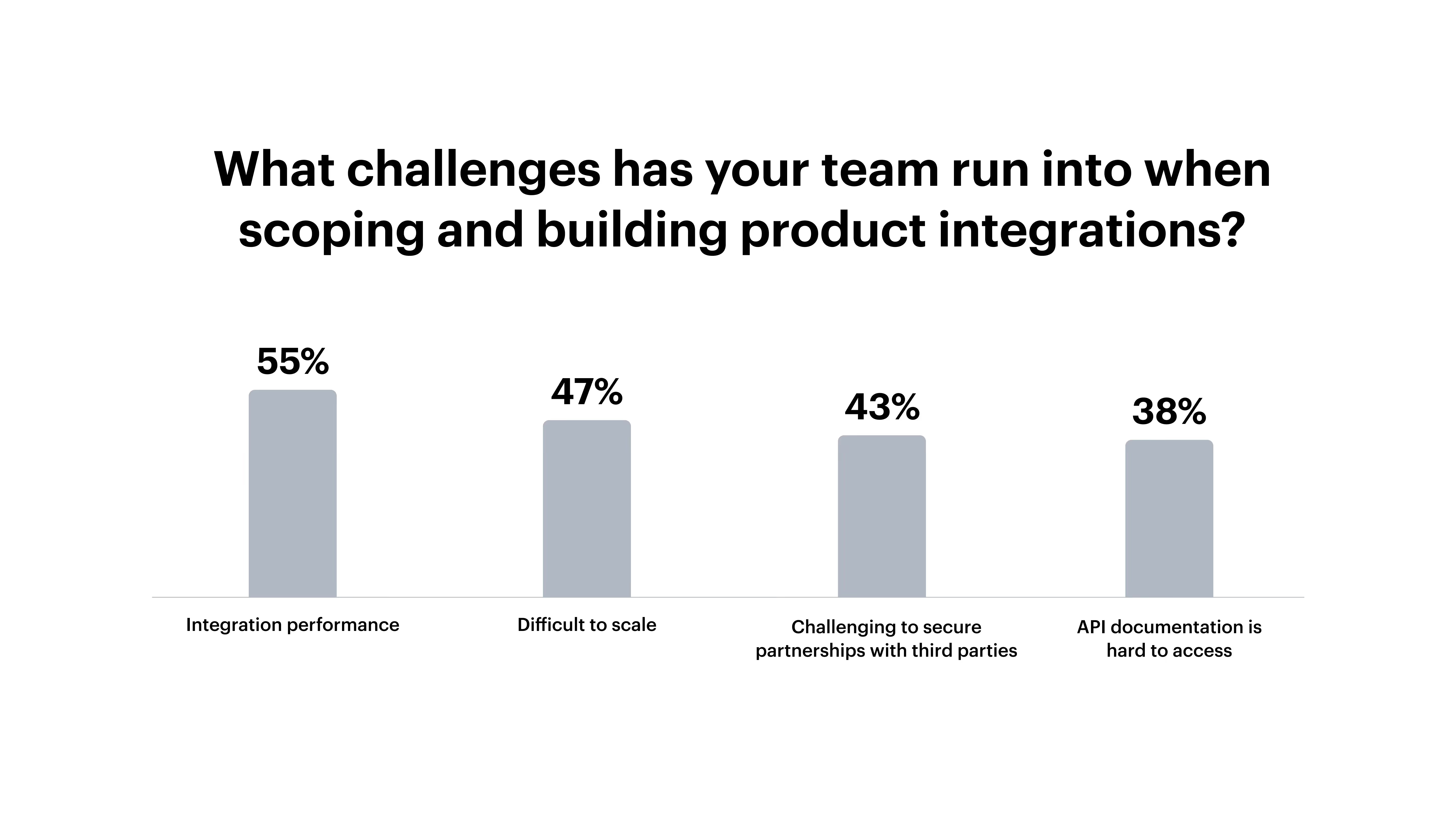
You can read on to learn more about the most common challenges of building product integrations.
Related: The top API integration challenges
Ensuring your integrations meet expectations
In the context of product integrations, it’s especially important that companies build high-performing integrations. After all, these integrations impact clients—not just your business.
Integrations with syncs that often fail, take a long time to process, run infrequently, or only work for a limited set of data can ultimately disappoint clients.
As a result, your team needs to invest enough time and resources on building, testing, and fine tuning the integrations before taking them to market.
Difficult to scale
SaaS integrations can also be incredibly difficult to scale when managed in-house.
You’re relying on a small group of developers who understand the APIs of the associated applications you’re looking to connect and who can stitch together the applications with your product via custom code.
Since these engineers are, in most cases, uniquely positioned to tackle projects for your core product, you likely can’t afford to allocate all—or even any—of them to your integration projects.
Building more integrations will also likely require forming additional partnerships with 3rd parties and allocating more support resources to help manage integration issues. The former is often a lengthy process (although it depends on the vendor) and both demand significant investments in time from your team.
As you account for all these resourcing requirements, you’ll likely find that integration builds and resource investments aren’t neatly correlated; building more integrations requires an increasing rate of resource investments.

Related: Common software integration challenges
Accessing API documentation
Despite the benefits of offering centralized, easy-to-follow, up-to-date, and comprehensive API documentation, many organizations fail to do so.
Here are some of the issues your developers might run up against for just a single API provider:
- Having to form some level of partnership with the vendor to access the relevant documentation
- Needing to search for information across several web pages
- Finding that the documentation on the current API version isn’t readily available (but docs on the older version are)
- Discovering that the relevant documentation isn’t localized in their language
As a result of these issues, your developers will likely have to invest significant time on just finding the information they need—assuming they find it in the first place.
Over relying on select individuals
While this challenge didn’t top the list in our research, it’s worth considering.
Since only a few employees can participate in the process of building your integrations, it’s imperative that they stay with your company throughout the duration of the build. If any of your builders leave during the process, your implementation timeline can get extended; in some cases, the employees leftover may not even have the expertise needed to continue the integration project, leading the project to end shortly thereafter.
Hard to build integrations in 3rd-party platforms
When in-house engineers finally decide to embrace 3rd-party integrations over native builds, the transition is often anything but seamless.
More than 2 in 5 respondents (42%) from our study said that 3rd-party integration solutions—like an embedded iPaaS (e.g. Workato Embedded) or a task automation tool (e.g. Zapier)—aren’t intuitive and easy to use.

As a result, your engineers are likely forced to use these tools themselves, which largely negates the benefits you’d hope for when going the 3rd-party route.
Related: The top benefits of SaaS integration
Overcome any integration challenge with Merge
Merge, the leading unified API platform, addresses all of the issues presented throughout this page.
By integrating with Merge’s Unified API, you can access hundreds of integrations across key software categories, like CRM, HRIS, file storage, and ticketing—all but ensuring that your team can integrate at scale with ease.

Merge also offers comprehensive Common Models and advanced features like Field Mapping to access any standard and custom objects and fields; webhooks to help your product receive data in real-time; and Blueprint to accelerate integration development with any of Merge’s Unified APIs.
You can learn more about Merge by scheduling a demo with one of our integration experts.
Jon Gitlin



But Merge isn’t just a Unified
API product. Merge is an integration platform to also manage customer integrations. gradient text
But Merge isn’t just a Unified
API product. Merge is an integration platform to also manage customer integrations. gradient text
But Merge isn’t just a Unified
API product. Merge is an integration platform to also manage customer integrations. gradient text
But Merge isn’t just a Unified
API product. Merge is an integration platform to also manage customer integrations. gradient text
