

Table of contents
Just for you
No items found.
7 benefits of SaaS integration


Jon Gitlin
As you and your team adopt more SaaS applications over time, you'll likely want and need to build integrations that work across them.
Similarly, as you onboard more clients to your SaaS product, you’ll likely experience an increasing number of requests for integrating your solution with 3rd-party SaaS apps.
The ever-growing demand for integrating both internal and 3rd-party SaaS applications boils down to the benefits these integrations provide your employees and clients.
You can keep reading to learn about the top benefits of integration. But to get us started, let’s define SaaS integration.
What is SaaS integration?
It’s the process of connecting SaaS applications with one another. This includes connecting your internal applications with one another as well as syncing your product with clients’ applications.

Related: How to build a SaaS integration strategy
SaaS integration benefits
Internal integrations and product, or customer-facing, integrations naturally offer different benefits, so we’ll explore their respective benefits separately.
Benefits of integrating with internal SaaS applications
Here’s how internal integrations can help your employees and your company more broadly:
Removes data silos
In the absence of integration, your employees simply can’t access the information they need within the applications they use day-to-day. As a result, they’ll ask their colleagues for the information or, worse, simply operate without it.
SaaS integration can break down any data silos and any of the issues that are derived from them, as data can flow through to the appropriate applications seamlessly.
Prevents human errors
Forcing your employees to perform data entry can lead to mistakes that cost your business down the line. For instance, finance can accidentally input the wrong invoice amount for a client, which can upset the client and damage the business relationship.
Using SaaS integrations, you can streamline most data entry-related tasks, thereby preventing human errors from taking place.

Related: Common API integration benefits
Improves employee engagement
Data entry isn’t just an error-prone task—it’s also time-consuming and generally unpleasant to perform.
SaaS integrations can minimize the amount of time that employees perform data entry, allowing employees instead to focus on the tasks they value and that are most likely to benefit the company. In turn, they’ll likely become more engaged; and as extensive research shows, your business will then benefit in a variety of ways.
Benefits of integrating with clients’ SaaS applications
Now let’s review the top benefits of integrating with your clients’ tech stacks:
Enables you to close more sales
As leads evaluate your product, they’re likely considering the integrations you offer relative to your competitors. If you can offer more integrations that your prospects care about than your rivals, you’ll—all else equal—stand a higher chance of closing a given sale.
Allows you to retain more clients
Once clients begin implementing your integrations, they’ll likely see more value from your product—whether that’s using the data from your product across their other applications or that’s accessing additional valuable, up-to-date information within your product.
In addition, integrations naturally make your product “stickier” for clients; removing your integrations and rebuilding the same integrations natively or through one of your competitors is likely a significant hassle for your clients.
These factors should ultimately help you increase, if not at least maintain, your customer retention rate.

Related: How to evaluate SaaS integration platforms
Improves your ability to move upmarket
As you look to move from selling to startups to mid-sized businesses or from selling to mid-sized businesses to enterprise organizations, you’ll likely find that the new set of organizations you’re targeting rely on a different set of apps within a given software category.
For instance, enterprise organizations likely use a CRM like Salesforce instead of Insightly as well as an HRIS like Workday instead of Gusto.
Providing integrations with the applications your target market uses can, as a result, position your product more favorably in their eyes and help you win their business more easily.
Supports your product’s AI features
Building powerful and highly-personalized AI features in your product largely comes down to consistently feeding your AI and machine learning models high volumes of relevant data.
Accomplishing this successfully requires pulling data from clients' applications, whether it’s their file storage app, CRM, marketing automation platform, etc.
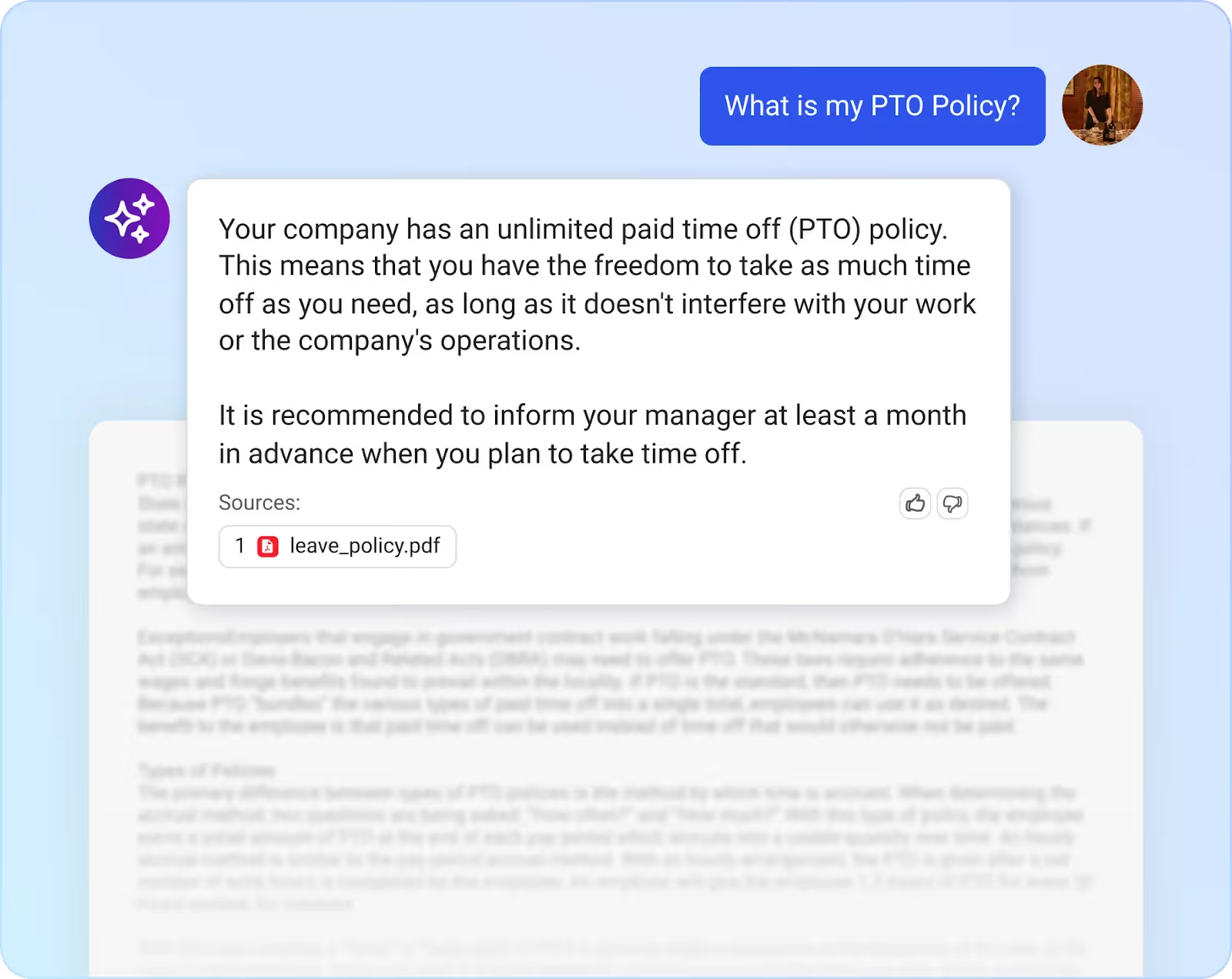
For example, one of Merge's clients, Assembly, which provides a variety of HR solutions, lets clients integrate Assembly’s product with 3rd-party file storage applications. This provides clients the direct benefit of accessing their documents and information within Assembly, but it also allows Assembly to offer “Dora AI”.
Using a client’s files, Dora AI can learn all kinds of information about the company and then apply those learnings when answering employees’ questions.
For instance, as the screenshot below shows, Dora AI can answer a question around a company’s PTO policy and link to the source that provides this information. This encourages the reader to learn more if they’d like to and it gives the employee confidence in Dora AI’s response.
Related: How Merge unblocked 10x in sales for Assembly
Reap the benefits of customer-facing SaaS integrations with Merge
Merge, the leading unified API platform, allows companies to offer a whole category of integrations by building to a single universal API.
The platform also provides maintenance support and management tooling for your customer-facing teams—all but ensuring that your integrations are reliable and performant.
You can learn more about Merge by scheduling a demo with one of our integration experts.
Jon Gitlin



But Merge isn’t just a Unified
API product. Merge is an integration platform to also manage customer integrations. gradient text
But Merge isn’t just a Unified
API product. Merge is an integration platform to also manage customer integrations. gradient text
But Merge isn’t just a Unified
API product. Merge is an integration platform to also manage customer integrations. gradient text
But Merge isn’t just a Unified
API product. Merge is an integration platform to also manage customer integrations. gradient text
