

Table of contents


A guide to API integration middleware



Jon Gitlin
As your company looks to build API integrations with a 3rd-party solution, you’ll have a host of tools to choose from.
We’ll help you narrow your list by comparing the categories of middleware tools for building customer-facing integrations and integrations between internal systems.
But before we jump into covering API integration tools, let’s align on the definition of API integration middleware and cover common use cases.
Related: What you need to know about integration middleware
What is API integration middleware?
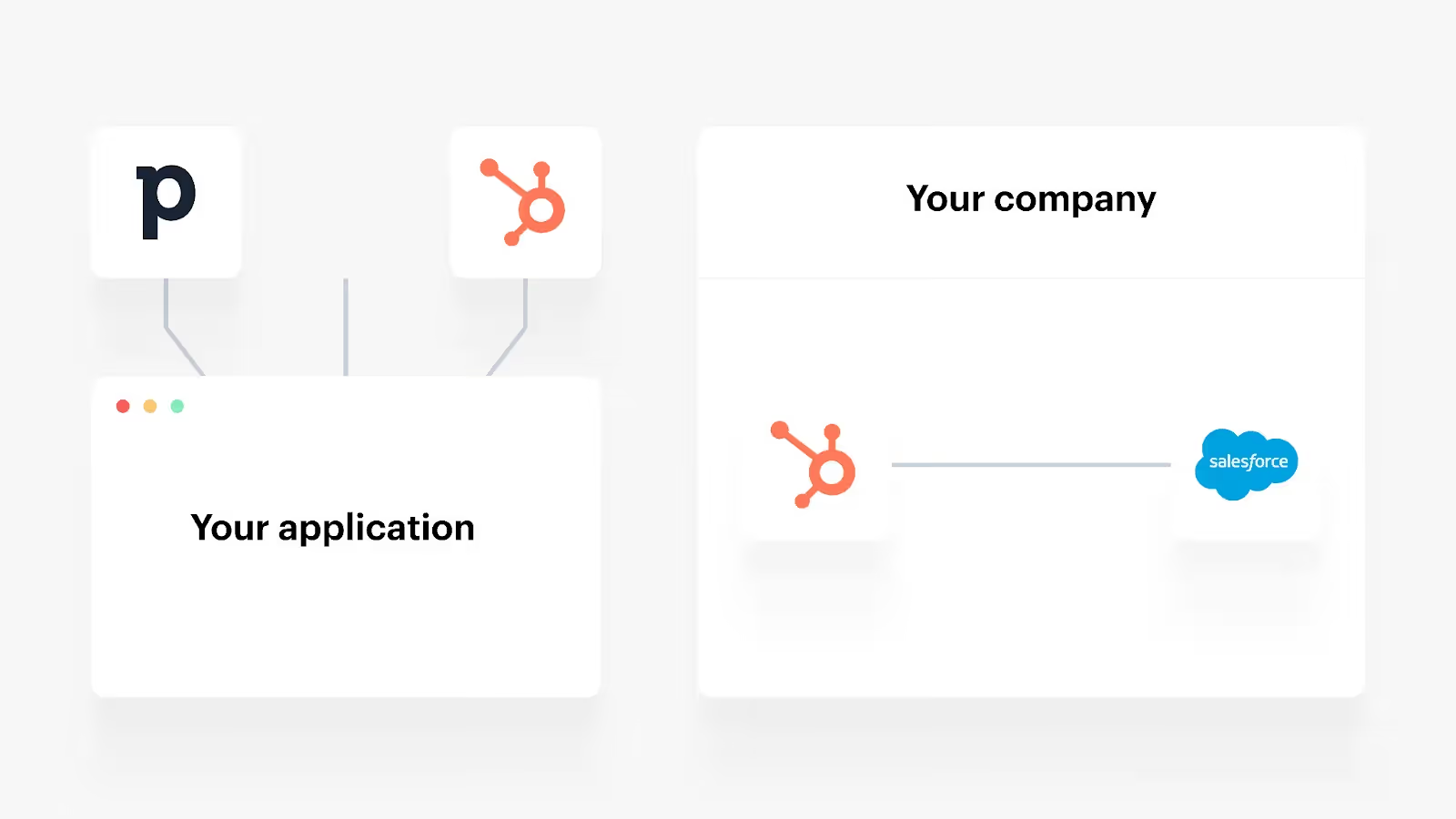
It’s a 3rd-party tool that lets you build integrations between software applications. This includes integrations between your product and the 3rd-party applications your clients and prospects use as well as integrations between the applications your teams use internally.
Related: What is workflow integration?
Integration middleware examples
Here are some common use cases for middleware integration solutions:
Note: The first two examples are for internal integration use cases while the third and fourth examples are customer-facing integration use cases.
Manage application provisioning and deprovisioning seamlessly
Your employees will likely need to access different applications—as well as change their access levels within applications—over time.
To handle these changes quickly and with minimal human intervention, you can use a middleware tool to integrate the single source of truth for employee data, your HRIS (e.g. Workday), with your identity and access management system (e.g. Okta). Once connected, you can sync employees and specific employee fields, like department, job title, and location, from your HRIS to the identity and access management system. The latter can then successfully determine the applications each employee needs, along with the level of permissions they should receive for each app over time.
Nurture leads intelligently
Unfortunately, many, if not most, of your leads will fail to convert into paying customers.
However, if your team can send leads that didn’t close the right messages at the right time and in the right place a few months after they fail to close, you have a chance to reignite their interest.
You can use a middleware integration solution to solve this exact use case. Simply use the tool to connect your CRM (e.g. Salesforce) with your sales engagement platform (e.g. Outreach) and build a flow where once a lead is marked as “closed lost” in the former, they’re added to a specific nurture sequence in the latter (which can be scheduled to start at a certain period of time).
Onboard users in your product seamlessly
Let’s say you offer a product that needs clients’ new hires to be provisioned.
Forcing clients to add new hires to your product manually is tedious, overwhelming, and can lead to costly human errors (e.g. forgetting to add a user).
To prevent these issues and to make the process easy and scalable, you can integrate your product with clients’ HRIS solutions. From there, you can build a flow where once a client adds an employee into your product, they can automatically get added to your product, along with the associated fields you want to sync.
Help clients manage leads effectively in your product
Imagine you offer a sales automation tool that recommends leads to clients.
Your users can choose whether to accept the lead, and if they accept it, they can go ahead and reach out without leaving your product.
One of the last things you’d want for clients is for them to receive a lead recommendation and reach out—only to find out that it was a client or a lead that’s already in the pipeline.
To address this head on, you can integrate your product with CRM solutions and sync the accounts and opportunities in the CRM systems with your product. From there, you can build an in-product flow where once a client receives a lead recommendation, they can check if it also lives in their CRM with the click of a button.
Related: A guide to API integration management
Integration middleware tools
Here are some common categories of API integration middleware for internal tools:
iPaaS
An integration platform as a service (iPaaS) lets you connect applications via their APIs and develop data flows that work across them.
Since the platform uses APIs, the integrations are resilient, stable, and high-performing. An iPaaS also offers pre-built connectors to expedite integration development.
That said, the platform typically can’t connect with applications that don’t have APIs available. In addition, the platform requires a high level of technical expertise, which prevents the majority of your employees from being able to use it.
RPA
Robotic process automation (RPA) software uses scripts (i.e. “bots”) to mimic human tasks at user-interface level. Some RPA tools have also gained API integration capabilities via company acquisitions.
RPA software is ideal when any of the applications you want to connect don’t have APIs or offer the specific endpoints you need. However, since its API integration capabilities are, in many cases, “bolted on” through the acquisitions, they’re less robust than that of iPaaS solutions.
Here are some common categories of middleware for product integrations:
Embedded iPaaS
An embedded iPaaS is simply an iPaaS that organizations can embed directly into their product.

Depending on the implementation, end users may be able to build and modify the integrations (via iframes) or rely on the organization to build and maintain them. In addition, if end users can participate in the process of building integrations, the embedded iPaaS’ iframe can use the company’s branding—making it seem like a natural extension of their product.
While embedded iPaaS solutions allow organizations to develop and deploy integrations faster than native builds, the approach still comes with several issues.
For one, the platform requires technical expertise to use. This likely forces your engineers to build and maintain the embedded integrations themselves. In addition, the platform doesn’t let you build more than one integration at a time, which (along with forcing your engineers to use the platform) naturally makes it difficult to scale your integrations. Finally, the platform typically lacks the integration management capabilities needed to monitor, troubleshoot, and resolve integration issues.
Unified APIs
A unified API solution (also referred to as a universal API solution) provides a single, aggregated API that offers multiple integrations for a category of software (e.g. HRIS).

The platform naturally addresses the scalability challenges presented by embedded iPaaS solutions. Also, through Merge, the leading unified API solution, you can access a variety of software categories, from ticketing to HRIS to file storage to CRM; sync a broad set of data through our common models; empower support or customer success to track integration issues and work with clients on resolving them quickly—and much more.
Learn more about Merge by scheduling a demo with one of our integration experts.
Jon Gitlin



But Merge isn’t just a Unified
API product. Merge is an integration platform to also manage customer integrations. gradient text
But Merge isn’t just a Unified
API product. Merge is an integration platform to also manage customer integrations. gradient text
But Merge isn’t just a Unified
API product. Merge is an integration platform to also manage customer integrations. gradient text
But Merge isn’t just a Unified
API product. Merge is an integration platform to also manage customer integrations. gradient text
