

Table of contents


A guide to using employee APIs



Jon Gitlin
There are several ways to sync employee data, from using SFTP to deploying custom scripts. APIs, however, offer the most reliable, performant, and secure method.
We’ll break down why that is. But first, let’s align on the definition of an employee API, cover common employee API endpoints from a popular HRIS provider, and break down a few employee API integrations.
What is an employee API?
It’s any endpoint from an API provider that lets you sync employee data. This can include employees’ first and last names, phone numbers, email addresses, employment statuses, and more.
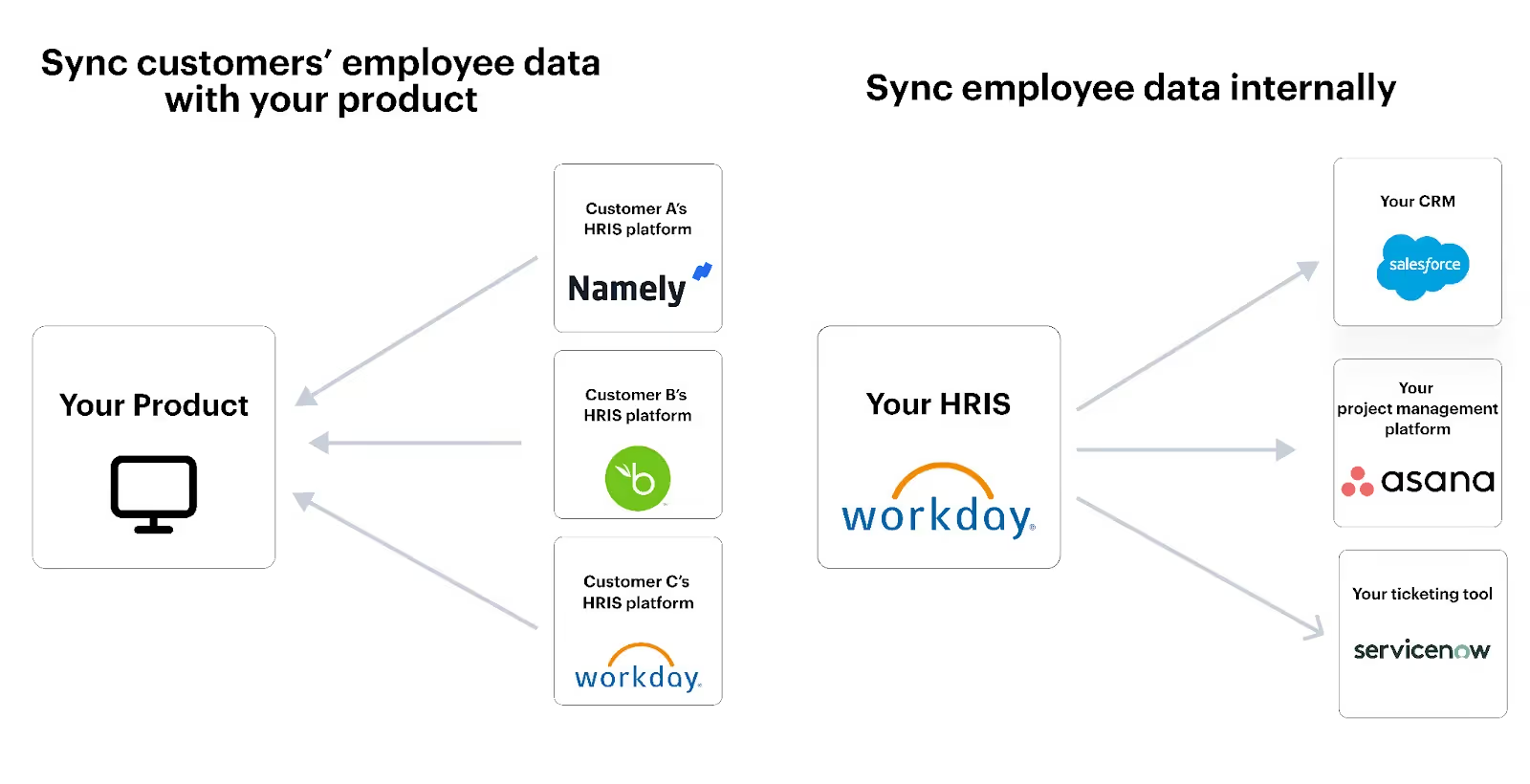
In addition, you can use an employee API to sync data internally (i.e., between the applications your organization uses) or with your product (i.e., between your customers’ HRIS solutions and your product)
Related: What is HRIS integration?
Employee API example
BambooHR, a widely-used HRIS solution, offers the following employee API endpoints (among many others):
- Fetch individual employees and specific fields associated with each via the endpoint <code class="blog_inline-code">GET https://api.bamboohr.com/api/gateway.php/{companyDomain}/v1/employees/{id}/</code>
- Create individual employees and include associated fields, such as dates of birth, social security numbers, genders, and hire dates, via the endpoint <code class="blog_inline-code">POST https://api.bamboohr.com/api/gateway.php/{companyDomain}/v1/employees/{id}/</code>
- Retrieve an entire employee director to sync employee data at scale via the endpoint <code class="blog_inline-code">GET https://api.bamboohr.com/api/gateway.php/{companyDomain}/v1/employees/directory</code>
- Update specific employee fields for a certain employee through the endpoint <code class="blog_inline-code">POST https://api.bamboohr.com/api/gateway.php/{companyDomain}/v1/employees/{id}/</code>
Learn more about BambooHR’s employee endpoints by visiting their docs.
Employee API integration use cases
To help bring our definition and example to life, let’s walk through a few use cases.
We’ll start with a couple of internal examples and then break down a few customer-facing ones.
Streamline employee onboarding
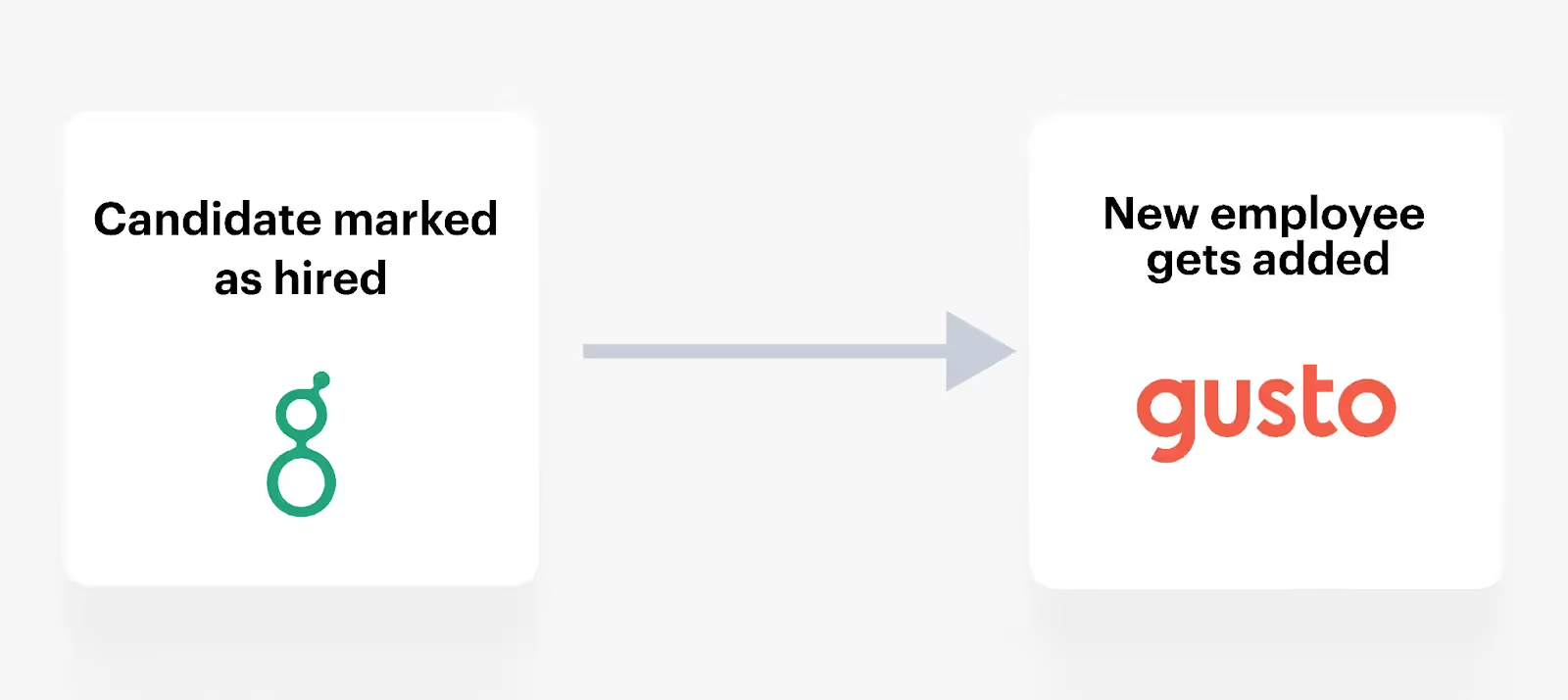
To help your HR team kickstart the onboarding process on time and for every incoming team member, you can connect your ATS (e.g., Greenhouse) with your HRIS (e.g., Gusto) and implement the following flow: Once a candidate is marked as hired in the ATS, a new employee gets created in the HRIS.
Certain fields can also populate for each employee added to the HRIS, such as first and last names, job titles, departments, addresses, etc.
Notify the company of key milestone events
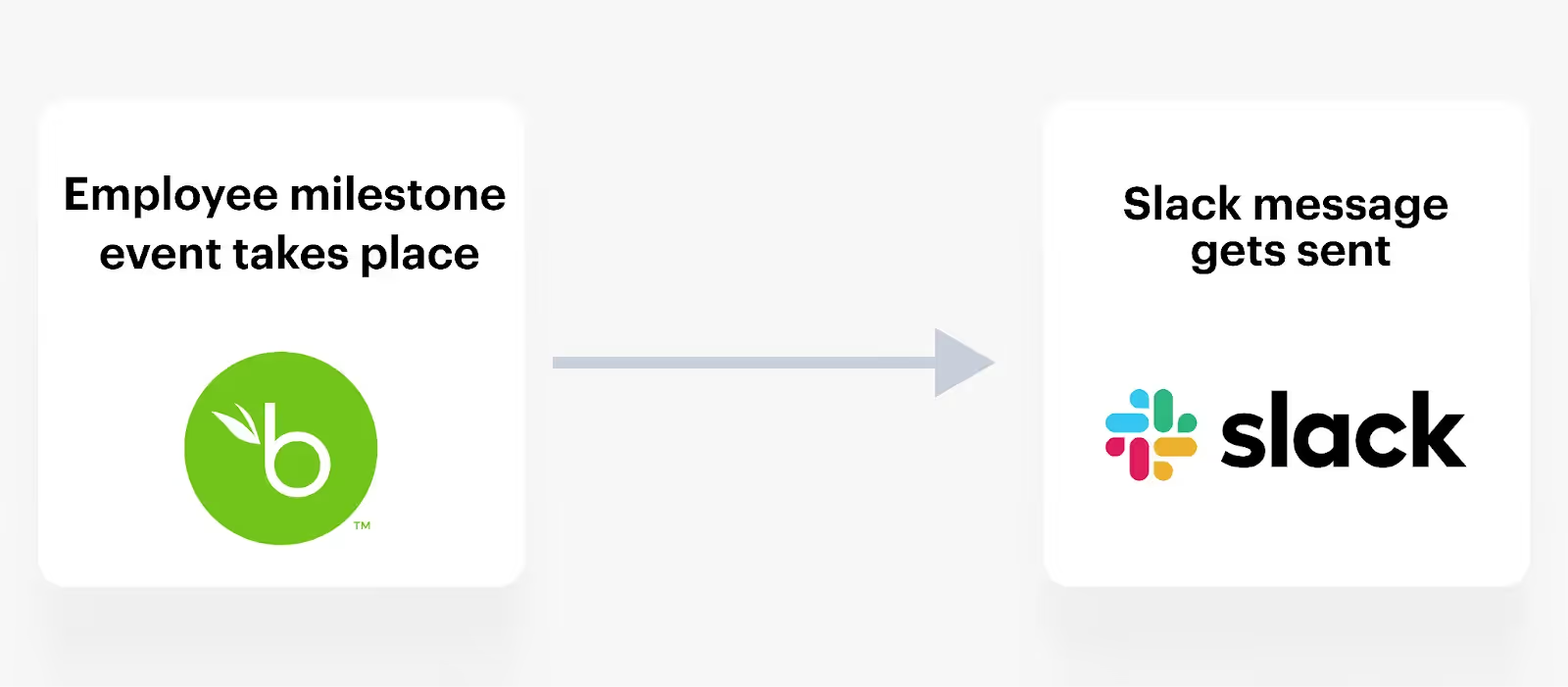
To recognize employees when they reach a certain work anniversary, get promoted, married, or reach another milestone event, you can integrate your HRIS with your business communications platform (e.g., Slack) and implement the following workflow: Once a certain employee milestone event gets detected in the HRIS, a predefined Slack message gets delivered to a specific Slack channel.
Related: How to build employee agents
Help users deliver department-specific recognitions
Say you provide a peer-recognition solution—like Bonusly—and want customers’ employees to access and give department-specific recognitions.
To do this, you could integrate with customers’ HRIS solutions and add employees from these systems with your product, which would include the departments they work in, on a recurring cadence. Employees can then easily find and distribute their department-specific recognitions as soon as they're provisioned as users in your product.

Automate user provisioning and de provisioning in your product
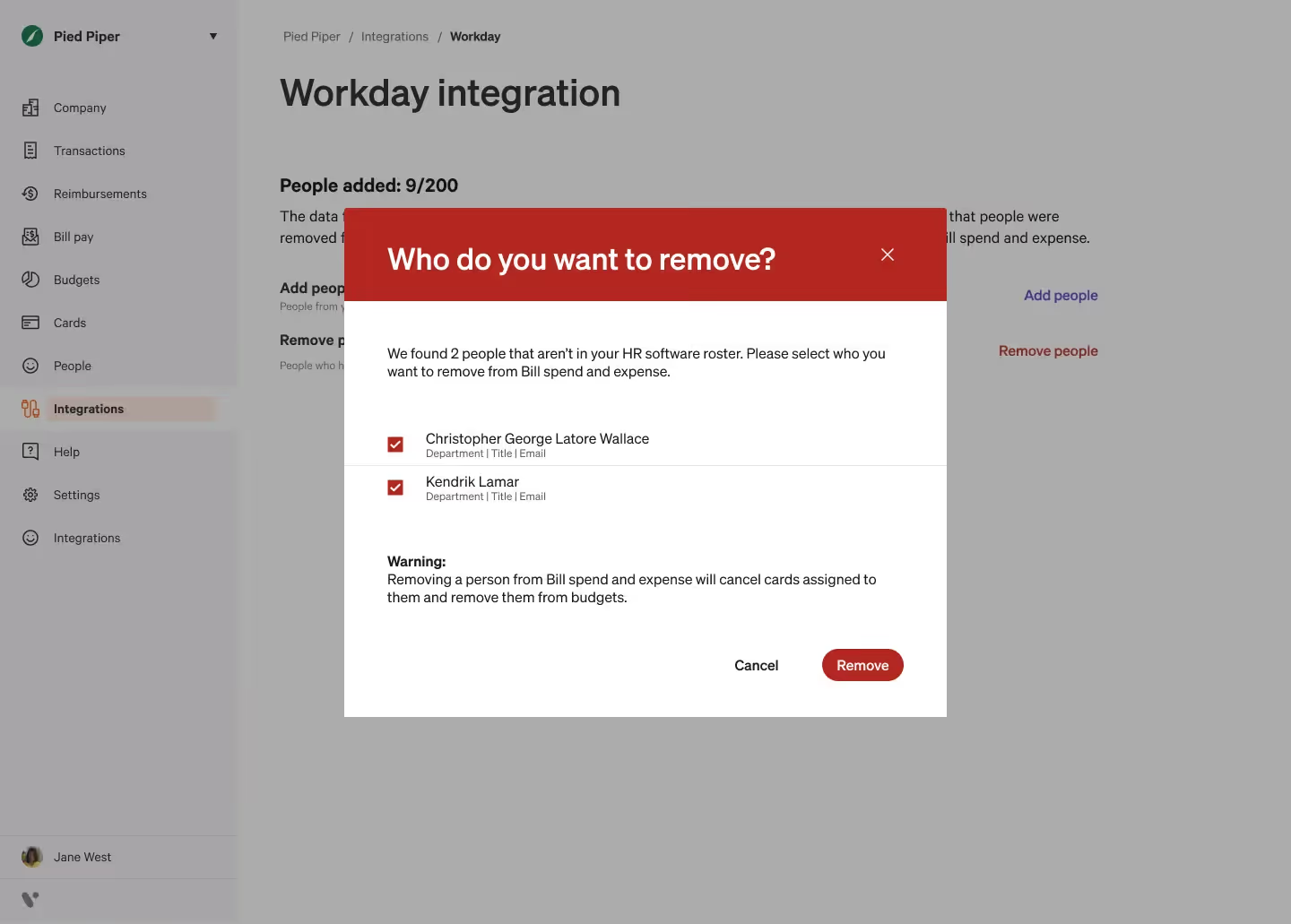
To help users access your product with the right level of permissions as well as remove their access once they’re terminated, you can integrate with customers’ HRIS solutions and implement the following syncs:
- Once a customer adds an employee in the integrated HRIS, that individual is queued as a user that can be added to your product. An admin in your app can then review the individual and decide whether to add them

- Once a customer removes an employee in the integrated HRIS, an admin in your product can get notified and remove them with the click of a button
Benefits of using an employee API
Here are just a few benefits to keep in mind:
- Robust security: Employee APIs can include highly-sensitive data, such as social security numbers and home addresses. By using secure authorization protocols, like OAUTH 2.0, you can keep this data limited to the appropriate requestors
- High performance: Your integration use cases might require syncing employee data on a frequent cadence, such as every hour or every few minutes. API-based connections can help address this requirement
- Universal accessibility: Most HRIS providers offer APIs, and those that do will almost certainly provide employee APIs—as employee data is a fundamental part of HRIS solutions
- 3rd-party integration support: There are a variety of 3rd-party integration solutions that can help you build to employee APIs and maintain those connections, making the process of implementing and scaling these integration builds relatively easier than in the past
Sync customers’ employee data with your product through Merge
Merge, the leading unified API solution, lets you add hundreds of integrations to your product by simply building to its unified API. This includes dozens of HRIS solutions that are popular across different regions, industries, and company sizes.
In addition, through each HRIS integration, you can sync a wide range of employee data via Merge’s comprehensive Employees Common Model and advanced syncing features (e.g., Field Mapping).
Learn more about using Merge to sync employee data with your product by scheduling a demo with one of our integration experts.
Jon Gitlin



But Merge isn’t just a Unified
API product. Merge is an integration platform to also manage customer integrations. gradient text
But Merge isn’t just a Unified
API product. Merge is an integration platform to also manage customer integrations. gradient text
But Merge isn’t just a Unified
API product. Merge is an integration platform to also manage customer integrations. gradient text
But Merge isn’t just a Unified
API product. Merge is an integration platform to also manage customer integrations. gradient text
