


How BILL uses Merge to offer 40+ HRIS integrations that save customers time on managing users
How BILL uses Merge to offer 40+ HRIS integrations that save customers time on managing users

BILL fact sheet
Product
BILL Spend & Expense
HQ
San Jose, CA
Industry
FinTech
Merge category
Merge Common Models
Before launching our HRIS integrations, a few team members at Merge came on-site to train our customer-facing teams on marketing, selling and supporting the integrations. This took additional work off of my team’s plate and has helped us take the integrations to market more efficiently.

Alex Giddens
Problem
Building integrations in-house would prevent engineers from focusing on other timely and valuable work
BILL is a leading financial operations platform for small and midsize businesses (SMBs) that helps businesses to more efficiently control their payables, receivables and spend and expense management.
As the company looked for ways to enhance their business card solution that combines expense management, spend controls, and flexible rewards to give businesses the streamlined efficiency they need to grow, BILL decided that they needed to add HRIS integrations.
By adding these integrations, customers could automate user-provisioning tasks, saving them time and letting them avoid potential human errors altogether. For example, an admin using BILL Spend & Expense could forget to deprovision a former employee, leaving them with access to sensitive information and a corporate card that still works.
Equally important, these integrations would be critical to customers.
Alex Giddens, a Senior Product Manager at BILL, explains that “HRIS integrations are a common feature request we receive from customers, especially from enterprise accounts. As a result, adding these integrations were important to help us continue to improve the customer experience and address the functional needs we were hearing.”
While BILL’s product engineers were capable of building and maintaining HRIS integrations, BILL chose to outsource the work to accelerate the development process. This would also enable BILL’s engineering team to remain focused on other timely product priorities.
After evaluating a few 3rd-party integration solutions, they ultimately landed on Merge for the platform’s ease of use, level of support, and ample HRIS integration coverage.
Solution
Leveraging Merge to build 40+ HRIS integrations that help customers provision and deprovision users quickly, securely, and easily
Once the team connected to Merge’s Unified API, they were able to take 40+ HRIS integrations to market, which include widely-used applications like BambooHR, Workday, UKG, ADP, and many more.

Through these integrations, users are able to sync fields like first and last names, job titles, locations, departments, and more. They’re also able to automate the following flows:
- Onboarding users: Once an integration is established, an admin user in BILL Spend & Expense will get notified that they can add users.
They can then add everyone or filter for specific attributes (e.g., only employees in marketing) and check off the specific employees they’d like to add.
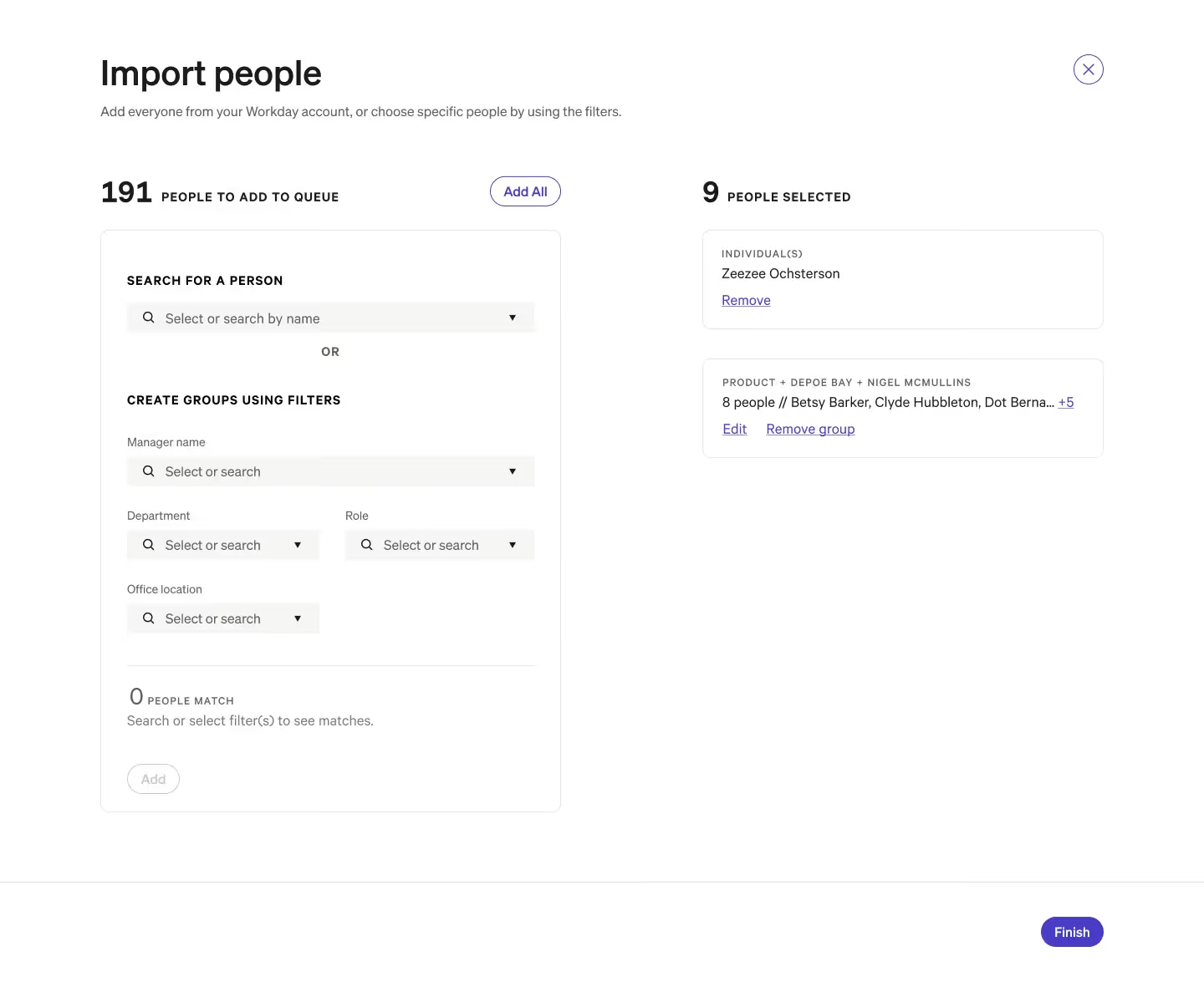
This same workflow applies any time an employee gets added to the connected HRIS.
- Keeping employee information in sync: Any time an employee’s information changes in the connected HRIS, the associated changes occur in that employee’s BILL Spend & Expense profile (if they have a profile).
The admin for BILL Spend & Expense can then review the changes and decide whether to make any adjustments to the employee’s account, such as increasing their spend limit.
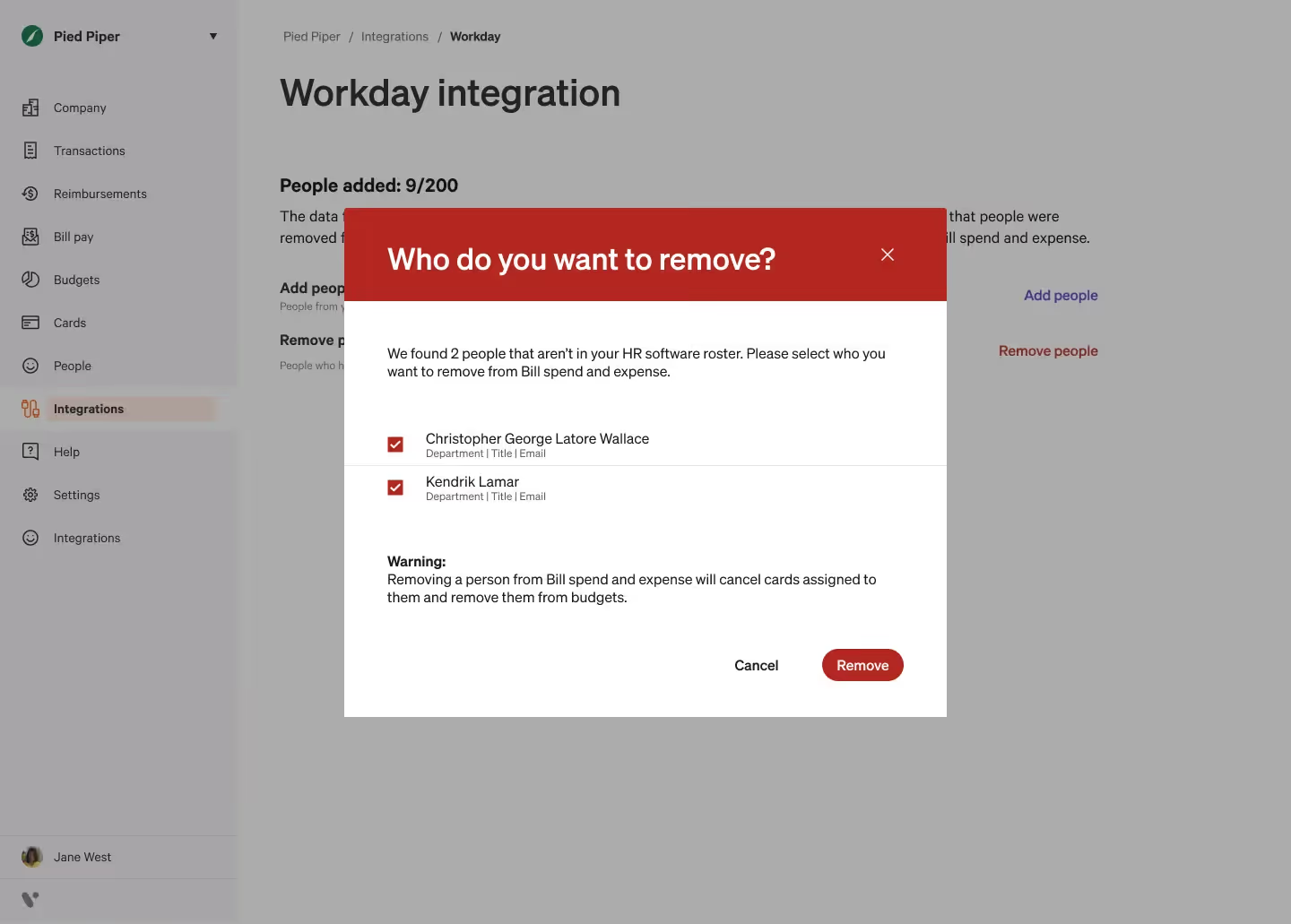
- Offboarding users: Once an employee is removed from or marked as terminated in the connected HRIS, the admin receives a notification in BILL Spend & Expense and can go on to remove them from the platform with a few clicks.
Finally, the team uses Merge’s Issue Webhooks to route any integration challenges discovered in Merge to an internally-built communication tool. This allows BILL’s customer-facing team to find and troubleshoot any potential integration issues with customers quickly and by only having to log into their own communication tool.
Outcome
Delighting customers and helping BILL's product teams
Now that a customer can easily add, edit, or remove employees, they’re able to save time, avoid human errors (like allowing former employees to access corporate cards), and onboard users onto the platform faster.
Alex adds that “Automating the process of provisioning users is helping us deliver value to our customers, faster.”
BILL’s sales reps also gain another value-add feature, which especially helps them address functionality that larger businesses have expressed an interest in.
Finally, the team at BILL has appreciated working with Merge. Alex highlights one occasion that stands out:
“Before launching our HRIS integrations, a few team members at Merge came on-site to train our customer-facing teams on marketing, selling and supporting the integrations. This took additional work off of my team’s plate and has helped us take the integrations to market more efficiently.”
We look forward to supporting BILL’s integration needs in the months and years ahead.
Customer stories


Make integrations your competitive advantage
Stay in touch to learn how Merge can unlock hundreds of integrations in days, not years

But Merge isn’t just a Unified
API product. Merge is an integration platform to also manage customer integrations. gradient text
But Merge isn’t just a Unified
API product. Merge is an integration platform to also manage customer integrations. gradient text
But Merge isn’t just a Unified
API product. Merge is an integration platform to also manage customer integrations. gradient text
But Merge isn’t just a Unified
API product. Merge is an integration platform to also manage customer integrations. gradient text
