

In Client-Side Service Discovery, the client service directly communicates with the Service Registry to discover available service instances. After obtaining the instance information, the client itself performs load balancing and selects the appropriate service instance to process the request. This approach eliminates the need for a dedicated load balancer and reduces network overhead.
- Enables direct communication between client services and the Service Registry.
- Eliminates the requirement for a dedicated Load Balancer or API Gateway.
- Improves performance by reducing additional network hops.
Service Discovery
Service Discovery is a mechanism that allows microservices to dynamically locate and communicate with other services in a distributed environment. Instead of hardcoding IP addresses and port numbers, services register themselves with a centralized server known as a Service Registry, which maintains information about all available service instances.
A Service Registry typically stores:
- Service Name
- IP Address
- Port Number
- Health Status
- Number of Active Instances
Architecture of Client-Side Service Discovery
The Client-Side Service Discovery architecture mainly consists of three components:
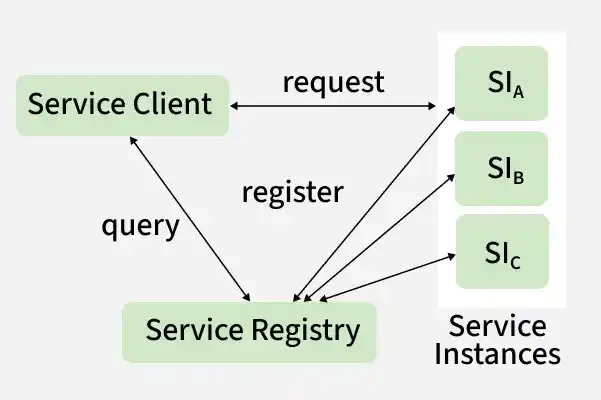
- Service Provider: These are the microservices that provide business functionality and register themselves with the Service Registry.
- Service Registry: The Service Registry maintains information about all active service instances, including their addresses and health status.
- Service Consumer: The client service acts as the service consumer. It retrieves available service instances from the registry and performs load balancing locally.
Working of Client-Side Service Discovery
Step 1: Service Registration
When a microservice starts, it registers itself with the Service Registry along with its IP address, port number, and health information.
- Service-A -> Service Registry
- Service-B -> Service Registry
Step 2: Service Discovery
When the client service wants to communicate with another service, it directly queries the Service Registry.
Client Service -> Service Registry
Step 3: Retrieve Available Instances
The Service Registry returns all healthy instances of the requested service.
- Service-B1
- Service-B2
- Service-B3
- Service-B4
Step 4: Client Performs Load Balancing
The client service applies a load balancing algorithm to select one of the available service instances.
Common algorithms include:
- Round Robin
- Random Selection
- Least Connections
- Weighted Response Time
Step 5: Service Invocation
The client directly sends the request to the selected service instance. This complete mechanism is known as Client-Side Service Discovery.
Client Service -> Selected Service Instance
Advantages
- Eliminates the need for dedicated Load Balancers.
- Reduces network latency and improves performance.
- Provides greater flexibility in load balancing strategies.
- Supports dynamic service scaling.
Limitations
- Client applications become more complex.
- Every client must implement service discovery logic.
- Requires client-side load balancing libraries.
Client-Side vs Server-Side Service Discovery
| Feature | Client-Side Discovery | Server-Side Discovery |
|---|---|---|
| Service Lookup | Client | Load Balancer/API Gateway |
| Load Balancing | Client | Server |
| Additional Network Hop | No | Yes |
| Client Complexity | High | Low |
| Infrastructure Complexity | Low | High |
