

DNS Spoofing, also known as DNS Cache Poisoning, is a network attack in which an attacker manipulates the Domain Name System (DNS) resolution process to redirect users from a legitimate domain to a malicious IP address. When the victim requests a domain:
- The malicious DNS response is accepted.
- The incorrect mapping is stored in the DNS cache.
- Future requests for the domain are redirected to the attacker's server until the cached record expires or is removed.
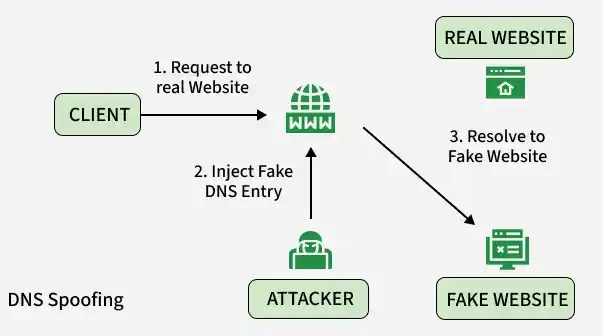
Working
- DNS Query: A client requests the IP address of a legitimate domain.
- Forged Response: The attacker transmits a spoofed DNS reply before the legitimate response arrives.
- Cache Poisoning: The DNS resolver accepts and stores the forged record in its cache.
- Malicious Resolution: Future DNS queries for the domain resolve to the attacker's IP address.
- Traffic Redirection: Users are transparently redirected to the attacker-controlled server.
Types of DNS Spoofing
- DNS Cache Poisoning: The attacker injects false DNS records into a recursive DNS resolver. Every user relying on that resolver receives the malicious IP address until the cache entry expires.
- Local DNS Spoofing: Malware modifies the victim's local DNS settings or hosts file, redirecting selected domains without affecting other users.
- Rogue DNS Server: The attacker configures a malicious DNS server and convinces victims to use it by changing router settings, DHCP configurations or device network settings.
- Man-in-the-Middle (MITM) DNS Spoofing: An attacker positioned between the victim and the DNS server intercepts DNS queries and replaces legitimate responses with forged records.
Common Attack Techniques
Attackers use multiple techniques to manipulate DNS resolution and redirect users to malicious destinations. The specific method depends on the targeted environment and the attacker's level of access.
- Forged DNS Responses: Send counterfeit DNS replies that map a legitimate domain to a malicious IP address.
- DNS Server Manipulation: Alter DNS server configurations or zone records to return malicious responses.
- Hosts File Modification: Change the local hosts file to override legitimate DNS resolution on a victim's system.
- Public Wi-Fi Exploitation: Intercept DNS traffic on unsecured wireless networks and inject spoofed DNS responses.
Impact of DNS Spoofing
DNS spoofing can have serious security consequences.
- Credential Theft: Victims may unknowingly enter usernames and passwords into fake login pages.
- Malware Distribution: Users can be redirected to websites hosting malicious software.
- Financial Fraud: Fake banking or payment portals may capture sensitive financial information.
- Session Hijacking: Attackers can intercept authenticated sessions and impersonate users.
- Business Disruption: Organizations may experience service outages, loss of customer trust and operational interruptions.
- Data Interception: Sensitive communications may pass through attacker-controlled infrastructure.
Detecting DNS Spoofing
Security teams commonly identify DNS spoofing using the following methods.
- DNS Traffic Analysis: Monitor DNS requests and responses for unexpected IP addresses or suspicious reply patterns.
- Packet Capture: Analyze DNS traffic using packet analysis tools to verify that responses originate from legitimate DNS servers.
- DNS Log Monitoring: Review resolver logs for abnormal record changes, repeated failed lookups or unauthorized responses.
- DNSSEC Validation: Verify DNS records using DNS Security Extensions (DNSSEC) to ensure responses are digitally signed and authentic.
- Threat Intelligence: Compare resolved IP addresses with known malicious infrastructure and threat intelligence feeds.
Preventing DNS Spoofing
Effective protection requires multiple security controls.
- Enable DNSSEC: DNSSEC digitally signs DNS records, allowing resolvers to verify their authenticity before accepting responses.
- Use Secure DNS Protocols: Implement encrypted DNS protocols such as DNS over HTTPS (DoH), DNS over TLS (DoT). These reduce the risk of interception during DNS communication.
- Keep DNS Servers Updated: Regularly apply security patches to DNS servers, routers and networking equipment.
- Secure Network Infrastructure: Restrict administrative access, use strong authentication and protect DNS servers from unauthorized modification.
- Monitor DNS Activity: Continuously monitor DNS logs for unusual queries, cache anomalies and unauthorized configuration changes.
- Use Trusted DNS Providers: Configure systems to use reputable DNS resolvers that support modern DNS security features.
DNS Spoofing vs DNS Hijacking
- Primary Method: DNS spoofing uses forged DNS responses, whereas DNS hijacking modifies DNS configurations.
- Target: DNS spoofing attacks DNS caches or DNS responses, while DNS hijacking targets DNS servers, routers or client DNS settings.
- Persistence: DNS spoofing is generally temporary until cached records expire, whereas DNS hijacking remains effective until the malicious configuration is corrected.
- Infrastructure Changes: DNS spoofing does not necessarily require infrastructure changes, while DNS hijacking typically involves unauthorized configuration changes.
- Primary Goal: DNS spoofing redirects users by poisoning DNS resolution, whereas DNS hijacking aims to gain persistent control over DNS resolution.
