

Active Directory (AD) is Microsoft’s directory service that manages users, computers, groups, applications and network resources within an organization.
- It securely maintains user accounts, computer objects, security groups organizational units, permissions and authentication policies across the enterprise.
- Because AD controls authentication and privileged access to critical systems, it is a high-value target for attackers seeking privilege escalation, lateral movement and long-term persistence within a network.
Components of Active Directory
Active Directory is built on two major categories of components:
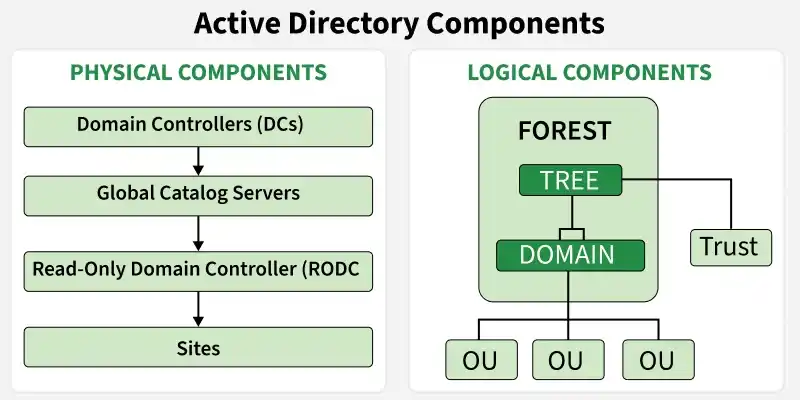
1. Physical Components
These are the infrastructure elements responsible for running and maintaining AD services.
- Domain Controllers (DCs): Domain Controllers are the core servers of Active Directory. They store the AD database and handle authentication, authorization and policy enforcement for users and devices.
- Global Catalog Servers: These servers maintain a partial copy of all objects in the forest. They improve search efficiency and help users authenticate across multiple domains.
- Read-Only Domain Controllers (RODCs): RODCs contain a read-only copy of the AD database and are mainly deployed in branch or remote offices to reduce security risks.
- Sites: Sites represent the physical network structure of an organization. They optimize AD replication traffic and improve authentication performance across locations.
2. Logical Components
Logical components define how resources are organized and managed within Active Directory.
- Domains: A domain is the primary administrative boundary in AD that contains users, computers, groups and security policies.
- Organizational Units (OUs): OUs are containers used to organize users and systems logically. They simplify administration and Group Policy management.
- Trees: A tree is a collection of related domains that share a contiguous namespace.
- Forests: A forest is the top-level structure in Active Directory that contains multiple trees sharing trust relationships and a common schema.
- Trusts: Trust relationships allow users in one domain to securely access resources in another domain.
- Group Policy Objects (GPOs): GPOs are centralized configurations used to enforce security settings, software deployment and administrative policies across systems.
Initial Attack Vectors on Active Directory
Attackers use multiple techniques to gain their first foothold inside an Active Directory environment.
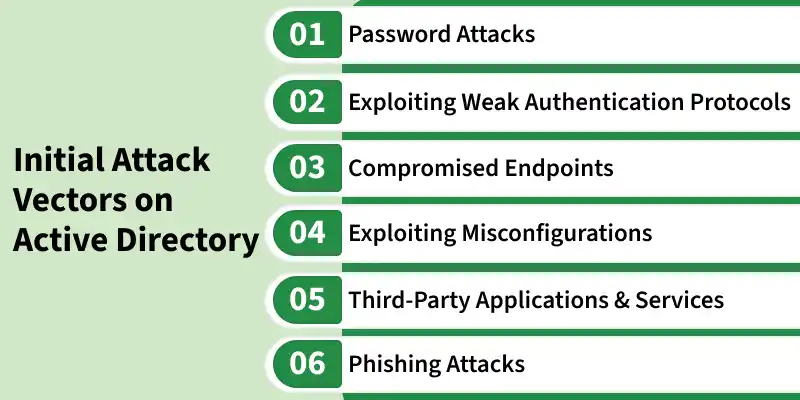
1. Phishing Attacks
Phishing remains one of the most common attack vectors against Active Directory environments.
- Attackers send fake emails containing malicious links or attachments.
- Victims unknowingly provide login credentials or execute malware.
- Stolen credentials are then used to access domain resources.
2. Password Attacks
Weak passwords provide attackers with easy access to AD accounts.
- Brute Force and Dictionary Attacks: Attackers repeatedly test password combinations until they successfully authenticate.
- Password Spraying: Attackers try commonly used passwords across multiple accounts to avoid lockouts.
3. Exploiting Weak Authentication Protocols
Legacy or misconfigured authentication mechanisms are frequently abused.
- NTLM Relay Attacks: Attackers capture NTLM authentication requests and relay them to other services without cracking passwords.
- Kerberos-Based Attacks: Techniques such as Pass-the-Ticket and Kerberoasting allow attackers to abuse Kerberos tickets and extract service account credentials.
4. Compromised Endpoints
Endpoints infected with malware often become the starting point of an AD compromise.
- Keyloggers can capture usernames and passwords.
- Credential dumping tools such as Mimikatz extract cached credentials from memory.
- Infected systems can provide lateral movement opportunities across the domain.
5. Exploiting Misconfigurations
Poor security configurations create unnecessary attack paths.
- Excessive administrative privileges increase exposure.
- Weak delegation settings may allow privilege escalation.
- Unpatched systems can be exploited using publicly known vulnerabilities.
6. Physical Access Attacks
Direct physical access can bypass many logical security controls.
- Stolen devices may contain cached credentials.
- Attackers can use bootable USB devices to extract sensitive information.
- Unsecured domain controllers are high-value physical targets.
7. Third-Party Applications & Services
Applications integrated with Active Directory can introduce additional risks.
- Weakly secured service accounts are often targeted.
- Applications with excessive permissions may expose sensitive resources.
- Forgotten or outdated services can provide hidden entry points.
Common Strategies Used in Active Directory Attacks
After gaining initial access, attackers often use specific techniques to expand control within the environment.
1. Credential Capture Through Network Poisoning
Attackers use tools such as Responder or mitm6 to intercept authentication traffic and capture NTLMv2 hashes.
- LLMNR and NBT-NS poisoning are commonly abused.
- Captured credentials may be relayed to SMB or LDAP services.
- Attackers may escalate privileges without cracking passwords.
2. Triggering Authentication Requests
Attackers generate network activity to force systems to authenticate.
- Tools like Nmap and CrackMapExec help identify exposed services.
- Authentication traffic can reveal reusable credentials.
- Network scanning may expose vulnerable systems and shares.
3. Hunting Internal Web Applications
Internal applications are often overlooked during security reviews.
- Attackers search for exposed admin portals and dashboards.
- Weak or default credentials are frequently abused.
- Poorly secured web services can provide direct access into the domain.
4. Exploiting Weak Credentials
Weak passwords remain a major security issue in enterprise environments.
- Default credentials are common on printers, monitoring tools and legacy systems.
- Credential spraying is often used against administrative interfaces.
- Shared passwords increase the impact of credential theft.
5. Abusing Misconfigured Services
Misconfigured services and policies create hidden attack opportunities.
- Group Policy Preference (GPP) passwords stored in SYSVOL can expose credentials.
- SMB shares may contain scripts, backups or configuration files with passwords.
- Kerberoasting can target service accounts with weak passwords.
Active Directory Target
Active Directory is considered one of the most critical assets in enterprise environments because it controls identity and access management across the organization.
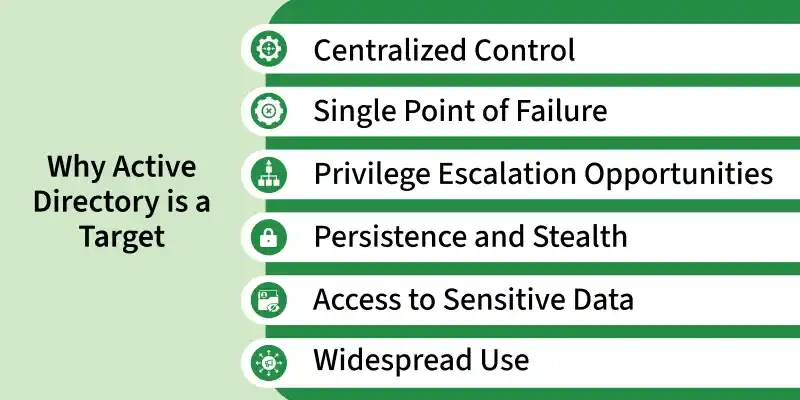
- Centralized Access Control: AD manages authentication and authorization for users, systems and applications from a single platform.
- Privilege Escalation Opportunities: Attackers often move from standard user accounts to privileged accounts such as Domain Admins to gain full control over the environment.
- Widespread Use: Since most enterprises rely on Active Directory, attackers focus on it because it maximizes their potential impact.
- Access to Sensitive Data: AD connects to critical resources like file servers, databases and email systems.
- Persistence and Stealth: AD allows attackers to create backdoors, add hidden users or modify group policies.
Best Practices to Reduce Initial Attack Risks in Active Directory
Organizations can strengthen Active Directory security by implementing the following measures:
- Enforce strong password and account lockout policies.
- Disable outdated protocols such as LLMNR and unnecessary NTLM usage.
- Regularly patch domain controllers and connected systems.
- Monitor authentication logs and suspicious activities.
- Secure service accounts with strong, managed passwords and MFA.
- Restrict administrative access and network exposure.
- Conduct periodic AD security audits and penetration testing.
