

Cybersecurity in critical infrastructure focuses on protecting essential systems and networks that support modern society from cyber threats and disruptions.
- Uses network segmentation, access control, encryption, and multi-factor authentication (MFA) to strengthen security.
- Integrates IT and OT security to protect industrial control systems (ICS), SCADA systems, and other critical operational environments.
Cybersecurity in Critical Infrastructure Threat Landscape
Cyber threats may compromise critical infrastructure and can come in many different forms, such as:
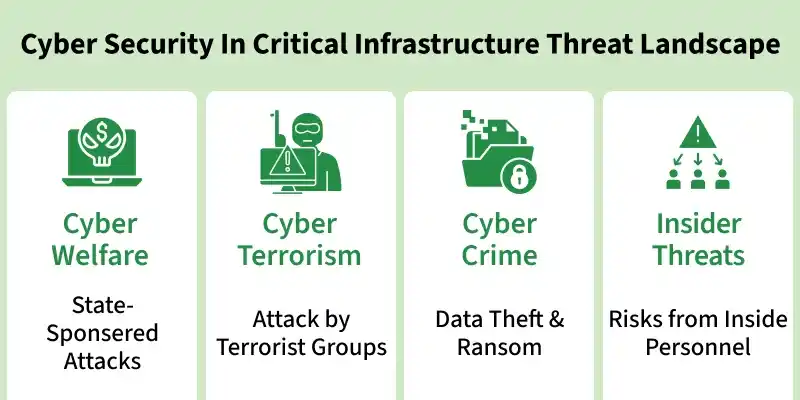
- Cyber Warfare: State-sponsored threat actors conduct cyber espionage, disruption or destructive attacks against critical infrastructure, government systems and strategic assets.
- Cyber Terrorism: Non-state actors use cyberattacks to disrupt services, spread fear and undermine public confidence in critical systems.
- Cyber Crime: Organized cybercriminal groups exploit security vulnerabilities to steal data, commit financial fraud, deploy ransomware or disrupt services.
- Insider Threats: Authorized users, whether malicious or negligent, compromise security by abusing privileges, mishandling sensitive data or enabling unauthorized access.
Major Challenges in Cybersecurity for Critical Infrastructure
Challenges of cybersecurity for critical infrastructure, which include:
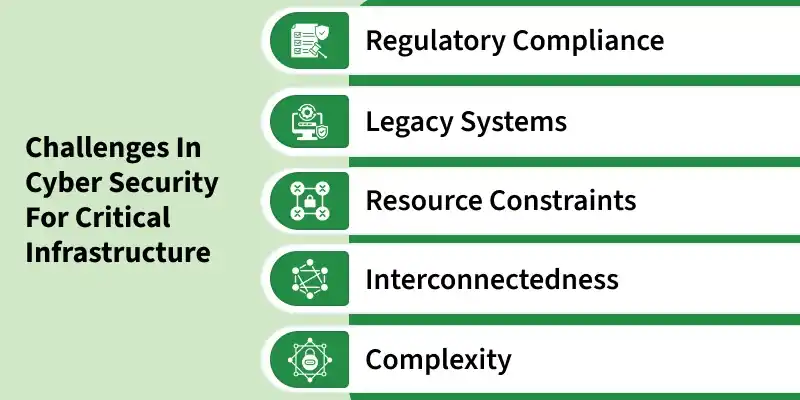
- Regulatory Compliance: Organizations must align cybersecurity programs with evolving regulatory requirements, industry standards and compliance frameworks while maintaining operational continuity.
- Legacy Systems: Outdated operational technologies and legacy systems often lack modern security controls, making them vulnerable to exploitation and difficult to secure or patch.
- Resource Constraints: Limited budgets, skilled personnel and cybersecurity resources can hinder the implementation of effective security controls and risk management strategies.
- Interconnectedness: Highly interconnected networks increase the attack surface, allowing compromises in one system to potentially impact multiple dependent systems.
- Complexity: Critical infrastructure environments consist of diverse technologies, stakeholders and integrated systems, making security management and threat mitigation more challenging.
Examples of Cybersecurity in Critical Infrastructure
1. Transportation Security
Transportation systems such as airports, railways, seaports and traffic management networks rely on cybersecurity controls to ensure safe and uninterrupted operations.
- Encrypted Communications: Protects data exchanged between control centers, vehicles and operational systems.
- Multi-Factor and Biometric Authentication: Verifies the identity of personnel accessing critical systems and restricted areas.
- Network Segmentation: Separates operational technology (OT) systems from corporate IT networks to reduce attack exposure.
- Access Control Systems: Restricts access to sensitive infrastructure, control rooms and operational platforms.
2. Power Grid Protection
Electric power grids depend on cybersecurity mechanisms to maintain the reliability, stability and availability of electricity generation and distribution systems.
- Firewalls and Intrusion Detection Systems (IDS): Monitor and filter unauthorized network traffic.
- Security Information and Event Management (SIEM): Collects and analyzes logs to identify potential threats in real time.
- Continuous Network Monitoring: Detects abnormal activities affecting SCADA and industrial control systems.
- Vulnerability Assessments and Penetration Testing: Identifies and mitigates security weaknesses before exploitation.
Cybersecurity in Critical Infrastructure Best Practices
Best practices of cybersecurity in critical infrastructure, which include:
- Risk Assessment: Conduct continuous risk assessments to identify vulnerabilities, evaluate threats and prioritize security controls based on risk levels.
- Defense-in-Depth: Implement layered security controls, including firewalls, intrusion detection systems (IDS), encryption and access management, to strengthen overall resilience.
- Incident Response Planning: Establish and regularly test incident response procedures to enable rapid detection, containment, eradication and recovery from cyber incidents.
- Collaboration and Information Sharing: Participate in threat intelligence sharing and public-private partnerships to improve situational awareness and collective cyber defense.
- Employee Training: Provide ongoing cybersecurity awareness training to reduce risks associated with phishing, social engineering and human error.
