

Vision Language Models (VLMs) are AI models that process both images and text to understand the relationship between visual and textual information. They enable machines to perform tasks that require reasoning across both modalities.
- Learn semantic relationships between images and language.
- Support tasks such as image captioning, visual question answering, and image retrieval.
- Generate text-based outputs from visual inputs and vice versa.
- Leverage large-scale image-text datasets for training.
- Commonly use transformer-based architectures for multimodal learning.
Types of Vision Language Models
Vision Language Models can be categorized based on how they process and connect visual and textual information.
1. Vision-to-Text Models
Vision-to-text models focus on generating textual descriptions or answering questions based on visual inputs. Key examples include:
Image Captioning
Image captioning automatically generates a natural language description of an image by identifying objects, scenes, and their relationships. Example:
- Input Image: Dog running on a beach
- Output: "A dog running on the beach."
Visual Question Answering (VQA)
Visual Question Answering takes an image and a question about the image as input and generates an appropriate text-based answer. Example:
- Image: Dog
- Question: What color is the dog?
- Answer: Brown
2. Text-to-Vision Models
Text-to-vision models generate or modify visual content based on textual descriptions.
Text-to-Image Generation
These models create images from natural language prompts. Example:
- Prompt: A sunset over the ocean
- Output: Generated image of a sunset scene
Text-Driven Image Manipulation
These models modify existing images according to text instructions, such as changing colors, objects or backgrounds. Example:
- Instruction: Change the background to a sunset
- Output: Modified image with a sunset background
3. Cross-Modal Retrieval Models
Cross-modal retrieval models use one type of data, such as text or images, to search and retrieve information from another modality.
Image Search Using Text
Allows users to retrieve relevant images using textual queries. Example:
- Query: Mountain view
- Output: Images of mountains
Text Search Using Images
Uses an image as input to retrieve related text, descriptions, or documents. Example:
- Input: Image of a car
- Output: Related descriptions or articles about cars
Popular Vision-Language Models
- CLIP (Contrastive Language–Image Pretraining): Developed by OpenAI, CLIP learns relationships between images and text using contrastive learning and can perform tasks such as image retrieval and zero-shot classification.
- ALIGN (A Large-scale ImaGe and Noisy-text Embedding): Developed by Google, ALIGN learns image-text representations from large-scale image and text data to improve cross-modal understanding.
- ViLT (Vision-and-Language Transformer): ViLT is a transformer-based Vision-Language Model that simplifies vision-language processing by reducing reliance on computationally expensive image encoders.
Working of Vision-Language Models
Vision-Language Models process visual and textual information together to understand multimodal inputs and generate meaningful outputs.
1. Visual Feature Extraction: The input image is processed using a vision encoder such as a Convolutional Neural Network (CNN) or Vision Transformer (ViT) to extract important visual features.
2. Text Processing: The text input is processed using a language model or transformer, which converts words into numerical representations that can be understood by the model.
3. Multimodal Fusion: The visual and textual features are combined into a shared representation, allowing the model to learn relationships between images and text.
4. Task Execution: The fused information is used to perform tasks such as:
- Image Captioning
- Visual Question Answering
- Image Retrieval
- Text-to-Image Generation
Implementing
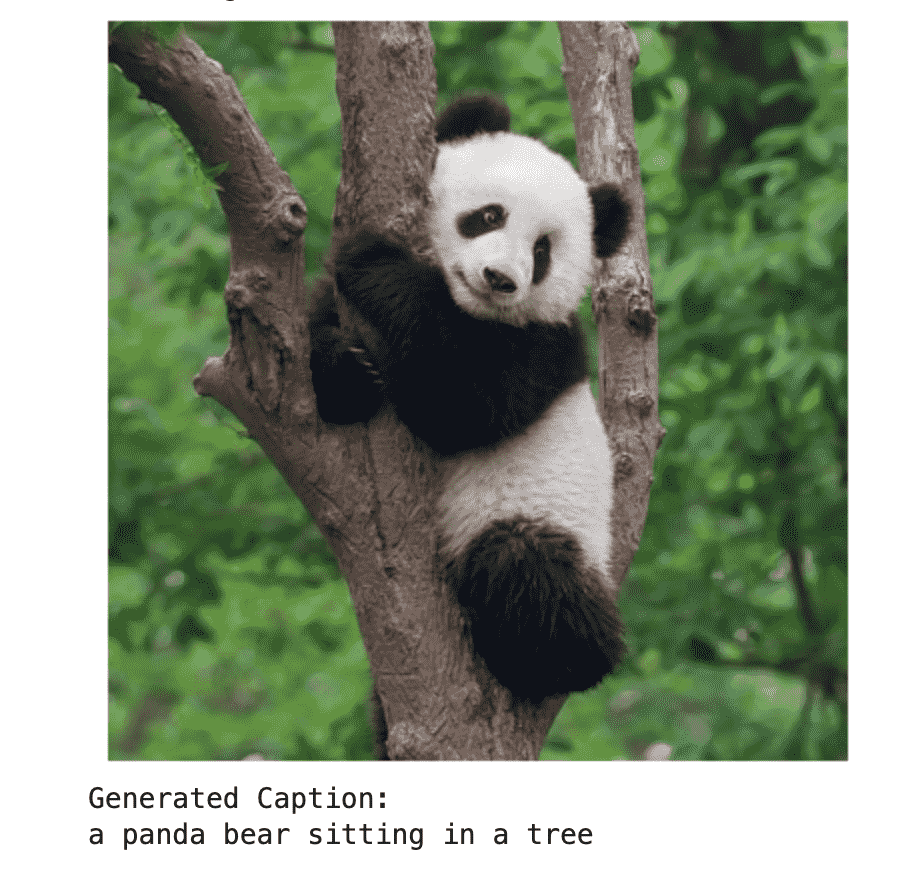
This example uses the BLIP (Bootstrapping Language-Image Pre-training) model to generate a caption for an image.
1. Install Required Libraries
Run the following command in your command prompt
pip install transformers pillow torch
2. Import Required Libraries
- BlipProcessor prepares the image for the model.
- BlipForConditionalGeneration loads the pre-trained BLIP model.
- Image is used to read images.
from transformers import BlipProcessor, BlipForConditionalGeneration
from PIL import Image
import matplotlib.pyplot as plt
import requests
3. Load the Pre-trained BLIP Model
- Loads the pre-trained BLIP model.
- The model has already been trained on large image-text datasets.
processor = BlipProcessor.from_pretrained(
    "Salesforce/blip-image-captioning-base"
)

model = BlipForConditionalGeneration.from_pretrained(
    "Salesforce/blip-image-captioning-base"
)
Output:

4. Load the Image
- Reads the input image.
- Converts it to RGB format.
image = Image.open(
    "Image path"
).convert("RGB")
5. Generate Image Caption
- Processes the image.
- Generates a caption using the BLIP model.
- Converts the model output into readable text.
inputs = processor(
    image,
    return_tensors="pt"
)

output = model.generate(
    **inputs
)

caption = processor.decode(
    output[0],
    skip_special_tokens=True
)

plt.imshow(image)
plt.axis("off")
plt.show()

print("Generated Caption:")
print(caption)
Output:
Download full code from here
Applications
- Generate captions and descriptions for images.
- Answer questions based on image content.
- Improve image search and retrieval systems.
- Assist visually impaired users through image understanding.
- Support medical image analysis and report generation.
- Enable multimodal AI assistants and chatbots.
- Create images from text descriptions.
Advantages
- Combines visual understanding and language reasoning.
- Supports multiple tasks using a single model.
- Learns rich relationships between images and text.
- Improves human computer interaction through multimodal understanding.
- Can generalize to a wide range of vision language tasks.
Limitations
- Requires large datasets and significant computational resources.
- Training and deployment can be expensive.
- May inherit biases present in training data.
- Performance can decrease on complex or unseen scenarios.
- Interpretation of model decisions can be challenging.
