

CLIP (Contrastive Language-Image Pretraining) is a multimodal AI model that learns the relationship between images and text. By training on image–text pairs, it can understand visual content through natural language descriptions and perform image recognition without task-specific training.
- Uses contrastive learning to distinguish matching and non-matching image–text pairs.
- Combines an image encoder and a text encoder to process visual and textual inputs.
- Enables zero-shot image classification using natural language prompts.
Key Features
- Multimodal Training: Learns from image–text pairs to build a shared understanding of visual and textual information.
- Zero-Shot Learning: Classifies images into new categories without additional training or fine-tuning.
- Self-Supervised Learning: Learns by distinguishing matching and non-matching image–text pairs instead of relying on manually labeled datasets.
Working
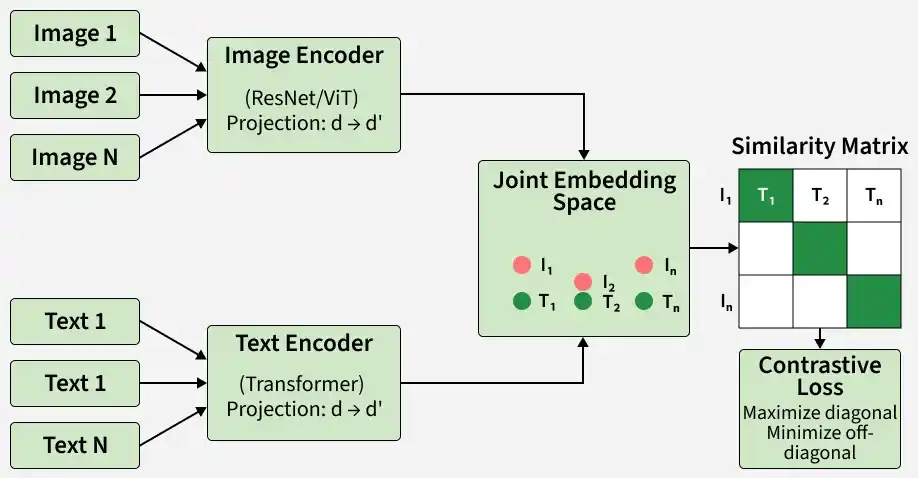
1. Text Encoder
CLIP uses a Transformer-based text encoder to convert text into dense embeddings that capture semantic meaning. The encoder contains 63 million parameters, 12 layers, and 8 attention heads.
2. Image Encoder
CLIP uses an image encoder to convert images into feature embeddings. It experimented with both ResNet and Vision Transformers (ViT), with ViT showing superior performance in image understanding.
3. Dataset
CLIP was trained on about 400 million image–text pairs collected from the web. The dataset, called WebImageText (WIT), covers around 500,000 words by focusing on terms frequently appearing in English Wikipedia, enabling strong generalization across diverse concepts.
4. Training Objective
CLIP learns to align image and text embeddings so that matching pairs are similar and non-matching pairs are far apart in a shared space.
- Cosine Similarity: Maximizes similarity for correct pairs and reduces it for incorrect ones.
- Shared Projection Space: Maps image and text embeddings into the same dimensional space for comparison.
- Contrastive Learning: Trains the model to distinguish between matching and non-matching image–text pairs.
- Loss Function: Uses cross-entropy loss to strengthen correct matches and suppress incorrect ones.
- Inference: Computes similarity scores between image and text embeddings to find the best match.
Applications
- Image Generation: Used in models like DALL·E 3 and MidJourney to align text prompts with image embeddings for better text-to-image generation.
- Image Segmentation: Helps models like SAM interpret prompts and improve region-based image understanding.
- Content Moderation: Detects harmful or inappropriate content by matching images with textual descriptions of policy violations.
- Semantic Search: Enables accurate text-to-image and image-to-text retrieval using shared embeddings.
- Visual Question Answering (VQA): Answers questions about images by linking visual features with natural language queries.
Advantages
- Zero-Shot Capability: Can classify images into new categories without additional training.
- Strong Multimodal Understanding: Effectively connects visual content with natural language.
- Flexible Applications: Works across classification, search, generation, and reasoning tasks.
- Reduces Label Dependency: Learns from image–text pairs without requiring manual annotations for every class.
- High Generalization: Performs well on diverse datasets and unseen concepts.
Limitations
- Bias in Training Data: Can inherit biases from web-sourced image–text pairs, leading to unfair or skewed associations.
- Limited Complex Reasoning: Struggles with fine-grained visual understanding and deep contextual reasoning.
- Data Dependency: Performance depends heavily on the quality and diversity of training data.
- High Computational Cost: Requires significant resources for training and deployment, limiting accessibility.
