United States of America (USA) Flag Color Codes with HEX, RGB, CMYK & Pantone
- Old Glory Red: #B31942
- White: #FFFFFF
- Old Glory Blue: #0A3161
The American flag has 3 primary colors, which are red, white and blue. The table below has the common and popular codes of these colors in HEX, RGB and CMYK formats along with Pantone (PMS), RAL and NCS (Natural Color System). Please note that HEX and RGB codes are to be used for digital works and web pages (including HTML and CSS) while the CMYK values are for printers. The United States of America (USA) flag is known as Stars and Stripes, Old Glory and the Star-Sprangled Banner.



| Hex | B31942 |
| RGB | 179, 25, 66 |
| CMYK | 0, 100, 66, 13 |
| Pantone | 193 • |
| RAL | 3027 |
| Download | |
| Hex | FFFFFF |
| RGB | 255, 255, 255 |
| CMYK | 0, 0, 0, 0 |
| Pantone | N. A. • |
| RAL | N. A. |
| Download | |
| Hex | 0A3161 |
| RGB | 10, 49, 97 |
| CMYK | 100, 68, 0, 54 |
| Pantone | 281 • |
| RAL | 5026 |
| Download | |
Red, white and blue, the three colors in the American flag, stand for hardiness and valour, purity and innocence and vigilance, perseverance, and justice, respectively. Also, specially in case of state flags, the meaning associated with the colors are generally endorsed by an official charter. However, at times the symbolism is simply understood by being descended from the culture of the land or has seeped so deeply into customs that, now, the two are inextricably linked. Please also note that there can be more than one meaning for the colors in the United States of America (USA) flag.
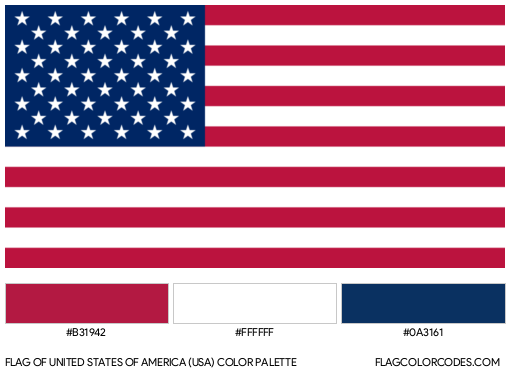
Download the American flag Color Palette image along with the color hex codes as a single image. These are the suggested colors to be used for digital media. For print and spot color values, please refer to the information above. The Pantone® (PMS) values and RAL.
Download Palette










Red, blue and yellow are the three primary colors. White is the absence of color and black is the presence of all colors.
You have black and white exactly backwards. In digital format, irrespective of RGB or CMYK, as in real life, white is the presence of all colors and black the absence of it. As evidence, the RGB hexidecimal code for black is 000000 – literally nothing – and white, FFFFFF – all values maxed out. IRL, hold a prism to sunlight and it refracts into color bans. The practical inverse shouldn’t need explanation.
AMERICA FIRST! AMERICA ONLY! 🇺🇸🇺🇸🇺🇸
You’re both partly right. For pigments, white is the absence of all colors and black is the presence of all colors. But for light, white is the presence of all colors and black is the absence of all colors.
The answer depends on whether we are talking about light or physical pigments.
In the RGB additive color model used for screens, black is the absence of emitted light, represented by #000000, while white is all three channels at maximum intensity, represented by #FFFFFF.
Paint, ink, and other pigments use subtractive color mixing. A white surface reflects most visible wavelengths, while pigments absorb portions of the light. Combining pigments generally produces a darker result because more wavelengths are absorbed. CMYK printing even uses a separate black ink because mixing cyan, magenta, and yellow does not usually create a clean, deep black.
So Jim is correct about RGB, but not about CMYK being the same. John’s explanation is closer to traditional pigment mixing, although red, yellow, and blue are the traditional art primaries rather than the scientific subtractive primaries, which are cyan, magenta, and yellow.