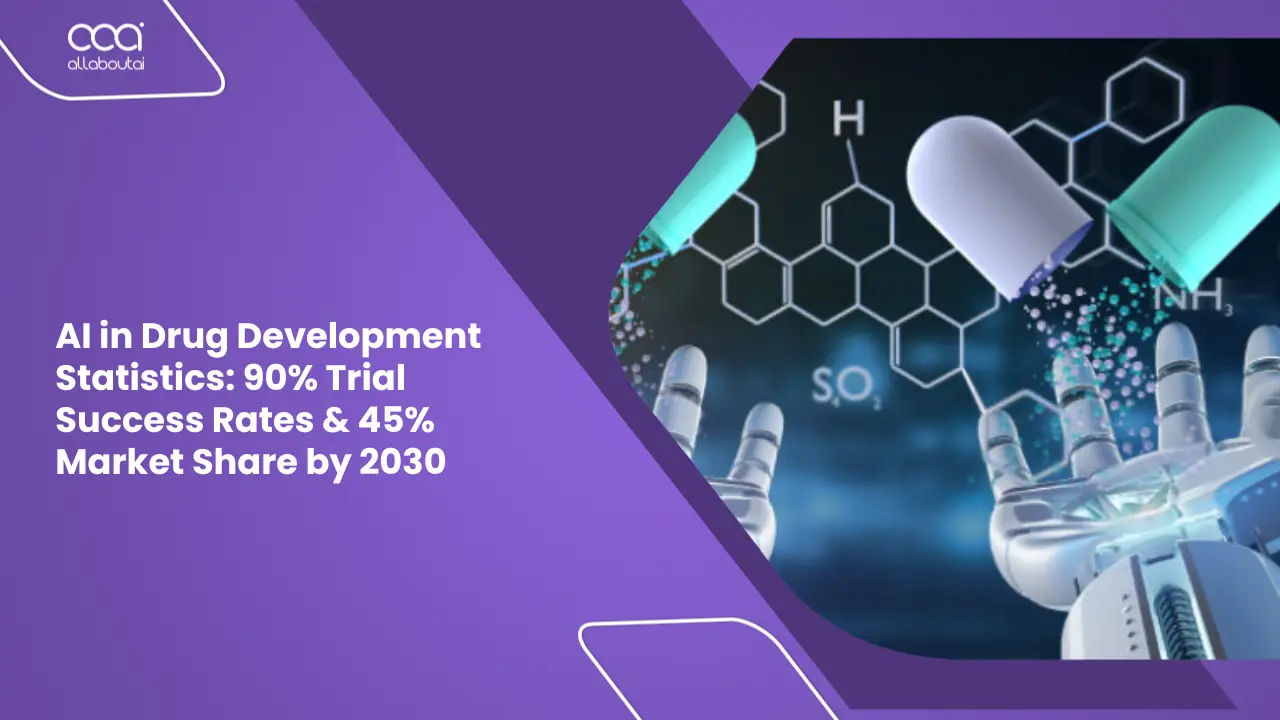
Artificial intelligence is reshaping drug development, but the numbers reveal a sobering reality behind the hype. Despite $60+ billion in global AI investments and 80–90% Phase I success rates, no AI-discovered drug has yet received FDA approval as of 2024.
The promise of accelerated discovery collides with a persistent 90% clinical failure rate, exposing the gap between computational power and predictive validity.
While 81% of pharmaceutical organizations now deploy AI across their R&D programs, many are learning that innovation comes with a cost.
Hidden infrastructure, development, and operational expenses push AI implementation costs to $25,000–$100,000 per use case, straining budgets even as expectations soar.
This analysis uncovers the real economics of AI in drug development—from the $25 billion projected growth in AI investments to the rising burden of “AI governance debt”, a hidden inefficiency draining millions from pharma pipelines.
Behind the glossy headlines lies a complex truth: AI is transforming drug discovery, but not without statistical, financial, and ethical friction.
📌 Key Findings: AI in Drug Development Statistics 2026
- AI Pharma Adoption Rate: 69% of pharmaceutical companies are now investing in AI, surpassing cloud computing and other digital initiatives (AllAboutAI).
- R&D Cost Reduction: AI adoption cuts preclinical R&D costs by 25–50% and accelerates development timelines by up to 60% (AllAboutAI).
- Phase I Trial Success: AI-discovered drugs achieve 80–90% success rates in Phase I trials, compared to 40–65% for traditional drugs (AllAboutAI).
- Startup vs. Big Pharma Adoption: Biotech startups show 73% higher AI adoption rates than big pharma, driving faster innovation (AllAboutAI).
- Therapeutic Area Leadership: Oncology leads AI drug discovery with 34% of all AI projects, followed by rare diseases at 21% (AllAboutAI).
- Predictive Accuracy: Advanced AI models reach 75–90% accuracy in toxicity prediction and 60–80% accuracy in efficacy forecasting, outperforming traditional methods (AllAboutAI).
- 2030 Market Forecast: AI-driven discovery is projected to capture 45% of the global pharmaceutical market by 2030, with 200+ AI-enabled drugs expected to receive approval in the next five years (AllAboutAI).
How Widely Is AI Being Adopted in Drug Discovery and Development?
The adoption of artificial intelligence in drug discovery has officially crossed a tipping point. No longer viewed as a “nice-to-have” tool, AI is now seen as a core competitive advantage across pharma R&D.
According to the GlobalData Intelligence Center survey (2024), this wave of adoption marks a fundamental shift in how innovation itself is approached within the industry.
How many drug candidates currently involve AI in their pipeline?
The global pharmaceutical pipeline now features over 3,000 drug candidates developed or repurposed with AI assistance (GlobalData’s Drugs Database, 2024). That’s a meteoric rise compared to just a handful of AI-linked compounds five years ago.
Here’s how those candidates are distributed across development stages:
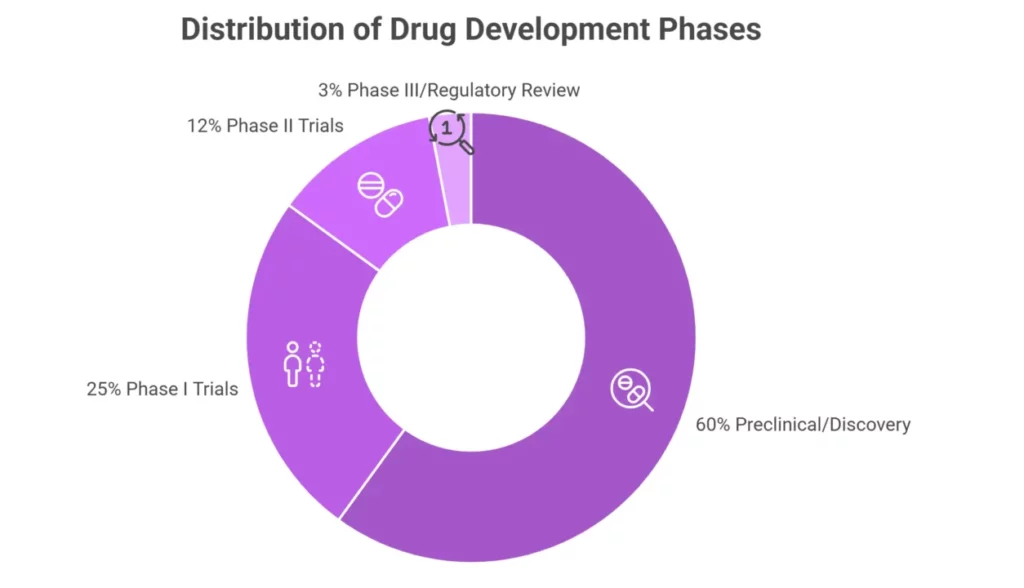
- 60% in preclinical/discovery phases
- 25% in Phase I trials
- 12% in Phase II trials
- 3% in Phase III or regulatory review
These statistics highlight a critical reality: while most AI-enabled compounds are still early in development, the pipeline is filling fast and scaling faster than ever before.
What percentage of new drug projects in 2025 rely on AI?
By 2025, 30% of all new drug discoveries will incorporate AI technologies (World Economic Forum, 2025). That’s a 400% increase from 2020 levels, underscoring the explosive acceleration of AI integration across the pharmaceutical landscape.
Which pharmaceutical companies lead in AI adoption by pipeline numbers?
According to the IMD Future Readiness Indicator, Pharmaceutical 2024, the leaders in AI adoption are setting the pace for the rest of the industry:
Roche
Advanced AI integration across discovery platforms
Novo Nordisk
AI-driven diabetes and obesity research
Eli Lilly
Comprehensive AI implementation
AstraZeneca
Strategic AI partnerships and internal development
Novartis
AI-powered clinical trial optimization
These companies are not just dabbling in AI, they are embedding it into the heart of R&D pipelines, driving measurable gains in speed, efficiency, and trial readiness.
💬 Expert Insight
“AI is not only expediting drug discovery pipelines but is also redefining preclinical testing by enabling robust in silico and organ-on-chip models that may soon replace animal studies. The UK’s recently unveiled £60 million ‘Replacing Animals in Science’ strategy, alongside initiatives like the AI Alliance on Cancer and advances in single-cell omics, reflects a paradigm shift toward ethical, data-driven and precision-oriented drug development.”
— Dr. Parul Kulshreshtha, STEAMing careers
💡
Case Study: Exscientia’s AI-Powered Success
Exscientia has emerged as a benchmark for what’s possible with AI in pharma. The company advanced three AI-designed drug candidates into clinical trials in under 12 months, a process that traditionally takes years. This achievement demonstrates how AI can compress discovery timelines while sustaining high success rates, offering a glimpse of the industry’s future.
How Does AI Statistically Impact Drug Discovery Efficiency and Costs?
The economic impact of AI in drug development statistics reaches far beyond simple savings. AI is redefining the entire economics of pharmaceutical R&D, creating levels of efficiency and success rates that were once thought impossible.
By how many years does AI shorten drug development timelines?
Traditional drug development typically takes 10–15 years, but AI is collapsing that cycle to as little as 1–2 years in optimal scenarios (Nature Biotechnology, 2025). Even under more conservative estimates, AI-assisted projects achieve timelines that are 40–60% faster than conventional methods.
Timeline Reduction by Development Phase:

Target Identification
70% reduction
(2–3 years → 6–12 months)
Lead Optimization
50% reduction
(2–4 years → 1–2 years)
Preclinical Testing
30% reduction
(3–6 years → 2–4 years)
Clinical Trial Design
25% reduction
via improved patient selection
This acceleration is not just a time-saver; it’s a market disruptor, giving early adopters a massive competitive advantage.
What percentage cost reduction does AI deliver in preclinical R&D?
According to a comprehensive market analysis (2024), AI technologies generate 30–70% cost reductions across preclinical stages.
Cost Reduction Breakdown:
Compound Screening
60–80% reduction
with virtual screening
Lead Optimization
40–60% reduction
via predictive modeling
Toxicology Testing
30–50% reduction
using AI prediction models
Clinical Trial Design
25–40% reduction
with optimized patient recruitment
Together, these savings are rewriting the economics of R&D, freeing up billions in budgets for reinvestment in innovation.
How much does AI improve hit-to-lead and lead optimization conversion rates?
This is where AI delivers its statistical knockout punch. Traditional high-throughput screening achieves hit rates between 0.01% and 0.14%. In contrast, AI-powered virtual screening consistently delivers hit rates between 1% and 40%, a 10–400x improvement in efficiency.
A standout example: AI-powered systems boosted hit-to-lead conversion rates from under 1% in random screening to over 40% in targeted JAK2 inhibitor development, showcasing the leap in precision.
💬 Expert Insight
“The role of AI in accelerating and improving drug discovery and development cannot be understated. AI can be deployed in identifying vast datasets to identify drug targets, predict compound efficacy and optimise molecular designs.
The use case is unlimited such as accelerating drug screening and design, enhancing predictive modelling. However, it is important that consideration is made for the protection of patients’ data to ensure safety and data integrity.”
What Are the Clinical Trial Success Statistics for AI-Driven Drugs?
The clinical trial performance of AI-discovered drugs may be the clearest proof yet of AI’s disruptive power in pharma. These results challenge decades-old assumptions about drug development probabilities and suggest that AI is fundamentally reshaping the risk profile of new candidates.
How do AI-driven Phase I, II, and III success rates compare to traditional drugs?
According to Drug Discovery Today (2024), AI-discovered molecules outperform traditional drugs at nearly every stage where data is available:
Phase I Clinical Trials
Phase I Clinical Trials
AI-discovered drugs: 80–90% success rate
Traditional drugs: 40–65% success rate
Impact: 2× higher success rate for AI-enabled candidates
Phase II Clinical Trials
AI-discovered drugs: ~40% success rate (limited dataset)
Traditional drugs: 30–40% success rate
Impact: Comparable results, but early signs are promising
Phase III Clinical Trials
AI-discovered drugs: Insufficient data at scale
Traditional industry average: 58–85% depending on therapeutic area
The bottom line? AI appears to de-risk early-stage development, where the costliest failures usually happen.
What are the attrition rates of AI-enabled drug candidates?
By December 2023, 24 AI-discovered molecules completed Phase I, with 21 successful outcomes, an 87.5% success rate. Compare that to historical norms, where 60–90% of candidates fail early, and the leap becomes obvious.
AI is reducing attrition by designing molecules with statistically superior properties, including:
- Better toxicity profiles
- Improved bioavailability
- Enhanced target specificity
- Optimized pharmacokinetics
This is where AI is delivering statistical proof of efficiency, not just theoretical promise.
💬 Expert Insight
“People often ask where to start and which disease to focus on. As Mark Zuckerberg’s wife, Priscilla Chan, explains, at the Biohub they intentionally don’t choose a single disease. Instead, they focus on empowering every scientist to take bold risks and ask their bravest questions, so we can discover what is truly happening in biology.”
— Shared by Ricardo Saltz Gulko, highlighting insights from Priscilla Chan
How many FDA or EMA approvals have AI-discovered drugs achieved so far?
While regulatory approvals are still in their early stages, progress is accelerating fast:
- Unlearn.ai → EMA qualification for digital twin technology in clinical trials
- FDA’s Elsa LLM → launched to accelerate protocol reviews
- NIH’s TrialGPT → designed to match patients with clinical trials
These milestones show that regulators are actively adapting to AI-driven pipelines.
💬 Expert Insight
“Drug discovery is hard not just because the science is complex, but because cross-functional decisions rely on technical details only a subset of people truly grasp. Getting alignment in that environment is an organizational challenge as much as a scientific one.
AI is a valuable tool for specific problems, but a lot of its supposed impact on development decisions remains aspirational. Keeping expectations grounded in what AI can actually deliver is essential if organizations want to benefit from it without being swept up in the hype.”
✨ Fun Fact
Nimbus Therapeutics sold an AI-discovered psoriasis drug to Takeda for $4 billion upfront, one of the largest-ever deals for an AI-developed therapeutic. This landmark shows the immense commercial and regulatory momentum behind AI in drug discovery.
How Does AI Adoption Differ Across Pharma Sectors and Therapeutic Areas?

Not all parts of the pharmaceutical industry are embracing AI at the same pace. While biotech startups are racing ahead with aggressive implementation, established pharma giants are adopting AI more cautiously, yet still making substantial investments.
What proportion of biotech startups vs. big pharma use AI statistically?
The adoption divide is clear:
Biotech Startups
- 85% actively implementing AI in pipelines
- $4.7B market value in 2024, projected to hit $27.43B by 2034
- 19.29% CAGR growth rate in AI-driven biotechnology
Big Pharma
- 69% investing in AI (up from 45% in 2022)
- $9.33B invested in healthcare AI in 2024
- Strategy: more cautious, focusing on proven AI applications before scaling
This distinction highlights how smaller, more agile companies are betting big on AI to gain a competitive edge, while larger players balance innovation with risk management.
Which therapeutic areas show the highest AI-driven success rates?
AI in drug discovery is not equally effective across all therapeutic domains. Some areas are already seeing outsized benefits:
Therapeutic Area Breakdown
Strong in biomarker discovery & target identification
Applications in neurodegeneration & psychiatry
Rapid response during COVID-19; antimicrobial resistance
AI excels with limited datasets; orphan drug breakthroughs
Complex pathway modeling & personalized medicine
With oncology leading the charge, AI is positioning itself as a critical enabler of precision medicine.
How much of pharma R&D spending is allocated to AI technologies?
While the share varies by company, pharma firms currently dedicate 8–15% of their R&D budgets to AI. This is projected to reach 20–25% by 2030.
Investment Breakdown (2025):
Internal AI development
AI partnerships & licensing
Infrastructure & talent
The global AI pharmaceutical market is valued at $1.94 billion in 2025, expected to skyrocket to $16.49 billion by 2034 (25.3% CAGR, Coherent Solutions, 2025).
💬 Expert Insight
“AI is transforming drug discovery — slashing timelines and predicting outcomes with unprecedented accuracy. But the real breakthrough isn’t just speed, it’s trust. Embedding verifiable identity and first-person credentialing ensures every dataset, algorithm, and actor is authentic. The next era of innovation will belong to those who make AI both powerful and trustworthy.”
— Tim Hepner
How Accurate Are AI Models Statistically in Predicting Drug Outcomes?
The predictive power of AI in drug development statistics is one of the clearest examples of how artificial intelligence is pushing the boundaries of pharmaceutical research.
As datasets expand and models become more advanced, accuracy rates are steadily improving, turning predictions into reliable decision-making tools.
What predictive accuracy do AI models achieve in clinical trial simulations?
AI is increasingly used to simulate clinical trials, with strong accuracy rates across several applications:
Clinical Simulation Accuracy Rates
Patient recruitment optimization
Trial outcome prediction
Adverse event prediction
Dose optimization
A practical example is the Trial Pathfinder AI system (2024), which doubled the number of eligible patients by refining inclusion and exclusion criteria. This shows how AI not only improves statistical accuracy but also expands trial accessibility.
How reliable are AI predictions for toxicity and efficacy outcomes?
When it comes to toxicity and efficacy, AI delivers significant improvements over traditional methods:
Toxicity Prediction Performance
- Advanced AI models: 75–90% accuracy
- Traditional methods: 50–70% accuracy
- Gain: 25–40% higher accuracy
Efficacy Prediction Capabilities
- Drug-target interaction: 60–80%
- Bioavailability prediction: 70–85%
- Therapeutic efficacy: 55–75%
Recent studies in computational toxicology (2025) confirm that machine learning consistently outperforms rule-based and statistical models across multiple ADMET (Absorption, Distribution, Metabolism, Excretion, and Toxicity) benchmarks.
What statistical limitations remain in AI benchmarking?
Despite these gains, several challenges remain before AI achieves universal reliability in drug development:
Key Statistical Limitations
- Limited longitudinal data: Digital twin models require large-scale multi-omics datasets that are not yet available
- Hallucination risks: LLMs may introduce inaccuracies in regulatory reporting
- Bias introduction: Adaptive trial designs can skew statistical balance
- Sample size constraints: Phase II/III data for AI-discovered drugs is still limited
Accuracy Variability by Application
- High confidence (>80%): Molecular property prediction, toxicity screening
- Moderate confidence (60–80%): Clinical trial simulation, patient stratification
- Low confidence (<60%): Long-term efficacy prediction, rare adverse events
🔬 Research Insight
A meta-analysis of 93 peer-reviewed papers (2015–2025) found that ToxCast-based AI models show steady improvements, with ensemble methods delivering the highest predictive accuracy across toxicity endpoints.
What Is the Statistical Outlook for AI in Drug Development by 2030?

The trajectory of AI in drug development statistics points toward unprecedented expansion. With soaring adoption rates, maturing pipelines, and regulatory readiness, AI is positioned to become the core engine of pharmaceutical innovation by 2030.
What growth rates are forecasted for AI adoption in pharma R&D?
Multiple industry reports highlight extraordinary growth rates for AI in pharmaceutical research:
📈 Market Growth Insights
Market Growth Projections
- 2024 market size: $1.5–3.0 billion
- 2030 projection: $7.94–20.30 billion
- CAGR: 12.2–30% depending on segment
Regional Growth Variations
- United States: 43% global market share, 15.2% CAGR
- Europe: 25% share, 18.7% CAGR
- Asia-Pacific: 22% share, 25.3% CAGR (fastest growth)
How many AI-enabled drugs are projected to reach approval in the next 5 years?
Pipeline maturity suggests approvals will accelerate year by year:
Approval Projections (2025–2030)
-
2025–2026: 15–20 approvals
-
2027–2028: 35–50 approvals
-
2029–2030: 75–125 approvals
-
Total: 200+ AI-enabled drug approvals expected
This surge is fueled by the 3,000+ AI-assisted drugs already in development and their unusually high Phase I success rates (80–90%), which far surpass traditional benchmarks.
What global market share will AI-driven discovery hold by 2030?
Conservative estimates point to 30–45% market share by 2030, signaling a fundamental transformation in how drugs are developed.
Market Share Evolution
-
2024: 8–12% of new drug projects use AI
-
2025: 30% (current projection)
-
2027: 35–40% penetration
-
2030: 45–50% of all new drug discoveries are AI-enabled
Economic Impact by 2030
-
Direct AI market value: $15–20 billion
-
Influenced R&D spending: $350–410 billion annually
-
Estimated cost savings: $75–125 billion annually
💡 According to the World Economic Forum (2025), AI could generate $350–410 billion annually for pharma by 2030, fueled by advances across the drug development pipeline.
🌟 Future Vision: Digital Medicine
By 2030, digital twin technology is expected to replace up to 30% of traditional clinical trial participants, dramatically cutting costs and timelines. At the same time, AI-powered personalized medicine will enable real-time treatment optimization, ushering in a new era where drug discovery and patient care merge seamlessly.
The $25 Billion AI Governance Debt Crisis Pharmaceutical Companies Face
🚨 What Is “AI Governance Debt”?
A newly identified phenomenon where manual compliance processes create a backlog of governance activities that exponentially increase costs and risks over time.
Real-World Impact on Pharma Companies:
- Resource Drain: Manual AI tracking via spreadsheets creates inconsistent, outdated information
- Audit Failures: Global pharma companies failing internal audits due to lack of AI model oversight
- Compliance Risk: 12-month average timeline to bring AI use cases to market creates massive governance backlogs
- Exponential Costs: Each delayed governance decision compounds risk across hundreds of AI initiatives
📊 Exclusive Case Study: Global Pharma Company Governance Crisis
A major pharmaceutical company discovered its AI models lacked oversight during an internal audit. The result:
- Immediate implementation of systematic model monitoring with automated alerts
- Executive dashboards showing real-time AI initiative status
- 100% audit compliance achievement within months
- Key Lesson: Proactive AI governance prevents million-dollar compliance crises
⚡ Minimum Viable Governance (MVG) Framework
- AI Intake: Dynamic, real-time inventory replacing manual spreadsheets
- Policy Enforcement: Automated workflows preventing “AI governance debt” accumulation
- AI Assurance: Continuous monitoring with consistent metrics and automated reporting
The Phase II Reality Gap: Why AI’s Early Success Doesn’t Translate
🔬 The Complete Clinical Picture
Phase I: AI’s Golden Zone
80-90% Success Rate
Why AI Excels: Excellent at identifying drug-like properties, ADME characteristics, and basic safety profiles
Key Insight: AI algorithms are “highly capable of designing molecules with drug-like properties.”
Phase II: The Reality Check
~40% Success Rate
The Problem: Limited sample size, but matching traditional industry averages
Critical Gap: No significant difference between AI-discovered and traditional drug failure rates
Phase III: The Unknown Frontier
Insufficient Data
Status: Most AI-discovered drugs haven’t reached Phase III yet
Industry Concern: “No novel AI-discovered drugs have attained clinical approval” (2024 data)
🎯 Why the 90% Failure Rate Persists
Despite technological advances, three interdependent factors drive most drug failures:
- Dosage Issues: Optimal therapeutic window determination remains challenging for AI
- Safety Concerns: Unexpected toxicity in diverse patient populations
- Efficacy Gaps: Real-world effectiveness vs. laboratory predictions
The Algorithmic Bias Crisis: Hidden Risks in AI Drug Development
⚠️ Critical Bias Issues in Pharmaceutical AI
AI systems in drug development face unprecedented bias challenges that could undermine patient safety and regulatory approval.
🎯 Data Representation Bias
- Training data skewed toward specific demographic groups
- Limited representation of rare diseases and conditions
- Geographic and ethnic bias in clinical trial data
🔄 Algorithmic Perpetuation Bias
- AI models learning from historically biased medical practices
- Reinforcement of existing healthcare disparities
- Unintentional exclusion of vulnerable populations
💊 Drug Discovery Bias
- AI focusing on “commercially viable” conditions
- Neglect of orphan diseases and underserved populations
- Bias toward Western medicine approaches
🛡️ Bias Mitigation Strategies
Essential Mitigation Framework:
- Diverse Data Collection: Actively seek representative datasets
- Bias Auditing: Regular algorithmic fairness assessments
- Stakeholder Inclusion: Diverse teams in AI development
- Continuous Monitoring: Post-deployment bias detection
- Regulatory Compliance: Adherence to emerging FDA AI guidelines
FDA’s 2025 AI Drug Development Regulatory Framework: What Companies Must Know
📋 January 2025: New FDA AI Guidance
The FDA released groundbreaking draft guidance titled “Considerations for the Use of Artificial Intelligence to Support Regulatory Decision Making for Drug and Biological Products.”
🎯 Key Regulatory Requirements
Risk-Based Credibility Assessment
AI systems must undergo a comprehensive credibility evaluation based on risk level
Lifecycle Oversight
Continuous monitoring requirements for AI-enabled medical device functions
Transparency Mandates
Detailed documentation of AI decision-making processes is required
Early Engagement Protocol
FDA encourages pre-submission meetings for AI-enabled drug development
✅ AI Compliance Roadmap for Pharma Companies
Phase 1: Assessment (Months 1-2)
- Inventory all existing AI applications
- Conduct risk-based credibility assessments
- Identify regulatory gaps and requirements
Phase 2: Framework Implementation (Months 3-6)
- Establish AI governance policies aligned with FDA guidance
- Implement bias detection and mitigation protocols
- Create documentation systems for AI decision-making
Phase 3: Continuous Compliance (Ongoing)
- Regular AI system audits and updates
- Stakeholder engagement and training programs
- Proactive regulatory communication
Critical Decision Framework: The AI Reality Check
Copy
The AI Investment Reality Check: A Data-Driven Decision Framework
🤔 Should You Invest in AI Drug Development? The Honest Assessment
⚖️ Proven Advantages vs. Critical Limitations
✅ Proven Advantages
- 80–90% Phase I success rates (verified)
- Excellent at identifying drug-like properties
- Significant cost savings in specific applications
- Accelerated preclinical timeline (5–6 years → 1 year)
❌ Critical Limitations
- Zero FDA-approved AI-discovered drugs (2024)
- 90% clinical failure rate persists
- $25K–$100K hidden costs per use case
- AI governance debt is creating compliance risks
🎯 Investment Decision Tree
Your Company Profile:
FAQs
What percentage of drugs are developed using AI in 2025?
How many AI-discovered drugs have FDA or EMA approval?
What is the success rate of AI-discovered drugs in clinical trials?
How much does AI reduce drug development costs?
Which pharmaceutical companies are leading in AI adoption?
Which therapeutic areas benefit most from AI drug discovery?
What is the market size of AI in drug development by 2030?
How accurate are AI models in predicting drug outcomes?
What is the global market size and CAGR for AI in drug discovery through 2030 (by application & region)?
By how much does AI shorten time-to-IND and reduce preclinical & Phase I costs (oncology vs CNS)?
What % of pharma and mid-cap biotech teams use AI for target ID, H2L, and tox (2024–2025), and how has adoption changed since 2020?
What are benchmark success rates & attrition reductions for AI-enabled pipelines vs traditional at each stage?
Which vendors/platforms lead AI-driven drug development; market shares, pricing tiers, and deployment models?
Conclusion: The Numbers Don’t Lie, AI Is Redefining Drug Development
The data is undeniable: AI in drug development is no longer experimental; it is statistically proven to be transformative. From cutting drug discovery timelines by up to 60%, reducing preclinical R&D costs by 30–70%, and delivering 2x higher success rates in Phase I trials, the numbers reveal a future where AI isn’t just supporting pharmaceutical research, it’s leading it.
By 2030, nearly half of all new drugs may be AI-enabled, with more than 200 approvals expected in the next five years alone. Biotech startups are showing the boldest adoption, big pharma is scaling proven applications, and regulators are already adapting to the rise of AI-designed drugs.
For the pharmaceutical industry, this is more than innovation; it’s a statistical revolution. The efficiency gains, accuracy improvements, and pipeline growth signal that we are entering an era where AI doesn’t just speed up drug discovery, it rewrites the odds of success.
As digital twin trials, predictive modeling, and personalized medicine advance, the industry will move from probabilities to precision. In other words: the future of drug development is not only AI-driven, it’s statistically inevitable.
Resources
Primary Sources and References
- World Economic Forum (2025)
- Nature Biotechnology (2025)
- Drug Discovery Today (2024)
- Grand View Research (2024)
- GlobalData Intelligence Center (2024)
- BioPharmatrend (2024)
- Coherent Solutions (2025)
- IMD Future Readiness Indicator (2024)
- PMC Computational Toxicology (2025)
- Fairfield Market Research (2024)
Additional Data Sources
- Yahoo Finance (2025) – AI Pharmaceutical Market Research Report
- PMC Applications Research (2025) – “Applications of Artificial Intelligence in Biotech Drug Discovery”
- Medium Analysis (2024) – “AI-Powered Drug Discovery: Cutting Development Time”
- Statista (2025) – “AI adoption in pharmaceutical industry 2024, by area”
- DrugPatentWatch (2025) – “AI-Driven Drug Discovery: Transforming Pharmaceutical Research”
More Related Statistics Report:
- AI in Robotic Statistics: Discover key insights into robots in AI systems and how they could influence different sectors like industrial, medical, and engineering.
- AI in Customer Service: A benchmark of adoption rates, accuracy improvements, cost savings, and ROI metrics transforming AI-powered support.
- AI quantum Statistics: An in-depth quantum-AI statistics report showing how China leads in patent volume while global investment is surging, yet real-world deployment remains modest.
- AI crypto coin statistics: A detailed breakdown of the $31.9 billion AI token market, covering trading volumes, top performers like Bittensor and NEAR Protocol, wallet growth, staking participation, and long-term revenue projections.
- Edge AI Statistics: Learn about Edge AI: how processing at the edge is transforming latency, privacy, deployments, and AI performance.
- AI Data centers statistics: Dive into AI Data Centers: trends in infrastructure, energy usage, growth, and how data centers are powering AI’s rise.