Claude
 Cursor
 Codex
 Hugging Face
 NVIDIA
 Visual Studio Code
 Devin
 Kiro
 Open Code
 NanoClaw

 Docker
 npm
 PyPy
 Wiz

 Financial Services
 Gaming
 Public Sector
 Automotive
 Technology
 Healthcare


Prove CERT-In Compliance Continuously
The Indian Computer Emergency Response Team (CERT-In) gives you 6 hours to report from the moment you detect an incident. With JFrog, your evidence is ready before that clock starts.
The Cost of Getting CERT-In Wrong

Financial: Fine of Up to ₹1 Crore
You have 6 hours to report an incident to CERT-In. Non-compliance with CERT-In directions can carry a fine of up to ₹1 crore.

Business: No Government Contract
Government contracts require SBOM coverage as a condition of award. An incomplete SBOM disqualifies the bid and your standing in every review cycle that follows impacting current and future business.
Personal: Liability for Executives
When a company breaches a CERT-In direction, the executives in charge are also subject to scrutiny and can face up to one year in prison, unless they prove they exercised due diligence.
Your Current Processes Leave Three Gaps CERT-In Will Expose
Your SBOM Stops at Build Time
Your build-time SBOM captures one snapshot. It reveals nothing about software running in production months later. CERT-In guidelines recommend a living component record across the entire lifecycle of software being deployed.
Your Incident Records Live in Logs, Not Reports
Your evidence sits in scattered tools. Your 6-hour reporting window becomes a frantic search. CERT-In’s window keeps running while your team hunts through disconnected logs, reducing the likelihood of complete evidence.
Your Third-Party and Fourth-Party Software Has No SBOM
Your source code scanners see only the code you write. CERT-In requires a complete SBOM for your entire supply chain. That includes vendor software and pre-compiled binaries that ship without source code, whether built by humans or AI. You cannot scan what you cannot inventory. An auditor can find that blind spot before you do.
CERT-In Requirements, Mapped to JFrog Capabilities
JFrog is a System of Record with a governance layer built in, so each requirement below ties to evidence.
SBOM Generation and Component Documentation
Continuous SBOM per Release
Vulnerability Handling and VEX
Continuous Monitoring and Release Gating
Incident Evidence and Reporting Records
Ready-Made Evidence for Reporting
SDLC Policy Gates and Third-Party Screening
Policy-Based Component Screening
Third-Party and Binary Software Coverage
Binary Scanning Without Source Code
Supply Chain Provenance and Build Traceability
Build-Info Chain of Custody
SBOM Governance and Access Control
RBAC and SBOM Distribution Controls
From CERT-In Guidelines to Automated Enforcement and Evidence-based Releases with JFrog AppTrust
Block Non-Compliant Releases Before They Ship
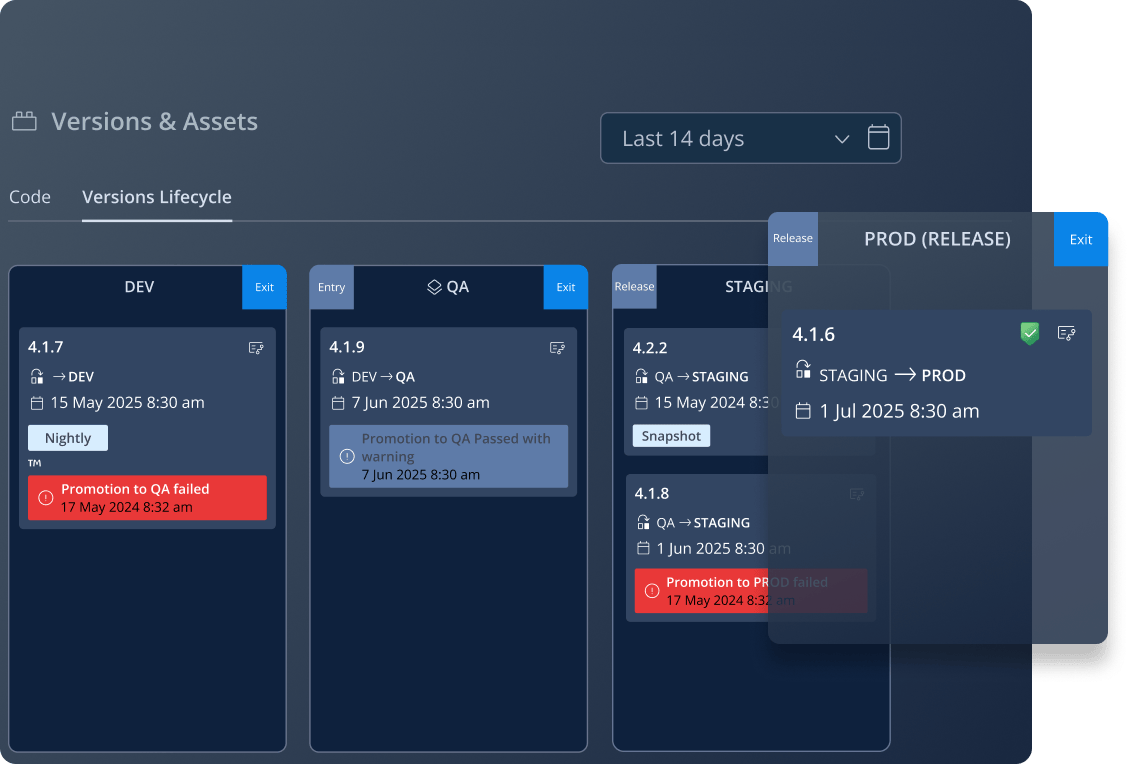
Automated policy gates evaluate every promotion across PR, build, and release. Any build with unresolved CVEs, missing SBOM fields, or undeclared components is blocked before reaching production.
Pull Complete Evidence for Any Release, Instantly
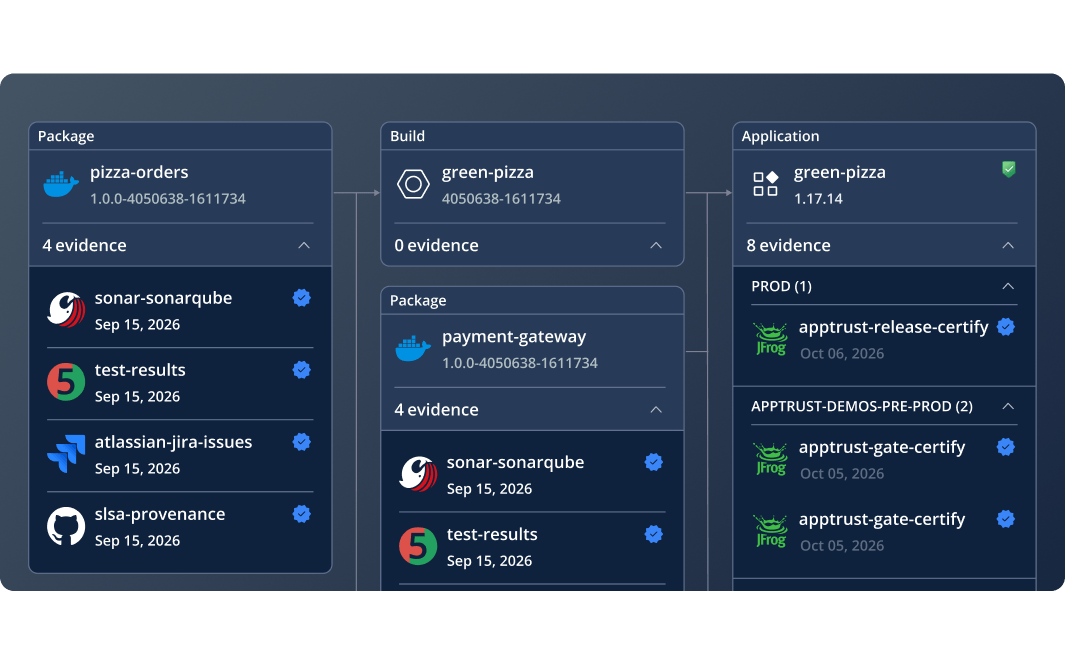
AppTrust automatically binds SBOMs, VEX, test results, and provenance into a single signed record as you build. When auditors ask, complete release evidence is instantly ready. No manual assembly of spreadsheets or screenshots is required.
Frequently Asked Questions
CERT-In obligations under the Information Technology Rules apply to service providers, intermediaries, data centres, body corporates, and government organizations operating in India, including operators of critical information infrastructure. The 2022 directions expanded the scope to cover service providers, data centers, and body corporates operating in India, with a 6-hour window to report incidents from the moment of detection. If your organization processes data, operates systems, or delivers services in India, CERT-In obligations apply to you.
Yes. CERT-In obligations apply based on where you operate and deliver services, not where your organization is incorporated. If your organization offers services to users in India, CERT-In reporting requirements extend to you.
JFrog AppTrust keeps scan results, remediation history, and policy sign-offs attached to each release continuously. When an incident fires, your team starts the 6-hour report from records that already exist, not from a reconstruction that starts after the alert. Your team still drafts and submits the report to CERT-In. JFrog provides the evidence that makes that process fast.
JFrog can generate standards-based SBOMs in CycloneDX and SPDX formats that cover the core mandatory data fields CERT-In defines. Some fields require organizational input, such as component criticality and usage restrictions, which no automated scanner can supply. JFrog captures those through structured Artifactory Property Sets that your security and legal teams control. One field, end-of-life date, remains an industry-wide gap across all SCA tools, not specific to JFrog.
JFrog is not a CERT-In certification body and does not issue compliance certifications. CERT-In obligations sit with your organization as the operator or service provider. JFrog provides the software supply chain visibility, SBOM generation, vulnerability intelligence, policy enforcement, and evidence chain that support your compliance program. Your team owns the compliance posture. JFrog builds the audit trail.
CERT-In Technical Guidelines v2.0 define mandatory data fields that go beyond what a standard CycloneDX or SPDX baseline export provides. The additional requirements include component criticality, usage restrictions, release date, end-of-life date, and SBOM author identity. Some fields require organizational judgment that no automated scanner can supply. JFrog covers the fields that scanning addresses and provides structured mechanisms for your team to supply the fields that require human input.
Yes. CERT-In guidelines recommend an SBOM for every software component in your supply chain, including open-source libraries, third-party dependencies, and COTS binaries. The obligation covers both software your organization develops and software it procures. JFrog Xray scans open-source components natively and generates a standards-based SBOM without requiring access to source code, which matters most for procured binaries where the vendor does not provide an SBOM.
The JFrog Platform holds your software artifacts and the governance layer in one System of Record, creating a Single Source of Truth. Curation, scanning, provenance, VEX, and release governance feed the same SBOM, from code to production. This allows teams to answer an auditor from one source vs. having to collect information from scattered tools. This reduces the time to respond and increases the completeness of the response.