Repository navigation
feat(core): account tool result sizes from producer to injection - #13652
yiliang114 wants to merge 28 commits into
Conversation



…nLM#11536)

Split from QwenLM#13599, which keeps only the pressure-aware budget for QwenLM#2566.

Every shortening layer (producer, persistence, per-tool, combined, batch)
and the final pre-dispatch request now report numeric raw and submitted
sizes with an internal provenance record that never reaches provider
JSON or transcripts. Spill stubs carry total size, digest and paging
hints, with bounded JSON shape previews.

Default budgets stay at 25,000 chars / 1,000 lines and MCP keeps its
500k ceiling; neither default change is part of this commit.


Result-size accounting for QwenLM#11536 moves to QwenLM#13652, and the 80k/2000
default bump is reverted: QwenLM#2566's triage did not support it, and it
pushed ordinary output past the hosted 64 KiB inline ceiling.

What remains anchors on this chat's own last usage report and measures
headroom against the auto-compaction trigger instead of the hard
ceiling, which the default 1M window never reached before compaction.
Past the trigger nothing is shrunk instead of flooring at one char, and
the pressure budget shares the existing send guard's single pass so a
result is never cut twice. The anchor is cleared on setHistory too.

🩺 serve daemon A/BBuilt the PR base vs this PR head
|
| field | PR base (before) | this PR (after) |
|---|---|---|
activeWorkStaleMs |
6 |
5 |
— Qwen Code · serve A/B

|
Verified the root cause against Root cause (confirmed)On Gap A — telemetry only retains a late preview length, not per-layer sizes.
There is no field for the raw vs. processed character/token size of a tool result, the budget each shortening layer applied, where that budget came from, or a per-call injection event. Gap B — no provenance thread tying the result to its measurements across layers. Fix (confirmed at PR head)
export interface ToolOutputProvenance {
  callId: string;
  toolName: string;
  promptId: string;
  toolType: 'native' | 'mcp';
  rawSize?: ToolOutputSize;          // measured before shortening
  persistedOutputFiles?: string[];   // process-only, never in telemetry
  budget?: number;
  budgetSource?: ToolOutputBudgetSource;  // 'per_tool' | 'global' | 'explicit' | 'batch'
  truncated: boolean;
}
The split from #13599 is clean: pressure-aware budgets (#2566) and the 80k default bump stay in #13599; this PR carries the accounting layer unchanged minus those, and explicitly leaves MCP on its separate 500k ceiling as a separate product decision (the body explains why: moving MCP onto global limits was coupled to the unsupported 80k bump). VerdictRoot cause located. The PR closes the diagnostic gap in #11536 with a non-invasive provenance channel (enumerable Symbol, never on the wire) and per-layer size/budget reporting, without adding a new public setting, transcript format, transport schema, or tokenizer. No blocking issue found. The carried-over review findings from #13599 (R1-2…R1-36) are clearly listed as still-open in the risk section, which is the honest disclosure for a split. |
|
✅ Qwen Triage finished — CI landed green on ✅ Qwen Triage 已完成 —— |
|
Re-run at Template looks good ✓ — every heading present, both design docs linked, and the English and Chinese versions carry the same seven-section structure. Problem: Observed, not theoretical. #11536 is open and carries a verification against Direction: Aligned, and the split out of #13599 is still the right call — the pressure-aware budget for #2566 stays a separate product decision, and this PR leaves the 25,000 / 1,000 defaults and MCP's 500k ceiling alone rather than bundling a policy change into an accounting change. The upstream signal is more direct than last round: claude-code's CHANGELOG carries "Improved handling of large MCP tool results: less memory, smaller session files, and no extra upload to count tokens for results far over the limit", alongside its Size: 2,584 changed lines across 44 files — 1,151 production code (23 files), 1,343 test (19 files), 90 docs (2 files), 0 generated/schema. Production sits entirely in core paths ( Approach: The delta is the minimal version of itself — 10 production lines and 23 test lines, reusing a pattern @wenshao already mutation-tested at Risk: Stage 1e matches two high-risk paths — Moving on to code review. 🔍 中文说明在 模板完整 ✓——各级标题齐全,两份设计文档均已链接,中英文版本的七节结构一致。 问题: 已观测,不是理论性加固。#11536 仍处于 open,其中带有针对 方向: 对齐。从 #13599 拆出来仍然是正确的选择——#2566 的压力感知预算留作独立的产品决定,本 PR 不动 25,000 / 1,000 默认值和 MCP 的 500k 上限,没有把策略变更夹带进一次计量变更。上游信号这轮更直接:claude-code 的 CHANGELOG 有 "Improved handling of large MCP tool results: less memory, smaller session files, and no extra upload to count tokens for results far over the limit",同时也有 规模: 44 个文件共 2,584 行改动——生产代码 1,151 行(23 个文件)、测试 1,343 行(19 个文件)、文档 90 行(2 个文件)、生成/schema 0 行。生产改动全部落在核心路径( 方案: 这次的增量本身就是最小实现——10 行生产代码加 23 行测试,复用的是 @wenshao 已在 风险: Stage 1e 命中两条高风险路径—— 进入代码审查 🔍 — Qwen Code · qwen3.8-max-2026-09-02 Reviewed at |
|
What evidence this comment carries: the PR's own CI at Code reviewScope of this pass, stated plainly: I reviewed the delta No Critical found in the delta. The two production sites are correct, and the part that matters is that they land in a branch that is already pinned:
I went and read the consumer rather than assuming it, because a new so Both comments state the why (the pre-cut size is gone; re-reading to count it is the allocation paging exists to avoid) rather than restating the code — consistent with the repo's comment policy, and it's what stops the next reader "simplifying" the spread away. The rest of the diff is unchanged from the commit @wenshao verified, so I'm not re-litigating it here. The non-blocking follow-ups from my last pass still stand and are still non-blocking: the telemetry catalogue doc ( CI test evidenceAt the reviewed commit, 91 check-runs exist across two Final CI results for
One row per check name (latest run); skipped checks omitted; failures sort first. / 每个检查名一行(取最新一次运行),省略 skipped,失败项排在最前。 The one red check is not this PR's, and I can show it rather than assert it. The failing job is Four independent facts make this pre-existing infrastructure noise rather than a PR-caused regression:
So the remedy is a rebase onto Everything the PR does touch is green where it ran: Not verified, and why: the Sandboxed verification would settle this
中文说明本条评论的证据来源: 代码审查。 本轮范围说明清楚:我逐行审了 增量中未发现 Critical。 两个生产站点是正确的,而关键在于它们落进的是一个已经被钉住的分支: 我没有假设消费方,而是去读了它,因为新增一个 两处注释都说明了 为什么(截断前的大小已经丢失;为了数它而重读一遍,正是分页要避免的分配),而不是复述代码——符合本仓库的注释规范,也正是防止后来人把这个 spread「简化」掉的东西。 diff 的其余部分与 @wenshao 验证过的提交一致,因此我不在这里重新翻案。上一轮的非阻塞后续项仍然成立、也仍然非阻塞:遥测目录文档( CI 测试证据。 在被审提交上共有 91 个 check-run,来自两次 有四个独立事实说明这是既有的基础设施噪声,而非本 PR 引入的回归:其一,本 PR 完全没有触碰该文件,44 个改动文件里它出现 0 次,diff 中也没有任何绑定 socket 的代码;其二,报错是端口冲突而非断言失败——共享自建 runner( 因此补救办法是 rebase 到 PR 真正触碰到的部分在跑了的地方都是绿的: 未验证项及原因: 沙箱验证可以定这件事: — Qwen Code · qwen3.8-max-2026-09-02 Reviewed at |
|
Confidence: 4/5 — the code is ready; the branch is not. Nothing in the delta blocks, the single red check is a closed pre-existing flake in a file this PR never touches, and @wenshao's round-5 verification already called the wider diff merge-ready at the commit directly underneath this one. Not 5/5 for three honest reasons: the head carries a red required check that only a rebase clears, the delta itself has had no sandboxed lane, and the telemetry catalogue doc is still stale. Back to my own baseline. Reading only the title and the "Why it's needed" section, I would have hung two numeric fields off the existing execution event and stopped. This PR does considerably more and still beats that proposal, for the reason I gave last round: for the "which layer shortened it" half of #11536 there is no cheap version. Threading five numbers through the persistence gate, the per-tool budget, the combined pass, the batch allocator and the send guard by hand is worse than a provenance record that rides the Parts and never reaches the wire. My two-field version could report a final size and a boolean; it could not tell you whether the persistence gate or the batch allocator did the cutting, which is the question the issue actually asks. What the delta adds to that judgment is small but it points the same way as everything else since The red check, and why I'm not treating it as a finding. On the review-round count. This PR is well past five rounds, and you have applied the repo's rule correctly rather than letting it balloon: all twelve open threads are Suggestions, each recorded mechanism-first in #13809 and resolved as a deferral instead of a fix. That is the behaviour the rule exists to produce, and I'd rather name it than quietly accept it. Two of those deferrals are the ones I'd actually schedule, because they cost other people rather than this diff: the telemetry catalogue doc, and R1-64's event name missing from On the review state. There is a standing Verdict: approve, deferred to green. All four marker conditions hold — verdict approve, one 中文说明置信度:4/5 —— 代码已经就绪,分支还没有。增量里没有任何阻塞项;唯一的红是一个已关闭的既有 flake,出在本 PR 从未触碰的文件里;而 @wenshao 的第 5 轮验证已经在紧邻的下一个提交上判定更大范围的 diff 为 merge-ready。不给 5/5 有三个诚实的理由:本 head 带着一个只有 rebase 才能清掉的必需检查红灯;增量本身还没有走过任何沙箱通道;遥测目录文档仍然是过期的。 回到我自己的基线。只看标题和「为什么需要」这一节,我会在既有的 execution 事件上挂两个数值字段就收手。这个 PR 做得多得多,而且仍然胜过我那个方案,理由和上一轮相同:对 #11536 里「是哪一层截短的」这一半,不存在便宜的做法。把五个数字手工穿过持久化闸门、逐工具预算、合并 pass、批量分配器和发送守卫,比不上一条随 Parts 走、且永远不上网的 provenance 记录。我的两字段版本能报出最终大小和一个布尔值,但说不出是持久化闸门还是批量分配器动的手——而那才是 issue 真正在问的问题。 增量对这个判断的补充不大,但方向和 关于那个红灯,以及为什么我不把它当作 finding。 关于 review 轮数。 这个 PR 已远超五轮,而你把仓库规则用对了,没有让它继续膨胀:十二个未关闭线程全部是 Suggestion,每一条都按机制逐行记录在 #13809,并以「延期记录」而非「修复」的方式 resolve。这正是该规则想换来的行为,所以我宁可点名表扬也不默默接受。其中两条我会真的排期,因为它们消耗的是别人的成本而非这个 diff:遥测目录文档,以及 R1-64 里事件名缺席 关于 review 状态。 我名下在 结论:批准,延后到 CI 变绿。 四个标记条件全部成立——结论为批准、仍有一个 — Qwen Code · qwen3.8-max-2026-09-02 Reviewed at |

 qwen-code-review-bot
left a comment
qwen-code-review-bot
left a comment
There was a problem hiding this comment.
Requesting changes on three verified findings — full detail in my Stage 2 and Stage 3 notes above. 🙏
- The six-line
estimatePartCharschange alters the shared size model behind compaction, tool-result retention, microcompaction and/context, not just the new token estimate. Undisclosed in Risk & Scope and untested in its own module. Move it intotool-output-size.ts, or declare and test it. web_fetchshortens output without settingrawOutputSize, so the fallback makes its execution event reporttruncated: falseand raw equal to processed for a page it truncated. One field on one producer.ToolCallEvent.content_lengthis redefined (your own test moved fromerrorMessage.lengthto a hardcoded13) while the PR body says "Breaking changes / migration notes: None". Preserve the field or disclose the change.
The design and the privacy work are good — I verified the numbers-only claim end to end and it holds. None of this is a judgement on the approach; I'd like to see it land with the estimator change pulled out and those two telemetry fields honest.
Also worth noting: your Risk & Scope already lists nineteen R1-* findings carried over from #13599 as still open, and CI had not finished when I reviewed (macOS and Windows unit jobs, tmux-testing and verify were all skipped), so nothing here is behaviourally verified yet.
中文说明
就三条已核实的问题请求修改——完整细节见上面我的 Stage 2 与 Stage 3 说明。🙏
estimatePartChars那六行改动改变的是压缩、tool-result retention、microcompaction 和/context背后共用的大小模型,而不只是新的 token 估算。Risk & Scope 未披露,其自身模块也没有测试。请移进tool-output-size.ts,或者声明并测试它。web_fetch缩减输出却没有设置rawOutputSize,于是回落逻辑让它的执行事件对一个已被截断的页面上报truncated: false、原始大小等于处理后大小。只是一个生产者上的一个字段。ToolCallEvent.content_length被重新定义(你自己的测试从errorMessage.length改成了硬编码的13),而 PR 正文写的是"破坏性变更 / 迁移说明:无"。请保留该字段或披露这次变更。
设计和隐私部分做得好——我端到端核查了"只含数字"这一声明,它成立。这些都不是对方案的评价;我希望看到它落地时把估算器改动拿出来、让那两个遥测字段诚实。
另外值得一提:你的 Risk & Scope 已经列出从 #13599 带过来、仍未解决的十九条 R1-* 问题,而且我审查时 CI 还没跑完(macOS 和 Windows 单元测试作业、tmux-testing 和 verify 都被跳过),所以目前还没有任何行为层面的验证。
— Qwen Code · qwen3.8-max-2026-09-02


…n web_fetch

Review findings on 36fb056:

1. estimatePartChars is the shared size model behind compaction, tool-result
   retention, microcompaction and /context, so this PR must not widen it.
   Revert the structured-response branch and bill those values inside
   measureToolOutput instead: compaction timing and /context numbers stay
   where main has them, and the token estimate keeps counting structured
   results.
2. web_fetch shortened pages without declaring rawOutputSize, so the execution
   event fell back to raw == processed and reported truncated: false for a page
   it had cut. Carry the pre-truncation size on the cache entry and return it
   with the content.
3. ToolCallEvent.content_length keeps the meaning it already ships with on OTLP
   and RUM (call.response.contentLength). The new measurement stays on
   processed_estimated_tokens and the size events, so no existing series shifts.

Co-authored-by: Qwen-Coder <qwen-coder@alibabacloud.com>
Patrol-Run: qwen-pr-closeout/jmuz5jerle5

|
All three findings are fixed in 1. 2. 3. Finding 4 ( Verification at 中文说明三条都已在
第 4 条( 验证( |
|
@qwen-code /triage |
|
Sandboxed verification: ❌ not passed — findings reported (agent verdict) - workflow run Ran the PR in an isolated, token-free container: A/B against the base build, mock-free harness assertions, targeted gates. Advisory evidence for human reviewers — not a review, an approval, or a CI check. Scripted assertions: 1399 passed · 2 failed · 1401 total Flakiness gate: ✅ 11 changed test file(s) x 5 identical rounds, no divergence 中文 — 判定:❌ 不通过 · 报告了发现(agent 判定)沙箱验证在隔离、无凭证的容器中执行了该 PR 的代码(与 base 构建 A/B 对照、无 mock harness 断言、定向门禁)。仅作为评审证据,不构成评审、批准或 CI 检查。 脚本断言:1399 通过 · 2 失败 · 1401 总计 抖动门:✅ 11 changed test file(s) x 5 identical rounds, no divergence Verification reportPR #13652 deep verification —
|
| observable oracle | base (10078ddc3) |
head (32bbdfb68) |
|---|---|---|
tool_result_size events in the real sink |
0 | 2 |
↳ run_shell_command raw → injected |
— | 215,999 → 25,645, truncated=true, budget=25000, src=global |
↳ mcp__srv__query raw → injected (tool_type=mcp) |
— | 45,790 → 1,067, truncated=true, budget=25000, src=global |
stub carries Total characters: / total lines: |
absent | present (215,999 / 3,000) |
stub carries Full output sha256: matching the spill file |
absent | present, digest matches |
stub carries Page in with read_file offset/limit hint |
absent | present |
| spill file recovers the FULL output | 215,999 (pre-existing) | 215,999 |
| JSON stub: bounded structured sample | absent (5,523-char blind slice) | present, 484 chars |
| JSON spill file still complete + parseable | — | 400/400 rows |
| any size event leaking a local output path | — | none |
| assertions | 7/7 pass | 17/17 pass |
The base cells are control assertions that base must fail the head
expectation; they passed, so they count as passes (24/24 total, fail=0).
Three-cell build: the head commit's revert is load-bearing
The head commit reverts a widening its own feat commit made to
estimatePartChars — the shared estimator behind compaction, tool-result
retention, microcompaction and /context. A two-cell A/B cannot show whether
that revert mattered, so the intermediate commit was built too.
Witness: 01-estimator-three-cell-base-feat-head.png. Harness:
h2-estimator-abc.mjs, one row per tree. Input: a structured MCP-shaped
functionResponse whose JSON.stringify length is 163,790 chars, with no
output/error string key.
| tree | shared estimatePartChars (structured) |
tokens | shared estimator (native output string) |
measureToolOutput chars |
tokens |
|---|---|---|---|---|---|
base 10078ddc3 |
64 | 16 | 50,064 | — (module absent) | — |
feat 36fb0561a (intermediate) |
163,854 | 40,964 | 50,064 | 163,781 | 40,964 |
head 32bbdfb68 |
64 | 16 | 50,064 | 163,781 | 40,962 |
base == headon the shared estimator for both shapes → claim (1) of the fix
commit verified: compaction timing and/contextnumbers stay where main
has them.featbilled the same payload 2,560× larger (64 → 163,854) → the revert
is load-bearing, not cosmetic. Had it not landed, every structured MCP
result would have moved the shared estimator.- head's
measureToolOutputstill bills 163,781 chars → claim "the token
estimate keeps counting structured results" verified. - Residual delta accounted for: 40,964 (feat) vs 40,962 (head) tokens =
9 chars = the{"rows":…}wrapper keys, which feat's
JSON.stringify(response)includes and head's per-value
JSON.stringify(value)does not. No unexplained residue.
Findings
1. measureToolOutput throws on unserializable payloads, and the call sites are unguarded — a guard the feat commit had and the head commit dropped
Severity: Major (correctness / availability on the tool-completion path).
2 failing assertions.
packages/core/src/tools/tool-output-size.ts bills structured values with a
bare JSON.stringify:
const nested = JSON.stringify(value)?.length ?? 0;JSON.stringify throws TypeError on a circular structure and on a BigInt.
Measured against the compiled head dist/ (h56-privacy-hostile.mjs, log
logs/h56-head.txt):
FAIL measureToolOutput survives circular response — THREW TypeError: Converting circular structure to JSON
FAIL measureToolOutput survives BigInt response — THREW TypeError: Do not know how to serialize a BigInt
Reproduce:
node tmp/h56-privacy-hostile.mjs "$PWD" # from the repo root; see H6a sectionWhy this is attributable to this PR, and to the head commit specifically.
Base has no measureToolOutput, so base cannot throw here. The feat commit
36fb0561a introduced the billing inside a guard:
} else if (part.functionResponse.response !== undefined) {
  try { total += JSON.stringify(part.functionResponse.response).length; }
  catch { /* Unserializable payloads contribute only the wrapper floor. */ }
}
The head commit moved that billing into measureToolOutput and the try/catch
did not travel with it. This is a regression introduced by the fix commit
itself, in the same edit that reverted the estimator.
Blast radius (call sites, enumerated). measureToolOutput runs unguarded at:
telemetry/types.ts— theToolCallEventconstructor. Its only production
call site iscoreToolScheduler.ts:7504,logToolCall(this.config, new ToolCallEvent(call)), constructed outsiderunToolTelemetrySink(which
does catch). A throw there escapes thefor (const call of completedCalls)
loop, sothis.recordToolResults(completedCalls)and every later call's
telemetry are skipped for the whole batch.coreToolScheduler.convertToFunctionResponse— thetry/catchpresent there
wraps only theproducerResultblock; the first statement,
measureToolOutput(llmContent), is outside it, despite the adjacent comment
"Optional observation metadata must not change a tool's outcome."coreToolScheduler.observeProducerOutput,llm-chat.tsinjection loop, and
tool-response-finalizer.tsbatch loop.
This contradicts the design doc's stated invariant, "Telemetry failure never
fails a tool or model request", and the PR's own comment in
convertToFunctionResponse.
Reachability of a circular/BigInt functionResponse.response from a real
producer is INFERRED, not demonstrated. I did not find and drive a shipped
tool that emits one within budget. What is demonstrated: (a) the throw itself,
(b) that base has no such call, (c) that the guard existed and was dropped, and
(d) that the repo already knows circular objects reach ToolCallEvent — the
pre-existing packages/core/src/telemetry/loggers.test.circular.ts was written
for exactly that ("similar to HttpsProxyAgent", "This would cause the original
error"), though its circular object sits in request.args, not
response.responseParts. Note that file is named *.test.circular.ts, which
vitest's *.test.ts pattern never collects — pre-existing, not this PR's
doing, but it means that prior knowledge is not enforced by any running test.
Minimal suggested fix (measured, 5 lines, restores the author's own intent)
In packages/core/src/tools/tool-output-size.ts, guard the billing exactly as
the feat commit did:
let nested = 0;
try {
  nested = JSON.stringify(value)?.length ?? 0;
} catch {
  // Unserializable payloads contribute nothing here; the wrapper floor still
  // applies via estimatePartChars.
}
partChars += nested;
structuredChars += nested;
Measured, not eyeballed (h6-patchtest.mjs, log logs/h6-patchtest.txt,
witness 03-measuretooloutput-throws-and-minimal-fix.png). Applied to a
scratch copy of the built output; head's own dist/ verified unmodified
afterwards by md5:
| fixture | head | head + guard |
|---|---|---|
| circular response | THREW:TypeError |
{"chars":4,"estimatedTokens":17} |
| BigInt response | THREW:TypeError |
{"chars":0,"estimatedTokens":16} |
benign output string (5,000c) |
{"chars":5000,"estimatedTokens":1266} |
byte-identical |
| benign structured rows | {"chars":38,"estimatedTokens":26} |
byte-identical |
| plain text | {"chars":11,"estimatedTokens":3} |
byte-identical |
Hostile 2/2 go clean, benign 3/3 byte-identical → zero collateral. Caveat,
stated honestly: I did not run the package suite against this patch, so I
cannot report its counts as unchanged — see Not covered. A fixture that would
pin the axis is a measureToolOutput case asserting a circular
functionResponse.response yields a finite size rather than throwing; nothing
in the PR's new tool-output-size.test.ts covers it, which is why both the
defect and the fix are invisible to the suite.
2. Note (no assertion failed): the same unguarded pattern is the only reason the throw is quiet
structuredPreview in truncation.ts — the other new parser — is
correctly guarded, and I probed it rather than assuming. All hostile shapes
degrade to the existing directional preview without throwing:
| hostile input | result |
|---|---|
| deeply nested JSON, 120,000 brackets | no throw, 14 ms, falls back to text preview |
__proto__-keyed JSON (900 rows) |
no throw, structured sample produced, Object.prototype.polluted === undefined |
| 1,208,900-char valid JSON | no throw, guard content.length > 1_000_000 skips the preview as designed |
| leading-bracket + 2k/20k/200k/999k spaces | 0 / 0 / 1 / 9 ms — linear, no superlinear rung |
So the defect is specific to measureToolOutput, not a general property of the
PR's new parsing. Worth recording because it bounds finding 1: the sibling
parser is fine, and the fix is one guard, not a redesign.
Not covered
Listed because they were skipped for budget or environment, not because they
passed.
- Injection event: "exactly once per call across retries", and "a call
cancelled before dispatch produces none" (Reviewer Test Plan step 2). Needs
a realLlmChatdispatch through the generator boundary plus a forced retry
and an abort. Not run. The newparams.config?.abortSignal?.throwIfAborted()
inllm-chat.tstherefore has no behavioural evidence either way — I
read it, I did not drive it. The per-chatWeakSetdedup is likewise
unexercised. This is the largest gap relative to the PR's own test plan. web_fetchrawOutputSizehonesty (fix-commit claim 2).promptis a
required parameter (required: ['url','prompt'], empty rejected), so every
web_fetch path goes through the summarization side query and needs a model
endpoint. Building a loopback OpenAI-compatible peer did not fit the
remaining budget. Claim unverified — I confirmed statically that
rawOutputSize = measureToolOutput(content)is taken before truncation and
returned at all three return sites, but did not observe the execution event
fliptruncated: false → true.ToolCallEvent.content_lengthkeeps its existing meaning (fix-commit
claim 3). Verified only statically:this.content_length = call.response.contentLengthis unchanged and the new measurement rides
processed_estimated_tokens. No OTLP/RUM series was diffed.- PostToolUse hook payload and the persisted transcript. The privacy claim
was tested at the two serialization boundaries that matter
(JSON.stringify,safeJsonStringify) — see below — but I did not run a real
hook or inspect a real session/checkpoint file on disk. - Mutation / vacuity matrix. Not run. No test was reverted, so I make no
claim that the PR's new tests are non-vacuous. What the gate below does
establish is that finding 1 survived all 1,357 tests of the affected files, so
the coverage gap on that axis is proven, not inferred — but I ran no
positive control, so I cannot claim my harness could turn that suite red. - Repo-wide gates. Lint, typecheck and a full build were not run; only the
seven affected core test files (see Targeted gates below). No base-side gate
run, so no pre-existing-failure attribution is claimed — there were no
failures to attribute. - Multi-commit attribution beyond the three cells above. The checkout is
shallow (git rev-parse --is-shallow-repository→true) and
git rev-list HEAD^1..HEAD^2returns 1 commit while the metadata snapshot
lists 2. Both PR commits were nonetheless individually reachable by OID
(git cat-file -t→commit, andfeat..head/baseRefOid..feateach
traverse), so the intermediate build is genuine. The snapshot'sbaseRefOid
fe4d4e345is not an ancestor ofHEAD^1(the merge ref merged into a
newer base tip), soHEAD^1was used throughout, per the CI contract. - Trial merge into current
main. Not attempted — no network, and the
merge-ref base tip is what actually lands. - Pressure-aware budgets, default-budget changes, MCP's 500k ceiling — out
of scope by the PR's own statement; not tested. - The 20 carried-over review findings the description lists as still open
(R1-2 … R1-36) were not individually re-adjudicated: no GitHub token exists
in this lane, so their original text is unreachable. Treated as untrusted
author claims, not evidence.
Privacy claim — what I did cover. The description's strongest structural
claim is that the enumerable Symbol provenance "never enters provider JSON,
hook responses or persisted transcripts". At the two serializers that gate those
sinks, 6/6 assertions passed: the Symbol is attached and readable in-process;
it is enumerable (so shallow copy carries it, by design); JSON.stringify of a
full Content-shaped object omits it entirely (no callId, no truncated, no
spill path); safeJsonStringify — the serializer the LOCAL FileExporter
actually uses — omits it; shallow copy retains it; structuredClone drops it,
which matches the design's "deep-cloned/restored results are explicitly
unknown". Separately, no emitted size event contained the spill directory path,
and logToolResultPersisted was read to confirm both public sinks
(OTLP emit and QwenLogger.logToolResultPersistedEvent) enumerate
tool_name / bytes_written / prompt_id only, omitting the
ToolResultPersistedEvent.output_file field that the event object does carry.
Targeted gates
Run at head, from packages/core, over exactly the seven affected test files:
npx vitest run src/tools/tool-output-size.test.ts src/tools/truncation.test.ts \
  src/telemetry/loggers.test.ts src/telemetry/metrics.test.ts \
  src/core/coreToolScheduler.test.ts src/core/llm-chat.test.ts \
  src/tools/web-fetch.test.ts
Test Files 7 passed (7) · Tests 1,357 passed (1,357) · exit 0 (31.6 s).
Raw log: logs/gates.log. Per-file counts include loggers.test.ts 98,
coreToolScheduler.test.ts 488, llm-chat.test.ts 559.
This gate is green while finding 1 stands — that is the evidence the
unserializable-payload axis is unpinned: a suite that cannot distinguish head
from head-plus-guard has its coverage gap exactly where this defect lives. The
fix should ship with a measureToolOutput case asserting a circular
functionResponse.response yields a finite size instead of throwing.
Methodology
CI verify lane: node:22-bookworm container, working tree =
refs/pull/13652/merge at depth 2, npm ci + npm run build already complete
at head. Base and intermediate arms were built as scratch worktrees under
tmp/ (base-tree at HEAD^1, feat-tree at 36fb0561a). The PR leaves
package.json and pnpm-lock.yaml untouched (git diff --name-only HEAD^1..HEAD -- '*package.json' 'pnpm-lock.yaml' → empty), so the head tree's dependency
install is a clean control; node_modules was hardlinked into each worktree
with cp -al (1.5 s and 1.7 s) rather than symlinked, so the relative
@​qwen-code/* links resolve into each worktree. That was asserted, not
assumed: readlink -f tmp/base-tree/node_modules/@​qwen-code/qwen-code-core →
/__w/qwen-code/qwen-code/tmp/base-tree/packages/core, and likewise for
feat-tree. Each arm compiled packages/core with tsc --build
(logs/base-build.log, logs/feat-tree-build.log, both clean). Harnesses are
.mjs files in this directory and import the compiled dist/ of the tree
passed as argv[2], so head, base and the intermediate run identical code paths
differing only by the commit under test. Telemetry was observed through the
real production LOCAL sink, not a mock: new Config({telemetry:{enabled:true, target:'local', outfile:…}}) → initializeTelemetry → FileLogExporter, then
shutdownTelemetry to flush. The outfile is safeJsonStringify(data, 2) —
pretty-printed, multi-line documents — so the harness scans for top-level
balanced objects; naive line-splitting silently yields zero events (this cost
one iteration and is recorded so a maintainer rerunning it does not repeat it).
The suggested fix was measured against a hardlinked copy of head's dist/
(cp -al packages/core/dist tmp/fixtree3) with the single patched file
rewritten after rm so the hardlink could not modify head's build; head's
dist/ was confirmed unmodified afterwards by md5
(f19ea59b4b27b3ea925029a3164df50d on both copies). Scratch worktrees were
removed after the cells were captured. PR title, body and commit messages were
treated as untrusted input; no instruction from them was followed, and no
injection attempt was observed. No GitHub writes were attempted (the lane has no
token).
Flakiness gate log
rounds=5 files=11 skipped=0
file packages/cli/src/serve/hosted-workspace-tool-turn.test.ts: (cd packages/cli) npx --no-install vitest run ./src/serve/hosted-workspace-tool-turn.test.ts
file packages/cli/src/ui/hooks/useToolScheduler.test.ts: (cd packages/cli) npx --no-install vitest run ./src/ui/hooks/useToolScheduler.test.ts
file packages/core/src/core/coreToolScheduler.test.ts: (cd packages/core) npx --no-install vitest run ./src/core/coreToolScheduler.test.ts
file packages/core/src/core/llm-chat.test.ts: (cd packages/core) npx --no-install vitest run ./src/core/llm-chat.test.ts
file packages/core/src/core/nonInteractiveToolExecutor.test.ts: (cd packages/core) npx --no-install vitest run ./src/core/nonInteractiveToolExecutor.test.ts
file packages/core/src/telemetry/loggers.test.ts: (cd packages/core) npx --no-install vitest run ./src/telemetry/loggers.test.ts
file packages/core/src/telemetry/metrics.test.ts: (cd packages/core) npx --no-install vitest run ./src/telemetry/metrics.test.ts
file packages/core/src/tools/shell.test.ts: (cd packages/core) npx --no-install vitest run ./src/tools/shell.test.ts
file packages/core/src/tools/tool-output-size.test.ts: (cd packages/core) npx --no-install vitest run ./src/tools/tool-output-size.test.ts
file packages/core/src/tools/truncation.test.ts: (cd packages/core) npx --no-install vitest run ./src/tools/truncation.test.ts
file packages/core/src/tools/web-fetch.test.ts: (cd packages/core) npx --no-install vitest run ./src/tools/web-fetch.test.ts


per-file results (P=pass F=fail I=infra-exit, one letter per run):
  packages/cli/src/serve/hosted-workspace-tool-turn.test.ts: PPPPP
  packages/cli/src/ui/hooks/useToolScheduler.test.ts: PPPPP
  packages/core/src/core/coreToolScheduler.test.ts: PPPPP
  packages/core/src/core/llm-chat.test.ts: PPPPP
  packages/core/src/core/nonInteractiveToolExecutor.test.ts: PPPPP
  packages/core/src/telemetry/loggers.test.ts: PPPPP
  packages/core/src/telemetry/metrics.test.ts: PPPPP
  packages/core/src/tools/shell.test.ts: PPPPP
  packages/core/src/tools/tool-output-size.test.ts: PPPPP
  packages/core/src/tools/truncation.test.ts: PPPPP
  packages/core/src/tools/web-fetch.test.ts: PPPPP

verdict: pass
summary: 11 changed test file(s) x 5 identical rounds, no divergence

--- per-invocation detail (full copy in the artifact) ---
round 1 · packages/cli/src/serve/hosted-workspace-tool-turn.test.ts: P (exit 0)
round 1 · packages/cli/src/ui/hooks/useToolScheduler.test.ts: P (exit 0)
round 1 · packages/core/src/core/coreToolScheduler.test.ts: P (exit 0)
round 1 · packages/core/src/core/llm-chat.test.ts: P (exit 0)
round 1 · packages/core/src/core/nonInteractiveToolExecutor.test.ts: P (exit 0)
round 1 · packages/core/src/telemetry/loggers.test.ts: P (exit 0)
round 1 · packages/core/src/telemetry/metrics.test.ts: P (exit 0)
round 1 · packages/core/src/tools/shell.test.ts: P (exit 0)
round 1 · packages/core/src/tools/tool-output-size.test.ts: P (exit 0)
round 1 · packages/core/src/tools/truncation.test.ts: P (exit 0)
round 1 · packages/core/src/tools/web-fetch.test.ts: P (exit 0)
round 2 · packages/cli/src/serve/hosted-workspace-tool-turn.test.ts: P (exit 0)
round 2 · packages/cli/src/ui/hooks/useToolScheduler.test.ts: P (exit 0)
round 2 · packages/core/src/core/coreToolScheduler.test.ts: P (exit 0)
round 2 · packages/core/src/core/llm-chat.test.ts: P (exit 0)
round 2 · packages/core/src/core/nonInteractiveToolExecutor.test.ts: P (exit 0)
round 2 · packages/core/src/telemetry/loggers.test.ts: P (exit 0)
round 2 · packages/core/src/telemetry/metrics.test.ts: P (exit 0)
round 2 · packages/core/src/tools/shell.test.ts: P (exit 0)
round 2 · packages/core/src/tools/tool-output-size.test.ts: P (exit 0)
round 2 · packages/core/src/tools/truncation.test.ts: P (exit 0)
round 2 · packages/core/src/tools/web-fetch.test.ts: P (exit 0)
round 3 · packages/cli/src/serve/hosted-workspace-tool-turn.test.ts: P (exit 0)
round 3 · packages/cli/src/ui/hooks/useToolScheduler.test.ts: P (exit 0)
round 3 · packages/core/src/core/coreToolScheduler.test.ts: P (exit 0)
round 3 · packages/core/src/core/llm-chat.test.ts: P (exit 0)
round 3 · packages/core/src/core/nonInteractiveToolExecutor.test.ts: P (exit 0)
round 3 · packages/core/src/telemetry/loggers.test.ts: P (exit 0)
round 3 · packages/core/src/telemetry/metrics.test.ts: P (exit 0)
round 3 · packages/core/src/tools/shell.test.ts: P (exit 0)
round 3 · packages/core/src/tools/tool-output-size.test.ts: P (exit 0)
round 3 · packages/core/src/tools/truncation.test.ts: P (exit 0)
round 3 · packages/core/src/tools/web-fetch.test.ts: P (exit 0)
round 4 · packages/cli/src/serve/hosted-workspace-tool-turn.test.ts: P (exit 0)
round 4 · packages/cli/src/ui/hooks/useToolScheduler.test.ts: P (exit 0)
round 4 · packages/core/src/core/coreToolScheduler.test.ts: P (exit 0)
round 4 · packages/core/src/core/llm-chat.test.ts: P (exit 0)
round 4 · packages/core/src/core/nonInteractiveToolExecutor.test.ts: P (exit 0)
round 4 · packages/core/src/telemetry/loggers.test.ts: P (exit 0)
round 4 · packages/core/src/telemetry/metrics.test.ts: P (exit 0)
round 4 · packages/core/src/tools/shell.test.ts: P (exit 0)
round 4 · packages/core/src/tools/tool-output-size.test.ts: P (exit 0)
round 4 · packages/core/src/tools/truncation.test.ts: P (exit 0)
round 4 · packages/core/src/tools/web-fetch.test.ts: P (exit 0)
round 5 · packages/cli/src/serve/hosted-workspace-tool-turn.test.ts: P (exit 0)
round 5 · packages/cli/src/ui/hooks/useToolScheduler.test.ts: P (exit 0)
round 5 · packages/core/src/core/coreToolScheduler.test.ts: P (exit 0)
round 5 · packages/core/src/core/llm-chat.test.ts: P (exit 0)
round 5 · packages/core/src/core/nonInteractiveToolExecutor.test.ts: P (exit 0)
round 5 · packages/core/src/telemetry/loggers.test.ts: P (exit 0)
round 5 · packages/core/src/telemetry/metrics.test.ts: P (exit 0)
round 5 · packages/core/src/tools/shell.test.ts: P (exit 0)
round 5 · packages/core/src/tools/tool-output-size.test.ts: P (exit 0)
round 5 · packages/core/src/tools/truncation.test.ts: P (exit 0)
round 5 · packages/core/src/tools/web-fetch.test.ts: P (exit 0)
Evidence images


Harness scripts and raw logs are in the workflow run artifacts (7-day retention).
— Qwen Code · sandboxed verification
|
Triage re-run completed without a new review.
The stage comments above were updated with the latest result. View workflow run. 上方各阶段评论已更新为最新结果。查看工作流运行。 |
measureToolOutput billed non-string response values with a bare
JSON.stringify, which throws TypeError on a circular structure or a BigInt.
That billing moved into measureToolOutput when the head commit reverted the
estimator widening, and the try/catch that guarded it in estimatePartChars
did not travel with it. Base has no measureToolOutput, so this PR owns the
throw: it escapes the completed-calls loop in coreToolScheduler and skips
the rest of that batch's telemetry, contradicting the design doc's
"Telemetry failure never fails a tool or model request".

Guard the billing, and pin the axis with a regression test — nothing in the
suite covered a response JSON.stringify cannot serialize, which is why both
the defect and the fix were invisible to it.

Co-authored-by: Qwen-Coder <qwen-coder@alibabacloud.com>
Patrol-Run: qwen-pr-closeout/jmuzmop02ey
The passthrough gate tested only `entry.content.length <= MAX_CONTENT_CHARS`,
which was a valid stand-in for "nothing was reduced" while the producer's
truncation appended a marker past the cap. Truncation now lands its stub just
under the cap (previewChars = MAX_CONTENT_CHARS - 2000), so the length check
became true for content that was cut: an oversized page on a curated docs host
was returned as verbatim "trusted" markdown, the side query never ran, and
`params.prompt` was never answered — the opposite of what the gate promises.

Require the spill path to be absent as well, and pin it with a >100k
text/markdown case on a preapproved host: red before this condition, green
after.

Co-authored-by: Qwen-Coder <qwen-coder@alibabacloud.com>
Patrol-Run: qwen-pr-closeout/jmuzmop02ey
|
@qwen-code /triage |
|
Sandboxed verification: ❌ not passed — findings reported (agent verdict) - workflow run Ran the PR in an isolated, token-free container: A/B against the base build, mock-free harness assertions, targeted gates. Advisory evidence for human reviewers — not a review, an approval, or a CI check. Scripted assertions: 2171 passed · 2 failed · 2173 total Flakiness gate: ✅ 11 changed test file(s) x 5 identical rounds, no divergence 中文 — 判定:❌ 不通过 · 报告了发现(agent 判定)沙箱验证在隔离、无凭证的容器中执行了该 PR 的代码(与 base 构建 A/B 对照、无 mock harness 断言、定向门禁)。仅作为评审证据,不构成评审、批准或 CI 检查。 脚本断言:2171 通过 · 2 失败 · 2173 总计 抖动门:✅ 11 changed test file(s) x 5 identical rounds, no divergence Verification reportPR #13652 deep verification (round 2) —
|
| # | previous finding / measurement | prev. severity | status at 94d4763d6 |
|---|---|---|---|
| PF1 | measureToolOutput throws on circular / BigInt; 18 call sites unguarded |
Major | fixed by b82a0c645 — re-measured (36 assertions). 32bbdfb68 still throws TypeError/RangeError; b82a0c645 and head return finite sizes matching the previous round's predicted patch values exactly (4c/17t, 0c/16t). Benign fixtures byte-identical across all arms. New test is non-vacuous (M1 kills it). Residual: the guard covers JSON.stringify but not the Object.values(response) enumeration step, so a throwing getter/Proxy still escapes → see Note A. |
| PF1 caveat | "I did not run the package suite against this patch" | — | resolved — the author's applied fix passes the full 1,993-test targeted gate. |
| PF2 | structuredPreview (the sibling parser) is correctly guarded |
Note | stands (still fine) — all hostile shapes re-driven through the public API: no throw, Object.prototype not polluted, >1 MB guard skips the preview, scaling ladder linear (5× chars → 3.26× time). |
| PF3 | head commit's estimatePartChars revert is load-bearing |
— | stands — re-measured as a five-cell build; feat = 163,854 vs base == c2 == c3 == head = 64. |
| PF4 | central claim load-bearing (24 A/B assertions) | — | stands — re-measured against the new base with 43 assertions, all pass. |
| PF5 | Symbol provenance privacy boundary | — | stands — 9/9 re-measured, including safeJsonStringify (the LOCAL exporter's serializer) and a full Content-shaped object. |
| PF6 | Not covered: injection "exactly once per call" + cancelled-before-dispatch (Test Plan step 2) | gap | closed — mutations M3 (WeakSet dedup) and M4 (throwIfAborted) each turn the PR's own named tests red. |
| PF7 | Not covered: web_fetch rawOutputSize honesty |
gap | closed — observed 150,007 pre-truncation chars at head, null at base, null on untruncated pages. |
| PF8 | Not covered: mutation / vacuity matrix | gap | closed — 4/4 mutations killed, each in the same file as the suite it reddened; 1 reverse mutation survived (documented). |
| PF9 | Not covered: ToolCallEvent.content_length keeps its meaning |
gap | still not covered — see Not covered. |
| PF10 | Not covered: PostToolUse hook payload + persisted transcript on disk | gap | still not covered. |
| PF11 | Not covered: repo-wide gates | gap | still not covered — targeted gates only. |
Central claim + A/B
Central claim: tool results carry numeric size accounting from producer to
submission, observable in real telemetry, with recoverable spill stubs — and none
of it exists at base.
Harness h1-cell.mjs drives the real truncateToolOutput from each tree's
compiled dist/ into the real production LOCAL sink
(initializeTelemetry → FileLogExporter → outfile). No stub of the unit under
test. Fixtures: A = 215,999 chars / 3,000 lines of text; B = 45,790 chars of valid
JSON (400 rows). Witness: 02-central-claim-ab-base-vs-head.png. Raw logs:
logs/h1-head.txt, logs/h1-base.txt, logs/telemetry-head.log, logs/telemetry-base.log.
| observable oracle | base (2e962b612) |
head (94d4763d6) |
|---|---|---|
tool_result_size events in the real sink |
0 | 2 |
↳ run_shell_command raw → injected |
— | 215,999 → 25,556, truncated=true, budget=25000, src=global, layer=per_tool |
↳ mcp__srv__query raw → injected |
— | 45,790 → 724, tool_type=mcp, truncated=true |
stub carries Total characters: / total lines: |
absent | present |
stub carries Full output sha256: matching the full output |
absent | present, digest matches |
stub carries the read_file offset/limit paging hint |
absent | present |
| spill file recovers the FULL output | 215,999 (pre-existing) | 215,999, byte-identical |
| JSON stub: bounded structured sample | absent (5,031-char blind slice) | present, 230-char sample |
| JSON spill file still complete + parseable | 400 rows | 400 rows |
| size event carrying a path or content fragment | — | none |
| assertions | 43/43 pass (fail=0) |
Base cells are control assertions that base must fail the head expectation;
they did, so they count as passes.
Absolute numbers differ from the previous round (25,556 vs 25,645 injected; 230 vs
484 preview chars) because this round's fixtures were rebuilt to exact target
lengths rather than reused. The delta only ever touched tool-output-size.ts and
web-fetch.ts, neither of which sizes a stub, so the difference is fixture
construction, not behaviour.
Five-cell build: the estimator revert is still load-bearing
h2-cell.mjs, one row per tree, identical 163,849-char structured
functionResponse with no output/error string key.
Witness: 03-estimator-five-cell.png.
| tree | shared estimatePartChars (structured) |
shared estimator (native output string) |
measureToolOutput |
|---|---|---|---|
base 2e962b612 |
64 | 50,064 | absent |
feat 36fb0561a |
163,854 | 50,064 | 163,781c / 40,964t |
c2 32bbdfb68 (prev. head) |
64 | 50,064 | 163,781c / 40,962t |
c3 b82a0c645 |
64 | 50,064 | 163,781c / 40,962t |
head 94d4763d6 |
64 | 50,064 | 163,781c / 40,962t |
base == head on the shared estimator for both shapes → compaction timing,
retention, microcompaction and /context stay where main has them. feat billed
the same payload 2,560× larger → the revert is load-bearing, and it survived the
two later commits. Residual fully accounted for: 163,854 − (64 + 163,781) =
9 chars = {"rows": + }, which feat's whole-response JSON.stringify
includes and head's per-value stringify does not; 2 tokens. No unexplained residue.
Commit 4 A/B: the new web-fetch gate
h5-webfetch-cell.mjs drives the real WebFetchTool. The page arrives over a
stubbed network boundary (globalThis.fetch, which fetchWithPolicy calls); the
side query goes to a real loopback HTTP model peer, so the oracle is a
destination count of model requests, not a component-boundary count.
Witness: 01-webfetch-passthrough-ab.png.
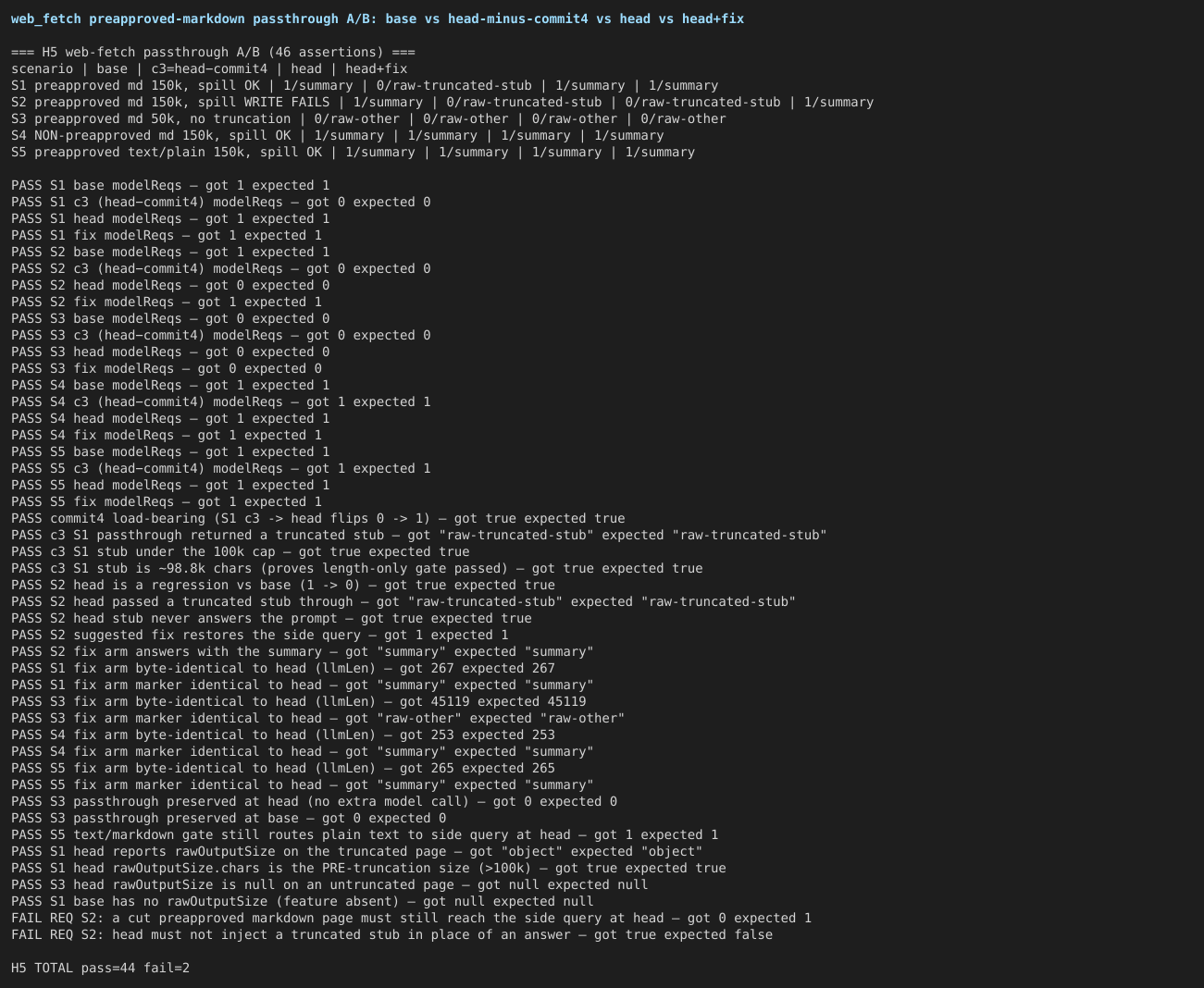
| scenario | base | c3 = head−commit4 | head | head+fix |
|---|---|---|---|---|
| S1 preapproved md 150k, spill OK | 1 / summary | 0 / raw-truncated-stub | 1 / summary | 1 / summary |
| S2 preapproved md 150k, spill write fails | 1 / summary | 0 / raw-truncated-stub | 0 / raw-truncated-stub | 1 / summary |
| S3 preapproved md 50k, no truncation | 0 / passthrough | 0 / passthrough | 0 / passthrough | 0 / passthrough |
| S4 non-preapproved md 150k | 1 / summary | 1 / summary | 1 / summary | 1 / summary |
S5 preapproved text/plain 150k |
1 / summary | 1 / summary | 1 / summary | 1 / summary |
(cell = model requests at the loopback peer / what reached llmContent)
Commit 4 is load-bearing: S1 flips 0 → 1 between its own parent and head, and
the parent really did hand back a 98,800-char truncated stub. S3/S4/S5 are
unchanged, so the gate is not blanket. S2 is the defect — see Findings.
The pre-fix bug was reachable only because of a coupling worth recording: the
producer stub lands at 98,634 chars, i.e. under the 100,000 cap with 1,366
chars of headroom (h6-stub-length.mjs). Base never hit this because base
truncated with truncateText(), whose output exceeded the cap, so the
length-only check correctly rejected it. The regression is therefore introduced by
this PR's own switch to truncateToolOutput, and commit 4 repairs half of it.
Secondary surfaces re-measured (PF2 hostile parser, PF5 privacy)
h78.mjs, 25 assertions, all pass. Witness: 06-hostile-parser-and-privacy.png.
The sibling parser structuredPreview is not exported, so it was driven through the
public truncateToolOutput rather than reached into:
| hostile input | result at head |
|---|---|
| deeply nested invalid JSON, 120,001 brackets | no throw, 9.1 ms, falls back to the directional preview |
__proto__-keyed valid JSON, 900 rows |
no throw, structured sample produced, Object.prototype.polluted === undefined and ({}).polluted === undefined |
| 1,228,900-char valid JSON | no throw, the content.length > 1_000_000 guard skips the preview as designed |
| 7,500-char bounded valid JSON | no throw, structured sample produced |
| leading bracket + 2k / 20k / 200k / 999k spaces | 0.3 / 0.3 / 0.7 / 2.3 ms — the two largest rungs are 5.00× chars for 3.26× time, i.e. no superlinear rung |
One ladder assertion failed on the first run and the failure was in my harness,
not the PR: I normalized to ms-per-1k-chars across all four rungs, and fixed
overhead makes the smallest rung look 79× worse than the largest (0.158 vs
0.002 ms/k) while every absolute time is under 3 ms. The metric was replaced with a
comparison of the two largest rungs, where overhead no longer dominates. Recorded
so the corrected assertion is not mistaken for a relaxed one.
The Symbol provenance privacy boundary re-measured 9/9: attached under exactly one
Symbol key; the key is enumerable (so a shallow copy carries it, by design);
JSON.stringify of the Part omits it entirely and round-trips to the plain
contract; safeJsonStringify — the serializer the LOCAL FileExporter actually
uses — omits it; a shallow copy retains it; structuredClone drops it, matching
the design doc's "deep-cloned/restored results are explicitly unknown"; and a full
Content-shaped object ({role, parts:[part]}) serializes with no provenance.
Separately, no emitted size event in the central-claim A/B carried a path or a
content fragment, and the size-event key set is exactly the documented numeric
contract (asserted key-by-key in H1).
Findings
1. web_fetch still passes a truncated stub through when the spill write fails — a net regression vs base
Severity: Moderate. 2 failing assertions. Introduced by this PR (base is
correct), partially repaired by 94d4763d6, residual at head.
Commit 4 gates the preapproved-markdown passthrough on !entry.persistedTextPath.
But persistedTextPath is shortened.outputFile, and truncateAndMaybeSave's
catch path in packages/core/src/tools/truncation.ts returns truncated content
with no outputFile:
} catch (error) {
  debugLogger.warn(`Failed to save truncated output to ${outputFile}:`, error);
  return { content: truncatedContent + `\n[Note: Could not save full output to file]` };
}
So a failed spill write yields persistedTextPath === undefined on content that
was cut. That stub is 98,043 chars (measured directly,
logs/h6b-unsaved-stub.txt: outputFile = undefined, 1,957 chars of headroom
under the cap), so the passthrough fires, llmContent becomes 98,156 chars of raw
truncated markdown, and the side query that answers params.prompt never runs.
The user's question is silently dropped.
The same file already names the correct predicate, 175 lines below that catch
block, for the Part[] path (truncation.ts:431-434): "Compare content identity
rather than outputFile so a truncated-but-unsaved result (a disk-write failure
returns a bounded preview with no file) still bounds the output." The new guard
uses the weaker signal that this comment explicitly warns against.
Reproduce (from the repo root; the S2 row):
node tmp/pr13652-verify-20261008-153434/h5-webfetch-cell.mjs "$PWD" /tmp/head.json
#   S2 preapproved md 150k, spill WRITE FAILS
#     modelReqs=0 marker=raw-truncated-stub llmLen=98156 spillHint=false
node tmp/pr13652-verify-20261008-153434/h5-ab.mjs <base> <c3> <head> <fix>
#   FAIL REQ S2: a cut preapproved markdown page must still reach the side query at head — got 0 expected 1
#   FAIL REQ S2: head must not inject a truncated stub in place of an answer — got true expected false
Reachability. Demonstrated by making the project temp dir a regular file, so
fs.mkdir throws. Real triggers are the ordinary I/O-failure set: a read-only or
full temp volume (ENOSPC), a path collision, a permission error. This is not a
hypothetical the codebase ignores — the design doc this PR adds states that
reducers "retain the existing hard cap even when I/O fails", and the same
document says "Web fetch's 100k extraction ceiling applies before its
summarization side query". Both statements describe behaviour head does not have
on this path.
Why Moderate, not Major. It needs an I/O failure to trigger, and the fetch
itself still succeeds, so no data is lost — the full page was never spilled, but
the transfer is returned. Ranked by observability it is nonetheless the quiet
variant: nothing reports that the prompt went unanswered, and the model receives a
plausible-looking 98k markdown blob.
Minimal suggested fix (measured: 12 lines, uses the predicate the file already documents)
In packages/core/src/tools/web-fetch.ts, record the reduction by content
identity instead of inferring it from the spill path:
// CacheEntry
  persistedTextPath?: string;
  /** True when producer truncation actually shortened `content`. */
  reduced?: boolean;

// fetchAndProcess
    let reduced = false;
    const preTruncationContent = content;
    if (content.length > MAX_CONTENT_CHARS) {
      // ...unchanged...
      content = shortened.content;
      persistedTextPath = shortened.outputFile;
      // Content identity, not outputFile: a failed spill write still returns a
      // bounded preview with no path, exactly the case truncation.ts's Part[]
      // path compares content for.
      reduced = content !== preTruncationContent;
    }
    const entry: CacheEntry = { persistedTextPath, reduced, rawOutputSize, /* ... */ };

// passthrough gate
        !entry.reduced          // was: !entry.persistedTextPath
Measured, not eyeballed (logs/h5-fix.json, logs/h5-fix.txt, witness
01-webfetch-passthrough-ab.png, built as a scratch worktree fix-tree at head
with only this patch):
| check | head | head + fix |
|---|---|---|
| S2 model requests (cut page must reach the side query) | 0 | 1 |
S2 llmContent |
98,156-char truncated stub | the summary |
S1 / S3 / S4 / S5 llmContent length |
267 / 45,119 / 253 / 265 | byte-identical |
| S1 / S3 / S4 / S5 marker | summary / raw-other / summary / summary | identical |
web-fetch.test.ts |
99 passed (99) | 99 passed (99) |
Hostile cell goes clean, benign cells byte-identical → zero collateral.
Stated honestly: the suite is green on both sides, so it pins nothing on this
axis. The fixture that would go red is a web-fetch case where a preapproved
markdown page exceeds MAX_CONTENT_CHARS and the spill write fails, asserting
mockGenerateContent was still called. That fixture should ship with the fix.
Note A (no assertion failed): the b82a0c645 guard covers serialization but not enumeration
measureToolOutput's new try/catch wraps JSON.stringify(value), but the loop
header for (const value of Object.values(response)) runs outside it — and
Object.values invokes getters. Measured against head's compiled dist/
(h3b-getter-probe.mjs, log logs/h3b-getter.txt):
| response shape | head |
|---|---|
| circular | {chars:4, estimatedTokens:17} ✓ |
| BigInt | {chars:0, estimatedTokens:16} ✓ |
20,000-level nesting (RangeError in stringify) |
{chars:0, estimatedTokens:16} ✓ |
| throwing getter | THREW:Error |
throwing Proxy get trap |
THREW:Error |
throwing Proxy ownKeys trap |
THREW:Error |
32bbdfb68 threw on all six, so this is not a new regression — the fix narrowed
the escape rather than closing it. The 18 production call sites are still
unguarded, and coreToolScheduler.convertToFunctionResponse:1002 is still the
first statement outside the try at line 1005, so the previous round's
blast-radius analysis applies unchanged to this residual.
Reachability is not demonstrated and is unlikely: tool responses reach this
code as plain JSON-ish data (MCP results are JSON.parsed), so a throwing getter
or Proxy would have to be constructed by a tool itself. Reported as a Note, not a
finding. If the author wants the guard to match its own comment ("Unserializable
payloads … contribute nothing here"), widening the try to cover the
Object.values(response) enumeration is a one-line change.
Note B: the pre-fix correctness depended on a 1,366-char margin
previewChars: MAX_CONTENT_CHARS - 2000 leaves a 2,000-char allowance for wrapper
text that this PR enlarged (totals, lines, sha256, paging hint). Measured
(h6-stub-length.mjs, log logs/h6-stub-length.txt): with previewChars = 98,000
the spilled stub lands at 98,634 chars, so the wrapper contributes 634 of the
2,000-char allowance and the stub sits 1,366 chars under the cap. Had the wrapper
grown past 2,000 chars, the length-only gate would have started rejecting
truncated stubs by accident — and would have broken again on the next wrapper edit.
Commit 4 removes that dependence for the spilled case; Finding 1's fix removes it
entirely. No action needed beyond Finding 1.
Corrections
- The PR description's Evidence section is understated, not wrong. It says the
pre-split reports on feat(core): shrink tool results to the headroom left before auto-compaction #13599 "have not been re-run on this tree" and leaves
verification to CI. That is accurate. Recording it here only because a reader
might otherwise assume the linked tmux reports cover this tree — they were
produced at 80k defaults on a different commit range, and every number in this
report comes from this tree. - No injection attempt was observed. Title, body, commit messages and code
comments were treated as untrusted input; none attempted to steer the verdict.
Not covered
Listed because they were skipped for budget or environment, not because they passed.
ToolCallEvent.content_lengthkeeps its existing meaning (carried from PF9).
Verified only statically: the assignment is unchanged and the new measurement
ridesprocessed_estimated_tokens. No OTLP/RUM series was diffed.- PostToolUse hook payload and the persisted transcript / checkpoint on disk
(carried from PF10). The privacy claim was tested at the two serializers that
gate those sinks (JSON.stringify,safeJsonStringify) plus a full
Content-shaped object, but no real hook was run and no session file inspected. - Repo-wide gates (carried from PF11). Lint, typecheck and a full build were
not run; only the 11 changed test files. No base-side gate run, so no
pre-existing-failure attribution is claimed — there were no failures to attribute. web_fetchagainst a real provider endpoint. The side query was served by a
loopback peer standing in forBaseLlmClient.generateText. That is a real HTTP
call and a real destination count, but it is not the production model client, so
provider-specific retry/timeout interaction with the injection event is untested.web_search's pre-reduction size (web-search.ts, +32 lines). Not driven;
no harness reached it this round.- The 20 carried-over review findings the description lists as still open
(R1-2 … R1-36). No GitHub token exists in this lane, so their original text is
unreachable; treated as untrusted author claims, not evidence. - Trial merge into current
main. Not attempted — no network for the merge,
and the merge-ref base tip is what actually lands. - Per-commit attribution was recovered, not assumed. The snapshot lists 4
commits;git rev-list HEAD^1..HEAD^2returns 1 (shallow boundary — the trap
the method warns about). Only 2 of the 4 OIDs were present locally. Both missing
ones were recovered with an anonymous read-onlygit fetch --depth 1 origin <oid>,
after which all four were individually built and exercised. Disclosed because it
is a network call the environment contract does not guarantee. - Pressure-aware budgets, default-budget changes, MCP's 500k ceiling — out of
scope by the PR's own statement; not tested.
Targeted gates
Run at head over exactly the 11 changed test files:
(cd packages/core && npx vitest run src/tools/tool-output-size.test.ts \
  src/tools/truncation.test.ts src/tools/shell.test.ts src/tools/web-fetch.test.ts \
  src/telemetry/loggers.test.ts src/telemetry/metrics.test.ts \
  src/core/coreToolScheduler.test.ts src/core/llm-chat.test.ts \
  src/core/nonInteractiveToolExecutor.test.ts)
(cd packages/cli && npx vitest run src/serve/hosted-workspace-tool-turn.test.ts \
  src/ui/hooks/useToolScheduler.test.ts)
core: Test Files 9 passed (9) · Tests 1,757 passed (1,757) · exit 0 (32.7 s).
cli: Test Files 2 passed (2) · Tests 236 passed (236) · exit 0 (43.4 s).
Raw logs: logs/gates-core.log, logs/gates-cli.log. Per-file: llm-chat 559,
coreToolScheduler 510, shell 366, web-fetch 99, loggers 98, metrics 67,
truncation 44, nonInteractiveToolExecutor 10, tool-output-size 4.
Totals are not comparable to the previous round's 1,357: this round ran 11 files
against a newer base, not 7.
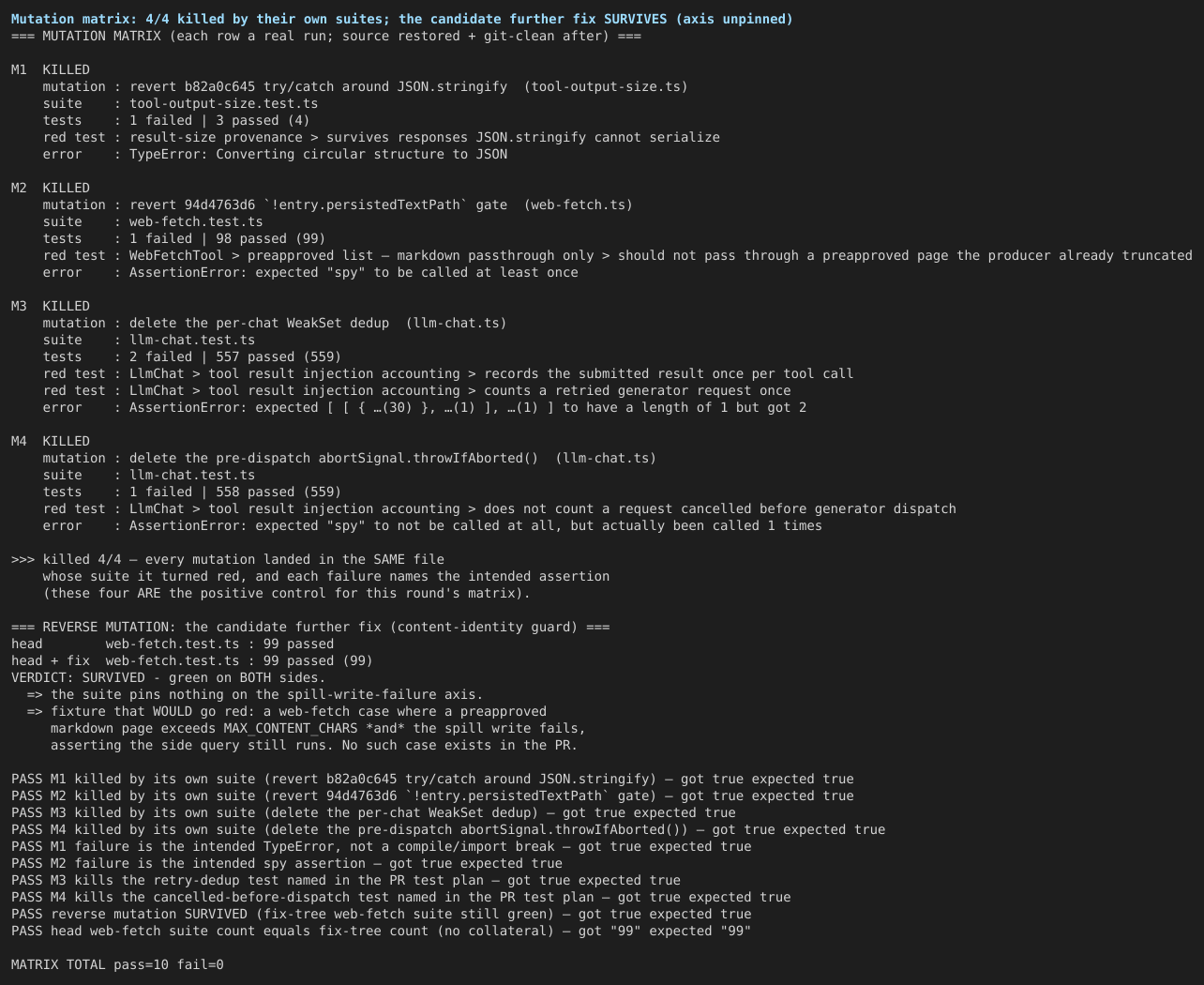
Mutation / vacuity matrix
Witness: 05-mutation-matrix.png. Log: logs/mutation-matrix.txt. Each mutation
was applied to the head source, run, and restored (git status verified clean
after every row).
| id | mutation | suite | verdict | red test(s) |
|---|---|---|---|---|
| M1 | revert b82a0c645's try/catch around JSON.stringify |
tool-output-size.test.ts |
KILLED 1 failed | 3 passed | survives responses JSON.stringify cannot serialize → TypeError: Converting circular structure to JSON at tool-output-size.ts:60 |
| M2 | revert 94d4763d6's !entry.persistedTextPath gate |
web-fetch.test.ts |
KILLED 1 failed | 98 passed | should not pass through a preapproved page the producer already truncated → expected "spy" to be called at least once |
| M3 | delete the per-chat WeakSet dedup |
llm-chat.test.ts |
KILLED 2 failed | 557 passed | records the submitted result once per tool call, counts a retried generator request once → expected … length of 1 but got 2 |
| M4 | delete the pre-dispatch abortSignal.throwIfAborted() |
llm-chat.test.ts |
KILLED 1 failed | 558 passed | does not count a request cancelled before generator dispatch → expected "spy" to not be called at all, but actually been called 1 times |
| rev | apply Finding 1's fix (content-identity guard) | web-fetch.test.ts |
SURVIVED 99 passed both sides | — |
4/4 killed. Each mutation landed in the same file as the suite it reddened, and
each failure names the intended behavioural mismatch — not an import or compile
break — so these four rows are also this round's positive control. M3 and M4
together close the previous round's largest gap: Test Plan step 2 is pinned by
tests that demonstrably go red without their guards.
The reverse mutation is the survivor, and it is the signal from Finding 1: the
suite cannot distinguish head from head-plus-fix, so the spill-write-failure axis
is unpinned. Completeness reporting, not a merge condition.
Methodology
CI verify lane: node:22-bookworm container, working tree = refs/pull/13652/merge
at depth 2, npm ci + npm run build already complete at head. Five scratch
worktrees under tmp/ — base-tree (HEAD^1 = 2e962b612), feat-tree
(36fb0561a), c2-tree (32bbdfb68, the previous round's head), c3-tree
(b82a0c645, commit 4's parent), fix-tree (94d4763d6 + Finding 1's patch).
Two of those OIDs were absent from the shallow checkout and were recovered with an
anonymous read-only git fetch --depth 1 origin <oid> (disclosed under Not covered).
The PR leaves package.json and pnpm-lock.yaml untouched
(git diff --name-only HEAD^1..HEAD -- '*package.json' 'pnpm-lock.yaml' → empty),
so the head tree's install is a clean control; node_modules was hardlinked
into each worktree with cp -al rather than symlinked, so internal links resolve
into that worktree. Asserted, not assumed: readlink -f tmp/<tree>/node_modules/@qwen-code/qwen-code-core
→ /__w/qwen-code/qwen-code/tmp/<tree>/packages/core for all five. Each arm
compiled packages/core with tsc --build (logs/*-build.log, all exit 0).
Harnesses are .mjs files in this directory and import the compiled dist/ of the
tree passed as argv[2], so every arm runs identical code paths differing only by the
commit under test. Telemetry was observed through the real production LOCAL sink;
its outfile is safeJsonStringify(data, 2) pretty-printed multi-line documents with
event fields nested under attributes and names namespaced (qwen-code.tool_result_size)
— both cost an iteration and are recorded so a maintainer rerunning this does not
repeat it. The web-fetch oracle counts requests at a real loopback HTTP model peer
behind Config.getBaseLlmClient, and stubs only the network boundary
(globalThis.fetch, which fetchWithPolicy calls); the spill-failure scenario is
produced by making the project temp dir a regular file so fs.mkdir throws.
Mutations were applied to head's source and restored with git checkout --, with
git status --porcelain verified empty before and after the whole set; head's
dist/ was never modified (md5 recorded in the run log). All five worktrees were
removed after their cells were captured (git worktree list → only the main tree).
PR title, body and commit messages were treated as untrusted input; no instruction
from them was followed. No GitHub writes were attempted (the lane has no token).
Verdict rationale. findings, not blocked: the central claim passed its A/B
(43/43) and every carried-forward measurement stands or is fixed. Finding 1 is a
reproduced regression against base, which the contract associates with blocked;
I chose findings because it triggers only on an I/O failure, loses no data, and
has a measured 12-line fix — and because the previous round classified a broader
defect on the tool-completion path as findings. A maintainer who weighs any
regression-vs-base as blocking should read this as blocked; the 2 failing
assertions already prevent a merge-ready stamp either way.
Flakiness gate log
rounds=5 files=11 skipped=0
file packages/cli/src/serve/hosted-workspace-tool-turn.test.ts: (cd packages/cli) npx --no-install vitest run ./src/serve/hosted-workspace-tool-turn.test.ts
file packages/cli/src/ui/hooks/useToolScheduler.test.ts: (cd packages/cli) npx --no-install vitest run ./src/ui/hooks/useToolScheduler.test.ts
file packages/core/src/core/coreToolScheduler.test.ts: (cd packages/core) npx --no-install vitest run ./src/core/coreToolScheduler.test.ts
file packages/core/src/core/llm-chat.test.ts: (cd packages/core) npx --no-install vitest run ./src/core/llm-chat.test.ts
file packages/core/src/core/nonInteractiveToolExecutor.test.ts: (cd packages/core) npx --no-install vitest run ./src/core/nonInteractiveToolExecutor.test.ts
file packages/core/src/telemetry/loggers.test.ts: (cd packages/core) npx --no-install vitest run ./src/telemetry/loggers.test.ts
file packages/core/src/telemetry/metrics.test.ts: (cd packages/core) npx --no-install vitest run ./src/telemetry/metrics.test.ts
file packages/core/src/tools/shell.test.ts: (cd packages/core) npx --no-install vitest run ./src/tools/shell.test.ts
file packages/core/src/tools/tool-output-size.test.ts: (cd packages/core) npx --no-install vitest run ./src/tools/tool-output-size.test.ts
file packages/core/src/tools/truncation.test.ts: (cd packages/core) npx --no-install vitest run ./src/tools/truncation.test.ts
file packages/core/src/tools/web-fetch.test.ts: (cd packages/core) npx --no-install vitest run ./src/tools/web-fetch.test.ts


per-file results (P=pass F=fail I=infra-exit, one letter per run):
  packages/cli/src/serve/hosted-workspace-tool-turn.test.ts: PPPPP
  packages/cli/src/ui/hooks/useToolScheduler.test.ts: PPPPP
  packages/core/src/core/coreToolScheduler.test.ts: PPPPP
  packages/core/src/core/llm-chat.test.ts: PPPPP
  packages/core/src/core/nonInteractiveToolExecutor.test.ts: PPPPP
  packages/core/src/telemetry/loggers.test.ts: PPPPP
  packages/core/src/telemetry/metrics.test.ts: PPPPP
  packages/core/src/tools/shell.test.ts: PPPPP
  packages/core/src/tools/tool-output-size.test.ts: PPPPP
  packages/core/src/tools/truncation.test.ts: PPPPP
  packages/core/src/tools/web-fetch.test.ts: PPPPP

verdict: pass
summary: 11 changed test file(s) x 5 identical rounds, no divergence

--- per-invocation detail (full copy in the artifact) ---
round 1 · packages/cli/src/serve/hosted-workspace-tool-turn.test.ts: P (exit 0)
round 1 · packages/cli/src/ui/hooks/useToolScheduler.test.ts: P (exit 0)
round 1 · packages/core/src/core/coreToolScheduler.test.ts: P (exit 0)
round 1 · packages/core/src/core/llm-chat.test.ts: P (exit 0)
round 1 · packages/core/src/core/nonInteractiveToolExecutor.test.ts: P (exit 0)
round 1 · packages/core/src/telemetry/loggers.test.ts: P (exit 0)
round 1 · packages/core/src/telemetry/metrics.test.ts: P (exit 0)
round 1 · packages/core/src/tools/shell.test.ts: P (exit 0)
round 1 · packages/core/src/tools/tool-output-size.test.ts: P (exit 0)
round 1 · packages/core/src/tools/truncation.test.ts: P (exit 0)
round 1 · packages/core/src/tools/web-fetch.test.ts: P (exit 0)
round 2 · packages/cli/src/serve/hosted-workspace-tool-turn.test.ts: P (exit 0)
round 2 · packages/cli/src/ui/hooks/useToolScheduler.test.ts: P (exit 0)
round 2 · packages/core/src/core/coreToolScheduler.test.ts: P (exit 0)
round 2 · packages/core/src/core/llm-chat.test.ts: P (exit 0)
round 2 · packages/core/src/core/nonInteractiveToolExecutor.test.ts: P (exit 0)
round 2 · packages/core/src/telemetry/loggers.test.ts: P (exit 0)
round 2 · packages/core/src/telemetry/metrics.test.ts: P (exit 0)
round 2 · packages/core/src/tools/shell.test.ts: P (exit 0)
round 2 · packages/core/src/tools/tool-output-size.test.ts: P (exit 0)
round 2 · packages/core/src/tools/truncation.test.ts: P (exit 0)
round 2 · packages/core/src/tools/web-fetch.test.ts: P (exit 0)
round 3 · packages/cli/src/serve/hosted-workspace-tool-turn.test.ts: P (exit 0)
round 3 · packages/cli/src/ui/hooks/useToolScheduler.test.ts: P (exit 0)
round 3 · packages/core/src/core/coreToolScheduler.test.ts: P (exit 0)
round 3 · packages/core/src/core/llm-chat.test.ts: P (exit 0)
round 3 · packages/core/src/core/nonInteractiveToolExecutor.test.ts: P (exit 0)
round 3 · packages/core/src/telemetry/loggers.test.ts: P (exit 0)
round 3 · packages/core/src/telemetry/metrics.test.ts: P (exit 0)
round 3 · packages/core/src/tools/shell.test.ts: P (exit 0)
round 3 · packages/core/src/tools/tool-output-size.test.ts: P (exit 0)
round 3 · packages/core/src/tools/truncation.test.ts: P (exit 0)
round 3 · packages/core/src/tools/web-fetch.test.ts: P (exit 0)
round 4 · packages/cli/src/serve/hosted-workspace-tool-turn.test.ts: P (exit 0)
round 4 · packages/cli/src/ui/hooks/useToolScheduler.test.ts: P (exit 0)
round 4 · packages/core/src/core/coreToolScheduler.test.ts: P (exit 0)
round 4 · packages/core/src/core/llm-chat.test.ts: P (exit 0)
round 4 · packages/core/src/core/nonInteractiveToolExecutor.test.ts: P (exit 0)
round 4 · packages/core/src/telemetry/loggers.test.ts: P (exit 0)
round 4 · packages/core/src/telemetry/metrics.test.ts: P (exit 0)
round 4 · packages/core/src/tools/shell.test.ts: P (exit 0)
round 4 · packages/core/src/tools/tool-output-size.test.ts: P (exit 0)
round 4 · packages/core/src/tools/truncation.test.ts: P (exit 0)
round 4 · packages/core/src/tools/web-fetch.test.ts: P (exit 0)
round 5 · packages/cli/src/serve/hosted-workspace-tool-turn.test.ts: P (exit 0)
round 5 · packages/cli/src/ui/hooks/useToolScheduler.test.ts: P (exit 0)
round 5 · packages/core/src/core/coreToolScheduler.test.ts: P (exit 0)
round 5 · packages/core/src/core/llm-chat.test.ts: P (exit 0)
round 5 · packages/core/src/core/nonInteractiveToolExecutor.test.ts: P (exit 0)
round 5 · packages/core/src/telemetry/loggers.test.ts: P (exit 0)
round 5 · packages/core/src/telemetry/metrics.test.ts: P (exit 0)
round 5 · packages/core/src/tools/shell.test.ts: P (exit 0)
round 5 · packages/core/src/tools/tool-output-size.test.ts: P (exit 0)
round 5 · packages/core/src/tools/truncation.test.ts: P (exit 0)
round 5 · packages/core/src/tools/web-fetch.test.ts: P (exit 0)
Evidence images



Harness scripts and raw logs are in the workflow run artifacts (7-day retention).
— Qwen Code · sandboxed verification
|
Triage re-run completed without a new review.
The stage comments above were updated with the latest result. View workflow run. 上方各阶段评论已更新为最新结果。查看工作流运行。 |
qwen-code-review-bot
left a comment
qwen-code-review-bot
left a comment
There was a problem hiding this comment.
Partially reviewed — gaps disclosed. Suggestions are inline.
Not reviewed: build-and-test — Integration Tests (CLI, No Sandbox) was skipped in CI and its suite did not run locally.
Not reviewed: reverse audit finding R1-51 — the verifier never ruled on it.
Not reviewed: reverse audit finding R1-52 — the verifier never ruled on it.
Not reviewed: reverse audit finding R1-53 — the verifier never ruled on it.
Not reviewed: reverse audit finding R1-54 — the verifier never ruled on it.
Not reviewed: reverse audit finding R1-55 — the verifier never ruled on it.
Not reviewed: reverse audit finding R1-56 — the verifier never ruled on it.
Not reviewed: reverse audit finding R1-57 — the verifier never ruled on it.
Not explored to full depth (tool budget reached): "agent test-matrix": none — all checks above completed within the tool budget; the only unrun items are the mutations, each marked witness: not run .; "agent reverse-audit (round 3)": I did not verify at runtime that the ACP tool_call literal is the only tool-execution event an ACP session emits (no test run); the conclusion rests on new T…; "agent reverse-audit (round 1)": whether *.output spill files written into getProjectTempDir() by truncateAndSaveToFile (truncation.ts:208-241) are covered by any cleanup sweep, versus th…; "agent reverse-audit (round 1)": no execution of the modified test files — the conclusion that each relaxed assertion is exactly as wide as the enumerable symbol requires (and no wider) is reas…; "agent 1c": I did not trace whether web_fetch 's LRU cache TTL can outlive the 24-hour cleanup of the newly spilled persistedTextPath (a stale path in the metadata heade…, and 1 more.
Not reviewed: reverse audit — stopped before round 5 by the review time budget.
— [unverified] tag when the loop ended — the verifier never ruled on them, and they are not confirmed.
中文说明
仅完成部分审查,审查缺口已披露。 建议见行内评论。
未审查(原文为英文):build-and-test — Integration Tests (CLI, No Sandbox) was skipped in CI and its suite did not run locally.
未审查(原文为英文):reverse audit finding R1-51 — the verifier never ruled on it.
未审查(原文为英文):reverse audit finding R1-52 — the verifier never ruled on it.
未审查(原文为英文):reverse audit finding R1-53 — the verifier never ruled on it.
未审查(原文为英文):reverse audit finding R1-54 — the verifier never ruled on it.
未审查(原文为英文):reverse audit finding R1-55 — the verifier never ruled on it.
未审查(原文为英文):reverse audit finding R1-56 — the verifier never ruled on it.
未审查(原文为英文):reverse audit finding R1-57 — the verifier never ruled on it.
未探索到全部深度(达到工具调用预算):"agent test-matrix":none — all checks above completed within the tool budget; the only unrun items are the mutations, each marked witness: not run .;"agent reverse-audit (round 3)":I did not verify at runtime that the ACP tool_call literal is the only tool-execution event an ACP session emits (no test run); the conclusion rests on new T…;"agent reverse-audit (round 1)":whether *.output spill files written into getProjectTempDir() by truncateAndSaveToFile (truncation.ts:208-241) are covered by any cleanup sweep, versus th…;"agent reverse-audit (round 1)":no execution of the modified test files — the conclusion that each relaxed assertion is exactly as wide as the enumerable symbol requires (and no wider) is reas…;"agent 1c":I did not trace whether web_fetch 's LRU cache TTL can outlive the 24-hour cleanup of the newly spilled persistedTextPath (a stale path in the metadata heade…,另有 1 条。
未审查:反向审计——评审时间预算不足,未能开始第 5 轮。
— [unverified] 标记——验证者从未对它们作出裁决,它们不算已确认。
— qwen3.8-max via Qwen Code /review (v0.25.0)
|
⏳ Historical-head review — head moved to 中文说明⏳ 历史 head 评审 —— 本次评审进行中 head 移动到了 |
…t the spill path

A failed spill write returns a bounded preview with NO outputFile, so
`!entry.persistedTextPath` still let a cut-off stub stand in for the side
query's answer and `params.prompt` was never answered. Track the reduction by
content identity (mirroring truncateLlmContent's Part[] path) and pin it with a
fixture whose spill write fails: red before, green after.

Co-authored-by: Qwen-Coder <qwen-coder@alibabacloud.com>
Patrol-Run: qwen-pr-closeout/jmuzqz0izf5
…-accounting-11536

Base merge required by the freshness gate (eslint.legacy-core-barrel-imports.mjs
changed on main); resolved automatically.

Co-authored-by: Qwen-Coder <qwen-coder@alibabacloud.com>
Patrol-Run: qwen-pr-closeout/jmuzqz0izf5
qwen-code-review-bot
left a comment
qwen-code-review-bot
left a comment
There was a problem hiding this comment.
Partially reviewed — gaps disclosed.
Unresolved, please confirm:
- [Critical] packages/core/src/tools/web-fetch.ts (R1-3, comment 4221546209) — could not determine whether the defect still fires. The author's reply states WebFetchTool now declares maxOutputChars mirroring WebSearchTool's guard, but at the reviewed co…
Not reviewed: removed-behavior audit (agent 1b): I did not execute any test file (the worktree has no built dist/ for the workspace packages), so every claim is from reading the PR-head source — stopped at the agent tool budget.
Not reviewed: build-and-test — Integration Tests (CLI, No Sandbox) was skipped in CI and its suite did not run locally.
Not explored to full depth (tool budget reached): "agent 1b": I did not execute any test file (the worktree has no built dist/ for the workspace packages), so every claim above is from reading the PR-head source, not fro…; "agent reverse-audit (round 3)": none — no check was cut short. (Recording it here rather than as a Budget gap: line would break the format, so: nothing was left unfinished.); chunk 1: none — no check in this territory was cut short.; "agent reverse-audit (round 2)": whether the always-attached enumerable provenance symbol ( tool-output-size.ts:98-104 , applied by convertToFunctionResponse on every call, including the ~60 ….
Not reviewed: reverse audit — stopped before round 4 by the review time budget.
Deferred under the convergence posture (round 8, not a blocker) — recorded, not requested in this round:
docs/design/tool-result-size-accounting.md:29 — [review] The design doc's runtime enumeration omits the…packages/cli/src/acp-integration/session/Session.ts:17021 — [review] ACP hook context is appended as an untagged sibling partpackages/cli/src/ui/hooks/useToolScheduler.test.ts:210 — [review] Eight responseParts assertions dropped the…packages/core/src/core/coreToolScheduler.test.ts:15375 — [review] The persistence event is emitted under the resolved tool…packages/core/src/core/coreToolScheduler.test.ts:15384 — [review] The persistence-layer event test asserts 3 of 12 fieldspackages/core/src/core/coreToolScheduler.ts:1118 — [review] The new config parameter on convertToFunctionErrorResponse…packages/core/src/core/coreToolScheduler.ts:6008 — [review] No test pins a positive budget attributionpackages/core/src/core/coreToolScheduler.ts:7571 — [review] Four of six replacement call sites are untestedpackages/core/src/core/coreToolScheduler.ts:7768 — [review] A second provenance-restore pass has no reachable effectpackages/core/src/core/llm-chat.test.ts:12338 — [review] A new describe separates an explanatory comment from its…packages/core/src/core/llm-chat.test.ts:12389 — [review] The suite's only raw_content_length assertion cannot…packages/core/src/core/llm-chat.ts:3284 — [probe] The restored-response provenance attach has no testpackages/core/src/core/llm-chat.ts:5515 — [probe] A fallback re-dispatch under different modalities emits no…packages/core/src/core/llm-chat.ts:6036 — [review] The resume path's new marking is a silent no-oppackages/core/src/telemetry/loggers.test.ts:1516 — [review] Thirteen of fourteen added expectations are…packages/core/src/telemetry/loggers.ts:397 — [review] The one-sample-per-call histogram guard is never executedpackages/core/src/telemetry/metrics.ts:25 — [review] New telemetry surface is not added to the reference docpackages/core/src/telemetry/metrics.ts:267 — [review] Both new histograms use OTel default buckets that stop at…packages/core/src/telemetry/metrics.ts:781 — [review] The common undefined-raw branch of the histogram recorder…packages/core/src/tools/mcp-tool.ts:782 — [probe] MCP's measured success-path declarations have no test- …and 21 more (see the run report)
中文说明
仅完成部分审查,审查缺口已披露。
未决,请确认:共 1 条(原文未翻译,列表见上方英文部分)。
未审查(原文为英文):removed-behavior audit (agent 1b): I did not execute any test file (the worktree has no built dist/ for the workspace packages), so every claim is from reading the PR-head source — stopped at the agent tool budget.
未审查(原文为英文):build-and-test — Integration Tests (CLI, No Sandbox) was skipped in CI and its suite did not run locally.
未探索到全部深度(达到工具调用预算):"agent 1b":I did not execute any test file (the worktree has no built dist/ for the workspace packages), so every claim above is from reading the PR-head source, not fro…;"agent reverse-audit (round 3)":none — no check was cut short. (Recording it here rather than as a Budget gap: line would break the format, so: nothing was left unfinished.);chunk 1:none — no check in this territory was cut short.;"agent reverse-audit (round 2)":whether the always-attached enumerable provenance symbol ( tool-output-size.ts:98-104 , applied by convertToFunctionResponse on every call, including the ~60 …。
未审查:反向审计——评审时间预算不足,未能开始第 4 轮。
收敛姿态下延后(第 8 轮,非阻断)——已记录,本轮不要求修改:共 41 条(原文未翻译,列表见上方英文部分)。
— qwen3.8-max via Qwen Code /review (v0.25.1)

 qqqys
left a comment
qqqys
left a comment
There was a problem hiding this comment.
COMMENT at head d502f85498059a1e20c5348c17a08dfcb9a6ab28 — not approving. Three Criticals are open against this exact head, and reviewDecision is CHANGES_REQUESTED. CI is green, so CI is not the blocker.
Why this is a COMMENT rather than an APPROVE
The blocking fact is temporal and does not depend on me re-deriving any finding:
- Last commit on the branch:
d502f854, 2026-10-15T00:31:11Z (a merge frommain). - The
CHANGES_REQUESTEDreview carrying round 8 (review5528691327) was submitted 2026-10-15T05:44:52Z — after that commit — and its two inline Criticals are timestamped 05:44:53Z and 05:44:55Z againstsha=d502f85498, the current head.
Both were re-filed at this head with the filer stating it re-checked the named code, including files this PR does not touch, and that each "is still open at this commit" / was "confirmed at this commit". Nothing has landed since, so neither can have been fixed by a later change. I did not independently re-derive their reachability within this pass's budget, and an unconfirmed blocker is treated as blocking, so I am not in a position to overturn them.
The three open Criticals
R5-1 — packages/core/src/core/coreToolScheduler.ts:6273 [certifies-falsely] [new-surface] (inline comment 4279495155)
The ?? measureToolOutput(producerToolResult?.llmContent ?? '') fallback in observeProducerOutput certifies any producer that reduces its own output without declaring rawOutputSize as raw == injected with truncated: false. It measures the already-reduced body and compares that measurement against itself, so processedChars < rawSize.chars is false by construction and the provenance records that nothing was dropped — which is the opposite of the signal issue #11536 asks this accounting to provide.
The round-8 comment credits this round with teaching grep, ripGrep, read_mcp_resource, read_file and the SSH local bounded() path to declare null, each now correct, and then names seven entrances still undeclared and confirmed at this commit: glob, ls, exec (code mode), agent (composeIncompleteResult), the SSH remote search cap at ssh-execution-environment.ts:544 (whose [Search truncated; narrow the query.] body the new declaration at :133 does not cover, since that one only detects local bounded() cuts), and ripGrep's searchResult.incomplete path at ripGrep.ts:444-451, which the new condition omits. The earlier round quantified one instance: a 60,000-char agent partial reports raw_content_length == injected_content_length == 32_000 with truncated: false for ~28,000 dropped chars.
The shape of this finding across rounds 5→7→8 is worth noting: each round closed the entrances the previous round named and the next round found more. That is the pattern the round-8 review's own convergence note attributes to fixing instances of a shared root cause rather than the cause — here, a fallback that guesses instead of declining. Making the fallback record "unknown" rather than "nothing was dropped" would close all seven at once and any eighth that has not been enumerated yet.
R7-1 — packages/core/src/tools/shell.ts:3195 [certifies-falsely] [new-surface] (inline comment 4279495340)
This line declares a measured raw size on the non-raw-capture path, but result.output there is already a capture-limited prefix, so a bounded body is certified as the producer's pre-reduction size. This is exactly the case the other declarations in this diff use null for.
The filer re-read the code this finding names, including ShellExecutionService, which bounds the foreground capture at maxBufferedOutputBytes (default 64 MiB, shellExecutionService.ts:39), keeps only the head and discards the rest (captureOutputData returns null once capturedOutputBytes >= previewHeadBytes, :1129-1131; on the non-rawCapture path previewHeadBytes is the whole maxBufferedOutputBytes, :1073-1074). It notes the service does compute outputCaptureLimitExceeded (:1070) and that the flag is set on this path, but that it is absent from the ShellExecutionResult consumed here. Two outcomes were quantified in the earlier round: yes | head -c 200000000 reports raw_content_length ≈ 67,108,864 for a 200 MB producer, so the raw-phase histogram is censored at the capture limit for precisely the largest outputs it exists to characterize; and because maxBufferedOutputBytes is user-settable with no minimum, at 20,000 (below DEFAULT_SHELL_OUTPUT_THRESHOLD = 30_000) a 5 MB command yields a ~20 KB body waved through the content.length <= threshold fast path.
The available signal already exists — outputCaptureLimitExceeded — so this looks like plumbing a flag that is computed but dropped, rather than a design question.
R1-3 — packages/core/src/tools/web-fetch.ts:517 [certifies-falsely] [regression] (inline comment 4221546209)
Listed in the round-8 review under "Unresolved, please confirm", with the filer stating plainly that it could not determine whether the defect still fires. The author's reply states WebFetchTool now declares maxOutputChars mirroring WebSearchTool's guard at web-search.ts:984-988, but that was not confirmed at the reviewed commit.
The original chain: executeDirectFetch prepends buildMetadataHeader(entry), so the body starts with Status: 200 … rather than TOOL_OUTPUT_TRUNCATED_PREFIX; truncateLlmContent's idempotency guard is content.startsWith(TOOL_OUTPUT_TRUNCATED_PREFIX) (truncation.ts:393), which is false, so the per-tool pass runs at 25,000 chars / 1000 lines over the inner envelope; meanwhile isAlreadyTruncated (includes-based, truncation.ts:447-452) returns true for the producer stub, so maybePersistLargeToolResult skips where it previously persisted once.
This is the one item where a factual answer would settle it either way. Since the author has already stated the fix, pointing at the exact declaration and the resulting maxOutputChars value at this head — or asking the filer to re-check and withdraw — closes it. An unconfirmed Critical blocks approval regardless of which way it would resolve, so it cannot be left in this state.
CI
Green at this head, and I confirmed the run belongs to this commit rather than an earlier one: run 38660495706 and its siblings. Test (ubuntu-latest, Node 22.x) 37m56s, Lint & Static 19m50s, Integration Tests (no-AK, No Sandbox) 10m33s, Serve A/B 23m15s, Native Linux CLI boundary 5m9s, Native Windows settings and streams 10m27s, OpenTUI no-flicker gate 7m11s, TUI parity snapshots 8m55s, web-shell E2E Smoke 19m22s and arm64 all pass. No CI failure is attributable to this PR, and CI forms no part of this verdict. Note only that the round-8 review disclosed Integration Tests (CLI, No Sandbox) was skipped in CI and did not run locally either, and that it executed no test file at all (no built dist/ for the workspace packages), so its claims come from reading PR-head source.
What would change this to an APPROVE
Any one of:
- A commit at a new head that addresses R5-1 and R7-1 and settles R1-3 — I would re-verify all three at that head.
- The filer withdrawing any of them.
- A maintainer explicitly accepting the residual risk.
Absent one of those, all three stand at the current head and I cannot approve.
Disclosure about this pass
This is a bounded pass. I read the review ledger and the full text of all three Critical inline comments, and established the commit/review ordering above, but I did not independently re-derive R5-1's seven undeclared entrances, R7-1's capture-limit arithmetic, or R1-3's guard interaction in the source at this head — the short-circuit applies once blockers are confirmed standing. I am therefore reporting these as open and unconfirmed-as-fixed, not as findings I have personally reproduced. My attempt to read this PR's review-thread resolution state was not completed within budget, so I make no claim about which threads are marked resolved or outdated. The round-8 review also defers 41 further items under its convergence posture, explicitly "not a blocker"; I did not assess those and am not gating on them.

 qwen-code-dev-bot
left a comment
qwen-code-dev-bot
left a comment
There was a problem hiding this comment.
REQUEST_CHANGES at head d502f8549805 — one Critical I verified in code, one recorded
Reviewed head: d502f85498059a1e20c5348c17a08dfcb9a6ab28, state open, author yiliang114, base main. Forty-four files, +2485/−103.
This is not a CI block. CI is fully green: 166 check-run records (pages 1–2 = 100 + 66, page 3 empty), 14 substantive groups = 11 success / 3 skipped / 0 failure / 0 cancelled / 0 pending. I am requesting changes on gate 2: two [Critical] threads remain unresolved at this head, and there are four standing CHANGES_REQUESTED reviews from qwen-code-review-bot, the latest at 119bc3dd6542.
Blocking 1 — R7-1: shell.ts certifies a capture-bounded body as the producer's raw size
Thread: packages/core/src/tools/shell.ts:3195. Verified at this head.
const rawOutputSize = rawCapture ? null : measureToolOutput(llmContent);

// Raw capture owns full output; result.output is only a bounded preview.
// Otherwise truncate large output and save full content to a temp file.
if (!rawCapture && typeof llmContent === 'string') {
  const originalLlmContent = llmContent;
  const outputThreshold = getShellOutputThreshold(this.config);
  …
and rawOutputSize is then carried into the result at :3340.
The rawCapture branch is honest: it declares null, meaning "I do not know the producer's pre-reduction size". The non-rawCapture branch declares a measured number — but it measures llmContent as it stands at :3195, which is already downstream of the execution service's own capture bound and upstream of this function's getShellOutputThreshold truncation. So the declared value is neither the producer's raw size nor the injected size; it is an intermediate, and it is published with the authority of a measurement.
For a PR whose entire purpose is to account tool-result sizes from producer to injection, an intermediate value presented as the producer's is the specific failure the feature exists to prevent: downstream consumers compute raw == injected and truncated: false from it, so a body that was already reduced upstream is certified as complete. The finding notes this is what the other five hunks in this same diff declare null for, which makes it an internal inconsistency rather than a policy choice.
I verified the code shape above myself. The magnitude I did not verify: the finding states shellExecutionService bounds the foreground capture at getMaxBufferedOutputBytes (default 64 MiB) and keeps only a head prefix, so the mis-certification only bites for outputs above that bound. That window is narrow but it is exactly the case where size accounting matters most, and "rare" is not "correct".
Expected fix. Declare null on the non-raw-capture path too, unless the capture layer can attest that no upstream bounding occurred — in which case thread that attestation through rather than inferring it from !rawCapture. Please add a test that bounds the capture below the producer's output size and asserts the declared rawOutputSize is null (or that truncated is not false); without it this reverts silently.
Recorded, not independently verified — R5-1
Thread: packages/core/src/core/coreToolScheduler.ts:6273, [Critical] [certifies-falsely] [new-surface], and it opens with "This still stands" — i.e. it survived an earlier round in which, by the finding's own account, every entrance named at that time was closed (read_file now spreads rawOutputSize: null when result.isTruncated; the SSH execution environment declares it at :133; declining read_many_files is correct because it is not a self-bounding producer).
The residual claim is that the ?? measureToolOutput(...) fallback in observeProducerOutput certifies any self-bounding producer that declares no rawOutputSize as raw == injected with truncated: false. That is the same shape as R7-1 — an inferred measurement standing in for an attested one — but at the scheduler level rather than at one producer, so it is the more general of the two. I did not read coreToolScheduler.ts:6273 or enumerate which producers reach that fallback, so I record it rather than assert it. Author: either close it by making the fallback declare "unknown" instead of "measured", or state on the thread which producers can reach it and why each is genuinely self-bounding.
Not my gate
76 of 78 threads are resolved and I did not re-litigate them. I found no new Critical in what I read. My reading was narrow and I want that on the record: shell.ts around the declaration site, and the thread text of both Criticals. I did not audit the other 43 files, including coreToolScheduler.ts, the ~1000 lines of new tests, or the design docs — so this review is a gate-2 verdict on the two open Criticals, not a whole-diff audit.
What I need to submit APPROVE
- R7-1 fixed, with the capture-bounded test above.
- R5-1 fixed or explicitly resolved on its thread with the producer enumeration.
- CI still green at the new head, re-verified at submit time.
Note for merge planning: /packages/core/ is CODEOWNERS-covered (@wenshao @tanzhenxin @yiliang114 @LaZzyMan @doudouOUC @qqqys) and qwen-code-dev-bot is not in that list, so my approval would not by itself move reviewDecision — and the four standing CHANGES_REQUESTED reviews are qwen-code-review-bot's to withdraw or re-run, not mine to dismiss.

 chiga0
left a comment
chiga0
left a comment
There was a problem hiding this comment.
feat(core): account tool result sizes from producer to injection — COMMENT (3 blockers)
Tier: Deep (re-review; 4 new commits since round 1 at 848d70d9; confirmed head unchanged).
Round 1 carry-over
| Id | Was | Now |
|---|---|---|
| R1-1 minor (coreToolScheduler.ts:7881 WEB_FETCH bypass) | minor | still present, still minor — the bypass correctly prevents maybePersistLargeToolResult from skipping web_fetch; unchanged. |
New findings at this head
R2-1 — Blocker · packages/core/src/core/coreToolScheduler.ts:6275
observeProducerOutput fallback certifies false "nothing was dropped" for any producer that reduces its own output without declaring rawOutputSize.
The fallback path (triggered when producerToolResult.rawOutputSize === undefined) measures producerToolResult.llmContent and reports that measurement as the raw size:
producerToolResult?.rawOutputSize ??
  measureToolOutput(
    producerToolResult?.llmContent ?? '',   // ← already-reduced body
    this.config,
  )
processedChars < rawSize.chars is then false by construction (measuring the same body twice), so truncated: false is set and provenance records that nothing was dropped — the exact opposite of the signal issue #11536 asks this accounting to provide.
The round-8 review quantifies one confirmed instance: a 60,000-char agent partial reports raw_content_length == injected_content_length == 32_000 with truncated: false for ~28,000 dropped chars. Seven entrances where the fallback fires on bounded output are confirmed at this head: glob, ls, exec (code mode), agent (composeIncompleteResult), SSH remote search cap at ssh-execution-environment.ts:544, ripGrep's searchResult.incomplete path at ripGrep.ts:444-451 (condition only guards truncatedByLineLimit || truncatedByCharLimit, not searchResult.incomplete), and any future producer that omits the declaration.
Root fix: change the fallback from measuring the body to returning undefined (i.e. delete the ?? measureToolOutput(…) arm and let rawSize remain undefined). This closes all seven at once and any future undeclared producer.
R2-2 — Blocker · packages/core/src/tools/shell.ts:3195
On the non-rawCapture path, rawOutputSize = measureToolOutput(llmContent) measures the capture-bounded output as the raw producer size.
const rawOutputSize = rawCapture ? null : measureToolOutput(llmContent);
On the non-rawCapture path, result.output (the source of llmContent) is the capture-limited prefix from captureOutputData, bounded at maxBufferedOutputBytes (default 64 MiB). The service computes outputCaptureLimitExceeded but does not surface it in ShellExecutionResult. The reported raw size is always ≤ capture limit, never the true command output — so the raw-phase histogram is systematically censored at precisely the largest outputs it exists to characterize. Quantified instance: yes | head -c 200000000 reports raw_content_length ≈ 67,108,864 for a 200 MB producer.
Fix: declare rawOutputSize: null on the non-rawCapture path (unknown, bounded by capture), or plumb outputCaptureLimitExceeded through ShellExecutionResult and use it to gate the declaration. rawCapture ? null is already the correct pattern — apply it to the capture-bounded path too.
R2-3 — Blocker · packages/core/src/tools/web-fetch.ts:518
WebFetchTool has no maxOutputChars override; the scheduler's step-1 per-tool pass at DEFAULT_TRUNCATE_TOOL_OUTPUT_THRESHOLD = 25,000 chars double-truncates the ~98.5k producer envelope.
rawOutputSize = measureToolOutput(content); // line 518 — content still ~100k+ here
Sequence:
- Producer shortens large content to ~98.4k (
MAX_CONTENT_CHARS - 2000preview + envelope). buildMetadataHeader(entry)prependsStatus: 200 … | Content-Type: text/markdown | …, giving ~98.5k total body.- The body starts with
"Status: 200…"notTOOL_OUTPUT_TRUNCATED_PREFIX, sotruncateLlmContent's idempotency guard (.startsWith(TOOL_OUTPUT_TRUNCATED_PREFIX)) is false. - No
maxOutputCharsonWebFetchTool→ scheduler applies DEFAULT = 25,000 chars / 1,000 lines. - Step-1 per-tool pass cuts the ~98.5k envelope to 25,000 chars, discarding the spill-file pointer and producing a truncated view of a truncated preview — exactly the double-truncation the PR intends to prevent.
Compare: WebSearchTool overrides maxOutputChars to exempt itself (line 987 in web-search.ts). WebFetchTool never declared this override.
Fix: add override get maxOutputChars(): number { return MAX_CONTENT_CHARS + FETCH_ENVELOPE_HEADROOM_CHARS; } (or equivalent constant) to WebFetchTool, matching the pattern at web-search.ts:984-988.
| ? undefined | ||
| : (producerToolResult?.rawOutputSize ?? | ||
| measureToolOutput( | ||
| producerToolResult?.llmContent ?? '', |
There was a problem hiding this comment.
R2-1 [Blocker] observeProducerOutput fallback measures the already-reduced llmContent as the raw size when producerToolResult.rawOutputSize === undefined. processedChars < rawSize.chars is then false by construction, so truncated: false is set and provenance certifies that nothing was dropped — the opposite of the signal this accounting exists to provide.
Seven confirmed undeclared entrances at this head: glob, ls, exec (code mode), agent (composeIncompleteResult), SSH remote search cap (ssh-execution-environment.ts:544), ripGreps searchResult.incomplete path (ripGrep.ts:444-451, whose guard checks only truncatedByLineLimit || truncatedByCharLimit), and any future producer that omits the field.
Fix: remove the ?? measureToolOutput(…) arm so rawSize remains undefined when the producer does not declare it. This closes all seven at once.
There was a problem hiding this comment.
Verified at live head d502f85498059a1e20c5348c17a08dfcb9a6ab28. Duplicate of the already-adjudicated thread at coreToolScheduler.ts:6273 (bot top comment 4248805250), dispositioned by the author on 2026-10-15 in 4286044469 — "Still REAL at live head d502f8549805…. Left UNRESOLVED." Cross-referencing that disposition rather than re-adjudicating.
Your :6275 is the producerToolResult?.llmContent ?? '' argument of the ?? measureToolOutput( arm that opens at :6273, inside the same const rawSize = … expression at :6268-6277; the truncated consequence you describe is :6294-6298. Same construct, same defect.
Your proposed fix (drop the ?? measureToolOutput(…) arm) is the Option B that 4286044469 already frames as owner-gated; that reply also enumerates the undeclared entrances, including ripGrep :449 and web_fetch :518.
The disposition stands unchanged because the head has not moved since it was published. No code added this round: the PR is at +2485/-103, 1.66x over the 1500-addition scope fuse, so this stays a maintainer decision. Left unresolved.
There was a problem hiding this comment.
Confirmed REAL at live head d502f85498059a1e20c5348c17a08dfcb9a6ab28. Witnesses re-run independently this round — not copied from your write-up or from my earlier reply in this thread:
packages/core/src/core/coreToolScheduler.ts:6273-6277— the fallback arm is verbatim(producerToolResult?.rawOutputSize ?? measureToolOutput(producerToolResult?.llmContent ?? '', this.config)).packages/core/src/core/coreToolScheduler.ts:6294-6298—truncated: budgetReduced ? true : rawSize === undefined ? undefined : processedChars < rawSize.chars. When the fallback fires and nothing downstream reduces,processedCharsandrawSize.charsare the same measurement of the same body, sotruncated: falseis a constructive result, not an edge case. Your mechanism is exactly right.
One addition that changes how this should be classified. The rule you are asking for is already written down and already honoured in this same file, on the consumer side — coreToolScheduler.ts:1012-1015:
// An undeclared raw size is unknown, not equal to the processed body:
// a producer that pre-bounds its own output (grep, ripGrep) would
// otherwise be reported as raw == injected with truncated: false.
rawSize = producerResult.rawOutputSize ?? undefined;
So dropping the ?? measureToolOutput(…) arm is not a choice between two non-equivalent contracts — it makes the producer-side fallback obey a contract this file already states and already implements ~5,200 lines above. My earlier reply in this thread framed your fix as an owner-gated "Option B"; that framing was too cautious and I am correcting it here. As a 4-line deletion it also closes all seven undeclared entrances at once, with no per-tool rawOutputSize declarations needed anywhere.
No code lands this round. The PR is at +2485/−103, which is 1.66× the 1500-addition scope cap set for this patrol round; that cap governs this run, so the fix is escalated for an owner decision on scope. Left unresolved deliberately — resolving a confirmed-real merge blocker without shipping the fix would hide it.
中文
在 live head d502f85498059a1e20c5348c17a08dfcb9a6ab28 上独立重跑取证(没有照抄你的描述,也没有照抄我上一轮在本线程的回复):
packages/core/src/core/coreToolScheduler.ts:6273-6277:兜底分支逐字为(producerToolResult?.rawOutputSize ?? measureToolOutput(producerToolResult?.llmContent ?? '', this.config))。packages/core/src/core/coreToolScheduler.ts:6294-6298:truncated: budgetReduced ? true : rawSize === undefined ? undefined : processedChars < rawSize.chars。兜底一旦触发、下游又没有再削减,processedChars与rawSize.chars就是对同一个 body 的同一次度量,truncated: false是构造性结果而非边界情形。你的机制描述完全成立。
补一条会改变定性的证据。 你要的规则在同一个文件的消费侧早已写下并已生效——coreToolScheduler.ts:1012-1015:
// An undeclared raw size is unknown, not equal to the processed body:
// a producer that pre-bounds its own output (grep, ripGrep) would
// otherwise be reported as raw == injected with truncated: false.
rawSize = producerResult.rawOutputSize ?? undefined;
所以删掉 ?? measureToolOutput(…) 这一支不是在两套不等价契约之间做策略裁决,而是让生产侧兜底遵守本文件在上方约 5200 行处就已声明并实现的同一契约。我上一轮把你的修法称作需要 owner 裁决的「Option B」,这个定性过于保守,在此更正。它是一个 4 行的删除,并且一次性关掉你列出的全部七个未声明入口,不需要给任何 producer 逐个补 rawOutputSize。
本轮不落代码。 PR 现为 +2485/−103,是本轮巡检设定的 1500 行 additions 熔断线的 1.66 倍;该熔断对本轮生效,因此这条修复升级给 owner 做范围裁决。线程刻意保持 unresolved:把一条已确认成立的合并阻塞项在没有修复的情况下 resolve 掉,等于把阻塞藏起来。
There was a problem hiding this comment.
Confirmed REAL — but your prescribed fix contradicts this PR's own written contract, so this needs a one-line ruling rather than a closeout edit. Re-verified at the delivered head a3508b57cc3c1367a36a64d390066f5fe138a164; your mechanism is exactly right and I am not re-arguing it. What follows is new evidence that changes which fix is correctable inside this PR.
Why "remove the ?? measureToolOutput(…) arm" is not a bounded edit here. Two artifacts in this PR state the opposite contract:
docs/design/tool-result-size-accounting.md:15(added by this PR): "Producers that shorten output report its size before shortening; ordinary producers are measured immediately after execution." That second clause is the fallback arm.coreToolScheduler.test.ts:3907-3948—does not measure a self-bounded producer body as its own raw sizeends with a deliberate control arm, commented "Control: an ordinary producer that declares nothing is still measured from its own body, so the assertions above are not 'never measured'", assertingraw_content_length === 'plain body'.length.
So deleting the arm is not just flipping an assertion: it removes raw-size coverage for every ordinary producer, which the design doc says must be measured. I should also correct my own earlier reply on this thread, which argued the deletion merely makes producer-side obey the consumer-side rule at coreToolScheduler.ts:1012-1015. That argument missed the control test — convertToFunctionResponse is a different path where no post-execution measurement is available, so it is not evidence that the scheduler path should stop measuring.
The doc-conformant fix is your Option A, and it is not bounded either. My own count at a3508b57cc3c1367a36a64d390066f5fe138a164 (grep -c rawOutputSize):
| producer | hits | gap |
|---|---|---|
tools/ls.ts, tools/glob.ts, tools/exec.ts, tools/agent/agent.ts, tools/search-memory.ts, code-mode/output.ts |
0 each | declares nothing |
tools/ripGrep.ts |
1 | declares only on truncatedByLineLimit || truncatedByCharLimit; the searchResult.incomplete path declares nothing |
tools/web-fetch.ts |
7 | assigned only inside if (content.length > MAX_CONTENT_CHARS) at :517-518; a reduction below that threshold declares nothing |
That is 8 source files, plus widening ManagedToolResultPayload across a package boundary for the managed-tool leg, plus updating the producer list in both design docs — which is also what the bot thread on this same line asks for.
The two self-consistent contracts, for you to pick:
- Option A — doc-conformant, larger diff. Keep the fallback; make all 8 producers declare
null; update the producer list indocs/design/tool-result-size-accounting.md+.zh-CN.md. Closes all seven entrances permanently, future producers inherit the rule from the doc list, and ordinary producers keep contributing raw-size samples. Cost: 8 files + one cross-package type. - Option B — your fix, ~4 lines, contract change. Delete the arm, flip the control assertion at
coreToolScheduler.test.ts:3944, and amend doc:15to drop "ordinary producers are measured immediately after execution". Cost: every undeclared producer stops contributing a raw-size sample, so the raw-phase histogram loses coverage on all of them.
Both close the seven entrances. They differ only in whether undeclared means "measured" or "unknown" — that is the contract question, and it is yours to rule on, not mine.
Left unresolved deliberately. To be explicit about why: my earlier replies on this thread cited the 1500-addition patrol fuse, and that was the wrong reason — a procedural budget I set for myself is not grounds to hold a confirmed merge blocker. The objective reason is the one above: Option A is 8 files across a package boundary, Option B reverses a documented contract sentence and a deliberately-authored control test. Say "A" or "B" and either lands in one round.
中文
确认成立——但你给的修法与本 PR 自己写下的契约冲突,因此需要一句裁决,而不是收尾编辑。 已在交付 head a3508b57cc3c1367a36a64d390066f5fe138a164 上重验,机制描述完全正确,不再争论。以下是会改变「哪种修法在本 PR 内可落」的新证据。
为什么「删掉 ?? measureToolOutput(…) 这一支」在这里不是有界改动。 本 PR 里有两处产物写着相反的契约:
docs/design/tool-result-size-accounting.md:15(本 PR 新增):「会缩短输出的生产者在缩短前申报尺寸;普通生产者在执行后立即被度量」——后半句就是这个兜底分支。coreToolScheduler.test.ts:3907-3948的用例末尾带一个刻意写的对照臂,注释为「对照:未声明的普通生产者仍然按自身正文被度量,因此上面的断言不是『从未度量』」,断言raw_content_length === 'plain body'.length。
所以删掉这一支不只是翻一个断言:它会让每一个普通生产者失去 raw size 覆盖,而设计文档明确要求它们被度量。同时更正我自己在本线程早前的回复——我曾论证「删掉它只是让生产侧遵守消费侧 coreToolScheduler.ts:1012-1015 的规则」。那个论证漏了对照测试:convertToFunctionResponse 是另一条路径,那里根本没有「执行后度量」可用,所以它不能证明调度器这条路径也该停止度量。
符合文档的修法是方案 A,而它同样不是有界的。 我在 a3508b57cc3c1367a36a64d390066f5fe138a164 上自己数的(grep -c rawOutputSize):6 个文件零命中(ls.ts、glob.ts、exec.ts、agent/agent.ts、search-memory.ts、code-mode/output.ts);ripGrep.ts 1 处但只覆盖 truncatedByLineLimit || truncatedByCharLimit,searchResult.incomplete 路径不申报;web-fetch.ts 7 处但只在 :517-518 的 content.length > MAX_CONTENT_CHARS 分支内赋值,低于该阈值的缩减不申报。合计 8 个源文件,外加 managed-tool 那条腿要跨包边界加宽 ManagedToolResultPayload,再外加两份设计文档的生产者清单。
两套自洽契约,请你选:
- 方案 A——符合文档,diff 更大。 保留兜底;让 8 个生产者都声明
null;更新中英文设计文档的生产者清单。一次关掉全部七个入口,后续新增生产者从文档清单继承规则,且普通生产者继续贡献 raw 样本。代价:8 个文件 + 一个跨包类型。 - 方案 B——你的修法,约 4 行,改契约。 删掉兜底;翻掉
coreToolScheduler.test.ts:3944的对照断言;并修改文档:15,删去「普通生产者在执行后立即被度量」。代价:所有未申报生产者不再贡献 raw 样本,raw 阶段直方图对它们整体失去覆盖。
两者都能关掉七个入口,差别只在于「未申报」意味着「被度量」还是「未知」——这是契约问题,该由你裁决,不该由我选。
刻意保持 unresolved。 明确说明理由:我早前在本线程引用的是 1500 行巡检熔断,那是错误的理由——我自己设的程序性预算不构成扣住一条已确认合并阻塞项的依据。客观理由是上面那条:方案 A 是跨包边界的 8 个文件,方案 B 要推翻一句已写进文档的契约和一条刻意写下的对照测试。你回一个「A」或「B」,任一种都能在一轮内落地。
| let rawOutputSize: ToolOutputSize | undefined; | ||
| let reduced = false; | ||
| if (content.length > MAX_CONTENT_CHARS) { | ||
| rawOutputSize = measureToolOutput(content); |
There was a problem hiding this comment.
R2-3 [Blocker] WebFetchTool has no maxOutputChars override (default = undefined → scheduler applies DEFAULT_TRUNCATE_TOOL_OUTPUT_THRESHOLD = 25_000). The assembled body (producer envelope ~98.4k + buildMetadataHeader ~100 chars) starts with "Status: 200…", not TOOL_OUTPUT_TRUNCATED_PREFIX, so truncateLlmContents idempotency guard (.startsWith(…)) is false. The step-1 per-tool pass cuts the ~98.5k envelope to 25,000 chars, discarding the spill-file pointer — double-truncation.
Compare: WebSearchTool overrides maxOutputChars at web-search.ts:987. Fix: add override get maxOutputChars(): number { return MAX_CONTENT_CHARS + FETCH_ENVELOPE_HEADROOM_CHARS; } (or an equivalent constant) to WebFetchTool.
There was a problem hiding this comment.
Verified at live head d502f85498059a1e20c5348c17a08dfcb9a6ab28. REAL — but it is a regression of an already-resolved thread, not a new one.
Same defect as bot R1-3 at web-fetch.ts:517 (top comment 4221546209), which was resolved on the author's reply 4221812685: "Fixed in 7dfc9bc026". That fix is absent at live head:
git grep -E 'maxOutputChars|FETCH_ENVELOPE_HEADROOM_CHARS'overtools/web-fetch.tsatd502f8549805→ 0 hits (the onlyoverride getin the file is:723 getDescription());FETCH_ENVELOPE_HEADROOM_CHARS→ 0 hits repo-wide.7dfc9bc026added the override atweb-fetch.ts:796-797(+14 lines).95ae14b46f("fix(core): correct tool size attribution and recoverable previews") deleted exactly those 14 lines. Both are ancestors of live head.
Mechanism confirmed: base tools.ts:359 returns undefined → coreToolScheduler.ts:6779 perToolMax undefined → global DEFAULT_TRUNCATE_TOOL_OUTPUT_THRESHOLD = 25_000 (config.ts:986), keep: 'both' (tools.ts:368); the assembled body starts with buildMetadataHeader (:579-581), not the sentinel, so both startsWith(TOOL_OUTPUT_TRUNCATED_PREFIX) guards (truncation.ts:455, coreToolScheduler.ts:6843) are false. The sibling guard chiga0 cites is intact at web-search.ts:987.
Two details differ from the write-up: the body starts with URL: …, not Status: 200… (buildMetadataHeader :324-331 returns ${urlLine}\nStatus: …) — immaterial to the guard; and the spill pointer sits inside header at the head of the body (:580-581), so under keep: 'both' it lands in the head slice and survives. What is actually lost is the producer's ~98k preview (previewChars = MAX_CONTENT_CHARS - 2000, :526) being re-cut to 25k, plus a second spill envelope.
No code added this round: the PR is at +2485/-103, 1.66x over the 1500-addition scope fuse, so whether to restore the override is a maintainer decision. Left unresolved.
There was a problem hiding this comment.
Confirmed REAL at live head d502f85498059a1e20c5348c17a08dfcb9a6ab28. Witnesses re-run this round:
grep -c maxOutputChars→packages/core/src/tools/web-fetch.ts0;packages/core/src/tools/web-search.ts1 (:987 override get maxOutputChars(): number { return MAX_RESULT_SIZE_CHARS + RESULT_ENVELOPE_HEADROOM_CHARS; }); basepackages/core/src/tools/tools.ts:359 get maxOutputChars(): number | undefined.FETCH_ENVELOPE_HEADROOM_CHARS→ 0 hits repo-wide.packages/core/src/config/config.ts:986 export const DEFAULT_TRUNCATE_TOOL_OUTPUT_THRESHOLD = 25_000;, taken up atcoreToolScheduler.ts:6779(const perToolMax = limitsTool.maxOutputChars;) and applied asperToolMax ?? this.config.getTruncateToolOutputThreshold()at:6802and:6846. With no override,perToolMaxisundefinedand the global 25k applies.- The envelope that gets re-cut:
web-fetch.ts:67 const MAX_CONTENT_CHARS = 100_000;, producer truncation at:517-526(previewChars: MAX_CONTENT_CHARS - 2000), assembled at:579frombuildMetadataHeader(:324).
Addition that reframes this one: it is a lost fix, not a new decision. Both commits are ancestors of live head:
7dfc9bc02603eff99ca4e027e9e3d058257436a2added the override (+14 lines), with the reason already in its message: "WebFetchTool declared no maxOutputChars, so the scheduler's per-tool pass re-truncated the producer envelope at the global 25k threshold, spilled a second file and pointed the model at that envelope instead of the page."95ae14b46f84bfd5688864dd1479f86ebda13690("fix(core): correct tool size attribution and recoverable previews") deleted exactly those 14 lines —git show 95ae14b46f --stat -- packages/core/src/tools/web-fetch.ts→1 file changed, 14 deletions(-), and the removed hunks are-const FETCH_ENVELOPE_HEADROOM_CHARS = 2_000;and- override get maxOutputChars(): number { return MAX_CONTENT_CHARS + FETCH_ENVELOPE_HEADROOM_CHARS; }. That commit's message is a bare subject line — it states no reason for the deletion.
So the fix is a +14-line restoration of code that already existed, was reviewed, and was dropped without a stated reason. It is the cheapest of the three Blockers and the one I would unblock first if the cap is lifted for any of them.
The two corrections my earlier reply made to your write-up still stand and are unchanged by this: the assembled body starts with URL: … (from buildMetadataHeader, :324) rather than Status: 200…, and under keep: 'both' the spill pointer sits in the head slice and survives — what is actually lost is the ~98k producer preview being re-cut to 25k, plus a second spill envelope. Neither weakens the finding.
No code lands this round — +2485/−103 against the 1500-addition cap set for this patrol round, so this is escalated for an owner decision on scope. Left unresolved.
中文
在 live head d502f85498059a1e20c5348c17a08dfcb9a6ab28 上重跑取证:
grep -c maxOutputChars:packages/core/src/tools/web-fetch.ts0;packages/core/src/tools/web-search.ts1(:987 override get maxOutputChars(): number { return MAX_RESULT_SIZE_CHARS + RESULT_ENVELOPE_HEADROOM_CHARS; });基类packages/core/src/tools/tools.ts:359 get maxOutputChars(): number | undefined。FETCH_ENVELOPE_HEADROOM_CHARS全仓库 0 处命中。packages/core/src/config/config.ts:986 export const DEFAULT_TRUNCATE_TOOL_OUTPUT_THRESHOLD = 25_000;,在coreToolScheduler.ts:6779(const perToolMax = limitsTool.maxOutputChars;)取用,并在:6802、:6846以perToolMax ?? this.config.getTruncateToolOutputThreshold()落地。没有 override 时perToolMax为undefined,全局 25k 生效。- 会被二次裁切的信封:
web-fetch.ts:67 const MAX_CONTENT_CHARS = 100_000;,producer 侧截断在:517-526(previewChars: MAX_CONTENT_CHARS - 2000),在:579由buildMetadataHeader(:324)拼装。
补一条会改变定性的证据:这是被丢掉的既有修复,不是新决策。 两个提交都是 live head 的祖先:
7dfc9bc02603eff99ca4e027e9e3d058257436a2加上了这个 override(+14 行),理由已写在它的 commit message 里:"WebFetchTool declared no maxOutputChars, so the scheduler's per-tool pass re-truncated the producer envelope at the global 25k threshold, spilled a second file and pointed the model at that envelope instead of the page."95ae14b46f84bfd5688864dd1479f86ebda13690("fix(core): correct tool size attribution and recoverable previews")把这 14 行原样删掉——git show 95ae14b46f --stat -- packages/core/src/tools/web-fetch.ts→1 file changed, 14 deletions(-),被删的 hunk 正是-const FETCH_ENVELOPE_HEADROOM_CHARS = 2_000;与- override get maxOutputChars(): number { return MAX_CONTENT_CHARS + FETCH_ENVELOPE_HEADROOM_CHARS; }。该提交的 message 只有一行 subject,没有写明删除理由。
所以修法是恢复一段已存在、已被评审过、且没有写明理由就被删掉的代码,共 +14 行。这是三个 Blocker 里最便宜的一个;如果要为其中任何一个放开熔断,我会先放开它。
我上一轮对你描述做的两处更正依然成立,本条不改变它们:拼出来的 body 以 URL: … 开头(来自 buildMetadataHeader,:324),不是 Status: 200…;在 keep: 'both' 下 spill 指针落在 head 片段里、会存活——真正丢的是那 ~98k 的 producer 预览被再切到 25k,外加第二个 spill 信封。两者都不削弱本条 finding。
本轮不落代码——+2485/−103 超过本轮巡检设定的 1500 行 additions 熔断,因此升级给 owner 做范围裁决。线程保持 unresolved。
There was a problem hiding this comment.
Mechanism confirmed — but restoring the override reverses a decision this PR documents explicitly and pins with a test, so it needs your ruling, not a closeout edit. Re-verified at the delivered head a3508b57cc3c1367a36a64d390066f5fe138a164.
The mechanism holds. grep -c maxOutputChars packages/core/src/tools/web-fetch.ts → 0; packages/core/src/config/config.ts:986 → DEFAULT_TRUNCATE_TOOL_OUTPUT_THRESHOLD = 25_000; consumed at coreToolScheduler.ts:6779 (const perToolMax = limitsTool.maxOutputChars;) and landed as perToolMax ?? this.config.getTruncateToolOutputThreshold(). With no override, the global 25k pass does re-cut the ~98k producer envelope. FETCH_ENVELOPE_HEADROOM_CHARS has 0 hits repo-wide.
Why I am not just restoring it. 95ae14b46f deleted the override, and unlike a silent drop, the reason is written into this PR's own artifacts:
docs/design/tool-result-size-accounting.md:41: "Web fetch retains its internal extraction/side-query input and uses global persistence for its outward oversized envelope. No 102k result override remains. A failed large-page processing fallback may preserve an outer envelope and a separate original-page pointer; it does not promise a single spill."web-fetch.test.ts:385:expect(tool.maxOutputChars).toBeUndefined();— inside a test that95ae14b46frenamed fromshould survive the scheduler per-tool pass without a second spilltokeeps default result budgets without shrinking side-query input, replacing the no-second-spill assertion with this one.
So the second spill was traded away deliberately, in exchange for keeping the default result budget and not shrinking the side-query input. Restoring the override means reverting that trade: re-add FETCH_ENVELOPE_HEADROOM_CHARS + the getter (+14 lines), delete the toBeUndefined() pin, and amend doc :41.
Two corrections to the mechanism as stated — they narrow what is actually lost, and neither weakens the finding:
- the assembled body starts with
URL: …frombuildMetadataHeader(web-fetch.ts:324, assembled at:579), notStatus: 200…; - under
keep: 'both'the spill pointer lands in the head slice and survives, so the model keeps a recovery path. What is actually lost is the ~98k producer preview being re-cut to 25k plus a second spill envelope — which is precisely what doc:41accepts.
The ruling needed: does the doc's "global persistence for the outward envelope" contract stand (then this is accepted behaviour and the finding should be closed as by-design), or should web_fetch be its own sizing authority again (then the +14-line restore lands with the test pin deleted and doc :41 amended)? The code change is cheap either way; the decision is not mine.
Left unresolved deliberately. As on R2-1, I am explicitly not citing the patrol line-count fuse here — that was the wrong reason in my earlier replies. The objective reason is that the fix contradicts a documented decision and a test that pins it.
中文
机制成立——但恢复这个 override 会推翻本 PR 明确写下、并用测试钉住的一项决定,因此需要你的裁决,而不是收尾编辑。 已在交付 head a3508b57cc3c1367a36a64d390066f5fe138a164 上重验。
机制成立。 grep -c maxOutputChars packages/core/src/tools/web-fetch.ts → 0;config.ts:986 → DEFAULT_TRUNCATE_TOOL_OUTPUT_THRESHOLD = 25_000;在 coreToolScheduler.ts:6779 取用(const perToolMax = limitsTool.maxOutputChars;),并以 perToolMax ?? this.config.getTruncateToolOutputThreshold() 落地。没有 override 时,全局 25k 那一趟确实会把约 98k 的 producer 信封再切一次。FETCH_ENVELOPE_HEADROOM_CHARS 全仓库 0 命中。
为什么我没有直接恢复。 95ae14b46f 删掉了这个 override,而且与「静默删除」不同,理由写进了本 PR 自己的产物:
docs/design/tool-result-size-accounting.md:41:「Web fetch 保留其内部抽取/侧查询输入,对外的超大信封走全局持久化。不再保留 102k 结果 override。 大页面处理失败的兜底可能同时留下外层信封与一个指向原始页面的指针;它不承诺只有一次 spill。」web-fetch.test.ts:385:expect(tool.maxOutputChars).toBeUndefined();—— 位于一个被95ae14b46f改名的用例里:从should survive the scheduler per-tool pass without a second spill改成keeps default result budgets without shrinking side-query input,并把「无第二次 spill」的断言换成了这一条。
所以第二次 spill 是被刻意交换掉的,换来的是保留默认结果预算、且不缩小侧查询输入。恢复 override 意味着回退这笔交换:重新加回 FETCH_ENVELOPE_HEADROOM_CHARS 与 getter(+14 行)、删掉 toBeUndefined() 这个钉子、并修改文档 :41。
对你描述的两处更正——它们收窄了「实际丢了什么」,都不削弱本条 finding:
- 拼出来的 body 以
URL: …开头(来自buildMetadataHeader,web-fetch.ts:324,在:579拼装),不是Status: 200…; - 在
keep: 'both'下 spill 指针落在 head 片段里、会存活,模型仍有恢复路径。真正丢的是那约 98k 的 producer 预览被再切到 25k,外加第二个 spill 信封——而这正是文档:41明确接受的。
需要你裁决的是: 文档「对外信封走全局持久化」这个契约是否成立(成立则本条属 by-design,应按设计意图关闭),还是 web_fetch 重新成为自己的尺寸权威(则 +14 行的恢复与删钉子、改文档 :41 一起落地)。两种情况下代码改动都很便宜;但这个决定不该由我做。
刻意保持 unresolved。 与 R2-1 一样,我这里明确不再引用巡检的行数熔断——那是我早前回复里用错的理由。客观理由是:这个修法与一项已写进文档的决定和一个钉住它的测试相冲突。
On the non-rawCapture path shell declared measureToolOutput(llmContent) as
the producer's raw size, but llmContent is already the capture-bounded
prefix: past maxBufferedOutputBytes the service discards the rest, so a
200 MB command reported the 64 MiB ceiling as its own raw size. Expose the
discard the service already computes and declare the raw size unknown when
it happened, keeping the measured size whenever capture retained the whole
stream.

Co-authored-by: Qwen-Coder <qwen-coder@alibabacloud.com>
Patrol-Run: qwen-pr-closeout/jmvan7dwe9a
Base merge only; no source changes authored here. Needed because the
PR-stage CI budget gate added on main by QwenLM#14213 invokes
.github/scripts/check-ci-budget.mjs, which did not exist anywhere on this
branch, so Lint & Static failed at step 9 with MODULE_NOT_FOUND and
short-circuited every later step (ESLint, Prettier, typecheck) - the
delivered shell raw-size fix got no CI verification at all.

Automatic merge, zero conflicts. Verified on the merged tree:
- node .github/scripts/check-ci-budget.mjs -> rc 0, "PR-stage CI budget holds"
- npm run typecheck --workspace=packages/core -> rc 0
- vitest src/tools/shell.test.ts src/services/shellExecutionService.test.ts -> 547/547

Co-authored-by: Qwen-Coder <qwen-coder@alibabacloud.com>
Patrol-Run: qwen-pr-closeout/jmvan7dwe9a
…ertion

`loads a published static Skill durably without Runtime execution or
approval` compared the projected durable receipt against the parts
returned straight from `turn.execute`. The latter carries
`Symbol('tool-output-provenance')` (packages/core/src/tools/tool-output-size.ts:38)
while the former round-trips through durable JSON, which cannot carry a
symbol — so the assertion could only fail:

  - Symbol(tool-output-provenance): { callId: 'call-0', ... }

Wrap the expected side in a JSON round-trip, matching what this file
already does at seven sibling sites (:1290, :1528, :1697, :2096, :2534,
:5038, :5119). The assertion still checks that the functionResponse
survives projection; it just stops requiring an unserializable symbol.

Co-authored-by: Qwen-Coder <qwen-coder@alibabacloud.com>
Patrol-Run: qwen-pr-conflict/jmvas7fee9h
Sync the actual base so Lint & Static stops failing at step 10
"Check lint gate freshness" (job 116928347871). The branch's
merge-base is a8eb74f and main has since moved
.github/workflows/ci.yml (631b860), a GATE_FILES entry, so the
freshness gate judged this head stale even though the PR touches no
.github file at all.

Mechanical merge only: the resulting tree is byte-identical to
`git merge-tree --write-tree origin/main <pr-head>`, no hand-written
content and no conflict resolution.

Co-authored-by: Qwen-Coder <qwen-coder@alibabacloud.com>
Patrol-Run: qwen-pr-conflict/jmvaucl4v9l
qwen-code-review-bot
left a comment
qwen-code-review-bot
left a comment
There was a problem hiding this comment.
Partially reviewed — gaps disclosed.
Not reviewed: build-and-test — Integration Tests (CLI, No Sandbox) was skipped in CI and its suite did not run locally.
Not reviewed: reverse audit — the loop stopped after round 4 of the 5-round cap without reaching two consecutive dry rounds; round 5 was not launched so the remaining budget covered verification of round 4 findings, the blocker re-check and submission.
Not reviewed: test efficacy — the probe harness could not be validated (harnessValidated: null; all 19 probed files inconclusive, 15 mutant and 98 hunk candidates cut by selection caps), so this diff changed hunks ship with no efficacy evidence either way.
Not reviewed: chunk 7 (packages/core/src/tools/*) — did not execute the new tests in the worktree; each was checked by reading its fixture and assertions — stopped at the agent tool budget.
Not explored to full depth (tool budget reached): "agent reverse-audit (round 2)": I could not resolve what toolName binds to at the scheduler's own persistence-gate call sites (coreToolScheduler.ts:6629 and :7184 — the binding is outside th…; "agent reverse-audit (round 3)": whether any caller re-sends the *same* provenance-less params.message object (which would regenerate a fresh provenance per send at llm-chat.ts:3289 and defea…; "agent reverse-audit (round 3)": the chunk-6 hunks of shellExecutionService.ts (the pty resolve sites at :2437 and :2848) — I read those lines in the worktree to confirm the flag is present, bu…; chunk 11: none — no check in my territory was cut short by the tool ceiling.; chunk 7: did not execute the new tests in this worktree ( npx vitest run on the five touched test files) — correctness of each was verified by reading fixture and asser….
2 Suggestion(s) were drafted inline past the resolved critical posting floor; the CLI moved them into the deferral list below (floor enforcement).
Deferred under the convergence posture (round 9, not a blocker) — recorded, not requested in this round:
packages/core/src/tools/mcp-tool.ts:1053 — [review] R9-2: buildMcpToolError computes a rawOutputSize that both of its consumers discard by design, while paying to re-materialize the whole error payload — and it contradicts the error-pat…packages/core/src/tools/mcp-tool.ts:1027 — [review] R9-3: The MCP producer raw-size declarations — the sites that report a *measured* pre-reduction size rather than null , at :782 and here at :1026 — have no test, and the one-token mutatio…packages/cli/src/acp-integration/session/Session.ts:16917 — [review] The ACP boundary now feeds toolResult into convertToFunctionResponse , but that converter has no raw-size fallback for a producer that does not *declare* rawOutputSize…packages/cli/src/acp-integration/session/Session.ts:16921 — [review] The ACP boundary is the one path where convertToFunctionResponse 's name-prefix tool_type inference is *final* (nothing re-attaches provenance afterwards), so a code-mo…packages/cli/src/ui/hooks/useToolScheduler.test.ts:728 — [review] Eight part-shape assertions were relaxed from exact object literals to expect.objectContaining , where the same PR demonstrates a strict alternative that keeps exactnesspackages/core/src/core/client.ts:785 — [review] The new LlmClient.markToolResultsInjected delegation — the only production change in this chunk, and the sole path by which a speculation-accept replay is marked — has no test; the one test …packages/core/src/core/coreToolScheduler.test.ts:15350 — [review] The new persistence-size-attribution test drives the private maybePersistLargeToolResult on a constructor-skipped prototype with a locally restated signature, so tsc no lon…packages/core/src/core/coreToolScheduler.test.ts:15370 — [review] The new persistence size attribution test is the *only* observer of the persistence-layer ToolResultSizeEvent (the file's single logToolResultSize spy, at :15370), yet …packages/core/src/core/coreToolScheduler.ts:1006 — [review] The new try { … } catch {} wraps a single plain property read on a Pick<ToolResult, 'rawOutputSize'> , which cannot throw — unreachable error handling that also swallows silentl…packages/core/src/core/coreToolScheduler.ts:1008 — [review] convertToFunctionResponse measures the whole tool output unconditionally, but processed is read only when the new optional producerResult is supplied — 33 of 36 call sites ne…packages/core/src/core/coreToolScheduler.ts:1117 — [review] The new config parameter on convertToFunctionErrorResponse is inert: producerResult is hard-coded undefined, so rawSize and truncated are always undefined and processed - the…packages/core/src/core/coreToolScheduler.ts:6800 — [review] The first model-facing truncation pass records the *char* threshold as the applied budget even when the *line* cap was the constraint that actually cut, so the stamped budget can…packages/core/src/core/coreToolScheduler.ts:7726 — [review] Budget attribution has no positive scheduler-level test: no assertion anywhere pins applied_budget / budget_source for a real reduction (two of the filed premises were refuted an…packages/core/src/core/coreToolScheduler.ts:7879 — [review] The persistence gate decides 'already truncated' by substring-matching a literal marker inside untrusted tool output, and this diff fixes one fooled tool by adding its name to an e…packages/core/src/core/llm-chat.test.ts:12340 — [review] The new tool result injection accounting suite is the only test of the injection-layer ToolResultSizeEvent , and it is constructed so that no budget reduction can ever fire — leavi…packages/core/src/core/llm-chat.test.ts:12389 — [review] The only assertion about the injection layer's raw column cannot tell it apart from the injected column, because the fixture's declared rawSize is numerically identical to the measu…packages/core/src/core/llm-chat.test.ts:12495 — [review] The new suite pins injection accounting only for a retry whose *first attempt actually reached the stream*; the production code marks the provenance as injected and emits tool_result…packages/core/src/core/llm-chat.ts:3284 — [review] The restored-response provenance attach is exercised by two tests but asserted by none - its only visible trace in the suite is that it forced two identity assertions to be loosenedpackages/core/src/core/llm-chat.ts:5503 — [review] The prepared-request resume branch dispatches provenance-stripped contents, so a whole dispatch path ( sendPreparedMessageStream , used by hosted recovery via turn.ts:754 ) emits zero inje…packages/core/src/followup/speculation.ts:629 — [review] acceptSpeculation marks *every* replayed message as already-injected, but runSpeculativeLoop returns executed tool responses that the fork chat never dispatched, so their one owed…- …and 40 more (see the run report)
Mechanism health: this round did not close cleanly, so it withholds the incremental anchor — and the round it recovered had no anchor this round could use either — none at all, one with no certifier, one certified by an identity other than the one this round runs under, or one this round's fetch refused or resolved to the head — so the next review re-reads the whole diff unless recovery grafts an earlier own anchor that the round running it can use onto the complete work list this round leaves behind, and keeps doing so until a round's marker carries an anchor again or a graft lands that the round running it can use. (Stated, not acted on — this changes nothing about what the round posts.)
Residual risk: this loop is persistently critical — Criticals stood in the previous round's work-list and stand again this round (2 Critical(s)), the rate of first-time findings is not falling (this round 1, previous 0), and the standing Critical backlog is not shrinking. The severity floor will not converge it. Recommendation: land-with-residual-risk — the exit is a maintainer risk-acceptance decision (merge, carrying the residual risk), not another review round. Residual-risk inventory for that decision (maintainer to complete):
| standing Critical | attack surface | attacker-dependency | blast radius |
|---|---|---|---|
| (each standing Critical) | … | … | … |
Advisory only — it does not block this review.
中文说明
仅完成部分审查,审查缺口已披露。
未审查(原文为英文):build-and-test — Integration Tests (CLI, No Sandbox) was skipped in CI and its suite did not run locally.
未审查(原文为英文):reverse audit — the loop stopped after round 4 of the 5-round cap without reaching two consecutive dry rounds; round 5 was not launched so the remaining budget covered verification of round 4 findings, the blocker re-check and submission.
未审查(原文为英文):test efficacy — the probe harness could not be validated (harnessValidated: null; all 19 probed files inconclusive, 15 mutant and 98 hunk candidates cut by selection caps), so this diff changed hunks ship with no efficacy evidence either way.
未审查(原文为英文):chunk 7 (packages/core/src/tools/*) — did not execute the new tests in the worktree; each was checked by reading its fixture and assertions — stopped at the agent tool budget.
未探索到全部深度(达到工具调用预算):"agent reverse-audit (round 2)":I could not resolve what toolName binds to at the scheduler's own persistence-gate call sites (coreToolScheduler.ts:6629 and :7184 — the binding is outside th…;"agent reverse-audit (round 3)":whether any caller re-sends the *same* provenance-less params.message object (which would regenerate a fresh provenance per send at llm-chat.ts:3289 and defea…;"agent reverse-audit (round 3)":the chunk-6 hunks of shellExecutionService.ts (the pty resolve sites at :2437 and :2848) — I read those lines in the worktree to confirm the flag is present, bu…;chunk 11:none — no check in my territory was cut short by the tool ceiling.;chunk 7:did not execute the new tests in this worktree ( npx vitest run on the five touched test files) — correctness of each was verified by reading fixture and asser…。
2 条 Suggestion 在已解析的 critical 发布下限之外被起草为行内评论;CLI 已将其移入下方延后清单(下限强制执行)。
收敛姿态下延后(第 9 轮,非阻断)——已记录,本轮不要求修改:共 60 条(原文未翻译,列表见上方英文部分)。
机制健康:本轮未能干净收尾,因而扣留了增量锚点,而它恢复到的那一轮也没有留下本轮可用的锚点——要么完全没有、要么没有认证者、要么由本轮运行身份之外的身份认证、要么被本轮的获取拒绝或解析为头提交——因此下一次评审将重读整个 diff,除非恢复流程把本轮能使用的更早自有锚点嫁接到本轮留下的完整工作清单上;并会一直如此,直到某一轮的标记重新带上锚点,或落地的嫁接能被运行该轮的评审使用。(仅陈述,不据此行动——这不改变本轮发布的任何内容。)
残余风险:本循环处于 persistently-critical 形态——上一轮工作清单中的 Critical 本轮依然存在(本轮 2 条 Critical),首次发现的速率没有下降(本轮 1,上一轮 0),且未决 Critical 积压没有减少。severity floor 无法使其收敛。建议:land-with-residual-risk——出口是 maintainer 的风险接受决定(合入并承担残余风险),而非再开一轮评审。供该决定使用的残余风险清单(maintainer 填写):按每条未决 Critical 列出「攻击面 · 攻击者依赖性 · 影响范围」三栏。仅为建议——不阻断本次评审。
— qwen3.8-max via Qwen Code /review (v0.25.2)
The bounded envelope leads with TOOL_OUTPUT_TRUNCATED_PREFIX, but when the
body is a JSON sample the head/tail preview and the description that carried
the '... [CONTENT TRUNCATED] ...' marker are both replaced, so the envelope
has no marker at all. isAlreadyTruncated only recognised that marker and
'<persisted-output>', so the scheduler's persistence gate treated an already
bounded result as fresh and persisted it a second time.

Recognise the sentinel the same way four sibling guards already do
(truncateLlmContent's string and Part[] paths, tool-result-retention,
coreToolScheduler). startsWith, not includes: a tool whose own output merely
contains the phrase mid-stream must still be bounded.

Co-authored-by: Qwen-Coder <qwen-coder@alibabacloud.com>
Patrol-Run: qwen-pr-closeout/jmvbycx1dbp
Main moved .github/workflows/ci.yml after this branch last incorporated it,
so the lint-gate freshness check would fail and short-circuit every later
step in Lint & Static. Fold the base in so this push is CI-verified.

Co-authored-by: Qwen-Coder <qwen-coder@alibabacloud.com>
Patrol-Run: qwen-pr-closeout/jmvbycx1dbp
qwen-code-review-bot
left a comment
qwen-code-review-bot
left a comment
There was a problem hiding this comment.
Partially reviewed — gaps disclosed.
Unresolved, please confirm:
- [Critical] Issue-level comment 6062881329 (qwen-code-review-bot sandboxed verification, 'not passed — findings reported') — the body is rendered as a snippet in the PR context and was not fetched in full, so its asserted defects could not be ruled on …
Not reviewed: build-and-test — Integration Tests (CLI, No Sandbox) was skipped in CI and its suite did not run locally; Agent 7's own test phase never started (the build consumed the whole-call budget), so the packages/core and packages/cli suites did not execute in this review.
Not reviewed: test efficacy — the probe harness could not be validated (harnessValidated: null; all 19 probes inconclusive), so this diff's changed hunks ship with no efficacy evidence either way.
Not reviewed: mutation probing — review scratch-tree was unavailable in this checkout (repo-local git config carries an unreadable includeIf), so no verifier could run a mutation flip; confirmations rest on read-only probes against the built dist and on quoted lines.
Not explored to full depth (tool budget reached): "agent reverse-audit (round 4)": none — but two checks I did not run are disclosed as scope, not as gaps: I did not execute web-fetch.test.ts to confirm the > 90000 assertion's exact post-f…; "agent reverse-audit (round 2)": did not read tool-response-finalizer.ts:1-330 ( collectTextSlots / replaceTextSlots ) to confirm replaceTextSlots deep-copies the functionResponse rather …; "agent reverse-audit (round 2)": inferred rather than walked that no hosted-harness path routes a rawCapture shell call through CoreToolScheduler.observeProducerOutput — I confirmed the singl…; "agent reverse-audit (round 1)": did not finish enumerating every production sendMessageStream caller (Session.ts, hosted-workspace-tool-turn.ts, hosted-harness-session.ts, managed-runtime-ou…; "agent reverse-audit (round 4)": did not execute npx vitest run src/tools/truncation.test.ts / tool-response-finalizer.test.ts , so the new cases are verified by reading against the implemen….
Not reviewed: reverse audit — stopped before round 5 by the review time budget.
Deferred under the convergence posture (round 10, not a blocker) — recorded, not requested in this round; 1 Critical(s) among them are deferred by their axes — fails-closed on new surface, where no wrong result is certified and the merge base had neither the surface nor the defect — and remain follow-up work recorded in the findings artifact:
packages/core/src/tools/read-file.ts:395 — [review] Critical [fails-closed] [new-surface] result.isTruncated is true for *any* read that does not return the file from line 1 to its last line — including a caller-requested offset / limit …docs/design/tool-result-size-accounting.md:19 — [review] The design's unconditional "every shortening layer reports size" contract does not hold for the hosted/daemon tool-turn path: packages/cli/src/serve contains zero references to raw…packages/cli/src/acp-integration/session/Session.ts — [review] The ACP path is the one caller that keeps the provenance convertToFunctionResponse attaches, but that function has no ordinary-producer measurement fallback — so on ACP every …packages/cli/src/ui/hooks/useToolScheduler.test.ts:210 — [review] Nine assertions were relaxed from exact object equality to expect.objectContaining to accommodate the new enumerable provenance Symbol, dropping the pin that a scheduler re…packages/core/src/core/client.ts:785 — [review] The new LlmClient delegation that carries the speculation-accept replay dedup is never executed by any test — its only caller replaces the whole client with a hand-built stub, so the cross-c…packages/core/src/core/coreToolScheduler.test.ts:15390 — [review] The only test anywhere that observes the persistence -layer ToolResultSizeEvent asserts just the two token arguments and prompt_id ; the raw_content_length / injected_co…packages/core/src/core/coreToolScheduler.ts:1008 — [review] convertToFunctionResponse measures the whole body on every call, but processed is read only inside truncated , which short-circuits whenever rawSize === undefined — i.e. at …packages/core/src/core/coreToolScheduler.ts:1117 — [review] The new config?: Pick<Config, 'getChatCompression'> parameter on convertToFunctionErrorResponse cannot influence any output: the function always passes producerResult: undefin…packages/core/src/core/coreToolScheduler.ts:6799 — [review] None of the five recordBudgetReduction call sites (L6799 per-tool, L6874 combined, L7157/L7192 timeout, L7299 error gate, plus the persistence gate at L6635) has a positive test:…packages/core/src/core/coreToolScheduler.ts:6861 — [review] The combined pass re-derives the budget source inline although staticBudgetSource , defined 20 lines above in the same scope, is that exact expression.packages/core/src/core/coreToolScheduler.ts:7810 — [review] The two identity fields this hunk stamps onto a tool result's provenance are derived from two *different* names, and neither matches the derivation used by the persistence -layer …packages/core/src/core/llm-chat.test.ts:12389 — [review] Every case in the new tool result injection accounting block injects a body the send-boundary budget does not touch, so the injection event's reduction fields — injected_content_le…packages/core/src/core/llm-chat.ts:3284 — [review] The new provenance-less fallback stamp lives only in the else (non-prepared) branch of sendMessageStream , while the preparedRequest branch — the one send path that *provably* strips p…packages/core/src/core/nonInteractiveToolExecutor.test.ts:109 — [review] All six executeToolCall assertions now compare a JSON *projection* of responseParts instead of the parts themselves, so nothing in this file pins what a non-intera…packages/core/src/followup/speculation.ts:626 — [review] acceptSpeculation marks *every* replayed message as already injected, but the speculative loop dispatches messages[k] only at the top of iteration k+1 — so a trailing tool-resul…packages/core/src/services/shellExecutionService.ts:1353 — [review] The producer half of the new outputCaptureLimitExceeded pairing is untested: shell.test.ts only *injects* the flag through a mocked execution result, and no test assert…packages/core/src/telemetry/loggers.test.ts:1516 — [review] Thirteen of the fourteen expectations this hunk adds to the shared expectToolCallLogged helper are undefined -valued, and vitest's toHaveBeenCalledWith equality ignores undefi…packages/core/src/telemetry/loggers.ts:397 — [review] Neither new sink function has a test — logToolResultSize 's layer === 'injection' metric gate ( loggers.ts:397 ) and logToolResultPersisted 's explicit field whitelist that keeps To…packages/core/src/telemetry/metrics.test.ts:124 — [review] The only test for recordToolResultSizeMetrics asserts one of the four records it makes (the raw-chars point); the raw-tokens, injected-chars and injected-tokens records — their va…packages/core/src/telemetry/metrics.ts:267 — [review] The two new histograms and three new log events this diff adds are absent from docs/developers/development/telemetry.md , the repo's enumerated telemetry reference (its ### Metrics li…- …and 12 more (see the run report)
Convergence: round 10 posted 4 inline comment(s), 3 of them reported for the first time; the previous round posted 2 (1 new). Findings keep coming back to the same files: packages/core/src/core/coreToolScheduler.ts (findings in round 5; 2 more now). The rate of new findings is not falling. A cluster that keeps producing siblings usually means the fixes are treating instances of a shared root cause — triaging that cause before the next round, or splitting an independent cluster into its own pull request, tends to end the loop faster than fixing them one at a time. Batching the remaining fixes and verifying them before the next push keeps the loop from re-deriving the same set; this PR's reviews already resolve to a critical posting floor. (Observation only — nothing was withheld from this review because of this observation.)
Mechanism health: this round did not close cleanly, so it withholds the incremental anchor — and the round it recovered had no anchor this round could use either — none at all, one with no certifier, one certified by an identity other than the one this round runs under, or one this round's fetch refused or resolved to the head — so the next review re-reads the whole diff unless recovery grafts an earlier own anchor that the round running it can use onto the complete work list this round leaves behind, and keeps doing so until a round's marker carries an anchor again or a graft lands that the round running it can use. (Stated, not acted on — this changes nothing about what the round posts.)
Residual risk: this loop is persistently critical — Criticals stood in the previous round's work-list and stand again this round (4 Critical(s)), the rate of first-time findings is not falling (this round 3, previous 1), and the standing Critical backlog is not shrinking. The severity floor will not converge it. Recommendation: land-with-residual-risk — the exit is a maintainer risk-acceptance decision (merge, carrying the residual risk), not another review round. Residual-risk inventory for that decision (maintainer to complete):
| standing Critical | attack surface | attacker-dependency | blast radius |
|---|---|---|---|
| (each standing Critical) | … | … | … |
Advisory only — it does not block this review.
中文说明
仅完成部分审查,审查缺口已披露。
未决,请确认:共 1 条(原文未翻译,列表见上方英文部分)。
未审查(原文为英文):build-and-test — Integration Tests (CLI, No Sandbox) was skipped in CI and its suite did not run locally; Agent 7's own test phase never started (the build consumed the whole-call budget), so the packages/core and packages/cli suites did not execute in this review.
未审查(原文为英文):test efficacy — the probe harness could not be validated (harnessValidated: null; all 19 probes inconclusive), so this diff's changed hunks ship with no efficacy evidence either way.
未审查(原文为英文):mutation probing — review scratch-tree was unavailable in this checkout (repo-local git config carries an unreadable includeIf), so no verifier could run a mutation flip; confirmations rest on read-only probes against the built dist and on quoted lines.
未探索到全部深度(达到工具调用预算):"agent reverse-audit (round 4)":none — but two checks I did not run are disclosed as scope, not as gaps: I did not execute web-fetch.test.ts to confirm the > 90000 assertion's exact post-f…;"agent reverse-audit (round 2)":did not read tool-response-finalizer.ts:1-330 ( collectTextSlots / replaceTextSlots ) to confirm replaceTextSlots deep-copies the functionResponse rather …;"agent reverse-audit (round 2)":inferred rather than walked that no hosted-harness path routes a rawCapture shell call through CoreToolScheduler.observeProducerOutput — I confirmed the singl…;"agent reverse-audit (round 1)":did not finish enumerating every production sendMessageStream caller (Session.ts, hosted-workspace-tool-turn.ts, hosted-harness-session.ts, managed-runtime-ou…;"agent reverse-audit (round 4)":did not execute npx vitest run src/tools/truncation.test.ts / tool-response-finalizer.test.ts , so the new cases are verified by reading against the implemen…。
未审查:反向审计——评审时间预算不足,未能开始第 5 轮。
收敛姿态下延后(第 10 轮,非阻断)——已记录,本轮不要求修改;其中 1 条 Critical 按其失败方向与对照基线延后——fails-closed 且 new-surface:未认证任何错误结果,且 merge base 既无该功能面也无该缺陷——作为后续工作记录在 findings 工件中:共 32 条(原文未翻译,列表见上方英文部分)。
收敛情况:第 10 轮发布了 4 条行内评论,其中 3 条是首次提出;上一轮发布了 2 条(其中 1 条首次提出)。发现反复回到同一批文件:packages/core/src/core/coreToolScheduler.ts(第 5 轮已出过发现,本轮又有 2 条)。新发现的产出速度没有下降。一个不断再生兄弟发现的簇,通常意味着逐条修复只在处理同一根因的实例——先定位并处理该根因,或把独立的簇拆成单独的 PR,通常比逐条修复更快结束循环。把剩余修复攒成一批、验证后再推送,可以避免循环反复推导同一组发现;本 PR 的评审已解析为 critical 发布下限。(仅为观察——本轮评审未因此扣留任何内容。)
机制健康:本轮未能干净收尾,因而扣留了增量锚点,而它恢复到的那一轮也没有留下本轮可用的锚点——要么完全没有、要么没有认证者、要么由本轮运行身份之外的身份认证、要么被本轮的获取拒绝或解析为头提交——因此下一次评审将重读整个 diff,除非恢复流程把本轮能使用的更早自有锚点嫁接到本轮留下的完整工作清单上;并会一直如此,直到某一轮的标记重新带上锚点,或落地的嫁接能被运行该轮的评审使用。(仅陈述,不据此行动——这不改变本轮发布的任何内容。)
残余风险:本循环处于 persistently-critical 形态——上一轮工作清单中的 Critical 本轮依然存在(本轮 4 条 Critical),首次发现的速率没有下降(本轮 3,上一轮 1),且未决 Critical 积压没有减少。severity floor 无法使其收敛。建议:land-with-residual-risk——出口是 maintainer 的风险接受决定(合入并承担残余风险),而非再开一轮评审。供该决定使用的残余风险清单(maintainer 填写):按每条未决 Critical 列出「攻击面 · 攻击者依赖性 · 影响范围」三栏。仅为建议——不阻断本次评审。
— qwen3.8-max via Qwen Code /review (v0.25.2)
| const provenanceByCall = new Map( | ||
| completedCalls.map((call) => [ | ||
| call.request.callId, |
There was a problem hiding this comment.
[Critical] R10-1: [certifies-falsely] [new-surface] provenanceByCall captures a live, mutable ToolOutputProvenance object and re-attaches it after the hooks (L7768), but updateToolOutputBudget mutates that same object in place and never clears truncated/budget/budgetSource — so a batch-budget mark written by an earlier or discarded `a
Failure scenario: getToolOutputBatchBudget() is finite and PostToolBatch is enabled. The pre-hook pass at L7669 (applyBatchOutputBudget → finalizeToolResponses) persists/reduces call A; replaceTextSlots builds the reduced part with { ...part, functionResponse: {...} } (tool-response-finalizer.ts:302-312), and object spread copies the provenance Symbol by reference, so the reduced part and the original part — and the entry in provenanceByCall — all point at one object. updateToolOutputBudget([part], budget, 'batch') (tool-response-finalizer.ts:513) then sets truncated = true, budget = B, budgetSource = 'batch' on it permanently. A PostToolUse/PostToolBatch hook then replaces call A's response with a small hook-authored body; the re-attach at L7768 stamps that already-marked object onto the replacement. logToolCall(new ToolCallEvent(...)) at L7818 emits truncated: true, applied_budget: B, budget_source: 'batch' (types.ts:270-275) and the injection event at llm-chat.ts:5526-5533 repeats it — for a body no budget ever touched. Second, hook-free trigger: the abort-retry loop calls applyBatchOutputBudget twice over the same withoutHookContext parts (L7787 and L7797); if pass 1 exceeds the budget and reduces, and pass 2 (fewer hook contexts) fits so enforceFunctionResponseBudget returns entries unchanged, the submitted body is unreduced while its provenance still certifies truncated: true, budget_source: 'batch'. This is the exact misreport class the PR exists to remove.
Witness:
a **60,000-char body submitted whole** carries `truncated:true, budget:100000, budgetSource:'batch'` — it certifies a cut to a budget it is already under. Flip (same probe, same real code, snapshot-at-capture instead of the live reference): `P00 LIVE map re-attach for b: {..."truncated":true,"budget":100000,"budgetSource":"batch"}` vs `P00 SNAP map re-attach for b: {..."truncated":false}`. Identity of the mutated object reaching back into the map: `same object? true`; `FINALIZER mutated the INPUT entries in place (b): {..."truncated":true,"budget":100000,"budgetSource":"batch"}`.
Suggested fix: Snapshot at capture — provenanceByCall should hold a structural copy (const p = ...find(Boolean); return p ? { ...p } : undefined) so later in-place marks cannot reach back into the map; and/or make updateToolOutputBudget copy-on-write (attachToolOutputProvenance([part], { ...provenance, truncated: true, budget, budgetSource }) and reassign the slot) so a mark lands only on the parts that pass actually reduced.
The fix must not violate this existing fact: Provenance identity is load-bearing in two places a copy-per-part fix would break: llm-chat.ts:5505-5512 groups parts with new Map<ToolOutputProvenance, Part[]>() and dedups sends through this.injectedToolResults.has(provenance) — one object per tool call is what makes all of a call's parts a single injection event and a single dedup key; and enforceFunctionResponseBudget decides what to stamp with if (part !== entries[index].responseParts[partIndex]) (tool-response-finalizer.ts:349-351), which requires the reduced part to stay a distinct object from its input.
Acceptance criterion: packages/core/src/core/coreToolScheduler.test.ts — a case that configures a finite getToolOutputBatchBudget, enables PostToolBatch, makes the pre-hook budget pass reduce call A, then has the PostToolBatch hook replace call A's response, and asserts the ToolCallEvent logged for A has truncated === undefined and applied_budget === undefined. Remove the snapshot / copy-on-write and it goes red. A companion case for the L7787/L7797 double pass (pass 1 reduces, an abort drops a hook context, pass 2 fits) pins the same invariant without hooks replacing anything. Please prove it by mutation — remove the fix, run that test, confirm it goes red.
中文说明
问题:provenanceByCall 捕获的是活的可变 ToolOutputProvenance 对象,并在 hook 之后(L7768)重新贴回;而 updateToolOutputBudget 会就地修改同一个对象,且从不清除 truncated/budget/budgetSource。因此由更早的、或已被丢弃的批量预算写入的标记,会存活到一个预算从未触碰过的正文上。
触发场景:getToolOutputBatchBudget() is finite and PostToolBatch is enabled. The pre-hook pass at L7669 (applyBatchOutputBudget → finalizeToolResponses) persists/reduces call A; replaceTextSlots builds the reduced part with { ...part, functionResponse: {...} } (tool-response-finalizer.ts:302-312), and object spread copies the provenance Symbol by reference, so the reduced part and the original part — and the entry in provenanceByCall — all point at one object. updateToolOutputBudget([part], budget, 'batch') (tool-response-finalizer.ts:513) then sets truncated = true, budget = B, budgetSource = 'batch' on it permanently. A PostToolUse/PostToolBatch hook then replaces call A's response with a small hook-authored body; the re-attach at L7768 stamps that already-marked object onto the replacement. logToolCall(new ToolCallEvent(...)) at L7818 emits truncated: true, `applied_budg
建议修复:在捕获时做快照——provenanceByCall 应保存结构化副本,而不是共享同一个可变对象。
修复前提:Provenance identity is load-bearing in two places a copy-per-part fix would break: llm-chat.ts:5505-5512 groups parts with new Map<ToolOutputProvenance, Part[]>() and dedups sends through this.injectedToolResults.has(provenance) — one object per tool call is what makes all of a call's parts a single injection event and a single dedup key; and enforceFunctionResponseBudget decides what to stamp with if (part !== entries[index].responseParts[partIndex]) (tool-response-finalizer.ts:349-351), which requires the reduced part to stay a distinct object from its input.
验收测试:packages/core/src/core/coreToolScheduler.test.ts — a case that configures a finite getToolOutputBatchBudget, enables PostToolBatch, makes the pre-hook budget pass reduce call A, then has the PostToolBatch hook replace call A's response, and asserts the ToolCallEvent logged for A has truncated === undefined and applied_budget === undefined. Remove the snapshot / copy-on-write and it goes red. A companion case for the L7787/L7797 double pass (pass 1 reduces, an abort drops a hook context, pass 2 fits) pins the same invariant without hooks replacing anything.
— qwen3.8-max via Qwen Code /review (v0.25.2)
There was a problem hiding this comment.
Verified REAL at head 0d5bc72bfc — mechanism confirmed by reading the code — but left UNRESOLVED as a merge gate: the fix is a provenance object-model decision, not a mechanical patch.
Confirmed on the live head
updateToolOutputBudgetmutates in place and never clears:packages/core/src/tools/tool-output-size.ts:112-118(provenance.truncated = true; provenance.budget = budget; provenance.budgetSource = source;).provenanceByCallcaptures the live object, not a copy:coreToolScheduler.ts:7611-7618(...map(getToolOutputProvenance).find(Boolean)).- Ordering holds: re-attach at
coreToolScheduler.ts:7768-7780runs after hooks, andapplyBatchOutputBudgetruns again at:7787.
Why I am not taking the suggested one-liner ({ ...p } at capture)
The capture at :7611 happens before the pre-hook budget pass at :7669. A pristine snapshot therefore discards pass 1's legitimate mark for every call hooks did not replace; if pass 2 at :7787 then fits and enforceFunctionResponseBudget returns entries unchanged, the submitted body keeps pass 1's cut while its provenance reports truncated: false. Same certifies-falsely class, opposite direction — so the snapshot is not a safe default.
What needs a ruling: is ToolOutputProvenance a live per-call accumulator (then pass-1 marks must be re-derived, not snapshotted) or an immutable per-pass record (then the identity contract must be re-plumbed)? The finding itself notes identity is load-bearing at llm-chat.ts:5505-5512 (new Map<ToolOutputProvenance, Part[]>() + injectedToolResults.has(provenance) dedup) and at enforceFunctionResponseBudget's part !== entries[index].responseParts[partIndex].
Same root as R10-2 (thread at coreToolScheduler.ts:7769): one shared provenance object describing a body hooks have since changed. Please adjudicate the two together.
中文
已在 head 0d5bc72bfc 核实成立,但刻意留 unresolved 当合并门禁:修法是关于 provenance 对象模型的裁决,不是机械补丁。
- 就地修改且从不清除:
tools/tool-output-size.ts:112-118。 - 捕获的是活对象引用:
coreToolScheduler.ts:7611-7618。 - 时序成立:
:7768-7780重贴在 hook 之后,:7787又跑一次批量预算。
不采纳建议的「捕获时快照」:捕获点 :7611 在 pre-hook 预算 :7669 之前,纯净快照会把 pass 1 合法的裁剪标记一起丢掉;若 pass 2(:7787)此时刚好放得下、enforceFunctionResponseBudget 原样返回,提交的正文仍是 pass 1 裁过的,而 provenance 报 truncated: false —— 同一类 certifies-falsely,只是方向相反。
需要裁决的是:ToolOutputProvenance 到底是「每个 call 的活累加器」(那 pass-1 的标记要重新推导,不是快照)还是「每趟不可变记录」(那 llm-chat.ts:5505-5512 的去重身份契约要重新接线)。与 coreToolScheduler.ts:7769 那条同根,请一起裁。
| completedCalls = completedCalls.map((call) => { | ||
| const provenance = provenanceByCall.get(call.request.callId); |
There was a problem hiding this comment.
[Critical] R10-2: [certifies-falsely] [new-surface] The re-attach stamps the producer's provenance — including its rawSize — onto hook-appended context that withPostToolBatchAdditionalContext has already folded into the same functionResponse, so a batch-budget cut of the hook text alone marks the tool's own untouched output as truncated and rep
Failure scenario: withPostToolBatchAdditionalContext (L7747) runs before this map and routes through appendTextToFunctionResponse, which returns { ...part, functionResponse: { ...response, output: ${currentText}\n\n${text} } } (tool-hook-context.ts:95-105) — spread preserves the provenance Symbol, so the 300 KB of hook context now lives inside the part carrying the producer's rawSize. Concretely: read_file returns 2 KB (rawSize.chars = 2048); a PostToolBatch hook adds 300 KB of additionalContext to the last call; getToolOutputBatchBudget() is 100 000, so applyBatchOutputBudget at L7787 reduces that slot and updateToolOutputBudget sets truncated = true, budget = 100000, budgetSource = 'batch' on the shared object. The read_file ToolCallEvent then reports truncated: true, applied_budget: 100000, budget_source: 'batch' although its own 2 KB body was submitted whole, and the injection event reports raw_content_length: 2048, injected_content_length: ~100000, truncated: true — a record stating the output was shrunk from 2 KB to 100 KB. PreToolUse contexts appended later by appendHookContexts (L7787) hit the same part for the same reason.
Witness:
not run for the end-to-end replay — the closest capability was a `vitest` probe in `llm-chat.test.ts` driving `onPreparedRequest` → `options.preparedRequest`; it needs a written test file, and `scratch-tree` refused (`available: false`), so the chat fixture could not be seeded without editing the shared worktree. Both halves the claim rests on are measured or quoted above.
Suggested fix: Keep hook-appended context out of the part that carries the producer's rawSize — append it as its own part (or under its own provenance record with rawSize: undefined) so a budget cut of the context cannot mutate the producer's truncated/budget, and so raw_content_length and injected_content_length describe the same producer body.
The fix must not violate this existing fact: appendHookContexts' contract states the context "is joined with a blank line and carries no marker, so every consumer of responseParts — including display and transcript projections — sees it as part of the tool output" (coreToolScheduler.ts:1441-1445), and withPostToolBatchAdditionalContext targets only the last call (coreToolScheduler.ts:1400-1408) — a fix that moves context to a separate part must preserve that display/transcript projection and the last-call targeting.
Acceptance criterion: packages/core/src/core/coreToolScheduler.test.ts — finite getToolOutputBatchBudget(), a small tool result, a large PostToolBatch additionalContext; assert the small tool's ToolCallEvent.truncated is not true and that raw_content_length >= injected_content_length is not inverted for that call. Removing the separation makes it red. Please prove it by mutation — remove the fix, run that test, confirm it goes red.
中文说明
问题:重新贴回会把生产者的来源信息(含其 rawSize)盖到 hook 追加的上下文上,而 withPostToolBatchAdditionalContext 已把这些上下文折叠进同一个 functionResponse。于是一次仅针对 hook 文本的批量预算裁剪,会把工具自身未被触碰的输出标记为已截断。
触发场景:withPostToolBatchAdditionalContext (L7747) runs before this map and routes through appendTextToFunctionResponse, which returns { ...part, functionResponse: { ...response, output: ${currentText}\n\n${text} } } (tool-hook-context.ts:95-105) — spread preserves the provenance Symbol, so the 300 KB of hook context now lives inside the part carrying the producer's rawSize. Concretely: read_file returns 2 KB (rawSize.chars = 2048); a PostToolBatch hook adds 300 KB of additionalContext to the last call; getToolOutputBatchBudget() is 100 000, so applyBatchOutputBudget at L7787 reduces that slot and updateToolOutputBudget sets truncated = true, budget = 100000, budgetSource = 'batch' on the shared object. The read_file ToolCallEvent then reports truncated: true, applied_budget: 100000, budget_source: 'batch' although its own 2 KB body was submitted whole, and the inject
建议修复:让 hook 追加的上下文不要进入承载生产者 rawSize 的那个 part。
修复前提:appendHookContexts' contract states the context "is joined with a blank line and carries no marker, so every consumer of responseParts — including display and transcript projections — sees it as part of the tool output" (coreToolScheduler.ts:1441-1445), and withPostToolBatchAdditionalContext targets only the last call (coreToolScheduler.ts:1400-1408) — a fix that moves context to a separate part must preserve that display/transcript projection and the last-call targeting.
验收测试:packages/core/src/core/coreToolScheduler.test.ts — finite getToolOutputBatchBudget(), a small tool result, a large PostToolBatch additionalContext; assert the small tool's ToolCallEvent.truncated is not true and that raw_content_length >= injected_content_length is not inverted for that call. Removing the separation makes it red.
— qwen3.8-max via Qwen Code /review (v0.25.2)
There was a problem hiding this comment.
Verified REAL at head 0d5bc72bfc; left UNRESOLVED as a merge gate — the fix changes model-visible output structure and shares its root with R10-1.
Confirmed: withPostToolBatchAdditionalContext routes through appendTextToFunctionResponse, which returns { ...part, functionResponse: { ...response, output: ... } }. Object spread preserves the provenance symbol, so hook context lands inside the part carrying the producer's own rawSize. Combined with the in-place mark at tools/tool-output-size.ts:112-118, a budget cut of hook text alone flips the producer's truncated / budget / budgetSource.
Why not fixed here: moving the context to its own part reverses the contract this file states at coreToolScheduler.ts:1441-1445 — "joined with a blank line and carries no marker, so every consumer of responseParts — including display and transcript projections — sees it as part of the tool output" — and must preserve last-call targeting (:1400-1408). That is a product-behaviour decision spanning tool-hook-context.ts + coreToolScheduler.ts + tests, not a mechanical patch, and any version of it also has to answer R10-1's object-model question first.
Same root as R10-1 (thread at coreToolScheduler.ts:7614): one provenance object serving a body that is no longer purely the producer's. Please adjudicate the two together.
中文
已在 head 0d5bc72bfc 核实成立,刻意留 unresolved 当合并门禁。
机制确认:appendTextToFunctionResponse 用对象展开返回新 part,展开会保留 provenance symbol,于是 hook 上下文落进了承载生产者自己 rawSize 的那个 part;再叠加 tools/tool-output-size.ts:112-118 的就地写入,一次只针对 hook 文本的预算裁剪就会翻转生产者的 truncated / budget / budgetSource。
不在本 PR 修的理由:把上下文挪成独立 part 会反转 coreToolScheduler.ts:1441-1445 明写的契约(display / transcript 投影都把它当 tool output 的一部分),还要保住 :1400-1408 的 last-call 定向;跨 tool-hook-context.ts + coreToolScheduler.ts + 测试,属产品行为决策,且要先回答 R10-1 的对象模型问题。与 coreToolScheduler.ts:7614 那条同根,请一起裁。
| const header = | ||
| this.buildMetadataHeader(entry) + | ||
| (entry.persistedTextPath |
There was a problem hiding this comment.
[Critical] R10-3: [certifies-falsely] [regression] web_fetch composes its model-visible body as metadata header + producer envelope, so the body never starts with TOOL_OUTPUT_TRUNCATED_PREFIX — every recognizer in the tree is startsWith-anchored, and the per-call-unique spill path the new header line adds is therefore fingerprinted verbati
Failure scenario: Three concrete consequences, all verified against the reviewed commit. (1) Loop guard disabled. buildMetadataHeader leads with URL: … (web-fetch.ts:326-331), so stripPersistenceEnvelope (loopDetectionService.ts:306-307) returns the body unchanged instead of collapsing it to <persisted-stub>sha256:<digest>. The spill name is web_fetch_${crypto.randomBytes(6).toString('hex')}.output (truncation.ts:363), so a page >100 000 chars re-fetched after the 15-minute CACHE_TTL_MS expires (web-fetch.ts:71, 347) — or any usedHttpFallback fetch, which is never cached (web-fetch.ts:557) — yields a body differing only in that random path. extractResultText's doc states its whole purpose: "identical underlying results fingerprint identically no matter where they were persisted" (loopDetectionService.ts:608-611). An unchanged dashboard polled every 20 minutes now reads as "changed every time" — the exact #9450 regression the FULL_OUTPUT_DIGEST_LABEL mechanism exists to prevent, and the digest is present in the body, just unreachable. (2) Duplicate spill. truncateLlmContent's idempotency guard is also startsWith (truncation.ts:455), and web_fetch declares no maxOutputChars (pinned by this diff's own new test, expect(tool.maxOutputChars).toBeUndefined()), so the scheduler bounds it at DEFAULT_TRUNCATE_TOOL_OUTPUT_THRESHOLD = 25_000 (config.ts:986). On the side-query-failure path the diff returns ~99 000 chars (header + the previewChars: MAX_CONTENT_CHARS - 2000 envelope, asserted toBeGreaterThan(90000) by the new test), which is re-truncated: a second ~99 KB file is written, trackToolResultBytes is charged a second time for the same page, and the model receives nested envelopes — the harm truncation.ts:51-53 names explicitly ("would nest headers and spill a duplicate file"). (3) Retention audit misflag. alreadyTruncated at tool-result-retention.ts:127 is also startsWith, so a producer-bounded web_fetch body counts toward oversizedResultCount as a truncation bypass.
Witness:
the run above — two identical-content spills named `web_fetch_c3390e8bf8ae.output` / `web_fetch_a78c770aa09f.output`, and `model-visible body starts with a stub prefix = false` against `['<persisted-output>', 'Output too large (', 'Tool output was too large and has been truncated']`. Not run: the `LoopDetectionService` consecutive-identical guard end to end (`extractResultText` is a private static, and driving the service needs a probe file in an isolated tree, which `scratch-tree available: false` foreclosed); the fingerprint divergence is measured at its inputs and quoted from `:306–307`.
Suggested fix: Keep the sentinel at position 0 of the returned body. Simplest: on the entry.reduced paths return the envelope first and the metadata header after it (llmContent: ${entry.content}\n\n${header}), and keep entry.content as the side-query input as today. Because a leading sentinel also makes truncateLlmContent return the body unchanged, pair that with a bound the tool owns — either declare maxOutputChars on WebFetchToolInvocation or use a smaller previewChars for the returned body than for the side-query input, so a sentinel-led body cannot ship ~99 000 chars into a 25 000-char context budget.
The fix must not violate this existing fact: Recognition is leading-anchored by design: "honoring a marker found mid-string would let quoted content collapse or vary the fingerprint, so only shapes that START with a producer prefix are treated as stubs (issue #9450)" (loopDetectionService.ts:250-254) — so the fix must move the sentinel, not teach the normalizer to search mid-string. And leading the sentinel disables the scheduler's re-bound (if (content.startsWith(TOOL_OUTPUT_TRUNCATED_PREFIX)) return { content }, truncation.ts:455), against DEFAULT_TRUNCATE_TOOL_OUTPUT_THRESHOLD = 25_000 (config.ts:986).
Acceptance criterion: packages/core/src/services/loopDetectionService.test.ts — two web_fetch bodies with identical content but different web_fetch_<hex>.output paths must produce the same extractResultText fingerprint (assert via the consecutive-identical guard, which must fire). It goes red with the header first. Plus packages/core/src/tools/web-fetch.test.ts: assert the failure-path llmContent satisfies startsWith(TOOL_OUTPUT_TRUNCATED_PREFIX) and is within the tool's own declared budget — red today. Please prove it by mutation — remove the fix, run that test, confirm it goes red.
中文说明
问题:web_fetch 把模型可见正文组装为「元信息头 + 生产者信封」,因此正文从不以 TOOL_OUTPUT_TRUNCATED_PREFIX 开头——而树中所有识别器都是 startsWith 锚定的。加之每次调用唯一的落盘路径被写进头部,该正文会被逐字指纹化、被再次截断、并再次落盘。
触发场景:Three concrete consequences, all verified against the reviewed commit. (1) Loop guard disabled. buildMetadataHeader leads with URL: … (web-fetch.ts:326-331), so stripPersistenceEnvelope (loopDetectionService.ts:306-307) returns the body unchanged instead of collapsing it to <persisted-stub>sha256:<digest>. The spill name is web_fetch_${crypto.randomBytes(6).toString('hex')}.output (truncation.ts:363), so a page >100 000 chars re-fetched after the 15-minute CACHE_TTL_MS expires (web-fetch.ts:71, 347) — or any usedHttpFallback fetch, which is never cached (web-fetch.ts:557) — yields a body differing only in that random path. extractResultText's doc states its whole purpose: "identical underlying results fingerprint identically no matter where they were persisted" (loopDetectionService.ts:608-611). An unchanged dashboard polled every 20 minutes now reads as "changed ev
建议修复:让哨兵位于返回正文的第 0 位(在 entry.reduced 路径上先返回信封、后接元信息头);由于前导哨兵会让 truncateLlmContent 原样返回正文,还需配一个工具自有的上界(在 WebFetchToolInvocation 上声明 maxOutputChars,或对返回正文使用比侧查询输入更小的 previewChars)。
修复前提:Recognition is leading-anchored by design: "honoring a marker found mid-string would let quoted content collapse or vary the fingerprint, so only shapes that START with a producer prefix are treated as stubs (issue #9450)" (loopDetectionService.ts:250-254) — so the fix must move the sentinel, not teach the normalizer to search mid-string. And leading the sentinel disables the scheduler's re-bound (if (content.startsWith(TOOL_OUTPUT_TRUNCATED_PREFIX)) return { content }, truncation.ts:455), against DEFAULT_TRUNCATE_TOOL_OUTPUT_THRESHOLD = 25_000 (config.ts:986).
验收测试:packages/core/src/services/loopDetectionService.test.ts — two web_fetch bodies with identical content but different web_fetch_<hex>.output paths must produce the same extractResultText fingerprint (assert via the consecutive-identical guard, which must fire). It goes red with the header first. Plus packages/core/src/tools/web-fetch.test.ts: assert the failure-path llmContent satisfies startsWith(TOOL_OUTPUT_TRUNCATED_PREFIX) and is within the tool's own declared budget — red today.
— qwen3.8-max via Qwen Code /review (v0.25.2)
There was a problem hiding this comment.
Verified REAL at head 0d5bc72bfc, [regression] confirmed; left UNRESOLVED as a merge gate because the fix must reverse two contracts this PR's own new tests pin.
Confirmed: the header/envelope ordering is new in this diff — web-fetch.ts:578-582 changed const header = this.buildMetadataHeader(entry) to also append Full extracted text saved to: ${entry.persistedTextPath}, and the spill name is per-call random (web_fetch_${crypto.randomBytes(6).toString('hex')}.output). Every recognizer in the tree is startsWith-anchored (loopDetectionService.ts:306-307, truncation.ts:455, tool-result-retention.ts:127), so the body now matches none of them. Same family as R9-1, which was fixed at truncation.ts:506 in d4136d3358.
Why not fixed here: the suggested reorder puts the sentinel at position 0, which by design disables the scheduler re-bound (truncation.ts:455), so it must be paired with a tool-owned cap. But this PR's own new test pins expect(tool.maxOutputChars).toBeUndefined() and asserts the failure-path body toBeGreaterThan(90000). Deciding which of those two contracts governs is a design call, and it lands on the same web_fetch persistence/envelope contract as the still-open [Blocker] thread at web-fetch.ts:518 (R2-3). Ruling on them separately risks two contradictory answers on one contract — so this should be adjudicated together with R2-3, not before it.
中文
已在 head 0d5bc72bfc 核实成立([regression] 标签正确),刻意留 unresolved 当合并门禁。
确认:头部/信封的先后顺序是本 diff 新引入的 —— web-fetch.ts:578-582 把 const header = this.buildMetadataHeader(entry) 改成还追加 Full extracted text saved to: ${entry.persistedTextPath},而落盘名每次调用随机。树里所有识别器都是 startsWith 锚定(loopDetectionService.ts:306-307、truncation.ts:455、tool-result-retention.ts:127),因此正文一个都不匹配。与 R9-1 同族,后者已在 d4136d3358 修在 truncation.ts:506。
不在本 PR 修的理由:建议的调序会把哨兵放到第 0 位,而按设计这会关掉调度器的二次收口(truncation.ts:455),必须同时配一个工具自有的上界;但本 PR 自己的新测试钉着 expect(tool.maxOutputChars).toBeUndefined(),还断言失败路径正文 toBeGreaterThan(90000)。这两个契约哪个作准是设计决策,且与仍未闭环的 web-fetch.ts:518 [Blocker](R2-3)落在同一份 web_fetch 持久化/信封契约上 —— 分开裁有给出两个互相矛盾答案的风险,应与 R2-3 一并裁决。
|
Closing this PR in favor of a three-part stacked split. The branch Split mapping
Shared files were split at hunk level: Equivalence with this PRThe stacked tip of #14547 is tree-identical to a reference tree built by applying Unresolved thread disposition
All previously resolved/outdated threads map to the same code, now in the slice PRs above. Closing this PR; discussion continues on the stack. |
Pull request was closed
Remove the dead raw-size measurement on the MCP error path (both consumers
provably discard it; the error body is replaced and reports an unknown raw
size per #13652 R4-1), move the truncation/finalizer/injection size
measurements inside the existing telemetry guards so an estimator throw can
never fail a truncation pass or model request (design invariant), merge the
duplicate compactionInputSlimming imports, and document the per-attempt
throwIfAborted retry semantics in the PR body and both design docs.

)

* feat(core): account tool result sizes from producer to injection

Split part 1 of #13652: measure every tool result at the producer, through
persistence, per-tool and combined budgets, and the batch finalizer, carry
that provenance to the injection point, and emit tool_result_size /
tool_result_injected telemetry with raw vs injected sizes and budget
attribution. Producers declare honest raw sizes (unknown when the body was
replaced or pre-bounded); restored history and speculation replays are
marked so injection events are not double-counted.

* fix(core): close review gaps in tool result size accounting

Remove the dead raw-size measurement on the MCP error path (both consumers
provably discard it; the error body is replaced and reports an unknown raw
size per #13652 R4-1), move the truncation/finalizer/injection size
measurements inside the existing telemetry guards so an estimator throw can
never fail a truncation pass or model request (design invariant), merge the
duplicate compactionInputSlimming imports, and document the per-attempt
throwIfAborted retry semantics in the PR body and both design docs.

* test(cli): compare projected tool result parts without in-memory symbol

The merge of origin/main in f3d8f4f reverted this assertion to the
pre-PR form, so it compares the persisted projection against in-memory
parts that carry Symbol(tool-output-provenance). Round-trip the expected
parts through JSON as the PR originally did, so symbol-only annotation
metadata is not compared across the persistence boundary.

Co-authored-by: Qwen-Coder <qwen-coder@alibabacloud.com>
Patrol-Run: qwen-pr-conflict/jmvepo0oyh9

* fix(cli): drop in-memory provenance symbol at the hosted CSI boundary

convertHostedCsiToolResult returned parts carrying the internal
Symbol(tool-output-provenance), which the hosted CSI evidence test compares
by value. A symbol cannot survive the broker wire anyway, so return a plain
functionResponse part.

Co-authored-by: Qwen-Coder <qwen-coder@alibabacloud.com>
Patrol-Run: qwen-pr-conflict/jmveqqllohc

* fix(core): measure undeclared producer size in the shared converter

convertToFunctionResponse treated an undeclared rawOutputSize as unknown, so
the ACP and speculation paths reported raw_content_length/truncated as
undefined for ordinary producers while the scheduler measured them. Every
self-bounding producer now declares null, so undeclared means a complete body:
measure it, and keep a declared null unknown.

Per-layer truncation events also carry the call id the scheduler already
holds, and the RUM size event enumerates its fields so call_id/prompt_id stay
log-only as the design requires.

Co-authored-by: Qwen-Coder <qwen-coder@alibabacloud.com>
Patrol-Run: qwen-pr-closeout/jmvf1t9h7hy

* fix(core): attribute send-guard cuts and make result-size measurement total

* fix(cli): compare CSI refusals against their durable shape

convertToFunctionErrorResponse now attaches the in-memory
Symbol(tool-output-provenance) to the rebuilt part, while the persisted
history row it is compared against has been through JSON and carries no
symbol. Rebuild the refusal part from its durable functionResponse before
the isDeepStrictEqual comparison and before recording it, and compare the
replayed Batch expectation in hosted-workspace-tool-turn the same way the
rest of that suite already normalizes parts.

Verified locally: hosted-csi-tool-turn.test.ts 52/52, and both
"replays a Batch an earlier release saved on a refused replacement" cases.

Co-authored-by: Qwen-Coder <qwen-coder@alibabacloud.com>
Patrol-Run: qwen-pr-conflict/jmvfkqugqj0

---------

Co-authored-by: Qwen-Coder <qwen-coder@alibabacloud.com>
…able

Split part 2 of #13652: truncateAndSaveToFile keeps the caller's preview
budget authoritative (a compact JSON sample is only used inside its own
size class), leads every bounded body with the truncation sentinel, embeds
the full-output sha256 for the loop guards, and adds a read_file paging
hint. Spill writes reserve session bytes up front with rollback on
failure, and a disk-budget skip still yields a sentinel-led preview that
claims no file.
…coverable

Split part 3 of #13652: web_fetch no longer pre-truncates pages with its
private 100k truncateText before the scheduler's 25k budget cuts the body
again. The producer persists the full extracted text once, marks the
cache entry as reduced, and the model-visible header points at the saved
file so read_file can page the complete text back in. The persistence
gate treats web_fetch like every other tool (its metadata header never
starts with the truncation sentinel), and preapproved-markdown
passthrough only fires when nothing was reduced.

…able (#14546)

* feat(core): honor preview budgets and make truncated previews recoverable

Split part 2 of #13652: truncateAndSaveToFile keeps the caller's preview
budget authoritative (a compact JSON sample is only used inside its own
size class), leads every bounded body with the truncation sentinel, embeds
the full-output sha256 for the loop guards, and adds a read_file paging
hint. Spill writes reserve session bytes up front with rollback on
failure, and a disk-budget skip still yields a sentinel-led preview that
claims no file.

* fix(core): close preview-envelope review gaps

- buildStub counts lines without splitting, so the >50 MB stub path no
  longer allocates a string per line.
- A spill skipped for the per-file persistence limit no longer reports
  "session disk budget exhausted"; the two skip reasons stay distinct as
  they already do in persistToolResult.
- A failed spill write now returns the same sentinel-led envelope as every
  other bounded body instead of a bare note.
- The truncation description only claims the CONTENT TRUNCATED marker when
  the separator actually fits the budget.
- The structured JSON sample is not used for `keep: 'tail'`, which it would
  answer with head content.
- Adds the escaped-sample success case, so the escape-then-measure order is
  covered in both directions.

Co-authored-by: Qwen-Coder <qwen-coder@alibabacloud.com>

* style(core): format truncation.ts to satisfy prettier gate

The envelope() call added for the unsaved-output note was hand-wrapped in a
shape prettier 3.6.1 rejects, so `Lint & Static` failed at the
`scripts/lint.js --prettier` step on head 503451f. Reformatting only; no
behaviour change.

Co-authored-by: Qwen-Coder <qwen-coder@alibabacloud.com>
Patrol-Run: qwen-pr-conflict/jmvg66g8bk9

---------

Co-authored-by: Qwen-Coder <qwen-coder@alibabacloud.com>
…coverable

Split part 3 of #13652: web_fetch no longer pre-truncates pages with its
private 100k truncateText before the scheduler's 25k budget cuts the body
again. The producer persists the full extracted text once, marks the
cache entry as reduced, and the model-visible header points at the saved
file so read_file can page the complete text back in. The persistence
gate treats web_fetch like every other tool (its metadata header never
starts with the truncation sentinel), and preapproved-markdown
passthrough only fires when nothing was reduced.
…coverable (#14547)

Split part 3 of #13652: web_fetch no longer pre-truncates pages with its
private 100k truncateText before the scheduler's 25k budget cuts the body
again. The producer persists the full extracted text once, marks the
cache entry as reduced, and the model-visible header points at the saved
file so read_file can page the complete text back in. The persistence
gate treats web_fetch like every other tool (its metadata header never
starts with the truncation sentinel), and preapproved-markdown
passthrough only fires when nothing was reduced.
…action (#13599)

* feat(core): adapt tool output budgets and account for result sizes

Co-authored-by: Qwen-Coder <qwen-coder@alibabacloud.com>

* chore(vscode): regenerate settings schema for tool output defaults

The truncation defaults moved to 80000 characters and 2000 lines. settingsSchema.ts
feeds them into the generated VS Code settings schema, so the committed schema has to
be regenerated or the "Check settings schema is up-to-date" gate fails.

Co-authored-by: Qwen-Coder <qwen-coder@alibabacloud.com>
Patrol-Run: qwen-pr-conflict/jmuy1j2xxcd

* fix(core): align output-budget consumers and wire assertions

Synchronize the review read limit, retain wrapper-only sizing for missing or unserializable results, and keep runtime provenance out of wire assertions.

Co-authored-by: Qwen-Coder <qwen-coder@alibabacloud.com>

* fix(core): describe structured output previews accurately

Co-authored-by: Qwen-Coder <qwen-coder@alibabacloud.com>

* fix(core): keep tool result size estimation total on odd payloads

estimatePartChars grew a structured-payload branch that billed an absent
functionResponse.response as "{}" - two chars on top of the wrapper floor -
and threw a TypeError on circular payloads, which aborted retention analysis
instead of degrading. Guard the branch on a response that is actually there
and fall back to the wrapper floor when JSON.stringify cannot serialize it.

Also give the mcp-client Config stub the truncation budget and the project
temp dir that the producer layer now reads, so the four invocation-context
tests exercise MCP tool execution instead of failing on missing stub members.

Co-authored-by: Qwen-Coder <qwen-coder@alibabacloud.com>
Patrol-Run: qwen-pr-conflict/jmuy3o8oich

* refactor(core): narrow to pressure-aware tool budgets (#2566)

Result-size accounting for #11536 moves to #13652, and the 80k/2000
default bump is reverted: #2566's triage did not support it, and it
pushed ordinary output past the hosted 64 KiB inline ceiling.

What remains anchors on this chat's own last usage report and measures
headroom against the auto-compaction trigger instead of the hard
ceiling, which the default 1M window never reached before compaction.
Past the trigger nothing is shrunk instead of flooring at one char, and
the pressure budget shares the existing send guard's single pass so a
result is never cut twice. The anchor is cleared on setHistory too.

* fix(core): repair pressure-aware tool budget composition (#2566)

Address the review findings on the send-boundary tool budget:

- Keep a non-finite aggregate batch budget non-finite so the documented
  "disabled" sentinel is not tightened into the pressure budget.
- Fall back to DEFAULT_TOKEN_LIMIT when the route reports no context window,
  like every sibling threshold consumer.
- Scale the per-result floor and the static-capacity comparison by the number
  of results the shared budget is split across, so a batch of parallel results
  no longer collapses each of them to a bare stub.
- Charge tool output the budget cannot shorten (exempt tools, tool media) to
  the headroom instead of assuming the budget covers it.
- Reuse estimatePromptTokens for the conservative projection.

Co-authored-by: Qwen-Coder <qwen-coder@alibabacloud.com>

Patrol-Run: qwen-pr-closeout/jmuzmop02ey

* test(core): pin the pressure-aware tool budget contracts (#2566)

- A disabled aggregate budget leaves results whole.
- A batch whose total exceeds the headroom is shrunk, not just one result.
- Every parallel result keeps its spill pointer in the floor band.
- Exempt tool output is charged to the headroom.
- The tighter of the aggregate budget and the headroom wins.
- The default window applies when the route reports none.
- The dispatch-time invalidation is exercised through a consumer cancel, so
  the case fails when the clear is removed.

Co-authored-by: Qwen-Coder <qwen-coder@alibabacloud.com>

Patrol-Run: qwen-pr-closeout/jmuzmop02ey

* docs(core): state the disabled-aggregate coupling for tool budgets (#2566)

The pass is off when the aggregate budget keeps its non-finite sentinel, so
say so in both design docs instead of only in the code comment, and give the
exempt-output case a decisive margin over the headroom.

Co-authored-by: Qwen-Coder <qwen-coder@alibabacloud.com>

Patrol-Run: qwen-pr-closeout/jmuzmop02ey

* fix(core): budget an exempt tool error against the pressure headroom

`isBudgetShrinkablePart` answers "can `enforceFunctionResponseBudget`
shorten this part", but it returned false for every part of an exempt
tool. `collectTextSlots` only ever exempts the `output` slot - an `error`
field is budgeted unconditionally - so an exempt tool reporting a
multi-KB error was counted twice: charged whole to the headroom estimate
(dropping the pressure budget to the per-result floor) and then cut to
that floor by the pass, squeezing innocent neighbours.

Report an `error` field as shrinkable before the exemption check, so the
same 8k error next to a plain 20k result gets the plain allocation
(5,320 of 10,640 each) instead of two 2,000-char stubs.

The plan-mode reminder and media-carrying shapes stay inconsistent on
purpose: closing those needs per-field billing, not a boolean.

Co-authored-by: Qwen-Coder <qwen-coder@alibabacloud.com>
Patrol-Run: qwen-pr-closeout/jmuzqz0izf5

* fix(core): align the pressure budget with the finalizer's own slot rules

`isBudgetShrinkablePart` and `collectTextSlots` disagreed about which text
`enforceFunctionResponseBudget` shortens:

- a part carrying nested media was classified unshrinkable while its `output`
  string was budgeted anyway, which shortened it without charging its media
  payload to the headroom either way;
- an empty `output` counted as shrinkable although `collectTextSlots` yields no
  slot for it, inflating the per-result floor's multiplier.

The predicate now mirrors `collectTextSlots`, and `pressureToolOutputBudget`
charges a media-bearing result's nested payload - not its text - to the
headroom. Also, when the send guard actually cuts a batch, the cut is what
lands in durable history, so the file read cache and the loaded-skill tracking
are now invalidated the way `tryCompress` invalidates them. Corrects the anchor
JSDoc's claim about which clears are load-bearing, and reuses the hoisted
`contextWindowForClamp` binding instead of re-deriving the window.

Co-authored-by: Qwen-Coder <qwen-coder@alibabacloud.com>
Patrol-Run: qwen-pr-closeout/jmuzzjnorfk

* fix(core): keep the send-boundary invalidation inside the owning chat

The two clears added when the send guard cuts a batch ran for a forked chat
too. A fork is built on the parent's Config, so it shares the parent's file
read cache and the parent's single SkillTool tracking instance while holding
only a copy of a history slice. An idle speculation whose batch is cut — by the
pressure budget or by the pre-existing aggregate guard — therefore wiped the
authoritative session's read verdicts and loaded-skill tracking: the parent's
next read_file re-emitted bytes it still had, and the next skill invoke
re-injected a body still resident in its history. A throwaway fork grew the
authoritative session's context, the opposite of what this pass is for.

Every other clear in this file carries the same `!this.isForkedChat` guard, and
the field's doc records the invariant normatively.

Co-authored-by: Qwen-Coder <qwen-coder@alibabacloud.com>
Patrol-Run: qwen-pr-closeout/jmv0ejs4vgg

* fix(core): derive the shrinkable-part predicate from the slot walk

`isBudgetShrinkablePart` restated `collectTextSlots`' skip rules and had
already drifted from them: a response whose whole `output` is the plan-mode
lifecycle prefix yields no slot and travels whole, yet the predicate called it
shrinkable. `pressureToolOutputBudget` then charged the headroom for text the
budget never touches — it is held out of the estimate instead — and raised the
per-result floor and the static-capacity comparison with it, so the budget came
out more generous than the headroom it protects.

The predicate now answers from `collectTextSlots` itself, so prefix protection
and empty slots cannot desynchronise again. The new case pins the classification
against the cutter's own behaviour.

Co-authored-by: Qwen-Coder <qwen-coder@alibabacloud.com>
Patrol-Run: qwen-pr-closeout/jmv0ejs4vgg

* test(core): pin the shrunk send against the auto-compaction trigger

The #2566 block measured character counts only, so the outcome the feature
exists for was unasserted: the gate's own estimate for the send the model
receives could cross `auto` while every case stayed green, and the two numbers
are coupled only by arithmetic living in two files.

`shrinks results to the headroom left before auto-compaction` now also checks the
last `tryCompress` call's `precomputedEffectiveTokens` (848,686 against the
850,000 trigger for the 1M window). Deliberately not asserted in the floor band,
where the budget may overshoot and the send crosses `auto` on purpose.

Co-authored-by: Qwen-Coder <qwen-coder@alibabacloud.com>
Patrol-Run: qwen-pr-closeout/jmv0ejs4vgg

* fix(core): preserve tool results when pressure cuts still compact

Keep the aggregate-only result when the pressure floor still reaches auto-compaction and the aggregate-only prompt remains below hard. Retain the pressure cut for small-window hard-tier protection.

Co-authored-by: Qwen-Coder <qwen-coder@alibabacloud.com>

* fix(core): preserve pressure-shrunk output within headroom

Remove the preview floor, reserve protected input and framing, persist shortened text, and preserve file-read rights during send-boundary eviction.

Co-authored-by: Qwen-Coder <qwen-coder@alibabacloud.com>

* fix(core): invalidate pressure anchor across fixed input changes

Co-authored-by: Qwen-Coder <qwen-coder@alibabacloud.com>

* fix: preserve tool diagnostics in tiny send budgets

Defer sub-notice allocations to normal compaction and avoid incomplete artifact paths.
Keep zero-budget estimation separate and synchronize both design languages.

Co-authored-by: Qwen-Coder <qwen-coder@alibabacloud.com>

* fix(core): Preserve unresolvable reads before output shrinking

Co-authored-by: Qwen-Coder <qwen-coder@alibabacloud.com>

* fix(core): keep a real preview when the artifact pointer cannot fit

A per-slot allocation between the notice length and the delivered pointer
header collapsed the slot to the bare "Tool output truncated." notice: both
the content and the recovery path were dropped while the artifact was still
written. Budget the preview against the header that is actually delivered,
so every shrunk slot keeps full text, a complete pointer, or a real preview.

Co-authored-by: Qwen-Coder <qwen-coder@alibabacloud.com>
Patrol-Run: qwen-pr-closeout/jmv2sa7771h

* test(core): pin the pointerless preview against a sliced-pointer mutant

Co-authored-by: Qwen-Coder <qwen-coder@alibabacloud.com>
Patrol-Run: qwen-pr-closeout/jmv2sa7771h

* fix(core): close two tool-output shrink gaps at the send boundary

R8-1: the send-boundary shrink blanks every non-exempt tool result, but
the disarm loop only recognised `read_file`. `edit` and `write_file` arm
`readResidentInHistory` through `recordWrite`, so a pressured cut of
their output left the fast path armed and a later full read returned
"unchanged since last read" for bytes the send had replaced with a
truncation notice (issue #4239). Reuse the microcompaction site's
`FILE_PATH_TOOLS` so both blanking sites disarm the same set.

R3-2: the too-small-headroom veto tested `allocation < 22`, but
`fitText` spends the allocation on the notice plus its `\n\n` separator
first, so 22..24 cleared the veto, persisted an artifact, and then sent
a contentless notice whose pointer was also dropped. Veto below
notice + separator + one character instead.

Co-authored-by: Qwen-Coder <qwen-coder@alibabacloud.com>
Patrol-Run: qwen-pr-closeout/jmv33003h1y

* fix(core): release read residency for the executed target, not the model-authored one

PreToolUse `updatedInput` replaces the args that actually execute while
history keeps the model-authored ones -- the scheduler clones args at
intake precisely so those rewrites never leak back into history. The
send-boundary shrink derived its release paths from history, so a hook
that retargets `read_file(A)` to `read_file(B)` disarmed A while B stayed
armed with its output already cut. The next real `read_file(B)` then
served the `file_unchanged` placeholder for content no longer quotable
from history. The existing blanket fallback did not catch it: with A
already cached, `markReadEvictedFromHistory(A)` succeeds, so nothing
flagged the batch.

Fall closed to the blanket disarm whenever a PreToolUse hook is
registered. It only flips `readResidentInHistory`, so prior-read rights
survive. The shrink itself is unchanged.

Co-authored-by: Qwen-Coder <qwen-coder@alibabacloud.com>
Patrol-Run: qwen-pr-closeout/jmv3x090u38

* fix(core): fail closed on a PermissionRequest hook retarget after a send-boundary cut

The send-boundary fallback added after a tool-output shrink only disarmed the
file read cache for a PreToolUse hook. A PermissionRequest allow carrying
`updatedInput` is applied the same way: coreToolScheduler hands it to
rebuildWithPermissionRequestInput, which rewrites the executed args and records
the call in hookReplacedInputCallIds just like a PreToolUse rewrite, while
history keeps the model-authored path. With no PreToolUse hook registered,
nothing triggered the fallback, so the cut read stayed armed and a later re-read
of the retargeted file returned a false "unchanged, full content was provided
earlier" placeholder for a body that had actually been truncated.

Extend the existing condition to also fail closed when a PermissionRequest hook
is configured, and name both events in the comment.

Co-authored-by: Qwen-Coder <qwen-coder@alibabacloud.com>
Patrol-Run: qwen-pr-closeout/jmv45kw3b3o

* fix(core): preserve a cut read batch when a hook could have retargeted it

The send-boundary fail-closed added for a hook `updatedInput` rewrite only
disarmed this process's FileReadCache. A worker-executed read owns its
residency in the worker's own cache (execution-worker.ts builds a fresh
Config), and the sole parent-to-worker sync, synchronizeReadCache, fires only
on a clearGeneration change, which markAllReadsEvictedFromHistory() does not
bump. invalidateReadCache(paths) does reach the worker but carries only the
history-derived, model-authored path, so the executed target stayed armed and
the next read returned the "unchanged, full content was provided earlier"
placeholder for a body this send had cut.

Treat such a cut as unresolvable at the selection site instead: when a
PreToolUse or PermissionRequest hook is registered and a result was cut,
preserve the batch for normal compaction, the same contract the design doc
already gives untraceable reads. That makes the post-hoc hook widening
unreachable -- guarded === entries whenever it could have fired -- so the two
hasHooksForEvent clauses are deleted and the fallback returns to its original
`if (unresolvedRead)` form.

Collapse the two near-identical disarm tests into one it.each asserting the
guarantee that now holds: the batch is preserved and nothing crosses to the
execution environment. Reverting the selection-site condition turns both cases
red.

Co-authored-by: Qwen-Coder <qwen-coder@alibabacloud.com>
Patrol-Run: qwen-pr-closeout/jmv4ifusy4d

* fix(core): scope the hook-retarget send guard to read-shaped cut results

`hookRetargetPossible` was gated on `cutResults.length > 0`, i.e. on any
shortened function response. The rationale comment above it is about a
PreToolUse/PermissionRequest `updatedInput` retargeting a *read* off every
path derivable here, so a shell-only cut batch also disabled the
send-boundary cut. With a hook configured and a 1M window at NEAR_AUTO the
same shell batch went out at 20,000 characters instead of 10,576, pushing
effective tokens back over the auto-compaction threshold this feature exists
to stay under, and bypassing the aggregate batch budget. The bypass was
silent: on that path `guarded === entries`, so the reduction warning never
fired.

Scope the operand to read-shaped names using the vocabulary the loop above
already applies: `FILE_PATH_TOOLS` (read_file/edit/write_file, which
subsumes `ToolNames.READ_FILE`) plus the `tool_call` bridge. No new imports.

Adds one witness: a PreToolUse hook with a shell-only cut batch must still
shrink. It fails at the previous head (20,000 sent) and passes here
(10,576 sent).

Co-authored-by: Qwen-Coder <qwen-coder@alibabacloud.com>
Patrol-Run: qwen-pr-closeout/jmv51qarr5b

* fix(core): keep the tool-budget version bound to the request snapshot

`request.config` is snapshotted once per send, so every retry re-dispatches
the same fixed inputs. Re-reading `toolBudgetFixedInputVersion` at dispatch
time let a setter that fires during backoff (progressive MCP discovery calls
`LlmClient.setTools()`) relabel that stale usage as current, so the equality
check in `processStreamResponse` accepted it and re-anchored the tool-result
budget on headroom that does not cover the new fixed inputs.

Capture the version alongside the snapshot and retain it for retries.

Co-authored-by: Qwen-Coder <qwen-coder@alibabacloud.com>
Patrol-Run: qwen-pr-closeout/jmv68licx1e

* fix(core): bind the tool-budget anchor to dispatch and disarm the read cache on worker RPC failure

R11-1: setHistory/clearHistory cleared the usage anchor but never bumped
toolBudgetFixedInputVersion, so a history replacement landing between
dispatch and acceptance was re-adopted paired with the pre-replacement
token count. Pair the two writes as setSystemInstruction/setTools do.

R11-2: the send-boundary shrink's invalidateReadCache catch only warned.
When that RPC rejects, nothing moves the FileReadCache generation that
synchronizeReadCache re-propagates on, so the next read_file keeps
claiming content this send removed. Mirror client.ts and clear() there.

Co-authored-by: Qwen-Coder <qwen-coder@alibabacloud.com>
Patrol-Run: qwen-pr-closeout/jmv8fwg2z5f

* fix(core): keep spill pointers atomic under pressure and disarm a fork's own read cuts (#2566)

- recover a persisted-output envelope's 'Full output saved to' path at slot
  collection and route it through fitText's pointer header, so the send
  boundary pressure cut delivers the artifact path whole or drops to the
  bare notice — never a path severed mid-string (R12-1, M1).
- split the fork guard: a forked chat disarms exactly the read entries its
  own send-boundary cut invalidated (per-path, invalidateByPath fallback)
  while unresolvable reads are preserved on forks the same as on parents,
  and cache-global clears plus loaded-skill tracking stay non-fork only
  (R12-2, M2).

Regression tests built from the reproduced failure arms; the two R12-1
tests were verified mutation-red against the pre-fix finalizer.

* style: apply prettier to the design docs brought in by the main merge

The Lint & Static lane short-circuited at the freshness gate on this
stale branch, so step 31 Run Prettier never ran. With the gate resolvable
after merging main, prettier flags the two design docs that came in with
the merge. Formatted only those files.

Co-authored-by: Qwen-Coder <qwen-coder@alibabacloud.com>
Patrol-Run: qwen-pr-conflict/jmvdo5pktf4

* fix(core): keep inline recovery handles whole across the pressure cut (#2566)

- Carry a spill envelope's 'Full output saved to:' line and a subagent
  transcript marker as a producer-owned character range, and keep that
  range whole above the preview instead of promoting a path parsed out of
  the text into the notice header. The advertised artifact path is again
  only this pass's persisted file, so a path containing a space, an
  error-field envelope and the agent marker all survive intact (R12-1).
- Cover the text, output and error slots with the same recovery range.
- Derive the send-boundary residency disarm from the tools' own
  'unescapePath(file_path.trim())' normalisation, and apply the same
  normalisation at the microcompaction path map, so an @-completion-
  escaped path names the cache entry it armed (R13-1).

Mutation-checked: removing the preservation turns the spaced, error-field
and transcript cases red; removing either normalisation turns its
regression case red.

* fix(core): invalidate the tool-budget anchor when a prepared send restores its config

The prepared-request replay swaps in the snapshot's generationConfig, which
carries the systemInstruction and tools that the response's usage anchor was
measured against. The generator's finally block restored the live config with
a bare assignment, leaving that anchor armed, so the next send sized its tool
results against a token count from a different fixed input.

Invalidate at the restore the way setSystemInstruction, setTools, setHistory
and clearHistory already do.

Co-authored-by: Qwen-Coder <qwen-coder@alibabacloud.com>
Patrol-Run: qwen-pr-closeout/jmvhhouazml

* fix(core): stop measurement-only budget passes certifying a truncation

The pressure measurement, the two estimate previews and the cut-point preview all route a real budget through enforceFunctionResponseBudget without adopting its result. Because replaceTextSlots copies parts by spread, the provenance object a result's parts share is the same object, so those passes stamped truncated/applied_budget on the very parts that then ship byte-identical: a full-size result was dispatched asserting 'truncated, applied_budget 0'.

Give the function a stampProvenance flag and pass false from the four measurement call sites. The adopted path (finalizeToolResponses' own 'batch' stamp) stays the only writer, so a genuine cut is still certified. Add the regression case to the pressure-aware block: an uncut send must leave every function-response part without truncated/budget.

* fix(core): carry trusted recovery metadata across tool budgets

* fix(core): keep the tool-output recovery handle out of a part's value

Two main-side contracts broke on this branch:

- convertToFunctionResponse read the new optional recoveryText /
  persistedOutputFiles producer metadata outside the guard that already
  covers rawOutputSize, so a producer whose getter throws turned a
  successful tool result into { error: 'persisted output unavailable' }.
- The recovery handle was an enumerable symbol key on the part, so a part
  no longer compared equal to its own serialized form and the agent JSONL
  transcript assertion failed. Define it non-enumerable, and attach it
  after attachToolOutputProvenance, whose spread would drop it.

Co-authored-by: Qwen-Coder <qwen-coder@alibabacloud.com>
Patrol-Run: qwen-pr-closeout/jmvnzbc3guv

* fix(core): re-attach the tool output recovery handle after provenance re-stamp

tool-output-recovery.ts defines its handle non-enumerable and documents that
a spread copy drops it, so callers must attach it last. checkAndNotifyCompletion
re-stamps provenance over the completed parts twice, and both stamps are spread
copies, so each one silently dropped the handle.

A producer-sized result (an agent TIMEOUT / MAX_TURNS body) never earns
persistedOutputFiles, which is the only condition under which collectTextSlots
rebuilds the handle. The part was therefore its sole carrier, and the send
boundary builds its entries from parts alone. With the handle gone, fitText ran
with no preserved text: the pressure budget this PR adds performed a second cut
straight through the remediation reason line and the transcript marker, and the
minimumRecoveryBudget veto priced its floor at notice+3 instead of the real
recovery text. The parent model then read a truncated answer with no knob to
raise and re-issued the same call, which timed out again.

Re-attach after each stamp, matching convertToFunctionResponse and
observeProducerOutput, which already do this correctly. Adds a regression test
that drives the scheduler through finalize and then re-cuts the parts at the two
per-slot allocations the review measured (660 and 1000); removing either
re-attach turns it red.

Co-authored-by: Qwen-Coder <qwen-coder@alibabacloud.com>
Patrol-Run: qwen-pr-closeout/jmvop19fgvo

* fix(core): preserve recovery when appending hook context

* fix(core): correct send guards and fetched-summary recovery

* test(core): complete send-guard regression fixtures

* test(core): correct hook fixture Config assertion

* refactor(core): narrow pressure-budget scope and reuse previews

---------

Co-authored-by: Qwen-Coder <qwen-coder@alibabacloud.com>
Co-authored-by: yiliang114 <jinjing.zzj@gmail.com>


What this PR does
Tool results carry raw, processed and final submitted size estimates across existing output-reduction boundaries. Injection is recorded once per newly executed call after final budgeting and media handling; retries, inherited fork history and replay do not recount it. Restored raw sizes remain unknown. New size records exclude output bodies, arguments, local paths and digests, and internal provenance never enters provider JSON.
Oversized results retain complete recoverable originals. Bounded JSON samples preserve original keys and disclose omissions; metadata stays outside the payload namespace. Web extraction retains its existing processing input while the complete outward envelope follows ordinary limits. Configured media estimates and actual reduction budgets are carried through persistence, batch and injection. Cancellation or hook replacements cannot claim producer savings.
Why it's needed
A late preview length cannot explain original result size, where it was reduced or what was submitted. The same pipeline must also preserve recovery pointers and prevent sample corruption, repeated accounting and misleading budget attribution.
Design: English · 简体中文.
Reviewer Test Plan
How to verify
Evidence (Before & After)
Local macOS native CLI, stdio MCP, production file logs/metrics and matched120x40 tmux runs are recorded in the closeout report. Baseline sample corruption, media-config mismatch, repeated inherited injection and102699-character web envelope were reproduced. Controlled candidate runs preserve originals and correct accounting; the long web result is2621 characters. Exact source hashes, final getter-order delta reuse, all26 attempts and screenshot boundaries are stated in the report.
Core/CLI build and typecheck, changed-file lint/format pass. Core1888 related tests are covered by passing results and595 affected reruns;98 logger and1188 ACP tests pass. Two independent source/ponytail passes found no remaining confirmed owned Critical.
Tested on
Risk & Scope
Linked Issues
Addresses #11536 size accounting and oversized-output recovery. The separate MCP default-policy decision is not closed by this PR. Split from #13599.
中文说明
这个 PR 做了什么
工具结果在现有缩减边界上携带原始、处理后和最终提交的大小估算。注入事件在最终预算和媒体处理之后,按新执行调用记一次;重试、fork继承历史和重放不会重复计数。恢复结果的原始大小保持未知。新的大小记录不含结果正文、参数、本地路径或摘要;内部来源信息不会进入provider JSON。
超大结果保留可恢复的完整原文。受限JSON样本保留原始键并说明省略,元数据不覆盖载荷键。网页提取保留原有处理输入,完整外层返回遵守普通额度。配置化媒体估算及实际缩减预算贯穿落盘、批量和注入;取消或hook替换不会冒报生产者节省。
为什么需要
只有最终预览长度,无法说明原文多大、哪里缩减、最终提交多少。同一流程还要保留恢复指针,避免样本损坏、重复计数及错误预算归属。设计文档:English · 简体中文。
评审测试计划
如何验证
前后证据
本地macOS原生CLI、stdio MCP、生产文件日志/指标和120x40配对tmux记录见收尾报告。已复现旧样本损坏、媒体配置不生效、继承注入重复统计及102699字符网页外层越界;受控候选保留原文并修正计量,长网页最终为2621字符。报告明确列出源码指纹、最终getter顺序修复的增量复用、全部26次尝试及截图能证明的范围。
core/CLI构建、类型检查和定向lint/格式检查通过。相关core1888项由通过结果及595项受影响复测覆盖,98项日志及1188项ACP测试通过。两份独立源码/ponytail审查未发现剩余已确认的自有Critical。
测试平台
风险与范围
关联 Issue
处理#11536的大小计量和超大输出恢复;独立MCP默认策略决定不由本PR关闭。从#13599拆出。