

The Meadow Game
(bug: no audio on WebGL build)!
desktop build recommended
quick-start:
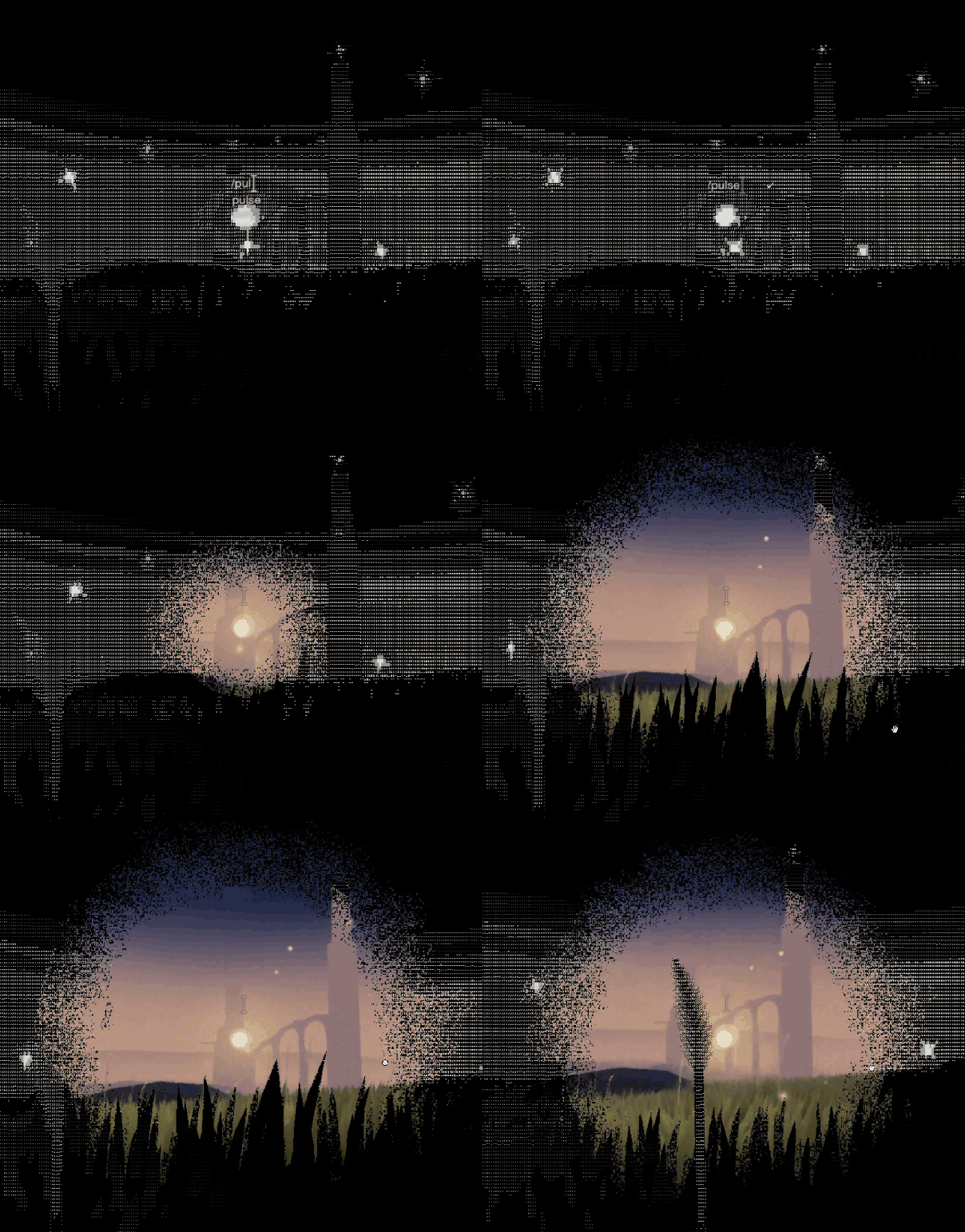
| on the loading screen - click 'Begin' to start the game! -WASD move, click to drag orbit -in ASCII-world, type the command /knock and hit enter to draw a door to reality - you don't need to find commands before you can use them- some are easy to guess |
| Meadow Game is a multiplayer social-puzzle sandbox game. you play as hopeful, bright sparks who are interfacing with this virtual environment. you have a text box above your head that you can use to talk to your fellow players. everyone sees what you are writing as you type it. you can also type commands here like /pulse, or /wave. there are over 45 commands to play with! |
you are cordially invited to hang out cool style and have fun.
About
| invite a friend to explore with you or meet a stranger. take your long-distance partner here on a date. its more fun with friends. share the commands you learn or spy on other people and copy what they type. there are two distinct visual 'layers'- you have reality, and then you have the 'code world' beneath. the code world is where you go to hunt for commands, which are carried by glowing stars. there are different zones of the map that contain different things. there's a glowing beach, an empty ocean and seabed, a tower, a sky layer, and an ominous red place where its always night time. theres also a forgotten, underground zone where you can learn how to customise your /lens. |
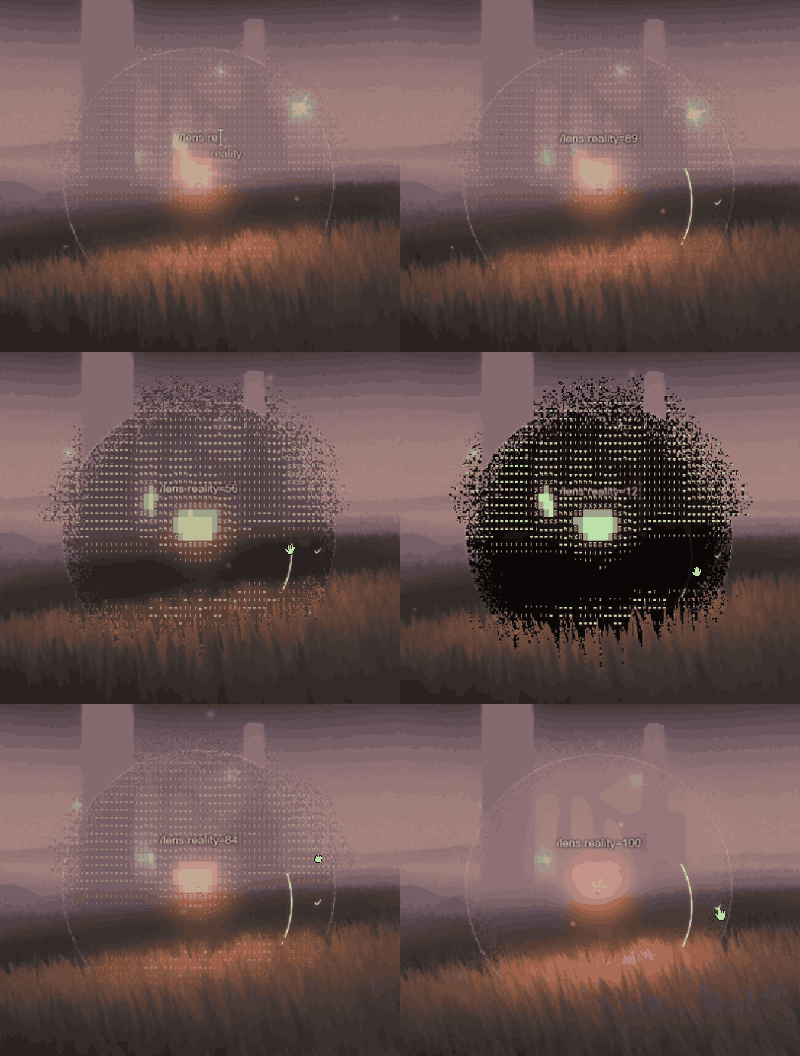
the fancy '/lens reality' slider.
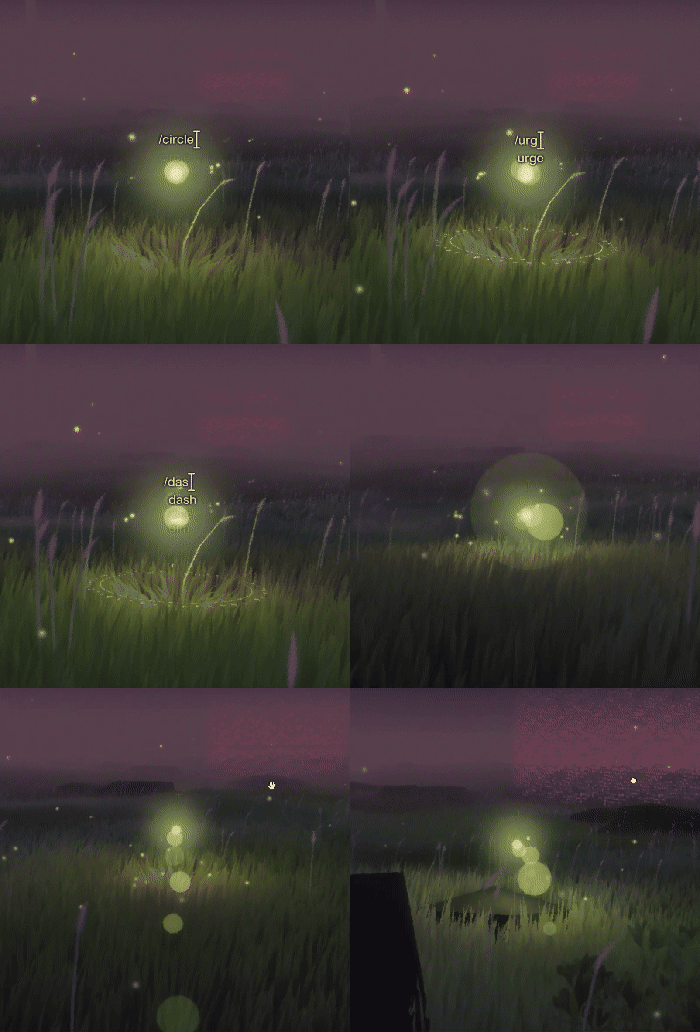
you can stack commands to increase their effects.
(theres an optional 'hardcore' mode, where you can only use commands you have found).
Theme
| the theme gave me that feeling of peering into a new tentative discovery and seeing all of its little machinations, watching it conjure up new possibilities as it unravels. like learning something new or beginning to grasp a new vocabulary. there's a few moments in games from my childhood that i remember distinctly.. the viva pinata grass , admin orbs from blockland, console commands& cheats, going underwater (in any game), swimming around in flOw, chirping in Journey, and typing to people in little chatrooms in the 2010s. all of these things inspired wonder in me, because it was digital magic you could only get from entering virtual environments- its all a big mystery ticking away beneath your screen, and you watch other people in there doing all types of cool things - and you come to the realisation that you can do anything they are doing. the process of entering videogame commands is always handled separately from the game environment- in command lines and text fields, so i had a lot of fun subverting that and incorporating it as a game mechanic. |
further writing (long!)
Methodology (click to expand)
i settled on the wisp-like orb very early as a recreation of the 'admin orb' / spectator mode from blockland, which was an old sandbox building game i played a lot as a kid. in my first thatgamejam submission, saint-ex, the final stage of the game the player transforms from a pilot in a plane into a star in the sky. and ive always had that image in my head- so this game is another variation of that.
i spent many afternoons on that game, thinking admins were so cool because they could fly, spawn things in, and do commands that would make their hats go rainbow coloured. I knew i could do all of that stuff, but i didnt know how. i had to learn through this interface- but its not just about menus and pages of documents- youre integrated into the sandbox, and the tools that were used to create it all sit half-buried infront of you. i actually cant name a comparable equivalent to that (besides literally a sandbox) - but its an aspect of 3d software and videogames, so that was the conceptual 'setting' i went for. sometimes, it seems digital art & computing gets characterised as a little soulless. i wonder if thats down to the systems we employ in order to interface with them, and the systems it typically serves. tables, rows, columns and terminals. i wonder about a future where software is 'like a world', would that even be a good idea? what would that look like, how should it be done.
i started with just an ascii sphere in an environment, as i had seen the effect as default in threejs and was curious if it could work in a game. ive always wanted a way to deliver this direct pixel value-to-glyph effect in my other games- but in unity it was less achievable. i pivoted to a realistic scene quite quickly as it wasnt feasible to design in ascii, and i started messing around with layering the two. i set up the 3d scene with the dynamic sky shader, and a simple grassy field with sloped height variation driven by perlin noise and simple lowpoly rock models dispersed randomly. i added a grass shader inspired by viva pinata- and the meadow came together.
i experimented initially with a floating pilgrim cloak character model, as i always liked the idea of the camino de santiago or 'the way of st james' and the historic design of the cloak (the scallop shell motif also features as a sign in my previous project loutra). it was cute like a little puppet, but didnt feel right, which is when i opted for the orb instead- which resonated a lot more. before this, i wasnt sure if i would enter the jam because i was just messing around, but seeing the orb flow over the grass made me want to commit to the jam.
Mechanics & Design process (click to expand)
i had the player controller, the grassy meadow, i websocketed players and then i wanted them to be able to type to eachother. since i was trying to avoid depending on user interfaces floating on top of the scene, my immediate thought was a textbox placed above the players head, central to the screen so it was always accessible. i didnt want a persistent floating send button though, so i just websocketed the textbox directly. i was also thinking about the dialogue in arctic eggs printing character-by-character, sometimes printing spelling errors and backspacing and typing the correction. it made the delivery of the text feel human.
this created a live-feed of players typing, usually chat messages are unseen until you hit the 'send' button. i found it immediately charming to invite a friend in to test multiplayer, typing to them in this manner and seeing them type back- it felt like a boundary that never had to be there was lifted away as if it was weightless. it had to stay.
speaking of boundaries, i designed the map boundaries as a hybrid between infinite generation and a fishbowl-shaped invisible wall- so players see a large expanse but they appear to reach a limit intrinsically. preserving intrinsic motivation was important - but i had to carefully steer players away from things i couldnt facilitate, or things that would break immersion or cheapen the experience. especially with exploratory players who see an infinite space and immediately seek its edge, this solution gives them just enough of what they sought without fully disrupting the experience.
i experimented with the onebit style, and the concept of 'gameworld as the game' in my other projects zetatech xpr and teenage fantasy- where i was thinking about 'netrunning' in cyberpunk narratives. there is a single frame in Blame! that shows the long-forgotten 'net', and its simply a grassy meadow- which really resonated. being able to merge this romantic, natural environment with its own existence - its code - became really exciting- but i didnt have the time to explore it. the 3d tower i designed was inspired by structures in Tower Dungeon, also by Tsutomu Nihei- ive not read this yet, but i find it really interesting how the artist went from a cyberpunk dystopia to a medieval fantasy, both employing their own forms of dense unknowable megastructures. another reference was the sci fi novel True Names, where the cyberspace was rendered as a swamp or dense ecological environment, as that was the only reference the hackers could conceptualise. i find megastructures are quite well established in the indie dev scene at the moment, and its not something im interested in developing in my own work- other people are already doing incredible things in that space. but depicting a 'cyberspace' is quite challenging and takes care to develop thoughtfully.
i really took these mechanics&concepts as far as i could in this project. there were a lot of ideas that may have worked, but would distort the players perception of their experience, so it was important to try to maintain consistency in the creative decision-making and establishing the world. this continues to be a challenge.
the idea of players modifying their visuals, and building that into the game as a diegetic mechanic, was something i first explored in my game loutra, as a panel of 'style switches' in a hidden room. that project started as a faithful depiction of a lived experience, but i learned to embrace the plasticity of the virtual environment as i developed it. it wouldnt ever be real- so i learned to play with its unreality- and i found myself wanting my players to have access to these methods of play too. i was already websocketing the players ascii vs. reality state so players could see who was seeing what- and i had made a devtool for modifying the global game visuals- so keeping the config local & broadcasting the configuration to everyone else came naturally. thats when i could conceptualise it as a player skin - and maybe players could find the variables hidden in the world, and show off their loot.
the commands, their uses, and their combinations came together very naturally as i thought of the things that inspired wonder in me, and it is very much a sandbox in that sense. thats something i aimed to embrace, rather than rush a story or linear power fantasies. and i think the commands list is more interesting and open-ended as a result.
i drew a lot from the digital image-processing and compositing techniques i have experimented with in my creative practice over the years, and '/lens menu' builds those workflows into the players toolkit, so they can actively tune their own styles and show off their configurations to other players. its like your own little world as your customisable skin. you can also copy/save your own presets, and import others.
using javascript-based ui methodologies via threejs was very liberating compared to UI systems in game engines like unity . i was really happy with the command rolodex, typing & autocomplete, and the arc-shaped '/lens (preset)' slider- i focused on integrating the digital interface into the game world so that it never detracted from feeling immersed in it. i was aiming for a 'meta UI' type style. the ascii style references the 'code' of the game in a similar meta way, but its built into the core gameplay loop. giving the player the ability to peer beyond the veil was really satisfying.
i had a home server to host the game and i used some server-side systems like a global day/night cycle that ticks by based on real-world time etc. this was my first practical test of websocketing in a live game - i cant help but feel like it will have some core limitations, but for this use-case it was surprisingly versatile and robust.
honestly, using threejs, i was able to find quite a few clever solutions to problems i had faced in game engines throughout the years- and its capabilities continue to surprise me. it has its limits of course, but i found accessibility to be one of the most beneficial aspects. this is my first game with full mobile functionality and multiplayer, which seemed like an ambitious dream a couple of years ago - but i was able to do it here and it actually worked.
Playing Offline? (click to expand)
You can download the exe and play offline, if you want to be alone or if the server is down (fragile home server, sorry).
note: offline, server-based visual styles won't be reachable & the game will load in a non-stylized state (a little ugly)- in this case, its encouraged to visit the visual tuning menu in Options to customise your look (try the monet preset).
The Meadow Game Futures
I intend on developing this game further to provide a narrative-led experience through environments, but I didnt want to rush or force this in such a short time. i was able to scope for the meadow and the underwater area. the aesthetic of the game is playful and meta, but the core of the experience is based in environmental, elemental & atmospheric experiences. players are treated as activators of an autonomous environment- they are not 'the chosen one', and i wanted to avoid reducing the experience to a predictable narrative of self-actualisation or arbitrary worldbuilding. subverting expectations is very important to keep the player 'hooked' and desiring more (rather than being told what to care about), and it turns the journey into a progression system that rewards players through experiences they discover- rather than fuelling power fantasies or placing them in a role they may not believe in.
an established motif in my work is the idea of 'headspaces' and how to ethically govern a players internal map of their experience- seeding intrinsic motivations. i think the supernatural cheat commands set a unique headspace for the player where they arent just engaging with prescribed game systems - its like modifying its code, like a developer / designer.
environmental artist olafur eliasson offers a viewer experience of discovery, subversion and/or 'illumination' - rendering the world & its internal systems as part of the artwork. it manages to avoid reducing the viewer to an art-observer, the responses & sensations the work creates become a part of the art experience. that player-as-art-observer became an inescapable drawback in my previous project loutra. in this game, i had more freedom to achieve that effect i wanted. but in pursuit of that, other core gameplay suffered and became underdeveloped, and theres uncertainty (or shoehorning) when tying the existing gameplay into what ive already got.
it would be convenient to leverage established game systems players are certain about, like collecting items, unlocking powers, or delivering a narrative of a lost civilisation - but i felt those things would contradict/cheapen the experience. i want to avoid tropes or predictable decisions, and i like the idea of the world & its ecology feeling primordial & elemental, while also being perceivably digital- without reducing that dichotomy into a typical reality bending gameplay loop. this is the main hole in the game that i need to figure out, and i have to slowly add & build things to work out where the game should go.
Open Questions
- im not sure i should have any artificial structures that imply humans in the world- but the tower currently serves as a centerpiece.
- i dont really want to offer violent/destructive actions but giving players the ability to /burn is just cool - and it looks cool in ascii- but its not fully been resolved- it feels a bit like one of those earth destroyer simulator webgames, not sure if thats 'my' side of the sandbox.
- the esc menu, lens tuning menu & tutorial/dialogue is all underdeveloped- it didnt come together as cohesively as the rolodex/lens sliders, and my workload was already stacked.
- the game is quite boring without other people- but i cant really control this unless i have some sort of ingame events and some way of building a community(?)
- id like to bring in different areas of the map or a journey to travel through, but its important to keep an overlap between late-stage and early-stage players so newbies can learn by observing others- especially when the playerbase is small. not sure how to handle this yet, but /relay and /ping and /link might help.
- command auto-assumption (/eat or /consume turns into /absorb) could make commands more accessible and turn command-hunting into a word-based guessing game. which could be fun. but it opens up a lot of trouble.
credits:
music & sounds by Johnathan @voxyll
Day Theme, Tower Theme, Italy, Aliens Dance
(modified)daytime skybox from https://freestylized.com/category/skybox/night_sky/
3d models by me
programmed with Claude Code
built with Vite and written in TypeScript, rendered with three.js
threeJS example addons used: Sky (Preetham sky model), EffectComposer, UnrealBloomPass, GLTFLoader, FBXLoader and BufferGeometryUtils.
libraries: three-mesh-bvh, React &React DOM, react-markdown.
Electron for the desktop build.
special thanks to playtesters caldera, alfie and robbie ; and taylor for inspiring me to start using threeJS in my creative projects :)
Unfortunately, it looks like the WebGL build does not have any audio due to URL path errors. this is fixed in a currently unpublished build.
Download
Install instructions
run open-frame-world2.exe
Development log
- commands list14 days ago
- known bugs15 days ago


Comments
Log in with itch.io to leave a comment.
I invited a friend and we played together!
It was really fun, full of the excitement of exploring the path.
I was especially impressed by the amazing visuals in the part where you input at night and the part where you use your opponent's Circle.
I couldn't reach the stars high up in the sky, so I gave up, but it was a lot of fun, meow~!