ArtHOI: Articulated Human-Object Interaction Synthesis by 4D Reconstruction from Video Priors

TPAMI 2026


Zihao Huang1,2,3   Tianqi Liu1,2,3   Zhaoxi Chen2   Shaocong Xu3   Saining Zhang2,3  
Lixing Xiao5   Zhiguo Cao1   Wei Li2   Hao Zhao4,3*   Ziwei Liu2*

1HUST     2NTU     3BAAI     4AIR, THU     5ZJU

*Corresponding Authors

TL;DR


ArtHOI synthesizes articulated human-object interactions through 4D reconstruction from monocular video priors and initial 3D assets, without 3D motion supervision.


Diverse Articulated Interactions

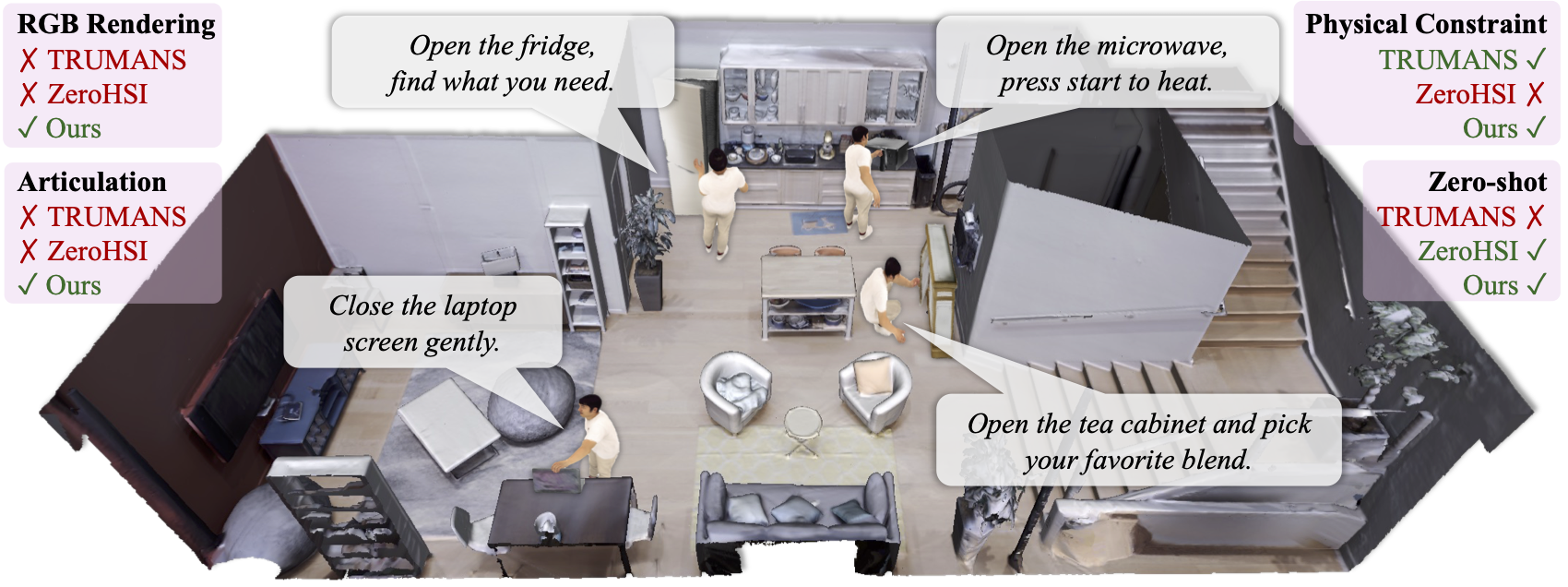
ArtHOI synthesizes realistic human-object interactions with articulated objects such as doors, cabinets, fridges, and microwaves—maintaining proper contact and kinematic constraints.


Abstract


ArtHOI Teaser

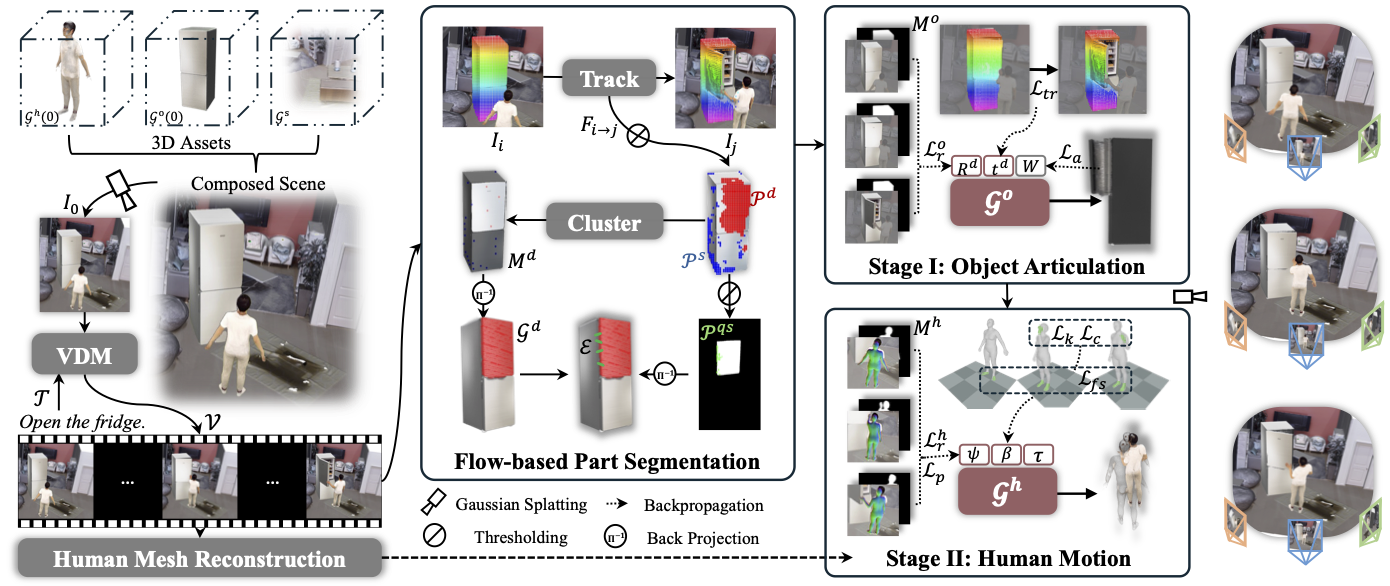
Synthesizing physically plausible articulated human-object interactions (HOI) without 3D/4D supervision remains a fundamental challenge. Recent zero-shot approaches use generative priors for 4D human-object interaction synthesis, but recovering explicit articulated object geometry from monocular video remains challenging. We formulate articulated HOI synthesis as a 4D reconstruction problem from monocular video priors. Given a video generated by a diffusion model and initial 3D assets, we reconstruct a full 4D articulated scene without 3D motion supervision. This reconstruction-based approach treats the generated 2D video as supervision for an inverse rendering problem, recovering geometrically consistent and physically plausible 4D scenes that naturally respect contact, articulation, and temporal coherence. We introduce ArtHOI, a zero-shot system that integrates two stages for articulated human-object interaction synthesis. 1) Flow-based part segmentation maps optical-flow cues and SAM masks to 3D Gaussian parts, using quasi-static binding to separate moving and static regions. 2) Decoupled reconstruction first recovers articulated object geometry and then refines human motion using contact targets derived from the fixed object reconstruction. ArtHOI bridges video-based generation and geometry-aware reconstruction, producing interactions that are both semantically aligned and physically grounded. Across diverse articulated scenes (e.g.,, opening fridges, cabinets, microwaves), ArtHOI reconstructs explicit part articulation and uses the reconstructed geometry to guide human motion refinement. The project page is available at https://arthoi.github.io/.

Method


ArtHOI Pipeline

Overview of ArtHOI. Given a monocular video \(\mathcal{V} = \{I(t)\}_{t=1}^T\) (generated from a text prompt or captured from real scenes), we formulate interaction synthesis as a 4D reconstruction problem. Stage I identifies articulated object parts via flow-based segmentation (point tracking, SAM-guided masks, back projection to 3D Gaussians, quasi-static binding), then recovers object articulation with kinematic constraints. Stage II refines human motion (SMPL-X) conditioned on the reconstructed 4D object scaffold, using 3D contact keypoints derived from 2D evidence and enforcing kinematic, collision, and foot-sliding losses. The decoupled design avoids monocular ambiguity and yields geometrically consistent, physically plausible articulated HOI.


Comparisons

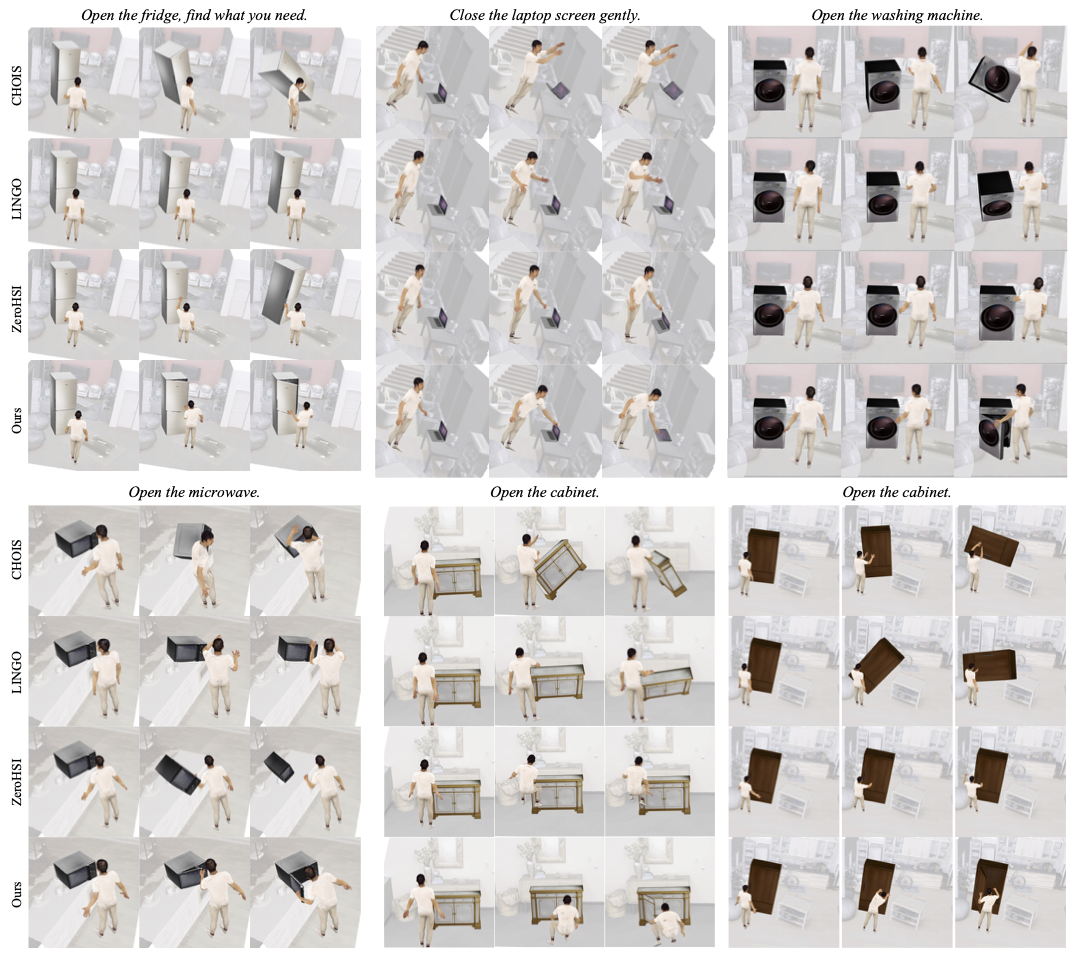
ArtHOI outperforms prior methods in contact accuracy, penetration reduction, and articulation fidelity. Zero-shot baselines (e.g., ZeroHSI) treat objects as rigid and fail to model part-wise articulation.
Comparisons


Citation

Accepted to IEEE TPAMI in October 2026. The arXiv citation below will be updated when the IEEE publication record is available.


@article{huang2026arthoi,
  title={ArtHOI: Articulated Human-Object Interaction Synthesis by 4D Reconstruction from Video Priors},
  author={Huang, Zihao and Liu, Tianqi and Chen, Zhaoxi and Xu, Shaocong and Zhang, Saining and Xiao, Lixing and Cao, Zhiguo and Li, Wei and Zhao, Hao and Liu, Ziwei},
  journal={arXiv preprint arXiv:2603.04338},
  year={2026}
}