
Juggalos on Writing
“It’s a lifestyle, it ain’t only a music choice.”
“Do what you gotta do, don’t gotta hate on people because they’re different.”
“I do whatever the fuck I want and don’t give two fucking shits.”
“I am fucked up on E and vodka.”
“I got fucked up.”
“It was a fucking spectacle and shit and I don’t give a fuck because it was righteous.”
“I can cook like a motherfucker.”
“I’m a happy motherfucker living life day to day.”
“Most people think I’m on drugs because I’m always happy.”
“It’s a puzzle and each and everyone of us is an integral piece.”
“It actually really burns, I’m not going to lie.”
“Keep it trippy. Legalize everything.”
“The gathering don’t stop. You do.”
“It’s the greatest.”
“I’m still fucking here.”
“Life is something special that you can only have one time. Enjoy the shit out of it.”
“We have alcohol and we’ve got explosives.”
“We just drank a little bit. Probably get all stoned, smoke some hash and fucking chill, do it all again the next day.”
“All of us have jobs.”
“Being a juggalo does not mean you’re not fit for society,”
“I’m insane. I like to stab people, know what I mean?”
“I’m showing my titties to everyone.”
“Why am I a juggalo? Because that’s who I am. That’s how I was born.”
‘There is no bigatory in juggaloism.”
“True life is inside your soul.”
“WOO WOO!”

Secrecy, speed, affect: The Marbled Swarm

The Marbled Swarm
by Dennis Cooper
Harper Perennial, November 1st, 2011
$10.19 / Buy from Amazon
1. A precursor: the often repeated and often obvious dictum from authors: if one could summarize the idea or express the idea elsewhere, it would not be a book.
2. Another precursor: I have to use numbers for this review. The accumulative force in The Marbled Swarm has made me nervous to write about it. These numbers should help. Related: numbers are very rarely used in the book; we are maybe twice given them as markers, as soft attempts at erasure, but more so as another meter to remember. I understand the absence of counting in the book.
3. Formal book reviews mostly feel homogenous to me; some young limping component of an old structure; sutured to print? The format seems off, or rather: very rarely off. I’m pretty often baffled, too, by the claim that some argument must be lodged and pushed through to agree a reader; maybe I discredit the militaristic form of rhetoric, or of establishing a reading. To me, the reviews, the books too, that are interesting and alive feeling do not seem camped or aimed, yet open and transfixed.
4. I read The Marbled Swarm for the first time on a plane. Enclosed by a tube, moving very fast through different pressured air, hoping for a smooth passage. Fantasizing about puncture. READ MORE >
13 Comments
September 30th, 2011 / 8:00 am
September 30th, 2011 / 8:00 am
“‘You should only read what is truly good or what is frankly bad.’ – Gertrude Stein” — Hemingway

Georg Scholz, "Female Nude with Plaster Bust" (1927)
Writing is a matter of taste, criticism a manner of penetration.
A little street

A rare Vermeer painting “The Little Street” (c. 1658) shows the side of a street in Holland spotted with a cast of the painter’s usual subjects, who may be taking a break from their role at the windows above. His sole painting of this nature, nobody knows why, that day, he decided to leave his room and paint from outside. Some art historians suggest that the scene in entirely imagined. I imagine the daylight, however dimmed by the clouds, entering the black windows — the soft angular light, the new shapes presented, and the intricate narratives unfolding inside. Neutral Milk Hotel’s “Holland, 1945,” which begins the only girl I’ve ever loved/was born with roses in her eyes/but then they buried her alive/one evening 1945 may well be about Anne Frank, her legacy one of edifice: of her building, of the bookshelf that led to her secret annex, the published cover of her diary proposing how one might look at it. This one sees her in her room, the way Vermeer would have imagined, reading a letter from a boy, or writing one; and while history congratulates composing letters, decomposing bodies has the final say. Buildings haven’t changed much in Holland, at least I’m guessing. I’ve never been. Who needs Amsterdam when you have rush hour traffic jam in front of you. At a red light, I imagine things in a glass room moving in an anthropologically sound way. We list our wars I and II, as if we were counting on something.
Starting With No

My creative writing pedagogy story starts in the Introduction to Poetry writing workshop I took as a nontraditional student at Florida International University. I signed up for the course because I was convinced that I was the baddest poet that had ever lived. I’d won both of the poetry slams I’d entered. I could rhyme like no one else. I prided myself on being able to write complete sentences where every word rhymed and still made sense. In the first class session, the professor told us that poems don’t have to rhyme and that most contemporary poetry didn’t rhyme at all. She even went so far to say that a good portion of bad poetry written by amateur poets today rhymed. She said rhyming is easy, rhyming well is hard. I was shattered. She hadn’t yet read any of my work, but I took her words personally. Everything I thought I knew about poetry and my ability to write it was destroyed.
Now when I teach my own intro to poetry writing workshops, I am aware of the extra inhabitants in the room—the students’ misconceptions. These misconceptions keep students from attempting to write poetry when they don’t believe they can make a poem do what they believe poetry is required to do. These misconceptions keep them from reading poetry because if they already believe they know what poetry is (and they don’t necessarily like it), why should they read anymore of it? That’s why I feel that my first job as a creative writing instructor is to overcome their false impressions.
Reading Comics: Christopher Lirette on the Dark Phoenix Saga
Welcome to the second installment of my new series: Reading Comics. I’m excited to report that I’ve got a bunch of great contributors lined up, and am myself working on a few entries. If you haven’t contacted me yet, but would like to participate, email me and let me know! Without further ado….here’s Christopher Lirette…
“The Libertine Adventures of Scott and Jean, or Genocidal Orgasm and Mystical Unions in the Dark Phoenix Saga”
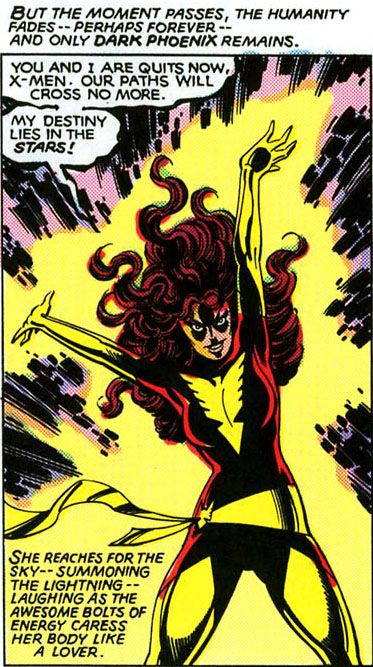
Over the last few weeks, my students and I read Chris Claremont and John Byrne’s 1980 Marvel comics classic “Dark Phoenix Saga,” the most popular story in Uncanny X-Men. I’m teaching a class focusing on superheroines and depictions of women kicking ass under the rubric of gender and sexuality. So far, I’ve spent a lot of time trying to teach that there’s more to studying gender in literature than pointing out moments of sexism—a harder task than I thought it would be, perhaps because our primary texts feature scantily clad women beating up villains and forming romance with dudes whose clothes get caught in their muscle striations. Although William Marston Moulton created Wonder Woman in 1942 to combat “the blood-curdling masculinity” he found plaguing titles such as Batman and Superman, it’s not until “Dark Phoenix Saga” that we get a comic book that truly addresses the problem of the deuxième sexe superheroique: a story that revels in the messiness of desire, one whose heroine’s problems, while mythic, symbolize the contradictory messages real people receive about gender.
The Powerlessness of Bad Writing
 At The Indypendent, in a fairly comprehensive overview of the very amazing and exciting protests happening on Wall Street and the issues behind the protests, there is this crucial paragraph:
Our system is broken at every level. More than 25 million Americans are unemployed. More than 50 million live without health insurance. And perhaps 100 million Americans are mired in poverty, using realistic measures. Yet the fat cats continue to get tax breaks and reap billions while politicians compete to turn the austerity screws on all of us.
This is the beef, right? I agree with it with all my heart and pump my fist a little, even though it is striving to say nothing. I’m disappointed that it is ruined by ghetto-ized rhetoric like “fat cats” and meaningless statements like “Our system is broken at every level.” Even the statistics shared are paltry (and made more so by “perhaps”). Granted, this is The Indypendent, so the preaching here is directed to the choir — I grant that, but actually it’s my point. Why? Why does every group have their own vernacular that they use to deafen their opponents?
The comment box is open for non-shitty articles about #WallStreet?
And it’s worth 15 minutes to watch this timeless discussion. Foucault is a tool. I’m in love with Chomsky, who at around 5:00, does a much better job characterizing our demise.
