Showing posts with label technology. Show all posts

Monday, September 20, 2010

Smart cars to mean safer driving

As was discussed in my book with John Urry - After the Car - one side of in-car technologies will be increased 'intelligent sensors' placed into cars. As this recent post from the BBC explains,


Cars could soon be ringing the emergency services themselves if they are involved in a crash.
Sensors embedded in future vehicles could also let emergency services work out the severity of the crash and how many people were involved.

The predictions came at a symposium considering the changes ushered in by the spread of small, smart processors. The growing number of on-board computers could also spell big changes for the way people drive.

"The car is probably going to be the most compute-intensive possession that we will have," said Steve Wainwright, European manager at Freescale Semiconductor which makes many of the chips inside car control systems.

Mr Wainwright said average cars have 25-30 electronic control units onboard already and high-end cars probably carry up to 80. These tiny computers are in charge of many car systems such as stability control, power distribution, safety and many others. 

Increasingly, said Mr Wainwright, they are helping to augment a person's driving skill and that trend would only continue as technologies such as collision detection systems and radar become more commonplace.


Read more at 'Smart cars to mean safer driving'

-

Wednesday, July 21, 2010

Power from thin air

Well, Tesla is never far away from modern communications...and his wireless technology has been trying to emerge into markets for quite some time now... here's some latest news on this:


A little over a century ago, the inventor Nikola Tesla drew up ambitious plans to transmit electrical power without wires. He carried out a series of experiments in which electric lights were illuminated via electrostatic induction, by connecting them to metal sheets suspended in a strong electric field produced by a distant transmitter. In 1898 he proposed a “world system” of giant towers that would form both a global wireless communications network and a means of delivering electricity over large areas without wires.

The construction of the first such tower, the Wardenclyffe Tower, on Long Island, began in 1901. Tesla’s backers included the financier J.P. Morgan, who invested $150,000. But before the tower was completed, Morgan and the other backers pulled out. They worried that the delivery of electricity through the air could not be metered, and there would be nothing to stop people from helping themselves. 

But has Tesla had the last laugh after all? Today several firms—including Fulton Innovation, eCoupled, WiTricity and Powercast—are pursuing various technologies that deliver electrical power without wires (though over shorter distances than Tesla had in mind). WiTricity has demonstrated the ability to send enough energy across a room to run a flat-screen television using its approach, called “resonant magnetic coupling”. This is different from Tesla’s approach, but the firm’s founders have acknowledged his pioneering work.


Read more at - 'Power from thin air'

-

Monday, March 22, 2010

Augmented Identity

Technology Review has a post on a new phone application that 'lets users point a smart phone at a stranger and immediately learn about them premiered last Tuesday at the Mobile World Congress in Barcelona, Spain. Developed by The Astonishing Tribe (TAT), a Swedish mobile software and design firm, the prototype software combines computer vision, cloud computing, facial recognition, social networking, and augmented reality.'  Now there's a combination! It's a confluence of mobile technologies to frame each identity:


"It's taking social networking to the next level," says Dan GÃĪrdenfors, head of user experience research at TAT. "We thought the idea of bridging the way people used to meet, in the real world, and the new Internet-based ways of congregating would be really interesting."
TAT built the augmented ID demo, called Recognizr, to work on a phone that has a five-megapixel camera and runs the Android operating system. A user opens the application and points the phone's camera at someone nearby. Software created by Swedish computer-vision firm Polar Rose then detects the subject's face and creates a unique signature by combining measurements of facial features and building a 3-D model. This signature is sent to a server where it's compared to others stored in a database. Providing the subject has opted in to the service and uploaded a photo and profile of themselves, the server then sends back that person's name along with links to her profile on several social networking sites, including Twitter or Facebook. The Polar Rose software also tracks the position of the subject's head--TAT uses this information to display the subject's name and icons for the Web links on the phone's screen without obscuring her face.


Read more on 'Augmented Identity'

-

Wednesday, March 10, 2010

Why you won't recognize the 'Net in 10 years

Security on the Net has always been a problem...but will it continue to be a problem...? Not, apparently, if the boffs have their way:

As they imagine the Internet of 2020, computer scientists across the country are starting from scratch and re-thinking everything: from IP addresses to DNS to routing tables to Internet security in general. They're envisioning how the Internet might work without some of the most fundamental features of today's ISP and enterprise networks.

Their goal is audacious: To create an Internet without so many security breaches, with better trust and built-in identity management. Researchers are trying to build an Internet that's more reliable, higher performing and better able to manage exabytes of content. And they're hoping to build an Internet that extends connectivity to the most remote regions of the world, perhaps to other planets...

 ... This high-risk, long-range Internet research will kick into high gear in 2010, as the U.S. federal government ramps up funding to allow a handful of projects to move out of the lab and into prototype. Indeed, the United States is building the world's largest virtual network lab across 14 college campuses and two nationwide backbone networks so that it can engage thousands – perhaps millions – of end users in its experiments.


Read more - 'Why you won't recognize the 'Net in 10 years'

-

Wednesday, March 03, 2010

The next hacking frontier: Your brain?

In this intriguing post from Wired they ask whether the trend in brain-wireless interfaces may not create a market for... wait for it.... Brain-Hacking! Well, read on......


bci
"Hackers who commandeer your computer are bad enough. Now scientists worry that someday, they’ll try to take over your brain"

In the past year, researchers have developed technology that makes it possible to use thoughts to operate a computer, maneuver a wheelchair or even use Twitter — all without lifting a finger. But as neural devices become more complicated — and go wireless — some scientists say the risks of “brain hacking” should be taken seriously.
“Neural devices are innovating at an extremely rapid rate and hold tremendous promise for the future,” said computer security expert Tadayoshi Kohno of the University of Washington. “But if we don’t start paying attention to security, we’re worried that we might find ourselves in five or 10 years saying we’ve made a big mistake.”
Hackers tap into personal computers all the time — but what would happen if they focused their nefarious energy on neural devices, such as the deep-brain stimulators currently used to treat Parkinson’s and depression, or electrode systems for controlling prosthetic limbs? According to Kohno and his colleagues, who published their concerns July 1 in Neurosurgical Focus, most current devices carry few security risks. But as neural engineering becomes more complex and more widespread, the potential for security breaches will mushroom.

For example, the next generation of implantable devices to control prosthetic limbs will likely include wireless controls that allow physicians to remotely adjust settings on the machine. If neural engineers don’t build in security features such as encryption and access control, an attacker could hijack the device and take over the robotic limb.
 Read more - 'The next hacking frontier: Your brain?'

-

Wednesday, February 10, 2010

10 Technologies that Will Rock 2010

More on 2010 predictions for the world of technology...and no real surprises in this list (see original site). There are references to the much-anticipated Tablet (see below) as well as some Google products and applications:

The Tablet: It’s the most anticipated product of the year. The mythical tablet computer (which everyone seems to be working on). There are beautiful Android tablets, concept tablets, and, of course, the one tablet which could define the category, the Apple (AAPL) Tablet. Or iSlate or whatever it’s called. If Steve Jobs is not working on a tablet, he’d better come up with one because anything else will be a huge disappointment. Why do we need yet another computer in between a laptop and an iPhone? We won’t really know until we have it. But the answer lies in the fact that increasingly the Web is all you need. As all of our apps and data and social lives move to the Web, the Tablet is the incarnation of the Web in device form, stripped down to its essentials. It will also be a superior e-reader for digital books, newspapers, and magazines, and a portable Web TV.


Read more - '10 Technologies that Will Rock 2010'

-

Monday, February 01, 2010

More Publications Moving To Digital Only

Here's some recent news following the (inevitable) trend of print publications gradually moving over to digital-only format:

The Online Information show at Olympia earlier this month coincided with a decision by the Guardian newspaper to cease print publication of the Technology supplement. From next year this will be available online only. So far there has been very little comment about this except for some extracts from Twitter and blogs that the Technology Guardian has republished in print. However the event could be seen as marking a new confidence for online publishing.

Academic journals have been moving towards a digital default for several years. Highwire Press, based at Stanford University Libraries, have started to promote e-books as well. They offer a hosting service for many university presses and journals. Oxford University Press (OUP) have added some handbooks alongside journals. OUP is also about to launch a series of online bibliographies with Web links selected by experts.

At a seminar presentation, Kristen Fisher Ratan explained (see YouTube video) that while it is important to make journals easy to discover, it is also important to make e-books more visible. They need to be seen within the workflow of students and professionals needing knowledge.


Read 'online'! at - 'More Publications Moving To Digital Only'

-

Friday, January 29, 2010

Controlling the TV with a wave of the hand

Apparently the new word on the street is 'Touchscreens are so yesterday. Remote controls? So last century. The future is controlling your devices with a simple wave of the hand.' So..what do 'they' have to say about this? Well...

A wiggle of the fingers will change television channels or turn the volume up or down. In videogames, your movements will control your onscreen digital avatar. It's called 3D gesture recognition and while it may not be in stores this Christmas a number of technology companies are promising that it will be by next year. Softkinetic, a Brussels-based software company, is one of the leaders in the gesture-control field and has teamed up with US semiconductor giant Texas Instruments and others to make this touchless vision of the future a reality...

..."We're in that transition to a time when gestural input will be quite natural," Kay said. "From what I've seen of the demos they're pretty close."On the gaming front, "using a camera in real time to capture motion and then take the representative avatar from that and play it on a screen with other elements in a is a pretty compelling experience," he said.


Read more - 'Controlling the TV with a wave of the hand'

-

Wednesday, January 27, 2010

The thrilling potential of SixthSense technology

This is a video - a TEDtalk India - with Pranav Mistry. Pranav Mistry demos several tools that help the physical world interact with the world of data - including a deep look at his SixthSense device and a new, paradigm-shifting paper "laptop." In an onstage Q&A, Mistry says he'll open-source the software behind SixthSense, to open its possibilities to all.

For the video, see here -  'The thrilling potential of SixthSense technology'

-

Friday, January 22, 2010

Augmented reality is on its way

Charlie Brooker over at the Guardian has written a post on the 2010 coming of augmented reality. But then again, it has always been coming... just never fully birthed. But it may now be 'more ready than ever' to enter into our everyday gadgets:

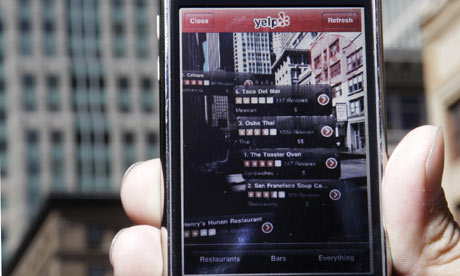
Monocle app
Cause an almighty logjam by shuffling slowly along the pavements staring at your augmented-reality app. Photograph: Marcio Jose Sanchez/AP

According to technophiles, experts, and that whispering voice in your head, 2010 will be the year that augmented reality makes a breakthrough. In case you don't know, "augmented reality" is the rather quotidian title given to a smart, gizmo-specific type of software that takes a live camera feed from the real world and superimposes stuff on to it in real time.

Being a gadget designed for people who'd rather look at a screen than the real world, the iPhone inevitably plays host to several examples of this sort of thing. Download the relevant app, hold your iPhone aloft and gawp in astonishment as it magically displays live footage of the actual world directly in front of you – just like the real thing but smaller, and with snazzy direction signs floating over it. You might see a magic hand pointing in the direction of the nearest Starbucks, for instance – a magic hand that repositions itself as you move around. It's incredibly useful, assuming you'd prefer to cause an almighty logjam by shuffling slowly along the pavement while staring into your palm than stop and ask a fellow human being for directions.


Read more at - 'Augmented reality is on its way'

-

Monday, January 18, 2010

Technology predictions for 2010

Charles Arthur from The Guardian has revealed his annual list of tech predictions including the year ahead for Google, Microsoft, Apple, Internet and social sites... here's an example:

Government

18) The Digital Britain bill will fall as the election (in May?) intervenes and kills off legislation in progress.
19) The freeing of Ordnance Survey map data (in April) will see rival companies vying to produce paper maps specialised for various niches such as ramblers and climbers, and an explosion in websites that mash all sorts of government content against maps.
20) If elected, the Tories will also back the freeing of Ordnance Survey data (rather than privatising it) and of other government data.

Being social

27) Facebook's growth will level off in the western world. There's only so many people you can encourage to poke and friend you.
28) Twitter will start making money – not just through searches (it charges Google and Bing), but also through charging companies for various sorts of access to its network and data.
29) AOL will sell Bebo and/or News Corporation will sell MySpace; in either or both cases, at a substantial loss.


Read more here - 'Technology predictions for 2010'

-

Thursday, December 03, 2009

HAL's bells: IBM makes 'thinking computer' breakthrough

Not there yet...but the tech-boffins are scurrying to get closer to the Tech-Holy-Grail... here's the latest over at IBM:

Scientists say they've made a breakthrough in their pursuit of computers that "think" like a living thing's brain - an effort that tests the limits of technology.Even the world's most powerful supercomputers can't replicate basic aspects of the human mind. The machines can't imagine a wall painted a different colour, for instance, or picture a person's face and connect that to an emotion.

If researchers can make computers operate more like a brain thinks - by reasoning and dealing with abstractions, among other things - they could unleash tremendous insights in such diverse fields as medicine and economics.A computer with the power of a human brain is not yet near.But this week researchers from IBM are reporting that they've simulated a cat's cerebral cortex, the thinking part of the brain, using a massive supercomputer.The computer has 147,456 processors (most modern PCs have just one or two processors) and 144 terabytes of main memory - 100,000 times as much as your computer has.

The scientists had previously simulated 40 per cent of a mouse's brain in 2006, a rat's full brain in 2007, and 1 per cent of a human's cerebral cortex this year, using progressively bigger supercomputers.The latest feat, being presented at a supercomputing conference in Portland, Oregon, doesn't mean the computer thinks like a cat, or that it is the progenitor of a race of robo-cats.The simulation, which runs 100 times slower than an actual cat's brain, is more about watching how thoughts are formed in the brain and how the roughly one billion neurons and 10 trillion synapses in a cat's brain work together.


Read more at - 'HAL's bells: IBM makes 'thinking computer' breakthrough'

Monday, February 23, 2009

Mobile tech is key for education

According to Smartmobs, the 2009 Horizon Report identifies personal web technologies from mobile and GPS to cloud computing as the defining trends in emergent educational technology:

The findings of the Horizon Report are not only good news for educational early adopters but also serve to help institutions better identify meaningful priorities and better negotiate the sometimes dizzying information prospects available online. From The Chronicle of Higher Education:

“Though the Internet has proved to be a helpful resource for many students and professors, the sheer volume of its content can make finding relevant information a tedious chore at times. According to the report, the personal Web—i.e., widgets and services that help connect individual users to the Web-based information relevant to them—will allow students, professors, and administrators to use the Web more efficiently.”


See the 2009 Horizon Report: Mobile tech is key for education

-

Tuesday, January 27, 2009

Aeromobilities


Aeromobilities is based on the 2006 Cosmobilities conference on Air Time Spaces in Lancaster. It provides a broad introduction to the study of air travel, airspaces and aviation from the perspective of the social sciences and the humanities. The book makes a strong case for a systematic, interdisciplinary study of some of the most powerful forces that have shaped our mobile globalization.

‘Aeromobilities’ by Saulo Cwerner, Sven Kesselring and John Urry, available from all good bookstores or direct from the Routledge website.


Table of Contents

Part 1: Aeromobilities, Globalization and Social Theory 1. Aeromobilities and the Global 2. Global Transfer Points: the Making of Airports in the Mobile Risk Society Part 2: The Production of Airspaces 3. >store>forward> Architectures of a Future Tense 4 Connecting the World: Analyzing Global City Networks Through Airline Flows 5. Airport Codes/Spaces 6. Air Craft: Producing UK Airspace 7. Around the World in 80 Airports Part 3: The Social Life of Air Travel 8. Airborne on Time 9. A Life in Corridors: Social Perspectives on Aeromobilities and Work in Knowledge Organizations 10. Getting into the Flow Part 4: Governing Air Travel 11. Science, Expertise, and Local Knowledge in Airport Conflicts: Towards a Cosmopolitical Approach 12. Helipads, Heliports and Urban Air Space: Governing the Contested Infrastructure of Helicopter Travel


Click to read more on 'Aeromobilities'

-

Wednesday, September 03, 2008

Tongue Drive Technology

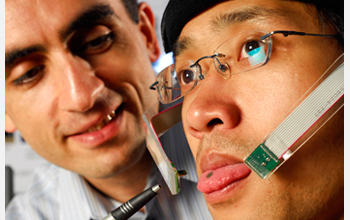
Photo of Maysam Ghovanloo (left) pointing to a small magnet attached to tongue of graduate student.


This article posted by The National Science Foundation describes a new mobility-enhancing technology whereby the human tongue can be used to control such objects as wheelchairs and computers:


Researchers have developed an experimental tongue-based system that may allow individuals with debilitating disabilities to control wheelchairs, computers and other devices with relative ease and no sophistication.

Because the tongue is directly connected to the brain via cranial nerves, it usually remains mobile when other body parts lose function to disease or accidents. That mobility underlies the new system, which may one day provide greater flexibility and simplicity to individuals who would otherwise use sip-and-puff controls or brain implants.

Electrical engineer Maysam Ghovanloo developed the Tongue Drive system in collaboration with graduate student Xueliang Huo and presented the findings June 29 at the 2008 Rehabilitation Engineering and Assistive Technology Society of North America (RESNA) Annual Conference in Washington, D.C.

"Tongue Drive is inherently wireless and touch-free because it relies on a tiny magnetic tracer attached to the tongue with no power consumption," said Ghovanloo. "Tongue movements are also fast, accurate and do not require much thinking, concentration or effort."


Read original article - 'Tongue Drive Technology'

-

Wednesday, August 20, 2008

Toyota tests Segway-like stand-up-and-ride machine


A model demonstrates Japanese automaker Toyota Motor Corp.s new motorized ride Winglet during a press conference in Tokyo Friday Aug. 1 2008. Toyota will start testing the stand-up-and-ride contraption that travels at up to 6 kph (3.7 mph) later this ...

Well, here's an alternative to the Sedgeway mobility vehicle being shown off by Toyota (shame there are no plans for commercial release!):

Toyota will start testing the stand-up-and-ride contraption, that travels at up to 6 kph (3.7 mph), later this year at a Japanese airport and resort complex and next year at a shopping mall to get feedback from people...

...But the "Winglet," shown Friday in Tokyo, takes some getting used to. A demonstrator was visibly worried about its safety while accompanying a reporter who cautiously tried it on a short course in a Toyota showroom...


...Still, Toyota Motor Corp. has no plans yet to turn the Winglet into a commercial product. The Japanese automaker will start testing the two-wheeler this year at an airport and resort complex and next year at a shopping mall, all in Japan, to get user feedback. Overseas test plans are undecided.


Read original article - 'Toyota tests Segway-like stand-up-and-ride machine'

-

Saturday, July 12, 2008

A laptop in your pocket?!

This recent post indicates that the laptop is likely to soon go the way of 5.25-in. floppy disks - 'made obsolete by smaller, more useful technology: the smart phone':

Based on current trends for low-power chips used in devices like cell phones and iPods, we're likely to see eight times the CPU power in handheld devices by 2010 that we have today, computer architecture enthusiast Adrian Cockcroft said at the Usenix '08 technical conference this afternoon.

"I wouldn't need a laptop if I had that kind of performance," said Cockcroft, formerly a distinguished engineer at Sun Microsystems Inc. who now works for Netflix Inc. and is a member of the Homebrew Mobile Club, which designs open-source mobile phones.

Instead, Cockcroft envisions an always-on device that can connect wirelessly (and seamlessly) to your car while you're driving, to a desktop monitor and keyboard when you're working, and to other devices such as a projection system at meetings or a 3-D portable display, no matter where you are.


Read full post - 'Coming soon: A laptop in your pocket'
-

Friday, July 11, 2008

Tech giants team for online ID cards

The Register reports that a group of software and online payment companies are teaming up to find a better way than passwords to protect, and prove, our identity online:

Problems with passwords are well known - people require ever more passwords which means they either get forgotten, or people use the same word for several different services which is a security risk. The new group will seek to find open standards to make it easier to prove your identity online without using dozens of passwords and usernames.

Equifax, Google, Microsoft, Novell, Oracle and PayPal will work together to create "Information Cards" - online cards like those in your wallet. Different cards can contain different levels of information and can be used to log in to different websites instead of using a username and password. Some may contain just a user name and password, others address information.Other information - such as whether or not the browser is over 21 years old - could also be verified by the website by sending a query to the independent third party. In theory this should be safer - your information will not have to be stored by several different websites.


Read article at - 'Tech giants team for online ID cards'
-

Windows for GPS

TechReview has an article that discusses Microsoft's latest operating system and how it makes it easier to integrate location detection with other services, such as in-car systems:

Internet-enabled services could become more common in vehicles, thanks to a new operating system launched this week by Microsoft. Dubbed Windows Embedded NavReady 09, the operating system is designed to improve wireless connectivity and Internet access in GPS devices. It also includes Bluetooth features that allow GPS receivers to be coupled with other devices, such as cell phones, PDAs, and laptops.

"The industry mostly knows us for Windows PC, Windows Mobile, Zune, and Xbox," says Dan Javnozon, senior product manager of Windows Embedded. But for the past 11 years, he says, Microsoft has been supplying embedded operating systems for everything from huge industrial robots and home automation appliances to temperature controls and some GPS devices.

Whereas the desktop version of Windows adds new functions and requires more memory with every release, embedded operating systems sacrifice versatility for leanness and efficiency. Currently, most GPS companies, such as TomTom and Garmin, use their own custom-built, proprietary operating systems. Others use off-the-shelf embedded systems that may not be ideal for GPS technology. Mio, for instance, uses an existing Microsoft operating system called Windows Embedded Compact, which is designed for real-time handheld devices.


Read more at - 'Windows for GPS'
-

Thursday, June 26, 2008

Mobiles, Tech & Hyper Island

Doc Rogers over at the Knitware blog has managed to get himself an interview with David Erixon, Director of Brand Strategy & Manifestation, Vodafone Global Marketing, and co founder of Hyper Island. Erixon discusses mobile phone users, the i-phone, and user's perceptions:


There is also a second video where Erixson talks about Hyper Island - for this you need to go to the original post - 'Mobiles, tech & Hyper Island. (interview)'

Thanks Doc for the link!

-