This picture was taken from the third floor of a renaissance chateau. Do you know which town it's in?
Friday, 9 December 2011
Where the Czech...? #163

Friday, 2 December 2011

Friday, 25 November 2011

Tuesday, 22 November 2011
These boots are made for walkin'...
 In the context of Czech towns and cities that might be interesting to foreign travellers, Zlín is quite unusual because most of its tourist attractions are modern.
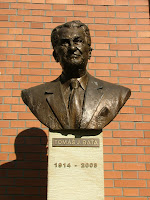 They're also connected with the story of one family and their company, Baťa Shoes. Siblings Anna, Antonín and Tomáš Baťa came from a long family line of cobblers but the company they founded in Zlín in 1894 became one of the biggest shoemaking concerns the world has ever seen and still has 50 factories, more than 4500 shops and almost 50,000 direct employees.
 There was an element of being in the right place at the right time for Baťa shoes (with the outbreak of World War One and huge orders from the Austrian army) but good management and integrity were key to the company's amazing expansion. Tomas Baťa was sometimes called the “Henry Ford of Eastern Europe” for his quickness to embrace the technologies of large-scale production, but he's best remembered in the history of Zlín for his integrity and social consciousness. Baťa employees were paid up to 4 times more than their counterparts in other countries and were assisted with housing, specialized training, medical care, insurance and retirement benefits decades (if not lifetimes) before before these things became the norm for factory workers elsewhere.The Baťa family left Czechoslovakia soon after the occupation by Nazi Germany, and in the late 1940s the remainder of Baťa shoes was nationalized by the new communist government. The communists tried to portray the Baťas as ruthless and exploitative capitalists, but such was the regard for the family that Jan Baťa was cleared of all 64 charges against him by an extraordinarily courageous jury. The communists came up with new charges, resorted to a closed military trial to justify the seizure of company assets and in 1949 Baťa shoes was renamed Svit, Zlín itself was renamed Gottwaldov (after the first Czech Communist president Klement Gottwald) and the Canadian province of Ontario became the new world home of Baťa shoes.
 Three places to find out more about the Zlín heyday of Baťa shoes are building 21 (the former headquarters), the excellent and extensive shoe museum, and street after street of the cute little Baťa villas - the cubelike houses built by the leading architects of the first republic for Baťa factory workers.
 The distinctive Baťa villas use the same combination of exposed red brick and pale grey concrete as the factories you'll see if you arrive at Zlín central station by train. Wandering the streets of villas and trying to imagine how wonderful they must have seemed to the factory workers of the 1920s and 30s is possible all year round, and from May through September the 1930s interior of the villa at Nad Ovčírnou II 1295 is also open to the public (unfortunately closed during 2011 'for technical reasons').
 The shoe museum takes its visitors through seven centuries of shoes ranging from peasant boots to embroidered royal slippers to a pair of 41cm monsters made for an American basketball player. There's also a recreated workshop and displays of techniques and tools. For non-Czech speakers there are translated booklets explaining all the exhibits, the history of shoemaking in general and the Baťa company specifically.
Building 21, the Zlín skyscraper, offers a wonderful view over the city from its new rooftop cafe and terrace, the chance to ride a continuous paternoster elevator and to visit the boss's office which was built in an 6x6m elevator (fitted with air-conditioning and running water) that could travel horizontally as well as vertically throughout the skyscraper! Unfortunately that was also closed on my last visit to Zlín, so I don't have any photos to show you, but the best way to remedy that is to plan a little trip to south Moravia and see it for yourself!
Monday, 21 November 2011
Markéta Irglová - Crossroads
Some nice shots of Wallachia sprinkled through this clip. See if you can spot the main square of Nový Jičín.
Friday, 18 November 2011

Thursday, 17 November 2011
Grandmother's Valley

"It was long, long ago, when last I gazed on that dear face, kissed those pale, wrinkled cheeks, and tried to fathom the depths of those blue eyes, in which were hidden so much goodness and love." The author of this simple lament for her deceased grandmother was one of Czech literature's most highly regarded figures, Božena Němcová. Her image graces the five hundred crown banknote, and the cool, green valley of the Úpa river around the Ratibořice chateau is called Grandmother's valley after her most beloved character. Grandmother is an iconic story in Romantic Czech literature and if you think of the regard for stories like Huckleberry Finn or the Adventures of Robin Hood you’ll have an idea of the tale's place in the national consciousness.
 For anyone who has read Grandmother and wants to find out more, the gentle, leafy stretch of the Úpa river valley from Havlovice to Česká Skalice is a good place to start. Božena's father worked as a stablehand at the Ratibořice chateau for most of her childhood and it along with the other prominent buildings of the valley provide the setting for her stories.
 The Ratibořice chateau sits on the side of a low hill surrounded by dense gardens. As you crossed the Úpa River and follow the road across its open floodplain, the trees of the forest provide an almost theatrical backdrop. As you draw close to the chateau around the gentle right hand bend, the huge carpark and the jumble of souvenir and refreshment stands will make immediately clear just how popular this place is among individuals and school groups.
 A little further along the same road is the old water mill. The narrow channel that runs alongside still turns the huge wooden waterwheels, but the roguish miller and his family are long gone. Further up the valley again near a weir is the wide flat plain called bělidlo, which come from the word běla or bíla meaning white. Usually translated into English as the Bleachery, it was the place that the peasants of the valley gathered to wash their linen and clothes and spread them out on the even grass to dry in the sunshine. The wooden cottage there was Božena's childhood home.
 When you've explored the chateau, the mill and the cottage at the old bleachery, there's also a very pretty 3km path along which young Božena walked from Ratibořice to attend school in Česká Skalice. The path is marked with signs describing the history but they’re only in Czech. The Božena Němcová museum in Česká Skalice's old wooden schoolhouse has translations for the exhibits.
 Even if you won't make it to Grandmothers valley, take a look at Božena's portrait on the five hundred crown banknote and keep an eye out for statues of her or streets named in her honour. She's an important and respected figure in modern Czech history and if you're spending much time in the Czech Republic it's good to be aware of at least a couple of those.
Monday, 14 November 2011
Subscribe to:
Posts (Atom)