https://www.haaretz.com/west-bank/2026-09-17/ty-article/israel-nearly-triples-e1-settlement-project-with-tender-for-2-167-new-houses/
The tender adds nearly twice as many housing units as were announced in August, an Israeli rights group said. The E1 settlement plans threaten the prospect of a geographically contiguous future Palestinian state by cutting across the territory.
By Matan Golan and Reuters. 17 September 2026 Haaretz
 Finance Minister Bezalel Smotrich announing the E1 tender in August. Credit: Menahem Kahana/AFP
Israel has announced an additional tender for 2,167 housing units to its E1 settlement expansion plan, Israeli rights groups said of a project that critics say endangers a future Palestinian state.
The project would bisect the Israeli-occupied West Bank and cut it off from East Jerusalem, fragmenting the land Palestinians hope will form the heart of a state. The tender is slated to open on October 25, two days before Israel's election.
The tender's 2,167 units is in addition to a previous tender for 1,234 units announced at the end of August, bringing the total number of planned housing units to 3,401, Israeli rights group Ir Amim said in a statement issued late on Wednesday.
The decision was condemned by a representative for Palestinian President Mahmoud Abbas on Thursday, who said the E1 tenders were in violation of international law.
Israeli Finance Minister Bezalel Smotrich, an ultra-nationalist in the governing right-wing coalition, has said the plan would "bury" a Palestinian state.

Rights group Ir Amim said the bidding date showed the government's resolve to push ahead with the E1 project and "create an increasingly irreversible reality on the ground ahead of the elections."
The Prime Minister's Office did not immediately respond to a request for comment.
Many Western states and campaign groups have opposed the E1 settlement project over concerns that it could undermine a future peace deal with the Palestinians.
Britain, France and Canada banned exports from Israeli settlements in the West Bank last week. British Foreign Secretary Ed Miliband has said the E1 project risks making a Palestinian state unviable.
Under Israel's right-wing coalition government, there has been a massive expansion of settlements in the West Bank.
E1 is a strategically contested area of the West Bank between Jerusalem and the Ma'aleh Adumim settlement. It is a small stretch of land – about 12 square kilometers (4.6 square miles) – within Area C, the part of the West Bank under full Israeli civil and security control.
Most of it has been declared Israeli state land and is sparsely populated, dotted with Palestinian towns and villages.
For Israel, building settlements in E1 is a way to expand the capital's cramped municipal borders and link Jerusalem to Ma'aleh Adumim, a city of close to 40,000.
------------------------------------------------------------------------------------------------------------------------
Related articles:
Summary of Eliminations in the Occupied West Bank: 17 September 2026. Haaretz
| |
 |
|
Esther Solomon
|
|
|
The far right has dreamed of an explosion in the West Bank since October 7: a crisis to exploit to permanently expel Palestinians – or worse. One settlement is a prime candidate for the provocation – or miscalculation – that could set it off
|
|
| |
 |
| |
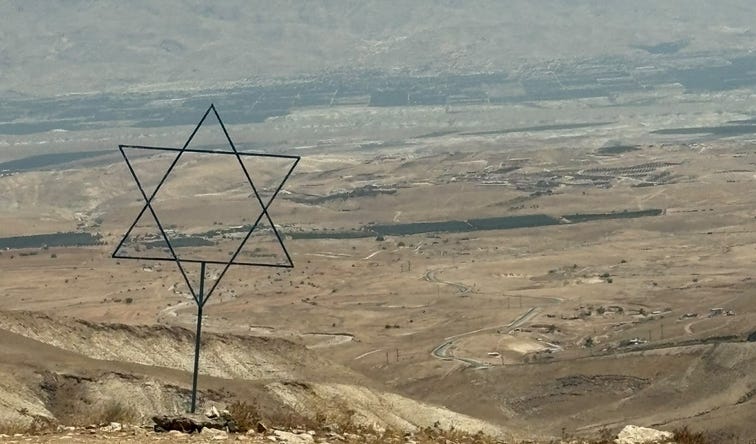
Driving around the central and northern West Bank, the feeling of impending catastrophe is unavoidable.
Just days before, a leading Israeli think tank had issuedits second-ever strategic alert regarding settler violence and the feeble Israeli response which, it determined, constituted "evidence that it is a policy directed from above." The first alert from the Institute for National Security Studies – issued months before the October 7 attack – was a warning about the judicial and political crisis initiated by the Netanyahu government's judicial coup program.
The week before the trip, the U.K. had announced sanctions on Israeli settlements, noting that "settler terrorists" were conducting "ethnic cleansing" backed by government ministers in support of the forced displacement of Palestinians.
But it was still startling to see recent headlines made flesh. There was Huwara, the scene of a settler rampageby masked men in pick-up trucks in June; there Qusra, where a settler siege of Palestinian villagers attracted global attention but, a month on, the outpost remains; there Jalud,where masked settlers attacked a Palestinian woman and an NBC News crew last month; there Turmus Ayya, where U.S. Ambassador Mike Huckabee, meeting with local Palestinian Americans, called on Israel to prosecute settler "terror" earlier this month – but characterized the perpetrators as a "tiny group of little marauders"; there al-Mughayyir, where nine Palestinians have been shot dead by settlers or soldiers since October 7, 2023; there Duma, synonymous with the 2015 firebombing by an Israeli extremist, which killed three members of the Dawabsheh family in their sleep; there Mu'ajjarat, where a multi-year campaign of settler assaults, arson and theft forced out its inhabitants last year, one of the largest expulsions since October 7; there Ras 'Ein al-Auja, the last of whose 120 families left this year after prolonged settler intimidation and abuse; and there Sebastiyeh, ground zero of the whole benighted settlement project.
On every hilltop and every ridge are low white caravans, signalling the arrival of yet more settler outposts. They encircle Palestinian villages, suffocating them through intimidation and outright violence. The caravans themselves are manufactured in settlement industrial zones, a 'virtuous circle' for the settlement surge.
The government and settler groups connect them to utilities, build them access roads, uproot olive trees near the roads and demolish roadside Palestinian businesses, for the sake of the settlers' security. Outpost 'farms' are established within breathing distance of Palestinian villages by settlers notorious for their violence; soon, the villagers cannot dare graze their flocks or tend their fields and the communities' economy implodes.
As the government retroactively legalizes outposts, the settlers are moving on from "clearing" Israeli-controlled Area C to shared Area B and even to Palestinian Authority-controlled Area A; they set up next to IDF posts, participate in the local security squads that coordinate with the IDF, and socialize with soldiers – such that, cumulatively, the distinction between them is purely formalistic.
"What is the army's role here? Is the army securing the protected [Palestinian] residents, or is it guarding the people who are harassing them?" Supreme Court President Isaac Amit asked last month, in response to a petition by three Palestinian families whose homes were taken over by settlers. As Yehuda Shaul, co-founder of Breaking the Silence and now co-director of OFEK: The Israeli Center for Public Affairs, who led the tour, noted, the "symbiosis" between settlers and the IDF is at an advanced stage.
Then we got to the area of Homesh and Sa-Nur, two of the northern West Bank settlements dismantled by then-Prime Minister Ariel Sharon – who regarded them as isolated settlements which created constant violent friction and casualties – as part of his 2005 Gaza disengagement plan.
But the Netanyahu government, dead set on reversing history, amended the disengagement law just months after its swearing in to allow settlers to return. The first settlers arrived in Sa-Nur in April, hailed by proud Judaizer-of-lands and annexation czar Bezalel Smotrich as "cancelling the disgrace of the expulsion and killing the idea of a Palestinian state."
Unlike most of the other new settlements, Sa-Nur – a handful of caravans festooned with Israeli flags squatting among a few trees, discordantly positioned around an Ottoman citadel and mosque – sits lower geographically, surrounded by Palestinian villages. There are now a number of outposts in the area, and the demolition of Palestinian properties is accelerating to secure an access road that is already under construction. Nonetheless, it is easy to see that Sa-Nur is in a more precarious position than its fellow settlements.
It is not hard to imagine that, with the pressure in the West Bank constantly rising, like more and more carbonation added to a soda bottle, there will be a point of explosion – and right here in Sa-Nur is a prime candidate for that fateful provocation or miscalculation to happen. That explosion is exactly what the apocalyptic Jewish far right has been dreaming of since October 7, 2023: a terrible event to be exploited for permanent expulsions, if not mass killings, of Palestinians.
These days, there is a feeling of existential vertigo in the West Bank: The ground is literally shifting from day to day, while the loss in lives and livelihoods deepens at a furious pace.
In Israel, the contradictions collapse in on themselves: As the IDF cosies up to violent settlers, Netanyahu calls for Israelis to have their citizenship revoked for "slandering" the army. Israel's UN ambassador derides Palestinian Authority President Mahmoud Abbas for both "promoting a culture that glorifies terrorism" and expecting "international legitimacy," while the government he represents subsidizes, protects and utilizes settler terror. In six weeks, we will find out if the accelerationists have won another term.
|
|
*****************************************************************************************
 Friday, September 18, 2026 at 05:42PM