Bacterial tocopherol biosynthesis

Bacterial tocopherol biosynthesis

  • Yang Zhang
  • Zhizhen Li
  • Jifeng Yuan
Article

Announcements

  • Scale

    Nature Metabolism participates in this collection together with other journals across the Nature Portfolio.This collection welcomes the submission of clinical and preclinical work that explores all aspects of obesity, including causes, pathophysiological mechanisms, incidence, and impact, as well as approaches to prevent or treat obesity, such as GLP-1 agonists alone or in combination therapies.

  • Crossing arrows

    The Career Pathways series features the stories of Nature Metabolism authors and their self-professed journeys to publication as young investigators. This Collection brings together the Career Pathway pieces and the original research published in Nature Metabolism by the authors.

  • Striated skeletal muscle

    Nature Metabolism participates in this collection together with other journals across the Nature Portfolio. This collection welcomes submissions on myogenesis, muscle metabolism, muscle regeneration and response to exercise, as well as muscle wasting in the context of ageing and cachexia.

    Open for submissions
  • Nature Conference announcement

    This Collection of articles, published in Nature Metabolism, aims to highlight best practices in experimental design, analysis and reporting to support the metabolic research community and increase reproducibility of research in the life sciences.

Advertisement

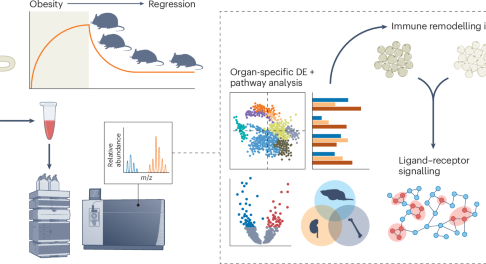
    • By performing mass spectrometry-based proteomic analysis of 15 organs during progressive weight loss, Boel et al. have created a multi-organ atlas to interrogate the protein-level changes in response to obesity and weight loss in male mice.

      • Natasha D. Suriani
      • Matthew J. Watt
      News & Views
    • This Review defines seven hallmarks of skeletal muscle homeostasis, providing a unifying framework for understanding, measuring and preserving muscle health.

      • Anna Vainshtein
      • Bert Blaauw
      • Marco Sandri
      Review Article
    • The neural mechanisms integrating cold sensory input with adaptive thermoregulation remain incompletely understood. A new study published in Nature Metabolism identifies cold-activated neurons in the parabrachial nucleus as recipients of cold sensory cues, which coordinate autonomic, metabolic and behavioural cold responses and act as therapeutic targets for metabolic disorders.

      • Óscar Freire-Agulleiro
      • Miguel LÃģpez
      News & Views
    • Academic careers are shaped by scientific discovery, professional networks, mentorship and the challenges of balancing research with personal and professional responsibilities. In this instalment of our Career Pathways series, Adelheid (Heidi) Lempradl and Lauren V. Albrecht share their experiences of building independent research careers and navigating the opportunities and challenges of academia.

      • Adelheid Lempradl
      • Lauren V. Albrecht
      Viewpoint
    • How liver metastases evade immunity remains unclear. A new study published in Nature Metabolism reveals that DHHC17-driven laminin 511 palmitoylation and its subsequent secretion blunts neutrophil-mediated killing of metastatic cancer cells, uncovering a druggable immune checkpoint in the liver.

      • Liang Zhou
      • Jun Cui
      News & Views
  • Somatic mutations are linked to diseases, yet their prevalence and relevance in health remain poorly defined. Technological advancements now enable us to delineate how tissue-specific somatic mutations drive adaptive metabolism across the lifespan and uncover hidden determinants of health and drivers of diseases.

    • Radhika Khandelwal
    • Anand Kumar Sharma
    Comment
  • Machine learning approaches are increasingly being used to aid small-molecule structure elucidation from mass spectrometry data. Surprisingly, however, current models often fail to outperform even simple baseline methods. Here we examine why these approaches fall short and propose strategies to overcome their limitations.

    • Ling Min Serena Khoo
    • Regina Barzilay
    Comment
  • Artificial intelligence (AI) excels at prediction but often remains disconnected from biological mechanisms. We propose that metabolism may serve as a biochemical language through which AI systems can gain mechanistic understanding of how molecular states govern physiological function.

    • Li Li
    • Yujue Wang
    • Zeping Hu
    Comment
  • The recent global consensus to rename polycystic ovary syndrome (PCOS) as polyendocrine metabolic ovarian syndrome (PMOS) accurately reframes the condition as a lifelong, multisystemic disorder rather than a localized ovarian pathology. This transition underscores the central role of metabolic dysfunction, specifically the high prevalence of insulin resistance and hyperinsulinaemia, and has important consequences for basic and clinical research.

    • Pawel Kordowitzki
    • Helena Teede
    Comment
  • Co-submissions bring together independent studies that offer complementary insights and strengthen one another, and they remain an integral part of how we support robust research at Nature Metabolism.

    Editorial