



How allwhere markets, sells, and supports their product integrations



Jon Gitlin
We’re thrilled to announce another edition of Startup Profiles, a content series that gives you the inside scoop on how startups build their customer-facing integrations and take them to market.
Today we’ll learn how allwhere—an IT asset management platform for distributed teams—builds, sells, and markets their integrations successfully based on our interview with Jimmy Jameson, allwhere’s Product Strategy and Operations Lead.
You can read on to see what he shared!
1. Why does allwhere need integrations?
Our clients’ IT and HR teams want to use allwhere to provide a great onboarding and offboarding experience for their employees. But to do that, they need a way to add employees and their associated information into our application automatically.
This need naturally led us down the path of exploring integrations with HRIS solutions. And after interviewing some clients about this possibility, it became clear that these integrations would address the critical pain point of adding, modifying, and removing users manually in our platform.
2. What was allwhere’s journey in building integrations like?
Through our interviews, we learned that our clients not only need integrations but that our clients also use 20+ HRIS solutions. When you couple this with the fact that we have limited engineering resources, it became clear that we needed to outsource our integrations to a 3rd-party.
We evaluated several unified API solutions, but chose Merge because they were the easiest to set up out of the box, offered the quickest syncs, covered the largest breadth of HRIS integrations, and provided the most comprehensive and accessible documentation.
Since using Merge, we’ve decided to take a slow approach to releasing HRIS integrations and we’ve only allowed a select number of clients to use them so far. We’re essentially treating this as our “beta phase.”
Our thinking here is that we want to gather early feedback on our integrations, including what clients like about them and what they think can be improved (e.g., the ability to sync additional employee objects and fields). Once we’ve collected all the feedback and addressed it, we'll be fully confident that the integrations will work effectively for the vast majority of our clients.
Related: A guide to helping product managers build integrations
3. Can you walk me through how your integrations work?
So we’re currently in our first iteration of our HRIS integrations; we’re automatically adding employee data from clients’ HRIS solutions—from employees’ full names to their departments to their addresses to their start dates—and keeping it synced with our system.
Based on the information that comes in, certain notifications can get sent to the clients’ admins, which lets them know what happened and provides suggestions on the steps they should take.
For example, if an employee was just added to allwhere and their start date is in a few weeks, the admin can receive a notification that lets them know and recommends that they start procuring certain devices and accessories on the new hire’s behalf.
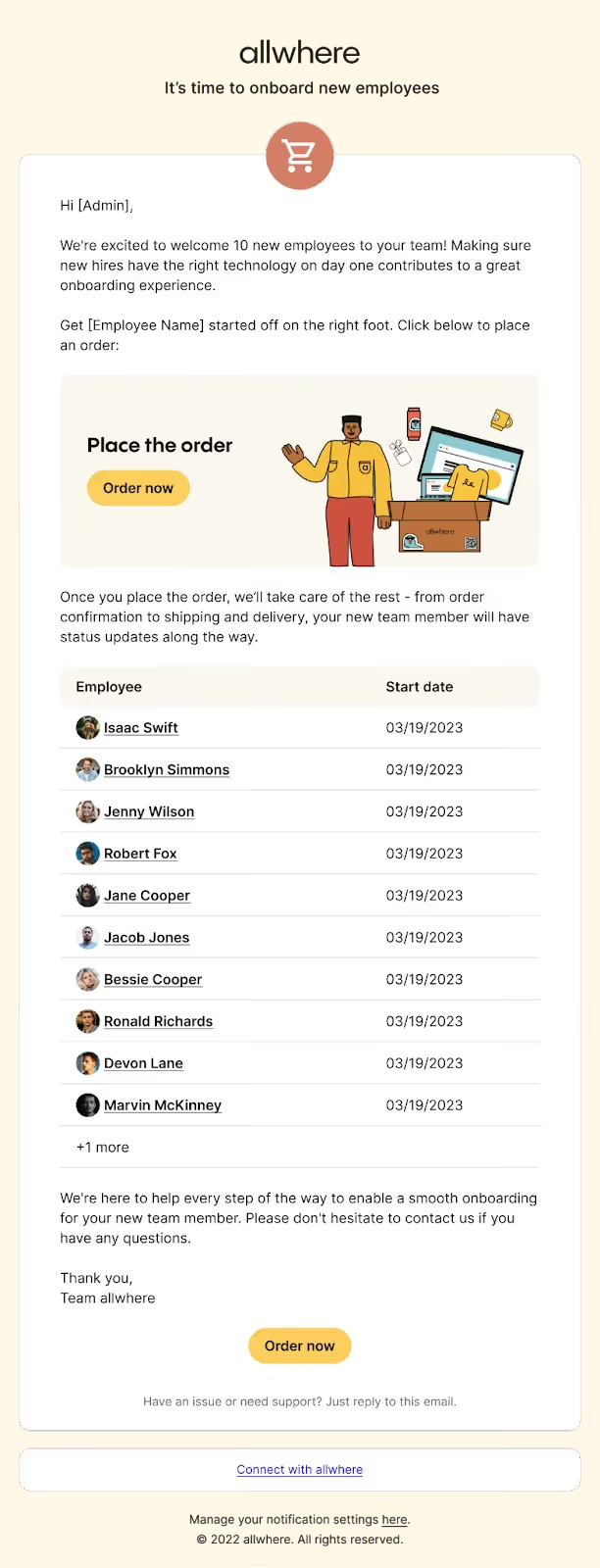
Our next iteration, and what we hope we’ll get to soon, is that our product will automatically perform the appropriate actions based on the data that’s synced over. So, using our previous example, we would automatically procure the devices and accessories a new hire needs and deliver it by the beginning of their first day on IT’s and HR’s behalf.
4. How does allwhere market its integrations?
We’ve used our client homepage (i.e., the page the client sees after they’ve logged in) to promote our integrations. For example, when our first batch of integrations with Merge were slated to be launched within a few weeks, we added a message at the top of the page to let our users know that these integrations were getting released. Our users could then learn more and apply to join our beta.
Since launching our integrations, we’ve continued to make announcements on the client homepage. But we’ll only make announcements when several HRIS integrations go live, as opposed to just one or two, in order to appeal to a broad audience.
We’ve also used email marketing to raise awareness of our integrations.
Similar to our messages on the client homepage, we sent an email blast weeks before launching the integrations with context on the ones we’re releasing, when we’re releasing them, and how our clients can apply to join the beta. We’ve also continued to send follow-up emails to promote additional batches of integrations we take live.
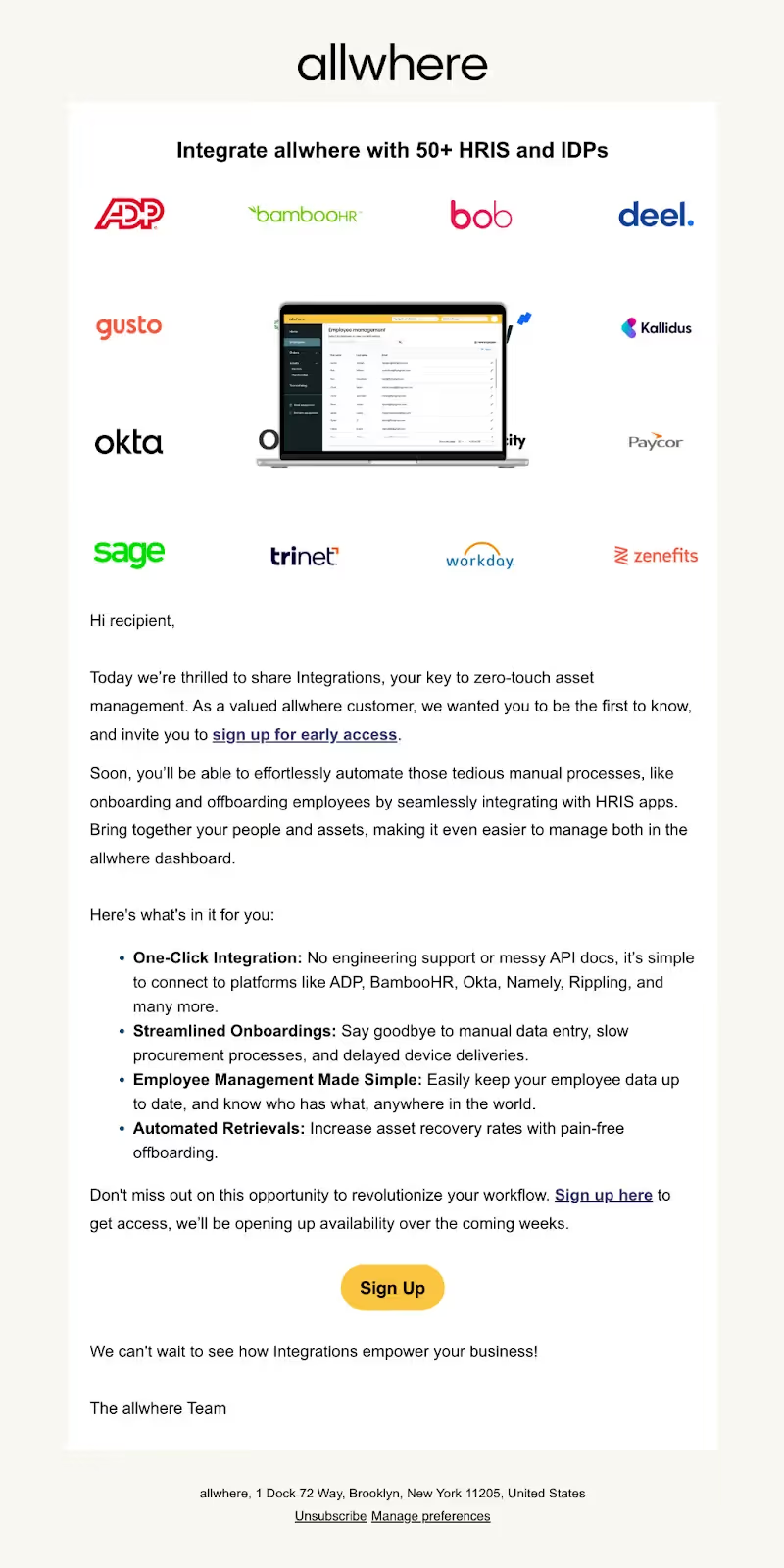
To be honest, we’ve seen both approaches perform really well.
Through the combination of our email and homepage marketing, we’ve managed to get about 25% of our active customers to request to join our HRIS integration beta.
5. How does allwhere sell its integrations?
We’ve decided to include our integrations at no additional cost across our price plans.
Our integrations are a great way to get clients onboarded into our product quickly and experience a fast time to value, so we think our integrations will ultimately pay for themselves through improved customer retention.
In terms of enabling sales, my team (product) has partnered closely with reps to align on the messaging they should use and to provide updates on our integration roadmap.
Since one of our company goals this year is to have as many clients as possible integrate us with their HRIS solutions, we’ve seen our sales team move quickly in driving interest, and my team has kept its foot on the pedal to keep pace with demand.
6. How does allwhere support its integrations?
Our integrations are still relatively new, so my team and our engineers have been closely monitoring the integrations and owning the process of troubleshooting and resolving any issues.
That said, we’re now starting to transition this responsibility to our customer success (CS) team. And in the short time since, we’re already seeing CS start using Merge’s Integration Observability features to find issues and work with clients on addressing them.
You can learn more about Merge’s Integration Observability features, HRIS Unified API, and more by scheduling a demo with one of our integration experts.
Jon Gitlin




But Merge isn’t just a Unified
API product. Merge is an integration platform to also manage customer integrations. gradient text
But Merge isn’t just a Unified
API product. Merge is an integration platform to also manage customer integrations. gradient text
But Merge isn’t just a Unified
API product. Merge is an integration platform to also manage customer integrations. gradient text
But Merge isn’t just a Unified
API product. Merge is an integration platform to also manage customer integrations. gradient text
