

Table of contents


How to build and maintain API integrations with ease



Jon Gitlin
As you look to build customer-facing API integrations, you’ll likely need to do so as quickly as possible.
Your clients can be requesting them; your prospects can be asking for them; and your customer-facing employees can be constantly pushing you to build them, quickly.
These pressures are stacked on top of your engineers' existing workload, forcing them to make tradeoffs that significantly impact your product roadmap for the worse.
Fortunately, you can easily build and maintain API integrations with a unified API solution. We’ll explain why, but first, let’s dive deeper on the challenges of implementing and managing a given API integration.
API integration challenges
When we surveyed hundreds of product managers as part of our State of Product Integrations, we learned that a significant proportion of SaaS organizations struggle with building API integrations:
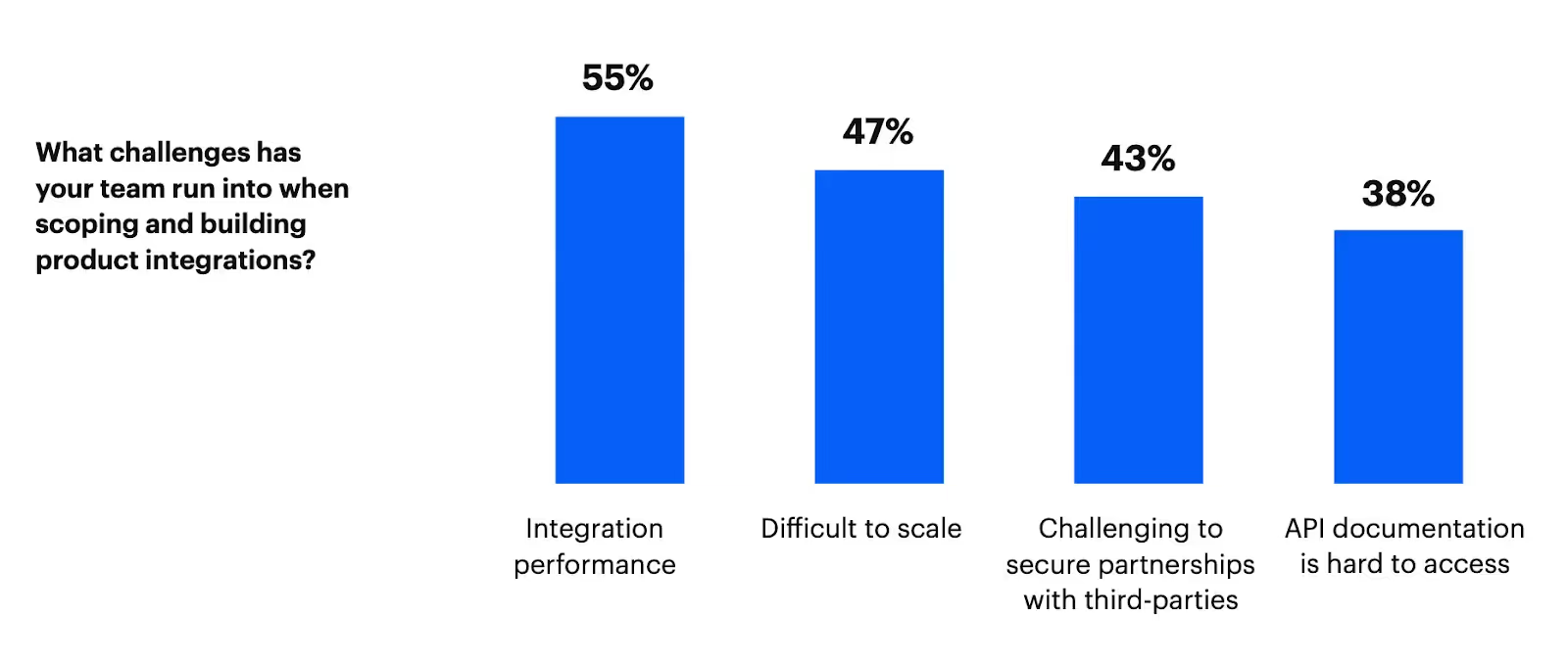
- Integration performance: Building performant and reliable integrations can be an extremely complex ordeal. You’ll need to perform a variety of tests in advance, which can be technical and time-intensive to carry out; you’ll need to build out effective error handling processes for different errors, and much more
- API documentation is hard to access: The quality of API providers’ documentation can vary widely. Some API providers provide all the details your team needs in a clear and organized way. But countless others will force your developers to look elsewhere for answers, which can delay their integration builds
- Challenging to secure partnerships with 3rd-parties: In some cases, you’ll need to form a business relationship with an API provider just to access their sandbox environment and API documentation. These partnerships can cost thousands, if not tens of thousands, of dollars per year, which might not be worth the investment for your team
- Difficult to scale: Given the challenges of building just a single customer-facing API integration, the prospect of implementing several quickly can be difficult, if not impossible, to accomplish
Our study also uncovered several challenges when maintaining and managing API integrations:
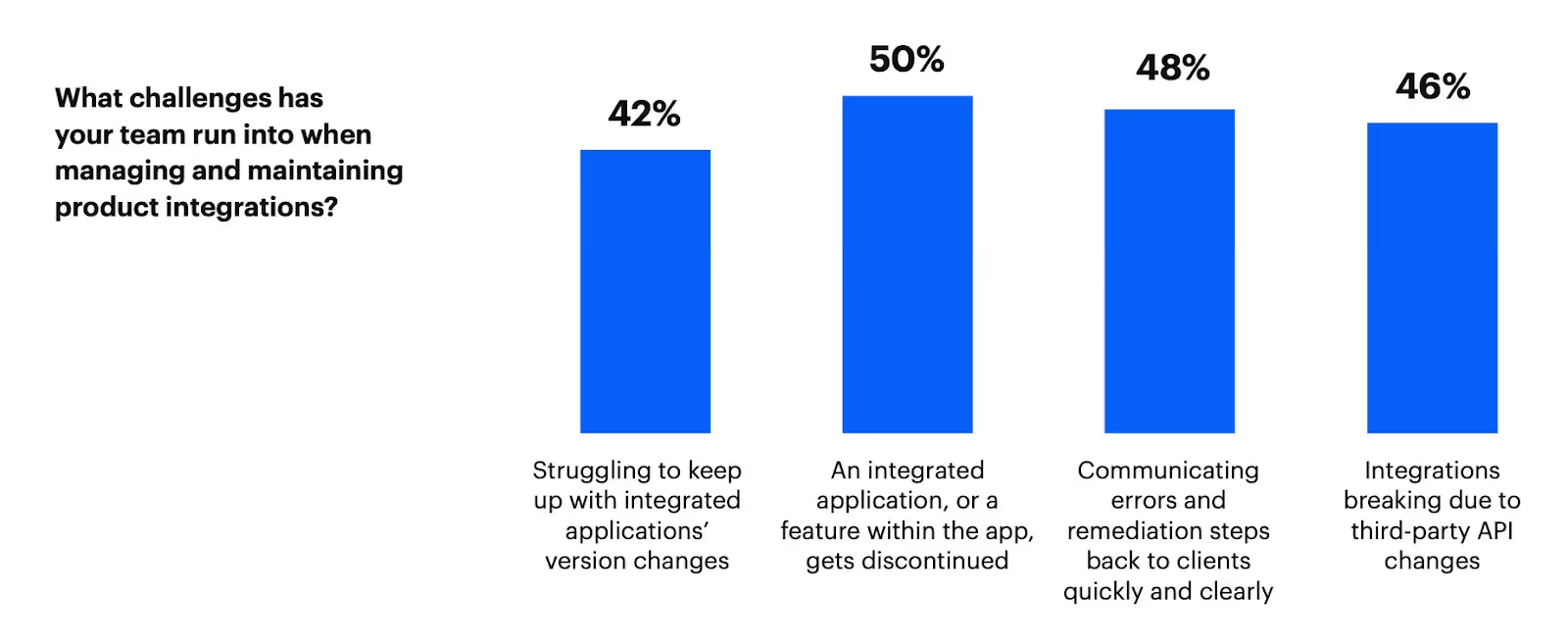
- An integrated application, or a feature within the app, gets discontinued: Your team’s ability to identify applications or features that get deprecated proactively can prove extremely difficult, especially as your team scales its integrations
- Communicating errors and remediation steps back to clients: Your team’s ability to diagnose issues and determine their solutions can be technically challenging and time-intensive. And explaining these issues and solutions in a way that’s clear and concise can prove equally hard
- Integration breaking due to third-party API changes: API endpoints can get deprecated or undergo backwards incompatible changes without any formal, widespread announcement. This can not only cause your your integrations to break but also compromise your engineers’ ability to address these issues quickly; they’ll have to try and understand the changes that transpired, why they would break their integrations, and how they can implement the fixes—all of which can lead your integrations to remain broken for an extended period of time
Build and maintain API integrations easily with a unified API platform
A unified API platform—otherwise known as a universal API platform—offers a single, aggregated API that lets you provide hundreds of integrations to your product. In other words, you only have to build to one API to offer all the integrations you want.
This helps minimize the drawbacks of building API integrations mentioned earlier, and in some cases, you can avoid them altogether. For instance, the unified API platform may offer comprehensive, up-to-date documentation on its unified API.

A unified API platform can also make the process of managing API integrations relatively easy.
The platform can offer tooling that automatically detects issues and their associated solutions in a UI that’s accessible to your customer-facing team. The solution can also offer logs that allow your team to audit API requests and further troubleshoot potential problems.

{{this-blog-only-cta}}
Jon Gitlin



Ready to build API integrations with ease?
Merge, the leading unified API solution, can help you take hundreds of customer-facing integrations to market in a matter of days.


But Merge isn’t just a Unified
API product. Merge is an integration platform to also manage customer integrations. gradient text
But Merge isn’t just a Unified
API product. Merge is an integration platform to also manage customer integrations. gradient text
But Merge isn’t just a Unified
API product. Merge is an integration platform to also manage customer integrations. gradient text
But Merge isn’t just a Unified
API product. Merge is an integration platform to also manage customer integrations. gradient text
