


The 5 best embedded iPaaS solutions in 2026


Jon Gitlin
As you evaluate embedded integration platform as a service (iPaaS) solutions to add integrations to your product, you’ll likely feel overwhelmed by all the options at your disposal.
In G2, for example, you’ll find more than 40 vendors in their list of “Best Embedded Integration Platforms.”
You’ll also notice that they share several key features and functionality, from providing pre-built API connectors to offering customizable implementation options (e.g., white labeling the integrations).
Taken together, it can be incredibly hard to evaluate your options quickly, comprehensively, and from unbiased sources.

Since Merge doesn’t offer an embedded iPaaS, we don’t have an incentive to promote one vendor over the rest. Instead, we’ll provide a neutral breakdown of the top solutions in the market based on our experience researching, hearing about, and, in some cases, using them.
Paragon
Paragon is quickly becoming one of the best embedded iPaaS solutions in the market because of their ability to quickly adapt their platform for AI products, whether that’s supporting enterprise AI search or more agentic use cases.
Here’s more on the platform’s benefits and drawbacks.
Pros
- Offers a Model Context Protocol (MCP) server to help customers’ AI agents access Paragon’s integrations and automations
- Supports robust and highly customizable retrieval-augmented generation (RAG) pipelines (e.g., users can pick and choose specific files that can be embedded and retrieved)
- Enables customers to sync integration workflows with their GitHub or GitLab repositories, allowing their developers to track changes, manage rollbacks, and align with existing CI/CD pipelines
Cons
- Critical security features are missing on Paragon’s enterprise price plan—single-sign on and role-based access control
- Customers’ support teams have to implement logic to catch and debug errors
- Doesn’t transform integrated data to a common data model, which can make it difficult to embed data accurately before adding it to a vector database. This can lead to poor performing RAG pipelines
Matt Schmidt, the CEO and co-founder of PeopleLogic, outlined this issue when his team developed a suite of peopleops agents (“Nova”).
“We looked at Paragon but found that they couldn’t normalize our customers’ data, which would help our agents provide accurate outputs, consistently. It was clear that this platform couldn’t support our AI agents’ integration requirements.”
Workato
Workato is the most well known embedded iPaaS solution and has managed to be the most successful in moving upmarket. The companies using their embedded iPaaS include the likes of Zendesk, Shutterstock, and OneLogin.
Pros
- Your engineers may already use their core product offering (their iPaaS solution for internal integrations and automations), which can make the transition to adopting their embedded iPaaS fairly seamless
- Workato has the most funding of any embedded iPaaS solution and likely generates the most revenue, making it the most stable integration partner for supporting your long-term integration needs
- Offers pre-built connectors with AI and machine learning tools, like Anthropic and Amazon Sage Maker

Cons
- The majority of Workato’s R&D team is focused on their core automation platform, leaving their embedded iPaaS offering relatively underdeveloped and slower to evolve
- Doesn’t provide sandboxes to test your integrations before pushing them to production. This can lead to integrations quickly breaking once they’re live
- Workato’s post-sales resources are also heavily skewed towards their core platform. As a result, embedded customers likely don’t receive the responsive, strategic support needed to take the integrations to market successfully
https://www.merge.dev/blog/workato-alternatives?blog-related=image
Prismatic
The platform stands out in its ability to support a self-serve integration marketplace.
Here’s more on that feature as well as the platform’s other benefits and drawbacks.
Pros
- Their integration marketplace is highly configurable; you can design it to match your branding, customize the authentication flows users take, decide which applications appear for certain customers, and more

- Provides a high level of support across their price plans, including email and chat support and a dedicated account manager
- Offers an OpenAI connector, which includes support for widely-used models, like GPT-4, GPT-3.5 Turbo, and DALLE 3
Cons
- The platform is slow to embrace AI. For example, they just announced their MCP server but this comes months after their rivals
- They haven't had success with enterprise companies (e.g., their customer stories are primarily with early-stage startups), which can point to scalability issues across their integrations, security shortcomings, shallow integration observability capabilities, and more
- You can’t explore the platform and validate your integration use cases through a proof of concept
{{this-blog-only-cta}}
Tray.ai
Tray.ai and Workato overlap in many ways.
They were founded at around the same time (Tray was founded in 2012, Workato was founded in 2013), they offer both iPaaS and embedded iPaaS products, they offer similar AI features to support integration and automation development—and the list goes on.
Their benefits and drawbacks also overlap in notable ways.
Pros
- If your engineers currently use their core iPaaS solution, their learning curve for the embedded offering can be short
- You might be able to leverage Tray.ai’s Merlin Agent Builder soon to develop AI agents that work with your product and your customers’ applications (it’s currently only available for their core iPaaS offering)
- They’ve moved to the enterprise successfully, helping big brands like Eventbrite, HackerOne, and Typeform adopt their embedded integrations
Cons
- Their embedded offering is treated as an afterthought internally. Case in point, their embedded iPaaS isn’t mentioned in the platform dropdown in their main navigation

- Their embedded offering is only available as an add on in their Enterprise plan, forcing you to pay for additional solutions that you don’t necessarily need
- Despite their low-code/no-code branding, their platform requires technical expertise to use and forces you to implement one integration at a time. Taken together, it isn’t easy to scale your integrations on the platform
Ivan Petrovic, the CEO and founder of Insightful, a workforce analytics solution, elaborates on the last drawback:
"Every integration we’d want to add through Tray.ai would require us to manually configure a trigger and set of actions, which wasn’t scalable."
Cyclr
While Cyclr is relatively smaller than Workato and Tray.ai, they manage to work with some well known enterprise brands, like Medallia and Purple. They also offer one of the largest API connector libraries in the market.
Here’s more on their benefits and drawbacks.
Pros
- Offers more than 30 categories of API connectors, allowing their customers to support seemingly endless use cases
- Provides a long-tail of features to help customers build impactful integration marketplaces, including functionality to request integrations and a coming soon-type section to help build demand for certain integrations
- You can trial their product for 2 weeks to determine whether it's the right integration solution for your team
Cons
- Several pricing plans prevent you from integrating at scale. Their “Growth” and “Scale” plans, for example, don't let you use more than 10 connectors
- Doesn't comply with several critical data privacy and protection regulations, like HIPAA, which may be table stakes for your customers

- Slowest of all the vendors in this list to embrace AI. For instance, they don’t support an MCP server and don’t seem to have plans to do so soon
https://www.merge.dev/blog/cyclr-pricing?blog-related=image
Merge offers a better way to add and maintain product integrations
Merge, the leading unified API solution, lets you add hundreds of cross-category integrations through a single build. This makes it significantly easier to scale your integrations, quickly.
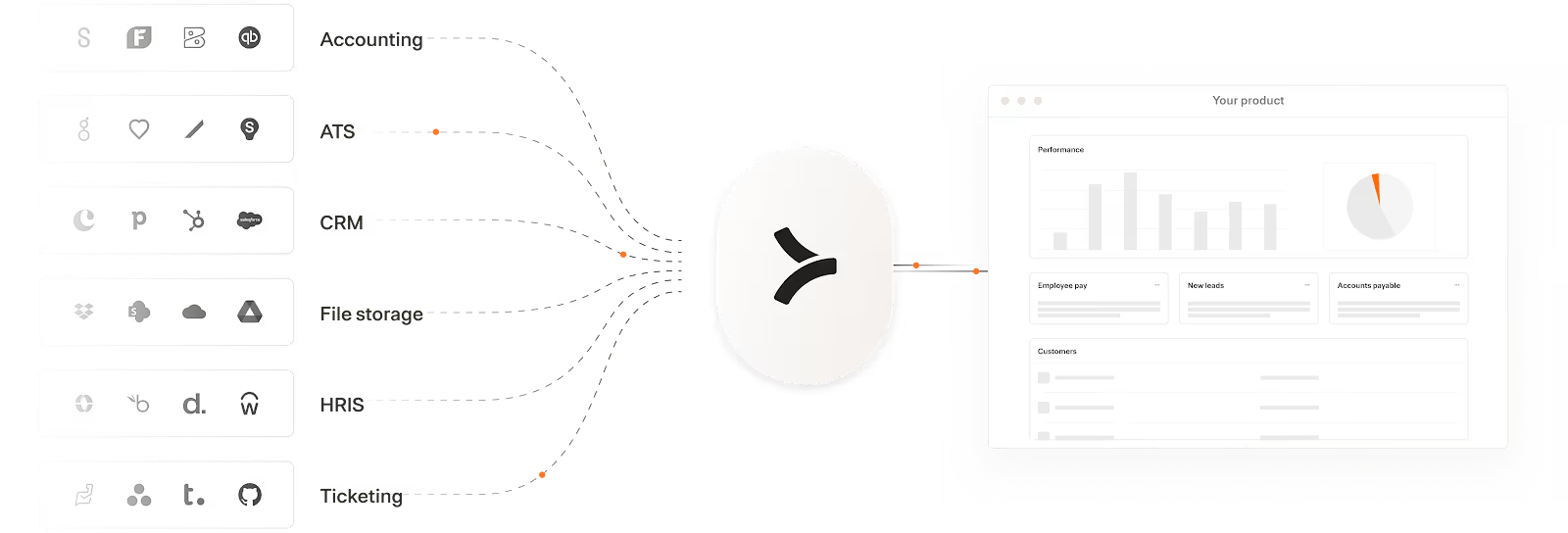
In addition, Merge:
- Normalizes all of the integrated data according to predefined data models to help you build reliable RAG pipelines
- Offers Merge MCP to enable your AI agents to interact with Merge’s integrations
- Provides advanced features to sync custom data, like Field Mapping and Authenticated Passthrough Request
- Supports comprehensive integration observability features to help your customer-facing teams diagnose, troubleshoot, and resolve integration issues themselves
Learn more about Merge’s unified approach to integrations by scheduling a demo with an integration expert.
Jon Gitlin


Don't settle for an embedded iPaaS
Learn how Merge's Unified API can help you scale your integrations more easily.


But Merge isn’t just a Unified
API product. Merge is an integration platform to also manage customer integrations. gradient text
But Merge isn’t just a Unified
API product. Merge is an integration platform to also manage customer integrations. gradient text
But Merge isn’t just a Unified
API product. Merge is an integration platform to also manage customer integrations. gradient text
But Merge isn’t just a Unified
API product. Merge is an integration platform to also manage customer integrations. gradient text
