

Model information updated September 26, 2026.
ChatGPT is a workspace for conversations, research, files, images and coding. Current access separates everyday Luna chat, Sol on paid Chat plans, and Astra on eligible Work/Codex routes. This guide explains how to choose the right tool and use it well.
Official plans have different tool allowances. ChatGPT Plus is $20/month, but it no longer unlocks the discontinued Sora consumer app: that app and web experience ended on April 26, 2026. OpenAI’s Videos API is scheduled to end on September 24; third-party platform access is a separate channel.
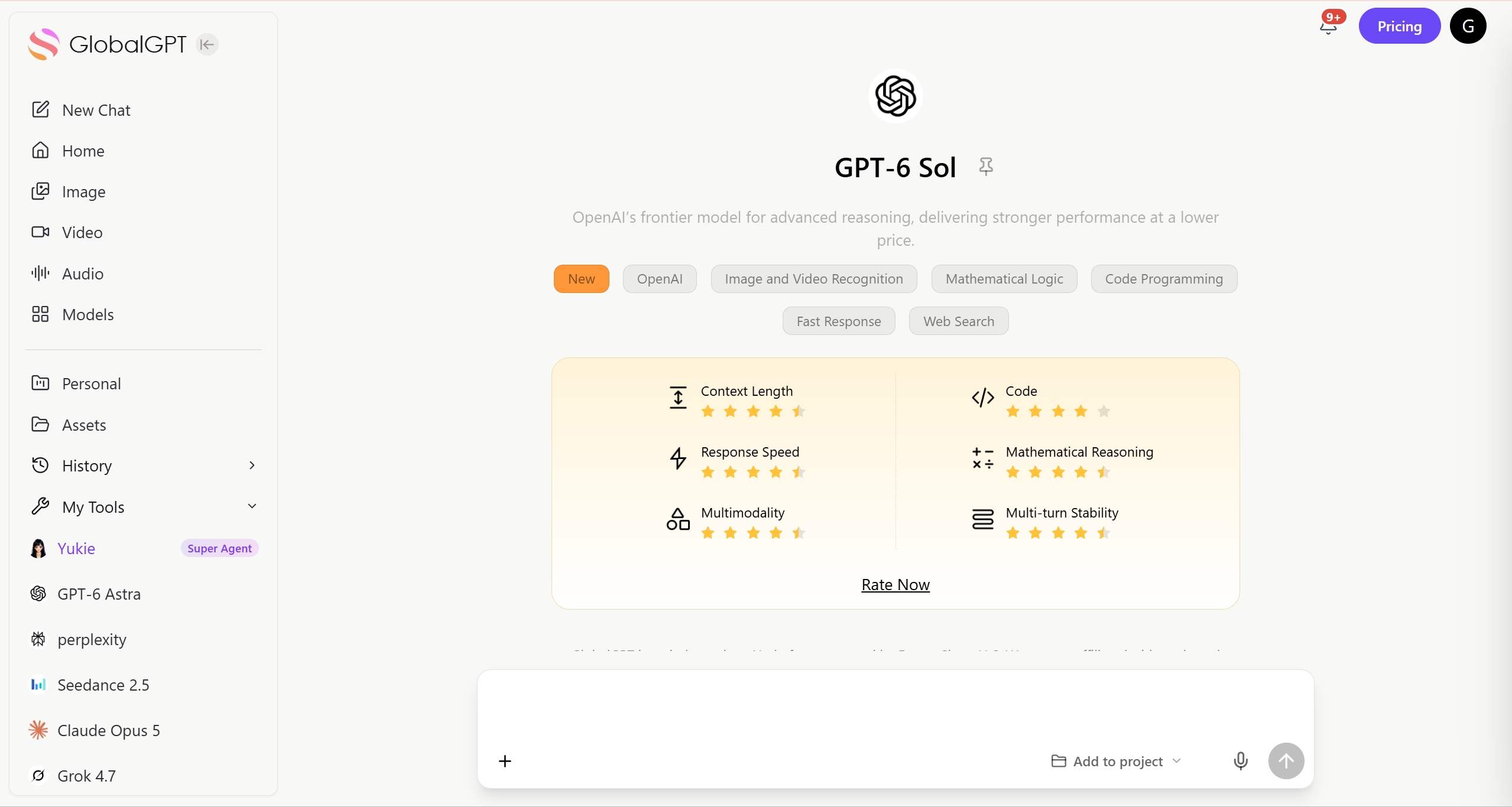
GlobalGPT changes the cost equation. Basic starts at $5.80/month equivalent with annual billing and brings 100+ models into one dashboard, including GPT-6 Sol, GPT-6 Astra, Claude Sonnet 5, Perplexity and Gemini 3.1 Pro. It is a multi-model platform subscription, separate from native ChatGPT app entitlements.
For creators, GlobalGPT Pro is $129.60 per year, equivalent to $10.80 per month with annual billing. Its media workspace includes Sora 2, Veo 3.1, Wan 3.0 and Seedance 2.5 alongside Nano Banana Pro and GPT Image 2.5, so scripting and creative production can stay in one place.
- What Is ChatGPT and What Can You Actually Use It For in 2026?
- Quick Guide: What You Will Learn
- How Do You Start Using ChatGPT for the First Time?
- How to Chat with ChatGPT ?
- What Should You Do After ChatGPT Gives an Answer?
- How Is ChatGPT Different on Desktop, Web, and Mobile?
- How Do You Write Better Prompts So ChatGPT Gives Better Answers?
- How to personalize ChatGPT : Custom Instructions vs. Custom GPTs
- How Do You Upload Files or Images and Get Useful Results?
- When Should You Use Thinking Mode Instead of Instant Mode?
- Beyond Conversation: Why ChatGPT Is No Longer Just a Chatbot
- How to Master Context Switching with “Projects”
- How to Automate Your Workflow with Scheduled Tasks
- How To Move from Chatting to Creating: The “Canvas” Interface
- How To Unlock Autonomous Actions with ChatGPT Agents
- How to Control Your Privacy and Data Footprint
- Frequently Asked Questions ( FAQ )
- Final Verdict: Stop Paying the “AI Tax” and Start Creating
What Is ChatGPT and What Can You Actually Use It For in 2026?
What is ChatGPT in simple terms?
At its core, ChatGPT is an AI-powered processing engine designed to understand and generate human-like text, code, and visuals. Unlike a standard Google search that gives you a list of links to read, ChatGPT gives you a direct answer. It predicts the next logical piece of information based on massive training data, allowing it to converse, reason, and create.
What types of tasks does ChatGPT handle well?
In 2026, ChatGPT has evolved into a multimodal workspace. It excels at:
- Drafting & Editing: Writing emails, essays, or debugging code.
- Visuals: Generate images with ChatGPT’s image tools or analyze uploaded photos.
- Reasoning: Solving complex math or logic puzzles using “Thinking Mode.”
- Data crunching: Analyzing Excel sheets and generating Python-based charts.
The “Single-Platform” Dilemma
Features and usage allowances depend on the plan and tool. Plus is $20/month; higher tiers offer different access. A historical “40 messages every 3 hours” figure is not a universal current cap for every model or account.
Specialization still matters: compare GPT-6 Astra, Claude Sonnet 5 and Gemini 3.1 Pro on the same task instead of assuming one subscription is best at every step. Keep the native app’s tools separate from the underlying model.
To achieve the best results, you need access to all of them. Instead ofjuggling fragmented subscriptions that cost over $60/month, an All-in-One platform is the most convenient and cost-effective choice. It gives you unrestricted access to the specific“best-in-class” model for every task in your workflow, ensuring your skills are never held back by a “Limit Reached” warning.
MODEL GUIDE · SEPTEMBER 2026
Choose Models by the Task
GPT-6 Astra: complex research and writing. Claude Sonnet 5: compare a second explanation. Gemini 3.1 Pro: compare another reasoning approach. Image and video generation use separate media models. This is a workflow guide, not measured performance scores.
The Solution: Your AI Operating SystemGlobalGPT
GlobalGPT brings the world’s top 100+ models into one workspace. Basic starts at $5.80 per month equivalent with annual billing, giving users a place to compare GPT, Claude and Gemini workflows without maintaining separate subscriptions.
MODEL GUIDE · SEPTEMBER 2026
One Workspace, Current Models
GPT-6 Astra · GPT-6 Sol · Claude Opus 5.5 · Claude Sonnet 5 · Gemini 3.1 Pro · Grok 4.7. Select the named model for your task.
Understanding Your New Engines
To use this ecosystem effectively, you must understand the specialized engines now at your fingertips:
- Everyday chat: Luna serves Free and Go, while Sol is available on paid Chat plans. Choose a mode by the task and the options available to your account; latency depends on workload and service conditions.
- Reasoning: More deliberate modes can help with multi-step problems. The original GPT-5.2 GDPval result describes that historical model and benchmark, not a score for Sol or Astra. Test the result on your own task rather than treating a benchmark as a guarantee.

- Beyond text: Native ChatGPT supports image, file and voice workflows according to plan and device. Sora is a separate lifecycle: its consumer app has ended, and its API timetable must not be confused with third-party video routes.
Quick Guide: What You Will Learn
Here is your roadmap to mastering the 2026 AI ecosystem in this article:
- How Do You Start Using ChatGPT for the First Time?
- How to Chat with ChatGPT?
- What Should You Do After ChatGPT Gives an Answer?
- How Is ChatGPT Different on Desktop, Web, and Mobile?
- How Do You Write Better Prompts So ChatGPT Gives Better Answers?
- How to personalize ChatGPT: Custom Instructions vs. Custom GPTs
- How Do You Upload Files or Images and Get Useful Results?
- When Should You Use Thinking Mode Instead of Instant Mode?
- How to Master Context Switching with “Projects”
- How to Automate Your Workflow with Scheduled Tasks
- How To Move from Chatting to Creating: The “Canvas” Interface
- How To Unlock Autonomous Actions with ChatGPT Agents
- How to Control Your Privacy and Data Footprint
How Do You Start Using ChatGPT for the First Time?
How do you create a ChatGPT account on web vs mobile?
- Web: Go to chatgpt.com and use one of the sign-in methods offered to your account.

- Mobile: Download the official app (iOS/Android). You can sign up using your Apple ID or Google Play account.

- Note: Mobile subscriptions are managed by the App Store, while web subscriptions are direct.
Why do signup availability differ by region and require a phone number or verification?
- OpenAI must comply with local laws and data regulations (like GDPR in Europe). Some regions (e.g., CN, HK, RU) are geo-blocked entirely, so the official service is unavailable there.
- Verification depends on the sign-up route and account. OpenAI’s phone-verification rules for generating an initial API key should not be treated as a universal requirement for every ChatGPT registration.
- GlobalGPT provides one account for GPT-6 Sol, GPT-6 Astra, Claude Sonnet 5 and Gemini 3.1 Pro. Basic starts at $5.80/month equivalent with annual billing; its platform account is separate from an official OpenAI account.

| Feature | Official OpenAI Account | GlobalGPT (All-in-One) |
| Phone Number Required? | Depends on sign-up route; API verification is separate | No (Email Only) |
| Region Lock? | Yes (Restricted in CN/HK/RU) | No (Global Access) |
| Payment Methods | Supported methods vary by country and billing platform | Alipay, Crypto, Cards |
| Setup Time | ~10 Minutes | ~30 Seconds |
What should you check first after logging in?
Once logged in, your experience depends heavily on your plan.
- Model picker: In native ChatGPT, available models depend on the plan and surface. Luna serves Free and Go and Sol is available on paid Chat plans. Claude is not an OpenAI model in ChatGPT’s native picker; use its own product or a multi-model platform to compare it.

- Settings & Memory:
- Go to Settings > Personalization. Check if Memory is ON. If you want the AI to remember your preferences (e.g., “Always answer in Python”), keep it enabled. If you prefer privacy, toggle it OFF.

How to Chat with ChatGPT ?
Once your model is selected, there are five distinct ways to input information into ChatGPT. It is not just a text box; it is a command center.
5 general Ways to Start a Conversation
- Standard Text Chat:
- Simply type your prompt in the main message bar at the bottom.
- Hit Enter or click the Up-Facing Arrow (⇡) to send.

- Web Search (Real-Time):
- By default, ChatGPT relies on training data. To force it to look up current events (e.g., “Today’s stock prices”), click the Plus (+) icon on the left of the text bar.
- Select Web Search.

- Enter your prompt. This ensures the answer is grounded in live internet data.

- Deep Research: Use the research tool when you need a sourced investigation rather than a quick lookup. Review the scope and sources, then check the decisive citations yourself; a cited report is not automatically verified.

- Voice & Speech-to-Text:
- Dictation: Press the small Microphone icon inside the text bar to convert your speech into text prompts.

- Live Conversation: Press the Voice Mode icon (headphones) to enter a fluid, two-way voice chat.

- Photos & File Uploads:
- Drag & Drop: Pull any image (PNG/JPG) or document (PDF/Excel) from your computer directly into the chat window.
- Manual Upload: Click the Plus (+) icon → Select Add Photos & Files.

What should beginners try in their first session?
Don’t just say “Hi.” Try a multimodal task:
- Upload a photo of your fridge contents.
- Ask: “What can I cook with these ingredients? Give me a recipe.” This immediately demonstrates vision + reasoning capabilities.

What Should You Do After ChatGPT Gives an Answer?
How do you regenerate or refine an answer?
If the first answer is “meh,” don’t just accept it.
- Regenerate: Click the “Circular Arrow” icon below the response to get a fresh variation.

- Refine: Use the “Edit” pencil icon on your own prompt to clarify instructions (e.g., add “Explain it like I’m 5”).

How do follow-up questions improve results?
Give the modification instructions directly: ChatGPT has “context.” It remembers what you just said. You don’t need to repeat the whole question. Just say: “Make it shorter,” “Add a table,” or “Change the tone to professional.”
When should you continue a chat vs start a new one?
- Continue: If you are refining the current topic (e.g., debugging the same code snippet).
- New Chat:
- Changing Topics: If you switch from “Coding” to “Recipe Planning,” start fresh. Mixing topics confuses the AI’s context window and degrades quality.
- Too Long: If a conversation drags on, the AI may start “forgetting” earlier instructions or slowing down. Rule of thumb: If the AI starts making repetitive errors, it’s time to start a new chat.
What do copy, share, and feedback buttons actually do?
- Copy: Copies raw text/code to clipboard.
- Share: Creates a public URL for that specific chat snapshot.

- Feedback: Use the rating controls to report helpful or problematic responses. Feedback data handling is governed by the product’s data controls and terms; it does not guarantee a specific future model change.

How Is ChatGPT Different on Desktop, Web, and Mobile?
| Feature | Web Browser (chat.com) | Desktop App (Mac/Win) | Mobile App (iOS/Android) |
| Voice Mode | Voice on supported web accounts | Support varies by desktop app and version | Voice on supported iOS/Android accounts |
| Screen Awareness | No | OS- and app-specific; not a universal Mac/Windows capability | Camera or screen sharing on eligible mobile voice sessions |
| Background Chat | No (Must keep tab open) | Yes (Floating Window) | Yes (Dynamic Island/Audio) |
| Shortcuts/Control | Limited (Browser defaults) | Full (Global Hotkeys) | Gestures & Action Button |
Is the desktop app better than the web version?
Desktop apps can provide convenient shortcuts and window capture, but macOS and Windows features differ. Use the shortcuts shown in your installed app, and grant capture permissions only for the material you intend to share.
What shortcuts make ChatGPT faster on desktop?
- Cmd/Ctrl + K: Open “Search History” instantly.

- Use the app’s new-chat shortcut or menu; choose Temporary Chat separately when you need that mode.
- Esc: Stop generation immediately.
What features feel different on mobile?
Mobile is “Perception-first.” The input box prioritizes the Camera and Voice icons. It creates a haptic, tactile experience (long-press to select text) that feels more like a tool than a website.

When does voice mode make more sense than typing?
Use Voice Mode when your hands are busy (cooking, driving) or when you are brainstorming. Speaking is faster than typing for “brain dumps.”
Can you interrupt or multitask during voice conversations?
Yes. The new Voice Mode is “interruptible.” You don’t have to wait for the AI to finish its paragraph. Just say, “Wait, stop, tell me about X instead,” and it shifts instantly. You can also background the app and keep chatting while checking emails.
How Do You Write Better Prompts So ChatGPT Gives Better Answers?
Why do vague prompts fail?
Garbage in, garbage out. If you ask “Write an email,” ChatGPT guesses the recipient, tone, and purpose—usually resulting in a generic, robotic response.
How specific should your instructions be?
Extremely specific. Instead of “Fix this code,” say: “This Python code throws a TypeError on line 5. Fix it and explain why it happened.”
Should you give examples or context?
Yes. “Few-shot prompting” (giving 1-3 examples of what you want) drastically improves quality. If you want a specific writing style, paste a paragraph of your own writing and say, “Mimic this style.”
What is a reusable prompt framework? (The CO-STAR Method)
To get consistent results, use this framework:
- C (Context): “I am a fitness coach…”
- O (Objective): “…help me write a diet plan…”
- S (Style): “…motivational and punchy…”
- T (Tone): “…empathetic but firm…”
- A (Audience): “…for busy moms…”
- R (Response): “…formatted as a weekly table.”

How do you fix wrong or shallow answers?
Don’t argue; redirect. Use the phrase: “You missed the part about [X]. Please rewrite the answer focusing on [X] and citing your sources.“

How to personalize ChatGPT: Custom Instructions vs. Custom GPTs
Instead of repeating your background or desired output style in every single conversation, ChatGPT offers two powerful ways to save your preferences. Understanding the difference is key:
- Custom Instructions: Your “Global Profile.” These settings apply to almost every standard chat you start.
- Custom GPTs: Specialized “Mini-Apps.” These are tailored for specific tasks, often with unique knowledge files or actions, that you switch to when needed.
Setting Your Profile with Custom Instructions
Custom Instructions let you set permanent preferences for how ChatGPT responds to you. Instead of repeating the same requirements in every prompt, you define them once, and ChatGPT applies them by default in all future conversations. This is available to all users, including those on the free plan.

Step-by-Step Setup:
- Open ChatGPT (web) → click your Profile icon (bottom-left) → Settings
- Go to Personalization
- (Optional) Set the dropdowns:
- Base style and tone (Default / etc.)
- Warm / Enthusiastic
- Headers & lists (turn on if you want structured answers)
- Emoji (reduce if you want more professional output)
- Scroll to Custom instructions → paste your rules into the box (example below)
- Fill About you:
- Nickname: what you want ChatGPT to call you
- Occupation: your role
- More about you: interests + preferences (short)
- Close Settings (it auto-saves in most versions). Start a new chat to test.
Pro Tip for Juggling Roles: If you need totally different personas (e.g., sometimes you are a “Creative Writer” and other times a “Strict Coder“), Custom Instructions might conflict. In that case, use separate ChatGPT Projects (if available on your plan) to isolate those different contexts.
Create Your Personal Assistant with Custom GPTs
While Custom Instructions are broad, Custom GPTs allow you to build distinct AI assistants, each with its own unique set of very specific instructions, uploaded knowledge files (like PDFs or datasets), or capabilities.
Note on Access: Everyone (including Free users) can use existing GPTs. However, you generally need a paid subscription to create your own Custom GPTs.
Quick Guide to Creating a Custom GPT (Paid Tier):
- Open ChatGPT and click GPTs in the side panel.

- Click the Create button in the top-right corner.

- You have two ways to build:
- The “Create” Tab (Conversational): Just chat with the GPT Builder. Tell it what you want in natural language (e.g., “Create a guide that helps me write SEO blog posts”), and it will set up the initial instructions for you.

- The “Configure” Tab (Manual): Click this tab for advanced customization. Here you can manually refine the name and instructions, upload knowledge files, and set up third-party actions.

- When finished, click Create (top right) and select how you want to share it (Private, Anyone with a link, or the GPT Store).
- Click Update / Confirm to finalize.
How to mention GPTs in any chat: You don’t always have to switch completely to a specialized GPT. In any standard conversation, you can type @ followed by a GPT’s name (e.g., @Data Analyst) in the message bar to temporarily bring that specialized assistant into your current conversation for a specific prompt.
How Do You Upload Files or Images and Get Useful Results?
What file types can ChatGPT read?
It is file-agnostic. It reads PDFs, Word docs (DOCX), Excel (XLSX/CSV), Code files (PY, JS, HTML), and images (JPG, PNG).
How do you upload images on web, desktop, and mobile?
- Web/Desktop: Drag and drop the file directly into the chat, or click the “Paperclip/Plus” icon.
- Mobile: Tap the “Plus” icon -> Choose from Photo Library or Click “Camera” to take photo.

What kinds of image questions work best?
- Diagnosis: “Why are the leaves on my plant turning yellow?”
- Transcription: “Turn this handwritten note into a text table.”
- Coding: “Here is a screenshot of my UI glitch. How do I fix the CSS?”

What files or images should you not upload?
Sensitive Data. Never upload confidential financial records, unreleased trade secrets, or photos containing PII (Personally Identifiable Information) unless you have Enterprise-grade privacy controls enabled.
When Should You Use Thinking Mode Instead of Instant Mode?
What is “Thinking Mode” in ChatGPT?
Thinking modes spend more effort on a problem before answering. A displayed reasoning summary is not the model’s complete internal chain of thought, and extra reasoning does not remove the need to verify the answer.
What tasks benefit from slower reasoning?
- Complex Math: Calculus, Physics problems.
- Coding Architecture: Designing a full database schema.
- Logic Puzzles: “Who is the killer in this mystery?”
- Strategy: “Critique this business plan for loopholes.”
Is Thinking Mode more accurate?
Reasoning modes can help on multi-step logic, coding and analysis, but accuracy depends on the model and task. Verify calculations and sources; there is no universal 40% reduction that applies to every Thinking-versus-Instant comparison.

When is Instant Mode actually better?
For creative writing, simple summaries, translations, or casual chat. Thinking Mode can “overthink” a simple “Happy Birthday” message, making it sound rigid.
Beyond Conversation: Why ChatGPT Is No Longer Just a Chatbot
In 2026, treating ChatGPT as a simple Q&A bot is like using a smartphone only for phone calls. It has evolved into a comprehensive AI Workspace, offering tools designed to organize your thinking, automate tasks, and collaborate on complex documents. These “chat-adjacent” features shift the platform from a passive interface to an active productivity engine.
Here is how to master the features that go beyond simple text generation.
How to Master Context Switching with “Projects”
When your work becomes complex—involving multiple documents, specific rules, and long-term goals—a single chat window is insufficient. Projects allow you to create isolated sandboxes for different workflows.
Imagine creating a project named “2026 Marketing Plan” where you store PDF reports, set a rule to “always use a professional tone,” and keep all related chats together, without them mixing with your casual recipe requests.
How to set it up:
- Open the side panel and click New project.

- Name your project (e.g., “Coding Assistant” or “Thesis Research”).

- Inside the project, you have three powerful tools:
- Add knowledge sources: Upload files (PDFs, Excel) that the AI should reference only within this project.

- Add custom instructions: Set specific behavioral rules that apply to every chat in this folder.

- Start chatting: Interact as normal, but with the full context of your uploaded files and instructions automatically applied.
How to Automate Your Workflow with Scheduled Tasks
Scheduled tasks support one-time and recurring work. Current active-task limits are 3 for Free/Go, 5 for Plus, 10 for Business/Edu and 15 for Pro/Enterprise. Free recurring tasks run at most daily and use flexible time windows; exact times require an eligible paid plan.
You no longer need to sit and wait for the AI to finish a job. With Scheduled Tasks, you can instruct ChatGPT to perform work in the future, allowing it to operate autonomously while you are offline.
Quick Setup Guide:
- Open Scheduled and describe the task and schedule. For example: “Remind me to review these notes tomorrow morning.” A task created inside a project cannot access its uploaded or stored project files.
- ChatGPT will recognize the intent and display a scheduled task confirmation.

- Open the task in Scheduled to edit its schedule or pause it. Manage delivery preferences in Settings > Notifications.

- Once the task is done, you will receive a push notification or email, depending on your notification settings.
- ⚠️Make sure you have already turned on desktoop notifications

How To Move from Chatting to Creating: The “Canvas” Interface
Canvas availability depends on the selected model, app and account. It is a writing and coding surface, separate from buying API credits.
For heavy-duty writing or coding, the standard chat stream is too narrow. Canvas provides a dedicated, document-style interface that opens side-by-side with your chat. It allows you to focus on the output rather than the conversation history.
How to activate it:
- Ask ChatGPT to “write this in a canvas” or “create a document.”

- A new window will slide open on the right half of the screen containing your content.

- Direct Editing: You can type directly into the Canvas like a Word doc.

- Targeted AI Edits: Highlight a specific paragraph in the Canvas and ask the AI to “shorten this” or “fix the bug,” without regenerating the entire document.

How To Unlock Autonomous Actions with ChatGPT Agents
⚠️ Note: Currently in Beta.
ChatGPT Agents represent the shift from “Passive Answerer” to “Active Doer.” Unlike the standard model that waits for a prompt, an Agent can plan and execute a series of steps to achieve a goal, such as surfing the web, filling out forms, or managing files.
- select “Agent” from your tools menu or type
/agentin the message bar.

- Describe a complex goal (e.g., “Research top 3 laptops released this month, compare their prices in a table, and download the specs as a PDF”)

- the Agent will autonomously attempt to navigate the web and tools to complete the workflow.
How to Control Your Privacy and Data Footprint
Managing what ChatGPT knows about you is just as important as knowing how to use it. Here is how to control your data.
Managing “Memory”: What the AI Remembers About You
ChatGPT automatically learns details (like your job or preferred coding language) to save you from repeating yourself.
- View/Delete: Go to Settings > Personalization > Manage memories. You can click the trash icon on specific facts or “Delete all” to wipe the slate clean.
- Disable: Toggle off “Reference saved memories” if you prefer a fresh start every time.

Going Incognito: Using Temporary Chats
Need to ask a sensitive question or have a one-off conversation you don’t want saved?
- How to use: Click the Temporary Chat icon in the top menu.

- Result: The interface turns dark. These chats do not appear in your history and are generally not used for memory, though OpenAI retains them briefly (30 days) for safety monitoring.

Opting Out of Model Training
By default, your chats help train future models. If you want to opt out:
- Path:Settings > Data controls.
- Action: Toggle OFF “Improve the model for everyone.”

Decluttering Your Workspace: Archiving vs. Deleting
Keep your sidebar clean by managing old chats.
- Archive (Hide): Best for cleaning up without losing data.
- Desktop: Hover over a chat > Click (…) > Archive.

- Mobile: Long press a chat > Archive.

- Restore: Go to Settings > Archived chats to bring them back.

- Delete (Destroy): Permanently removes the data.
- Desktop: Hover over a chat > Click (…) > Delete.
- Bulk Action: Go to Settings > Data controls > Delete all chats to wipe everything.

Frequently Asked Questions (FAQ)
Common questions about model access, billing, video tools and data handling.
Can I use GPT models through GlobalGPT?
GlobalGPT provides GPT-6 Sol and GPT-6 Astra alongside Claude and Gemini through one account. Its platform access and tools are separate from the native ChatGPT subscription.
Why use GlobalGPT instead of separate subscriptions?
GlobalGPT brings multiple model families into one workspace. Basic is $5.80 per month equivalent with annual billing; compare model credits and native app features against your actual workload.
Can I still use Sora 2?
OpenAI’s consumer Sora app has ended and its Videos API is scheduled to end September 24, 2026. GlobalGPT lists a separate Sora route; official shutdown dates alone do not establish that route’s status.
How should I handle company data?
Review your organization’s approved service, plan, retention and training rules. Remove unnecessary personal data and secrets. A model name alone does not establish a product’s privacy terms.
Can I use GlobalGPT on a phone?
Yes, its mobile browser workflow provides access to multiple models. This is separate from the microphone, live voice and other native features included in official provider apps.
Is the $5.80 Basic price month-to-month?
No. It is a monthly equivalent with annual billing. Review the actual billing period and cancellation terms before buying; it is not the price of a one-month commitment.
Final Verdict: Stop Paying the “AI Tax” and Start Creating
By reading this guide, you have mastered the skills of the future. You know how to leverage Projects to organize workflows, use Thinking Mode for deep logic, and deploy Agents to automate your busy work. You are ready to treat AI not as a chatbot, but as your operating system.
But skills are useless without access.
The official path forces you into a dilemma: accept limited free tools, or pay a “fragmentation tax” of over $60 to $200 per month just to access the best text, code, and video models across different platforms.
There is a smarter way.
GlobalGPT unifies GPT-6 Sol, GPT-6 Astra, Claude Sonnet 5, Gemini 3.1 Pro, Perplexity, Nano Banana Pro and Sora 2 in one multi-model workspace.
- No Region Locks.
- No $200/mo Subscription fees.
Ready to upgrade your workflow?
Compare GlobalGPT plans and choose a workflow. Basic starts at $5.80 per month equivalent with annual billing.