

Express.js is a minimal and flexible Node.js web application framework that simplifies building server-side applications and APIs.
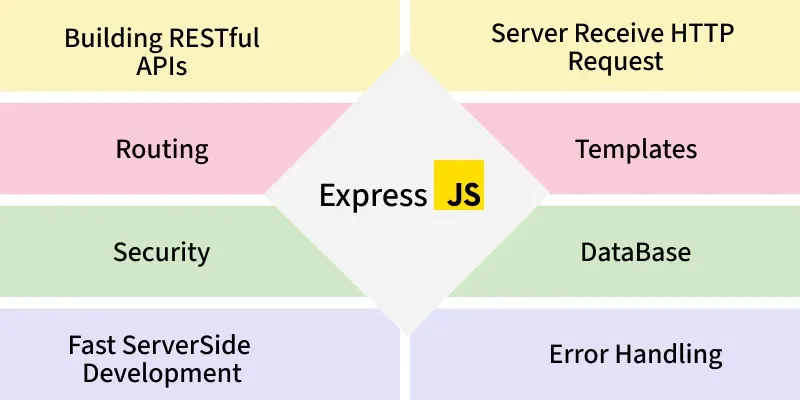
- Middleware-based: Uses middleware to handle requests, responses, and common features.
- Routing system: Structure—developers can design apps as they want.
- Integration: Works well with databases (MongoDB, MySQL, PostgreSQL) and front-end frameworks.
- Scalable: Suitable for small apps to large-scale enterprise APIs.
"Hello World" Example
Create a simple "Hello World" application with Express.
const express = require('express');
const app = express();
const PORT = 3000;

app.get('/', (req, res) => {
    res.send('Hello, Geeks!');
});

app.listen(PORT, () => {
    console.log(`Server is listening at http://localhost:${PORT}`);
});
Start the Server:
Run your server with the following command
node server.jsWeb Browser Output
When you navigate to http://localhost:3000 in your web browser, you should see:

Working of Express
Express.js works by handling client requests through a series of steps called the request-response cycle, using middleware and routing to process requests and send responses efficiently.
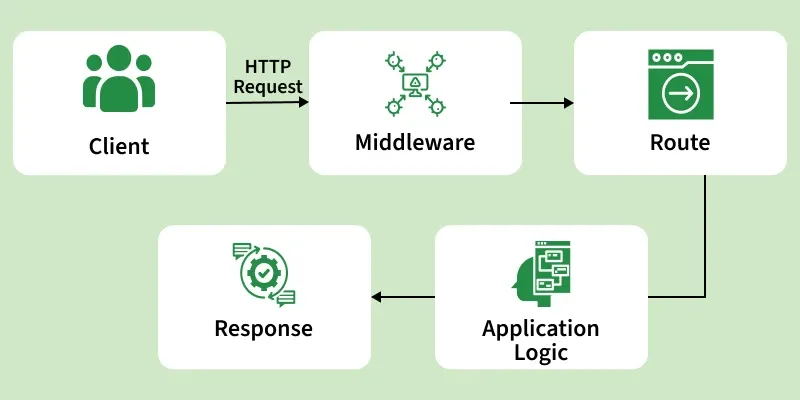
- A client sends a request (e.g., browser or app) to the Express server.
- The request flows through middleware that handles logging, authentication, and other processing tasks.
- Express matches the request to a route handler based on the URL and HTTP method.
- The route handler processes the request and prepares a response.
- The server sends the response back to the client.
- If any error occurs, it is caught by error-handling middleware to ensure the server remains stable.
Reason to use Express in web development
Express JS become the popular choice in web development because it simplifies the process of building web applications using Node JS. There are many features provided by express.js. Some common features are provided by the express.js.
1. Routing: Express provides a routing facility. The developer can set routes using express with different HTTP verbs(GET, POST, PUT, etc). It can be associated with different functions. It handles different requests.
Example: The following program demonstrates "How we can define the Routing in Express.js"
const express = require('express');
const app = express();
app.get('/', (req, res) => {
    res.send('Hello, Express!');
});
2. Middleware: The middleware functions are a core concept of node js. These functions can access the 'req' and 'res' response object. They can modify these object before reaching the route handler. The following program demonstrates the Middleware function.
app.use((req, res, next) => {
    console.log('Middleware executed!');
    next(); // Pass control to the next middleware or route handler
});
3. Error Handling: Express js can handle errors very easily. It can handle both type of requests like synchronous and asynchronous requests. The middleware function can used to catch the errors. The following program demonstrates the Error Handling.
app.use((err, req, res, next) => {
    console.error(err.stack);
    res.status(500).send('Something went wrong!');
});
Usage of Express.js
Express.js is a popular web framework for Node.js that simplifies server-side development. It is widely used to build web applications, APIs, and scalable server-side solutions.
- Web Applications: Build dynamic sites and SPAs efficiently.
- RESTful APIs: Create APIs for CRUD operations and data delivery.
- Middleware Apps: Add logging, authentication, and validation.
- Microservices: Lightweight and modular for scalable services.
- Server-Side Rendering: Supports EJS, Pug, Handlebars.
- Proxy/Gateway: Routes and manages HTTP traffic.
- Rapid Prototyping: Quickly develop and test server logic.
Also Check
