

In the Microservices Architecture, the API Gateway patterns stand out as a crucial architectural tool. It manages communication between clients and multiple microservices while improving security, performance, and request handling.
- The API Gateway routes client requests to the appropriate microservices, reducing complexity for clients and simplifying communication.
- It handles features like authentication, rate limiting, caching, and load balancing to enhance system security, scalability, and efficiency.
Microservices Architecture
Microservices architecture is a software design approach where an application is built using small, independent services, each responsible for a specific business function.
- Each microservice handles a specific functionality and can be developed, deployed, and scaled separately.
- Services communicate using lightweight APIs or network protocols, enabling flexibility and loose coupling between components.
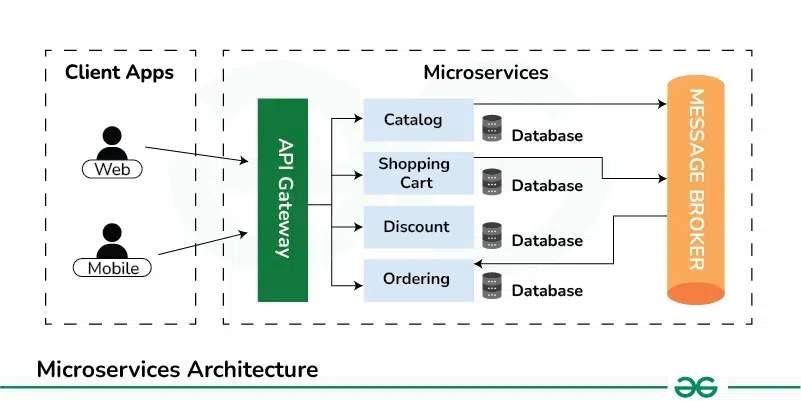
Characteristics
Microservices architecture builds applications as a collection of small, independent services that improve flexibility, scalability, and maintainability.
- Modularity: Application functionality is divided into smaller independent services, making development and maintenance easier.
- Scalability: Each microservice can be scaled independently based on workload and demand.
- Technology Diversity: Different services can use different technologies and databases according to their requirements.
- Continuous Deployment: Supports frequent updates and faster releases through automated deployment processes.
API Gateway
An API gateway is a machine or service that sits on the edge of a system or network of microservices and serves as the entry point into the system. It is essentially a single point of entry for all client requests and serves several purposes:
.png)
Characteristics
API Gateway Architecture provides a centralized entry point for managing requests and communication between clients and microservices.
- Routing and Load Balancing: Routes client requests to the appropriate services and distributes traffic across multiple instances.
- Protocol Translation: Converts requests between different communication protocols used by clients and backend services.
- Request Transformation: Modifies requests or responses to match the requirements of backend services.
- Caching: Stores frequently accessed responses to improve performance and reduce backend load.
Benefits of using API Gateway in Microservices
API Gateway enhances the security, performance, scalability, and management of microservices by providing a centralized access point for client requests.
- Centralized Management: Provides a single entry point for routing, traffic control, and service management.
- Improved Security: Handles authentication, authorization, and other security functions centrally.
- Load Balancing and Scalability: Distributes requests across service instances to improve availability and performance.
- Caching and Optimization: Reduces response time and backend workload by caching frequently requested data.
API Gateway Patterns with examples and uses in Microservices
Here are some of the key patterns along with examples and their use in microservices
1. Gateway Aggregation
Gateway Aggregation combines data from multiple microservices into a single response, reducing the number of requests made by clients.
- Unified Access: Collects data from multiple services and exposes it through a single endpoint.
- Improved Performance: Reduces network calls and decreases client-side complexity.
Example: In an e-commerce application, the gateway combines product details, inventory status, and customer reviews from different services into a single response. This allows the client to retrieve all required information with one API call.
Use Cases of Gateway Aggregation:
- Unified API Endpoint: Combines multiple backend services into a single API endpoint for easier client integration.
- Reduced Network Overhead: Minimizes network round-trips, improving application performance.
- Caching and Optimization: Caches aggregated responses to reduce backend load and improve response times.
2. Gateway Offloading
Gateway Offloading transfers common responsibilities from microservices to the API Gateway, improving efficiency and maintainability.
- Centralized Processing: Handles common tasks such as authentication and validation.
- Reduced Backend Workload: Allows microservices to focus on business logic.
Example: In an online shopping platform, authentication and request validation are performed by the gateway before requests are forwarded to backend services. This eliminates the need for each service to implement these features separately.
Use Cases of Gateway Offloading:
- Authentication and Authorization: Centralizes user authentication and access control.
- Rate Limiting and Throttling: Controls request rates to prevent service overload.
- Request Validation: Validates incoming requests before they reach backend services.
3. Gateway Routing
Gateway Routing directs incoming requests to the appropriate microservice based on routing rules.
- Intelligent Routing: Uses paths, headers, or metadata to determine the destination service.
- Service Discovery: Routes requests to available service instances dynamically.
Example: When a customer requests product information, the gateway routes the request to the Product Service. Order-related requests are routed to the Order Service.
Use Cases of Gateway Routing:
- Service Discovery: Automatically routes requests to available service instances.
- Path-Based Routing: Routes requests based on URL paths.
- Header-Based Routing: Uses HTTP headers to direct requests to specific service versions or environments.
4. Gateway Transformation
Gateway Transformation modifies requests and responses to ensure compatibility between clients and services.
- Data Conversion: Converts data formats such as JSON and XML.
- Protocol Adaptation: Enables communication between systems using different protocols.
Example: A mobile application sends data in JSON format, while the backend service requires XML. The gateway converts the request and response formats automatically.
Use Cases of Gateway Transformation:
- Protocol Conversion: Converts communication between protocols such as HTTP and gRPC.
- Data Format Conversion: Transforms data between JSON, XML, and other formats.
- Versioning: Supports multiple API versions and backward compatibility.
5. Gateway Security
Gateway Security protects backend services by enforcing security policies at a centralized access point.
- Centralized Security: Handles authentication, authorization, and encryption.
- Threat Prevention: Filters malicious requests before they reach services.
Example: An e-commerce platform uses the gateway to validate user credentials, encrypt communication, and block unauthorized requests before accessing payment services.
Use Cases of Gateway Security:
- Authentication and Authorization: Verifies user identity and controls access to services.
- Encryption: Secures data transmission using SSL/TLS protocols.
- Input Validation: Prevents attacks such as SQL injection and cross-site scripting (XSS).
