

The Ambassador Pattern in distributed systems is a design strategy used to manage communication between different parts of a system. In complex systems, services often need to interact with external resources, which can be slow or unreliable. The Ambassador Pattern acts as a middleman or ambassador that handles these interactions. It simplifies communication, manages errors, and ensures that the system remains stable even if external services fail or behave unpredictably. This pattern is particularly useful in microservices architectures, where different components need to work together seamlessly, despite potential external challenges.

Table of Content
- Importance of Design Patterns in Distributed Systems
- What is the Ambassador Pattern?
- Key Components of the Ambassador Pattern
- Common Scenarios for the use of Ambassador Pattern in Distributed Systems
- Step-by-Step Guide to Implementing the Ambassador Pattern in Distributed Systems
- Challenges with Ambassador Pattern in Distributed Systems
Importance of Design Patterns in Distributed Systems
Design patterns are crucial in distributed systems because they provide tried-and-tested solutions to common challenges. Here’s why they are important:
- Scalability: Design patterns help in creating systems that can efficiently handle growth, whether in terms of data, users, or services, without performance degradation.
- Reliability: They offer ways to manage failures gracefully, ensuring that the system remains available and robust even when parts of it fail.
- Maintainability: Patterns bring structure to complex systems, making them easier to understand, modify, and extend over time.
- Efficiency: They streamline communication and processing across distributed components, reducing latency and resource consumption.
- Consistency: Using established patterns ensures that similar problems are solved in consistent ways, making the system predictable and easier to manage.
What is the Ambassador Pattern?
The Ambassador Pattern is a structural design pattern used in distributed systems to manage and simplify the communication between an application and external services or resources. In distributed architectures, components often need to interact with services that are located on different networks, possibly with different reliability, latency, and security characteristics.
- The Ambassador Pattern introduces an intermediary component, called an "ambassador," which acts as a proxy between the application and the remote service.
- This intermediary handles a variety of concerns that the application code should not be burdened with directly, such as error handling, retry logic, circuit breaking, security, and monitoring.
- By isolating these concerns, the Ambassador Pattern allows the application code to remain focused on its primary responsibilities, reducing complexity and improving maintainability.
- The ambassador can manage network failures, retry failed requests, apply timeouts, enforce security policies like authentication and encryption, and log or monitor the interaction with the remote service.
- It can also optimize communication by batching requests, caching responses, or balancing loads across multiple service instances.
This pattern is particularly valuable in microservices architectures, where services must communicate over potentially unreliable networks, and in cloud or hybrid environments where services may be distributed across different locations and platforms.
Key Components of the Ambassador Pattern
The Ambassador Pattern involves several key components, each playing a crucial role in managing communication between an application and external services. Here's a breakdown of these components:
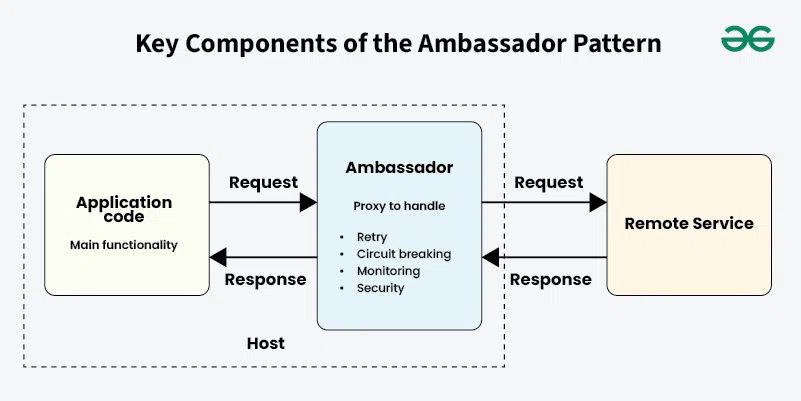
1. Application Code
The core logic of the system that performs the primary business functions. Handles the main processing tasks without dealing directly with the complexities of interacting with external services. It relies on the ambassador to manage those external interactions.
2. Ambassador
Acts as a proxy or intermediary between the application code and the external or remote services.
Responsibilities:
- Retry Logic: Automatically retries requests that fail due to transient issues, ensuring reliability.
- Circuit Breaking: Monitors the health of external services and stops sending requests to a failing service temporarily to prevent cascading failures.
- Monitoring: Logs and tracks the interactions with external services for performance, error tracking, and diagnostics.
- Security: Implements security measures like authentication, authorization, and encryption to protect communication with the external service.
3. Remote Service
The external or third-party service that the application code needs to interact with, such as an API, database, or another microservice. Processes the requests sent by the ambassador and returns the responses. The remote service itself is unaware of the ambassador’s existence and the additional logic it handles.
4. Communication Flow
The application code sends a request to the ambassador. The ambassador processes the request, applies any necessary logic like retries or circuit breaking, and forwards it to the remote service. The remote service processes the request and sends a response back to the ambassador. The ambassador handles the response potentially logging or securing it before sending it back to the application code.
Common Scenarios for the use of Ambassador Pattern in Distributed Systems
The Ambassador Pattern is commonly used in various scenarios within distributed systems to address challenges related to external communication. Here are some typical scenarios where the Ambassador Pattern is particularly useful:
- Interfacing with Unreliable External Services:
- When an application needs to interact with external services that are prone to failures, slow response times, or intermittent connectivity issues. The ambassador can implement retry logic, handle timeouts, and use circuit breakers to ensure that the application remains resilient even when the external service is unreliable.
- Implementing Security Protocols:
- When communication with an external service requires strict security protocols, such as encryption, authentication, or authorization. The ambassador can enforce security policies, ensuring that all communication with the external service adheres to required security standards, without burdening the core application code with this complexity.
- Managing Cross-Cutting Concerns:
- When there are common concerns like logging, monitoring, or tracing that need to be applied consistently across all interactions with external services. The ambassador can centralize these cross-cutting concerns, automatically logging requests and responses, collecting metrics, and ensuring that these operations are performed uniformly across the system.
- Working in Multi-Cloud or Hybrid Environments:
- When an application is deployed in a multi-cloud or hybrid environment, where services might be distributed across different clouds or on-premises data centers. The ambassador can manage the complexities of interacting with services across different environments, handling variations in network latency, security policies, and reliability.
- Supporting Legacy Systems:
- When an application needs to interact with legacy systems that have outdated or non-standard communication protocols. The ambassador can translate or adapt the communication between the modern application and the legacy system, ensuring compatibility without altering the core application.
- Handling Rate Limits or Quotas:
- When interacting with an external service that imposes strict rate limits or usage quotas. The ambassador can monitor and control the rate of requests sent to the external service, queuing or throttling requests to stay within allowed limits, and preventing the application from being blocked or penalized.
Step-by-Step Guide to Implementing the Ambassador Pattern in Distributed Systems
Implementing the Ambassador Pattern involves several steps to ensure that the communication between your application and external services is handled effectively and efficiently. Here’s a step-by-step guide to implementing the pattern:
Step 1. Identify the External Service
Determine which external service(s) your application needs to interact with, especially those that may introduce complexities such as unreliable performance, security concerns, or special communication protocols.
Actions:
- List all external dependencies in your system.
- Identify the ones that are most critical or problematic.
Step 2. Define the Responsibilities of the Ambassador
Clearly outline what tasks the ambassador will handle on behalf of the application. This could include retry logic, circuit breaking, logging, monitoring, security, and more.
Actions:
- Determine which cross-cutting concerns should be managed by the ambassador.
- Specify the retry policies (e.g., how many times to retry, intervals between retries).
- Define circuit breaker thresholds (e.g., how many failures before the circuit is "opened").
- Set up logging and monitoring requirements.
- Outline security protocols (e.g., encryption, authentication).
Step 3. Design the Ambassador Component
Architect the ambassador as a standalone component that can handle all interactions with the external service.
Actions:
- Decide whether the ambassador will be a standalone service, a library, or integrated directly into the application.
- Define the interface between the application and the ambassador (e.g., methods, endpoints).
- Design the ambassador to be extendable, allowing additional concerns to be added in the future.
Step 4. Implement the Ambassador
Develop the ambassador component, ensuring it fulfills its responsibilities.
Actions:
- Write the code for the ambassador to handle requests and responses between the application and the external service.
- Implement the retry logic, ensuring that requests are retried appropriately in case of failure.
- Add circuit breaker functionality to prevent the application from overwhelming a failing service.
- Integrate logging and monitoring tools to track interactions with the external service.
- Apply security measures, such as encryption and authentication.
Step 5. Integrate the Ambassador with the Application
Connect the application code to the ambassador so that all communication with the external service goes through it.
Actions:
- Modify the application code to route all external service requests through the ambassador.
- Ensure the application handles responses from the ambassador as if they were directly from the external service.
- Test the integration thoroughly to ensure that the ambassador correctly manages communication and that the application behaves as expected.
Step 6. Test and Validate the Ambassador
Ensure the ambassador performs correctly under various scenarios, including normal operations, service failures, and security attacks.
Actions:
- Perform unit testing on the ambassador’s logic (e.g., retry, circuit breaking).
- Conduct integration testing between the application, ambassador, and external service.
- Simulate failures of the external service to ensure the ambassador handles them gracefully.
- Test security aspects, such as proper handling of authentication and encryption.
Step 7. Deploy and Monitor the Ambassador
Roll out the ambassador into the production environment and monitor its performance.
Actions:
- Deploy the ambassador alongside your application or as part of your service infrastructure.
- Set up monitoring tools to track the ambassador’s performance, including request/response times, error rates, and circuit breaker status.
- Continuously monitor logs and metrics to identify potential issues.
Challenges with Ambassador Pattern in Distributed Systems
Implementing the Ambassador Pattern can bring significant benefits to distributed systems, but it also comes with certain challenges. Here are some of the key challenges associated with using the Ambassador Pattern:
- Increased Complexity:
- Introducing an ambassador adds another layer of complexity to the system.
- This additional component requires careful design, implementation, and maintenance.
- The application becomes more complex to manage and troubleshoot, especially when issues arise in the interaction between the application, the ambassador, and the external service.
- Performance Overhead:
- The ambassador acts as an intermediary, which can introduce latency into the system.
- Every request and response has to pass through the ambassador, potentially slowing down the overall communication.
- In high-performance systems where low latency is critical, the additional processing by the ambassador might be a concern, requiring optimizations to minimize delays.
- Maintenance and Upkeep:
- The ambassador requires ongoing maintenance to ensure it continues to function correctly as external services evolve or as new requirements arise.
- Regular updates and monitoring are necessary, which can increase the operational burden.
- Keeping the ambassador up to date with security patches, performance optimizations, and new features can be time-consuming.
- Single Point of Failure:
- If not implemented with redundancy, the ambassador can become a single point of failure in the system.
- If the ambassador fails, it can disrupt the communication between the application and the external service.
- This makes the ambassador a critical component that needs to be highly reliable and possibly replicated across multiple instances to ensure availability.
- Debugging and Troubleshooting:
- Debugging issues in a distributed system can be challenging, and adding an ambassador into the mix can make it even harder to pinpoint the source of a problem.
- When issues arise, it may be difficult to determine whether the problem lies with the application, the ambassador, or the external service. This complexity can lead to longer resolution times for issues.
- Resource Consumption:
- The ambassador requires resources such as CPU, memory, and potentially additional infrastructure (e.g., for logging and monitoring).
- This can increase the overall resource consumption of the system, leading to higher operational costs. In environments with limited resources, this could become a significant concern.
- Security Risks:
- While the ambassador can enhance security, it can also become a target for attacks.
- If compromised, the ambassador could expose sensitive communication between the application and the external service. This necessitates implementing strong security measures to protect the ambassador itself, adding to the complexity and cost of deployment.
- Configuration Management:
- The ambassador often requires complex configurations to handle retries, circuit breaking, and security protocols correctly.
- Misconfigurations can lead to suboptimal performance or failures, making it essential to manage and validate configurations carefully, especially in dynamic environments.
Conclusion
The Ambassador Pattern in distributed systems helps manage communication between a service and its clients. By using an intermediary, or ambassador, this pattern abstracts the complexities of interacting with a remote service. It can handle tasks such as load balancing, retries, and circuit breaking, which improves the reliability and efficiency of the system. Overall, the Ambassador Pattern simplifies the management of service interactions, making systems more robust and easier to maintain. By delegating these responsibilities to an ambassador, developers can focus on the core functionalities of their services without worrying about the intricacies of communication details.
