

Cloning or copying a table in SQL is used to create a duplicate of an existing table for various purposes.
- Helps create backup copies of important data.
- Allows testing and analysis without affecting the original table.
Example: First, we will create a demo SQL database and table, on which we will use the Cloning command.

Query:
CREATE TABLE employee_copy AS
SELECT * FROM employee;
Output:
Methods for Cloning Tables in SQL
There are three different methods to create a clone table in SQL:
- Simple Cloning
- Deep Cloning
- Shallow Cloning
Step 1: Create the Original Table
The following student table is used to demonstrate table cloning, with sample records added for illustration.

Simple Cloning
In this method, the clone table creates a copy of the original table’s structure and data, but constraints like primary keys, unique keys, and auto-increment properties are not preserved.
Syntax
CREATE TABLE clone_table
SELECT * FROM original_table;
Example: Let us see the example to understand how simple cloning syntax works.
Query
CREATE TABLE student_copy AS
SELECT * FROM student;

SELECT * FROM student_copy;
Output:
- Original STUDENT table: student_id is PRIMARY KEY and AUTO_INCREMENT
- roll_no is UNIQUE in the original table
- Cloned table student_copy does not retain constraints
- It only copies structure and data, without primary key, auto-increment, or unique key
Drawback Of Simple Cloning
Simple SQL cloning may not preserve unique constraints and auto-increment settings, which can affect data integrity. Reapply them manually after cloning if needed.
Query:
INSERT INTO  student_copy VALUES
(0, 'Noah Anderson', 'S400'),
(0, 'Emma Johnson', 'S500');
Output:
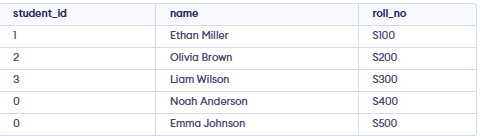
- In the original table STUDENT, the column student_id was set as the primary key.
- In STUDENT_COPY, the last two entries have duplicate values.
- AUTO_INCREMENT doesn’t work in the cloned table.
- Using Shallow Cloning can prevent these issues.
Shallow Cloning
Shallow cloning creates a new table with the same structure as the original table but without copying any data. It preserves constraints such as primary keys, unique keys, indexes, and auto-increment settings.
Syntax
CREATE TABLE clone_table
LIKE original_table;
Query
CREATE TABLE student_shallow_clone LIKE student;

SELECT * FROM student_shallow_clone;
Insert Data into Shallow Clone
INSERT INTO student_shallow_clone(name, roll_no)
VALUES ('Ethan Miller', 'S100');

INSERT INTO student_shallow_clone(name, roll_no)
VALUES ('Olivia Brown', 'S200');

INSERT INTO student_shallow_clone (name, roll_no)
VALUES ('Liam Wilson', 'S300');
Output:

- This cloning method copies the table structure and may include indexes and AUTO_INCREMENT
- It does not copy all properties (like triggers, foreign keys, permissions, metadata)
- The cloned table does not work exactly like the original
Deep Cloning
Deep cloning creates a copy of a table along with all its data, preserving both the structure and records of the original table.
Syntax
CREATE TABLE clone_table LIKE original_table;

INSERT INTO clone_table
SELECT *
FROM original_table;
Query
CREATE TABLE student_deep_clone LIKE student;

INSERT INTO student_deep_clone
SELECT *
FROM student;

SELECT *
FROM student_deep_clone;
Output:

The output of the "STUDENT_DEEP_CLONE" is exactly the same as the "STUDENT" table. We can add new entries to the deep clone table to confirm the preservation of constraints:
INSERT INTO student_deep_clone (name, roll_no)
VALUES ('Emma Johnson', 'S400');

INSERT INTO student_deep_clone (name, roll_no)
VALUES ('Sophia Davis', 'S500');

SELECT *
FROM student_deep_clone;
Output:

- This cloning method preserves all table properties.
- Indexes and AUTO_INCREMENT are copied from the original table.
- The cloned table works like the original with the same structure and constraints.
To better understand table cloning methods, see our detailed comparison of Shallow Cloning and Deep Cloning in SQL.
