

Interactive Application Security Testing (IAST) is an application security testing technique that analyzes an application while it is running to identify security vulnerabilities. It combines the capabilities of Static Application Security Testing (SAST) and Dynamic Application Security Testing (DAST) to provide accurate results with fewer false positives.
- Detects security vulnerabilities during application execution.
- Monitors code, data flow, and application behavior in real time.
- Integrates with CI/CD pipelines and DevSecOps workflows for continuous security testing.
Example: An e-commerce application uses IAST during automated testing to detect an SQL Injection vulnerability, identify the affected source code, and provide remediation guidance before deployment.
IAST Architecture
IAST architecture uses an agent inside the application to monitor runtime behavior and identify security vulnerabilities while the application is being tested.
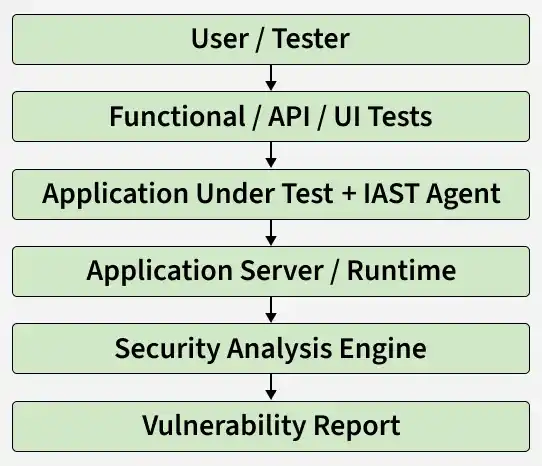
Components of IAST Architecture
- Application Under Test (AUT): The web application or API that is monitored for security vulnerabilities during execution.
- IAST Agent: A runtime agent that observes code execution, data flow, and security events in real time.
- Application Server / Runtime: The environment where the application and IAST agent run together.
- Test Execution: Manual, automated, functional, or API tests that trigger the application's code paths for analysis.
- Security Analysis Engine: Analyzes runtime behavior to detect vulnerabilities and map them to the source code.
- Reporting Dashboard: Displays detected vulnerabilities, their severity, affected code, and remediation recommendations.
IAST Testing Process
The IAST testing process monitors an application during runtime while functional or automated tests are executed to identify security vulnerabilities.
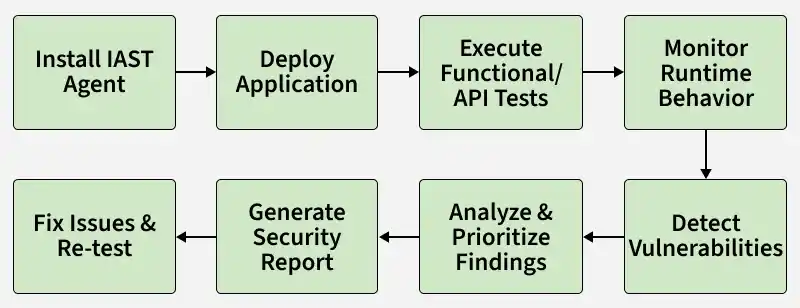
- Install the IAST Agent: Install the IAST agent in the application server or runtime environment to monitor the application's behavior during execution.
- Deploy the Application: Deploy the application in a development, testing, or staging environment where security testing will be performed.
- Execute Test Cases: Run manual, automated, functional, or API tests to exercise different features and workflows of the application.
- Monitor Runtime Behavior: The IAST agent continuously monitors code execution, data flow, and HTTP requests and responses while the tests are running.
- Detect Vulnerabilities: The agent identifies security vulnerabilities such as SQL Injection, Cross-Site Scripting (XSS), and Command Injection in real time.
- Analyze Findings: The detected vulnerabilities are analyzed, prioritized by severity, and mapped to the exact source code location.
- Generate Security Report: A detailed report is generated with vulnerability details, severity, root cause, and recommended remediation steps.
- Fix and Re-test: Developers fix the identified vulnerabilities and execute the tests again to verify that the issues have been resolved successfully.
Popular IAST Tools
- Contrast Assess: Provides real-time vulnerability detection by monitoring applications during runtime and helps developers fix security issues quickly.
- HCL AppScan: An application security testing solution that combines static, dynamic, and interactive testing to identify vulnerabilities.
- Seeker by Synopsys: Uses IAST technology to detect security flaws during application execution and provides detailed analysis of vulnerabilities.
- Checkmarx IAST: Integrates with development workflows to identify vulnerabilities and provide actionable remediation insights.
- Veracode Interactive Analysis: Performs runtime application analysis to detect security vulnerabilities with high accuracy and reduced false positives.
Vulnerabilities Detected by IAST
- Detects malicious SQL queries that can manipulate or access unauthorized database data.
- Identifies injected scripts that execute in users' web browsers.
- Detects vulnerabilities that allow execution of unauthorized operating system commands.
- Identifies attempts to access restricted files or directories outside the intended location.
- Detects unsafe deserialization of untrusted data that can lead to code execution.
- Identifies insecure XML parsing that may expose sensitive files or internal resources.
- Detects vulnerabilities that allow attackers to make unauthorized server-side requests.
- Identifies improper storage, transmission, or leakage of sensitive information.
Advantages of Using IAST
- Detects real-time vulnerabilities by analyzing application behavior during execution.
- Provides accurate results with fewer false positives compared to traditional security testing methods.
- Identifies security issues early in the development lifecycle.
- Provides detailed vulnerability information, including affected code and remediation guidance.
- Supports automated security testing with functional, API, and UI tests.
- Helps developers quickly locate and fix security vulnerabilities.
- Integrates with CI/CD pipelines for continuous security testing.
- Improves application security by combining SAST and DAST capabilities.
Limitations of IAST
- Requires the application to be running during testing.
- Detects vulnerabilities only in code paths exercised by the tests.
- Requires an IAST agent to be deployed in the application environment.
- May introduce a small runtime performance overhead.
- Depends on comprehensive test coverage for maximum effectiveness.
