

In TestNG, test management is crucial for handling different scenarios and conditions during testing. Sometimes, it is necessary to skip certain tests based on specific conditions or requirements. The SkipException class in TestNG provides a mechanism to skip tests programmatically. This feature allows you to handle situations where executing a test is not appropriate or possible due to certain conditions.
Table of Content
Approach to use TestNG SkipException
- Import the Exception: First, import the SkipException class from the org.testng package.
- Throw SkipException: In your test method, throw the SkipException when you need to skip the test.
- Conditional Skipping: Use conditional logic to determine when to throw the exception, based on your test requirements.
- Handle Skipped Tests: Optionally, use TestNG listeners to handle and report skipped tests.
Example Code
package test;
import org.testng.SkipException;
import org.testng.annotations.Test;

public class SkipTestExample {

    @Test
    public void skipTestWithCondition() {
    	System.out.println("Test executed because the feature is enabled.");
        boolean isFeatureEnabled = false; // Example condition

        if (!isFeatureEnabled) {
            // Skip the test if the feature is not enabled
            throw new SkipException("Skipping this test because the feature is disabled.");
        }

        // Test logic if the test is not skipped

    }

    @Test
    public void skipTestDirectly() {
        // Skip the test unconditionally
    	System.out.println("Skipping this test directly.");
        throw new SkipException("Skipping this test directly.");
    }

    @Test
    public void testWithoutSkipping() {
        // This test will run normally
        System.out.println("This test runs without being skipped.");
    }
}
testng.xml
<?xml version = "1.0" encoding = "UTF-8"?>

<suite name="Suite">
    <test name="Test Suite">
        <classes>

            <class name="test.SkipTestExample">

            </class>
        </classes>
    </test>
</suite>
Output:
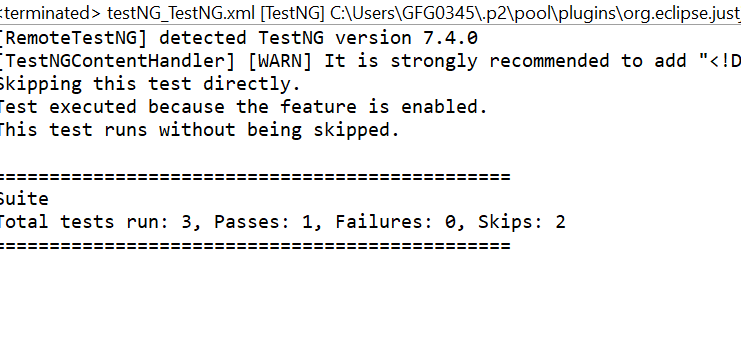
SkipTestWithCondition
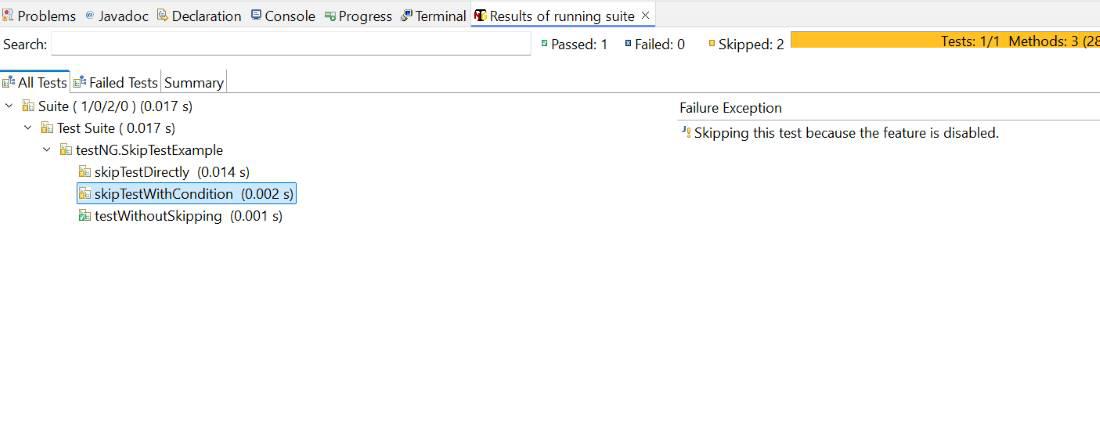
Conclusion
The SkipException class in TestNG is a powerful tool for managing test execution based on dynamic conditions. By throwing this exception, you can skip tests intentionally or based on specific conditions, making your test suite more flexible and manageable.
Using SkipException effectively helps you:
- Handle scenarios where tests should not be executed.
- Dynamically skip tests based on conditions or configuration.
- Improve test suite efficiency and relevance.
