

Inheritance is a key concept in object-oriented programming that allows one class (child/derived) to inherit the properties and methods of another class (parent/base). This promotes code reusability and improves maintainability.
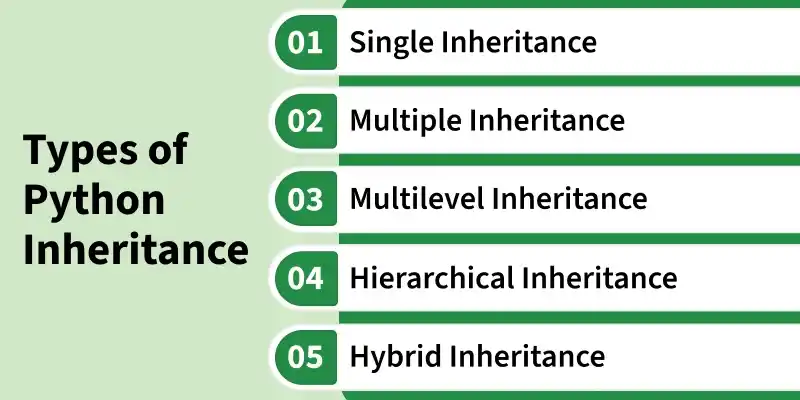
Types of Inheritance depend upon the number of child and parent classes involved. There are four types of inheritance in Python:
Single Inheritance
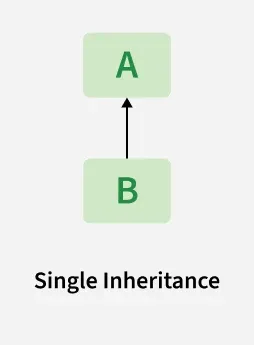
Single inheritance enables a derived class to inherit properties from a single parent class, thus enabling code reusability and the addition of new features to existing code.
class Parent:
    def func1(self):
        print("This function is in parent class.")

class Child(Parent):
    def func2(self):
        print("This function is in child class.")

obj = Child()
obj.func1()
obj.func2()
Output
This function is in parent class.
This function is in child class.
Explanation:
- The Child class inherits the method func1() from Parent.
- It also has its own method func2().
- This shows how one class can extend another using single inheritance.
Multiple Inheritance
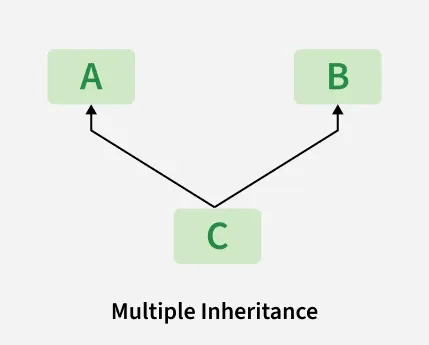
When a class can be derived from more than one base class this type of inheritance is called multiple inheritances. In multiple inheritances, all the features of the base classes are inherited into the derived class.
class Mother:
    mothername = ""

    def mother(self):
        print(self.mothername)

class Father:
    fathername = ""

    def father(self):
        print(self.fathername)

class Son(Mother, Father):
    def parents(self):
        print("Father :", self.fathername)
        print("Mother :", self.mothername)

s1 = Son()
s1.fathername = "RAM"
s1.mothername = "SITA"
s1.parents()
Output
Father : RAM
Mother : SITA
Explanation:
- Son inherits from both Mother and Father.
- It can access both mothername and fathername.
- This demonstrates how a class can combine functionalities from multiple sources.
Multilevel Inheritance
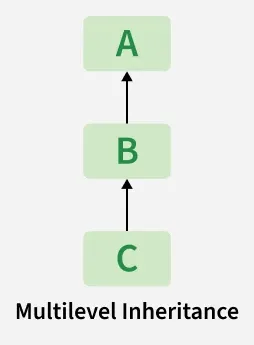
In multilevel inheritance, features of the base class and the derived class are further inherited into the new derived class. This is similar to a relationship representing a child and a grandfather.
class Grandfather:
    def __init__(self, grandfathername):
        self.grandfathername = grandfathername

class Father(Grandfather):
    def __init__(self, fathername, grandfathername):
        self.fathername = fathername
        Grandfather.__init__(self, grandfathername)

class Son(Father):
    def __init__(self, sonname, fathername, grandfathername):
        self.sonname = sonname
        Father.__init__(self, fathername, grandfathername)

    def print_name(self):
        print('Grandfather name :', self.grandfathername)
        print('Father name :', self.fathername)
        print('Son name :', self.sonname)

s1 = Son('Prince', 'Rampal', 'Lal mani')
print(s1.grandfathername)
s1.print_name()
Output
Lal mani
Grandfather name : Lal mani
Father name : Rampal
Son name : Prince
Explanation:
- Son inherits from Father, and Father inherits from Grandfather.
- Each constructor passes values up the inheritance chain using explicit constructor calls.
- All ancestor class attributes are accessible from the bottom-most class (Son).
Hierarchical Inheritance
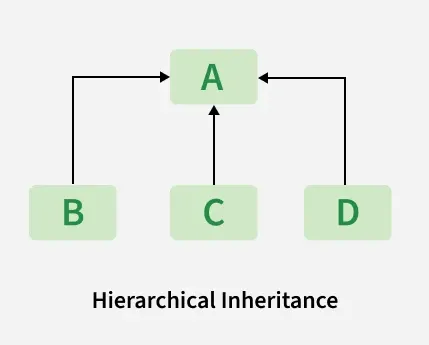
When more than one derived class are created from a single base this type of inheritance is called hierarchical inheritance. In this program, we have a parent (base) class and two child (derived) classes.
class Parent:
    def func1(self):
        print("This function is in parent class.")

class Child1(Parent):
    def func2(self):
        print("This function is in child 1.")

class Child2(Parent):
    def func3(self):
        print("This function is in child 2.")

object1 = Child1()
object2 = Child2()
object1.func1()
object1.func2()
object2.func1()
object2.func3()
Output
This function is in parent class.
This function is in child 1.
This function is in parent class.
This function is in child 2.
Explanation:
- Both Child1 and Child2 inherit from the same Parent class.
- Each child can access the func1() method of Parent, but also has its own specific method.
- This pattern is useful when multiple classes need the same base functionality but also have unique behaviors.
Hybrid Inheritance
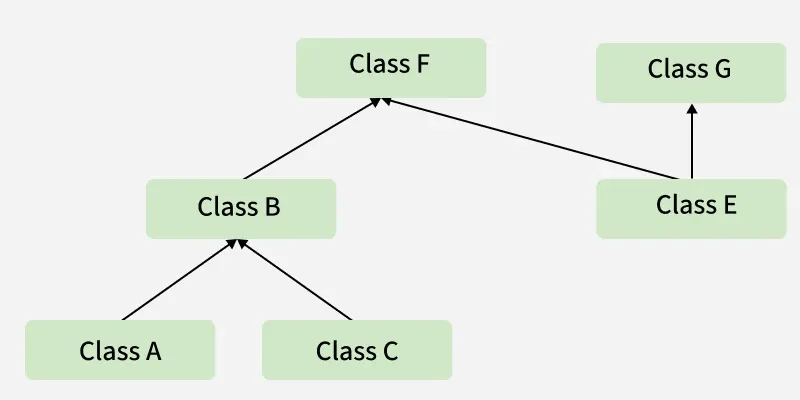
Hybrid inheritance is a combination of more than one type of inheritance. It uses a mix like single, multiple, or multilevel inheritance within the same program. Python's method resolution order (MRO) handles such cases.
class School:
    def func1(self):
        print("This function is in school.")

class Student1(School):
    def func2(self):
        print("This function is in student 1.")

class Student2(School):
    def func3(self):
        print("This function is in student 2.")

class Student3(Student1, School):
    def func4(self):
        print("This function is in student 3.")

obj = Student3()
obj.func1()
obj.func2()
Output
This function is in school.
This function is in student 1.
Explanation:
- School is the base class inherited by Student1, Student2, and Student3.
- Student1 and Student2 each inherit School (single inheritance).
- Student3 inherits both from Student1 and School (multiple inheritance).
- Python handles method resolution using the MRO, so func1() from School is resolved without ambiguity.
