

An Operating System (OS) and Kernel are closely related concepts in computer systems, but they are not the same. The operating system provides an interface and environment for users and applications, while the kernel is the core component that directly manages hardware and system resources.
- An Operating System is system software that manages computer hardware and provides services to application programs.
- A Kernel is the core part of an operating system that manages CPU, memory, processes, devices, and other system resources.
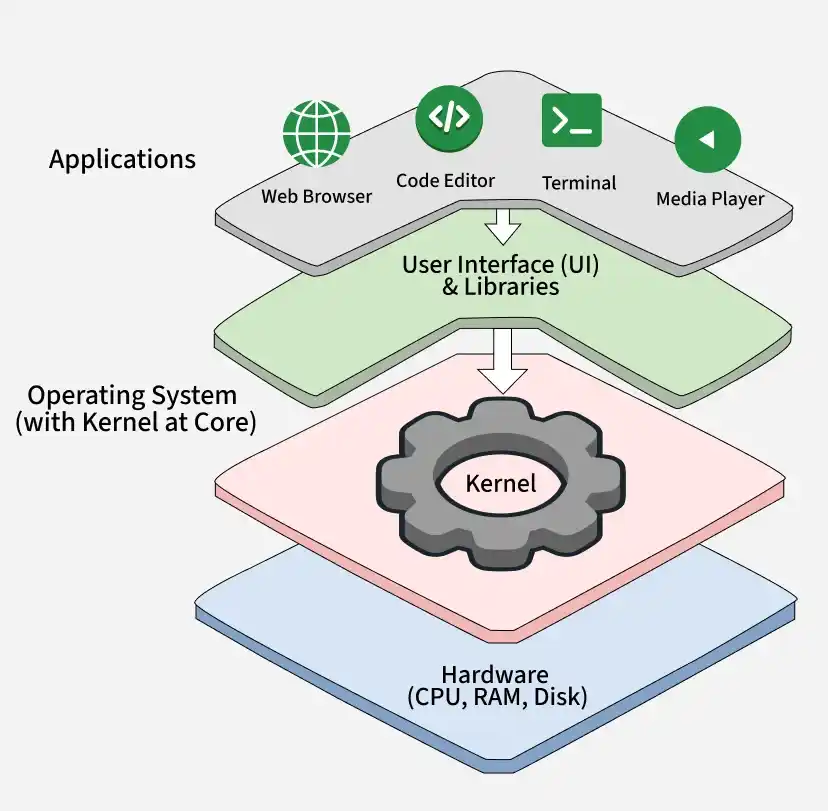
Operating System vs Kernel
| Operating System | Kernel |
|---|---|
| Complete system software that manages hardware and provides services to applications. | Core component of an OS that manages hardware and system resources. |
| Acts as an interface between users, applications, and hardware. | Acts as an interface between hardware and system software. |
| Includes the kernel, system utilities, libraries, drivers, and other components. | Is only a central part of the OS, not the complete system. |
| Handles file management, process management, memory management, security, and user interaction. | Primarily manages processes, memory, CPU, devices, and hardware resources. |
| Provides user interfaces such as CLI and GUI. | Operates in the background without directly providing a user interface. |
| Manages overall system security, permissions, and user access. | Enforces low-level security and controls access to hardware resources. |
| Examples: Windows, Linux, macOS, Android. | Examples: Linux Kernel, Windows NT Kernel, XNU Kernel. |
| Users interact with the OS directly through applications and system interfaces. | Users interact with the kernel indirectly through the operating system. |
Choosing Between Operating System and Kernel
The Operating System and Kernel are not alternatives that users normally choose between. The kernel is a component of an operating system, while the operating system is the complete software environment.
Operating System is responsible for:
- Providing an interface for users and applications.
- Managing files and storage.
- Managing system resources.
- Providing security and system services.
- Supporting application execution.
Kernel is responsible for:
- Managing CPU and processes.
- Managing memory.
- Controlling hardware devices.
- Handling system calls.
- Managing communication between software and hardware.
